


Dr Peter Attia, his book ‘Outlive’, health risks and health metrics.
This post will be the last one, for now, about my responses and actions taken on reading Dr Peter Attia’s recent book about longevity and health span as opposed to life span. For those of you that have been following my posts you will already know that I got a bit of a rude shock when I saw myself in a video clip and kind-of asked the question “so who’s the fat guy” ?……me of course.
Now, I know that right now on social media it seems to be ok to be ‘body positive’ about being obese – even morbidly obese and while I care not a whit about what others mistakenly think about their health (obese or not) I happen to care enough about my own to damn well do something positive about it.
If we do the science properly, as physicist Richard Feynman did, with data presented to him by British GP Dr David Unwin, we might conclude that there is a less of a direct correlation between obesity and metabolic ill health than we have all assumed. Take a look at the ‘Venn’ diagrams some time and you would see that there are both obese and sick people just as there normal weight but metabolically sick people – the ratio though is about 2 : 1 in favor of being both obese and metabolically sick. For his part I believe that Feynman didn’t see any relevant correlation and instead he thought he saw something else which he called ‘exposure’ (in this case exposure to a metabolic poison ie sugar).
My problem is that I go into this whole thing being both obese, not feeling great and not knowing whether I am metabolically normal (in terms of health metrics) or metabolically sick in terms of what Dr Attia would call a blood results ‘panel’ : metabolic disease such as pre-diabetes, actual type 2 diabetes and NAFLD (non alcoholic fatty liver disease) would all show up in a combination of blood results if and when I could ever get them done…..in this country getting something like that done by a busy GP is almost impossibly unlikely.
In my country (the UK) I can barely imagine the reaction that I would get if I showed up at my local surgery, explained that i’d been reading a book about longevity written by some leading edge doctor and asked for a full blood panel to start with, then tests (expensive tests) for specific genes, oh…..and while we’re at it can you arrange a dexa scan a VO2 test and a colonoscopy for me to check for incipient bowel cancer. These are all perfectly sound and rational things to if you’re either Dr Attia or one of his patients but far less likely a winning request in even a better example of GP surgeries over here.
If anything our man Dr Peter Attia is ‘crazy for the numbers’ with his patients and with himself but it’s one of the aspects of his work that I can’t see a way of applying over here. In fact, I am struggling with all of the metrics I should be doing right now – even the simple ones.
The opposite argument, if there is one, is that metrics haven’t helped me a jot in the past and there is almost nothing about any result of measurement that would have me doing a single thing different to what I am doing now without them….perhaps I need to explain that so….
I can safely say that I have central abdominal obesity just from my appearance and the everyday feel of the belt that I wear. I could have weighed myself when I went into this project and I could equally be doing a daily, or weekly, weight – just as I did on previous attempts at better fitness and lower BMI. The big problem then was that my daily weight just bounced all over the place and had probably far more to do with factors that I couldn’t control rather than the two simple ones that I was working with (diet and exercise).
My question though is would I be doing anything different today, tomorrow or next week if I knew what my weight was that day or that week ?, and the simple answer is no. What I am doing is that rather than obsessing over measurement I am assuming risk to be actual and present and proceeding as if I am at risk of any or all of the diseases that Dr Attia calls the ‘4 horsemen’. In short they all need the same basic approach to treat right now which are the things that I am already doing about the visual ‘metric’ of central abdominal obesity. Perhaps the only measurement that I would take note of at this stage would be one of visceral fat percentage and that’s almost impossible to do without a Dexa scan.
If at this stage I did actually have a raised HbAIC or raised liver ‘numbers’ indicating the presence of fatty liver disease then I would still be doing exactly what I am doing about it right now, so what am I doing right now ?
- Nutrition. Firstly I have qualatively changed my ‘diet’ in that I have made a large reduction in the amount of exogenous sugar that I consume (biscuits, cakes and such like). That I suspect will also constitute a caloric loss as I haven’t replaced them. Secondly with ‘diet’ (nutrition) I have quantatively increased my protein intake by one protein shake per day and usually a breakfast that includes a couple of eggs. Thirdly, I have stopped doing any fasts because of the greater risk that during an extended fast I will be losing/consuming muscle fibre. Lastly, when it comes to the combination of nutrition and exercise I now create more a more ideal metabolic state by doing an exercise routine and only then having a meal – it tends to mean that I have a later breakfast and usually after having done a hill hike, rucking session, press-ups or, later in the day a longer routine of several of the above.
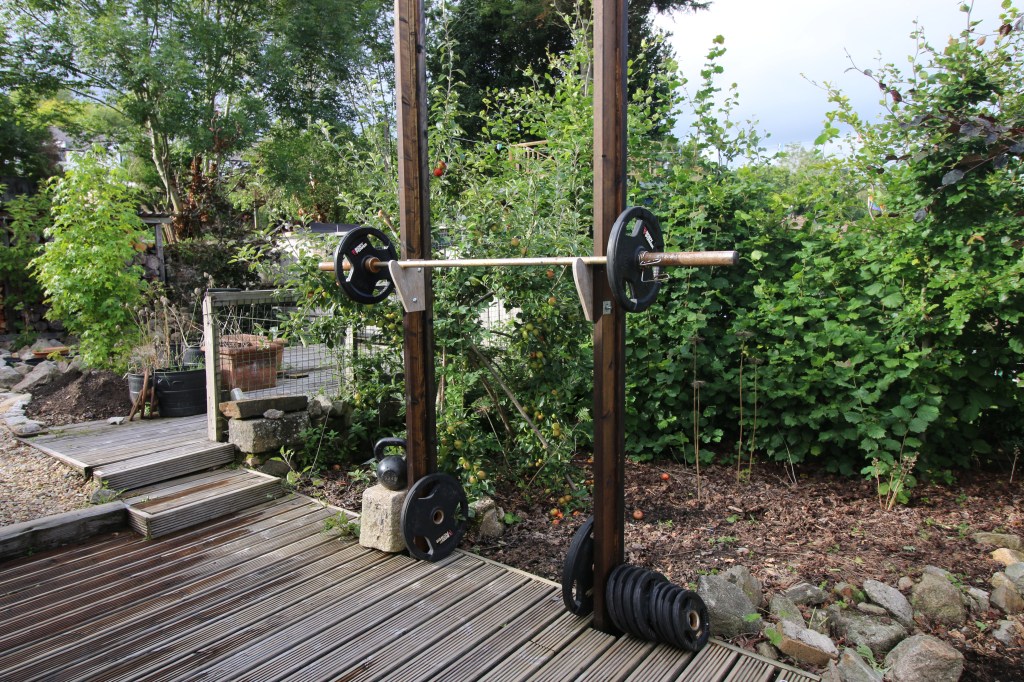
- Exercise. My daily routine is to have an early coffee in bed or while doing my morning admin, then go straight out for a hill hike before coming home to start on a hundred (target) press-up routine while I make my breakfast. Most days now, some time later in the day I complete either a second hill hike or rucking session and then go straight into a free weights session. As of this week that was only one free weights exercise (barbell squats) coupled with sets of press-ups ( 50 of one, 100 of the other) and next week I go up a notch to a ‘three exercise’ routine three times a week. Some days I just go out for a longer un-weighted walk because the scenery is quite nice around here.
My own feeling about that is that it might be beneficial to start doing some measurement of my nutrition and keeping some records of my training : iv’e never been good at tracking my macro-nutrients but begin to see that it might help to know where I am with overall caloric intake (in case I still need to reduce it) and my protein intake in case that still needs to increase.
What might help is something I used to do many years ago and that was to record and track my free weights training in terms of crude workload : what I used to do was multiply my weight lifted (or pressed) by the repetitions and sets and thus give me a crude ‘number’ indication of work done. This week’s best workout ‘number’ was a lowly 1500 based on a 30Kg weight ‘squatted’ in a 5 x 10 routine but that will go up next week as I add deadlifts to my routine at least once a week.
As with the amount of time spent under load while rucking I feel it will help to know what level of exercise ‘number’ starts to have an effect….almost like self-prescribing an exercise ‘dose’ because something that the good doctor says is that exercise acts in a kind of dose-response (the more exercise the better the result). One failure, I feel, with any written work on exercise is that I have never seen something similar, in terms of free weight training for strength, as Dr Attia has suggested is the minimum useful for Zone 2 cardio work.
I may be wrong about all of this just as I have been totally wrong in the past to have extolled the value of fasting and certain dietary regimes. Perhaps less wrong with the exercise side because what I am doing is all low risk and perhaps even beneficial. I do also feel that I have reduced risk when it comes to nutrition simply because I will have reduced self harm by cutting out as much sugar as I can for now ; it might need to go even lower than I have got it so far but as yet I don’t know. If there’s work to do next, and I suspect that there is then it’s probably that I have to start grappling with the numbers of caloric intake, protein intake – basically the macro’s .
It’s not that I don’t understand the clinical science either because as a former intensive care and specialist nurse i’m used to studying ‘the numbers’ and seeing what the blood results have to say about a patient’s internal and metabolic state – what I don’t see is a viable way of getting the same work done myself. Also, as I said earlier I already assume risk and I am already doing the best job I can (doing the work) to correct the metabolic problems that could be there.
If anything i’m a bit more comfortable working with risk because that is a poorly understood subject in terms of hospital care and iv’e already invested a lot of time learning and understanding the basics of risk. While it’s harder to quantify exactly where I am with health and disease risks in terms of what kind of overall health percentile I am at I can fairly easily say whether I am increasing or decreasing risk by what I am doing in each aspect of this right now. A couple of examples are that I can say I am reducing my risk of metabolic sickness (one of the major cornerstones of overall health risk) by reducing the amount of exogenous sugar I consume and secondly I can say that I will be increasing my overall health group percentile just by doing a couple of hours cardio exercise every week.
Dr Attia on ‘asymmetric‘ risk.
Given that I at least know most of the risks language, enough to know when what i’m hearing is basically BS I hadn’t ever come across the term asymmetric risk but it’s actually a very good way of approaching the problem of diet and nutrition. If i’m a bit ‘lost in the woods’ at the moment it’s because most things I used to think that I knew about ‘diet’ are either partly or completely untrue, often because the so called ‘diet’ claims to achieve one effect when in fact it’s something else creating the ‘diet’ effect.
Peter Attia describes at least one aspect of diet as forming an asymmetric risk problem because we can see that the standard approach – in fact the whole of the standard American/English diet can be shown to create harm while it is very difficult to say whether this dietary approach or that dietary approach has any benefit beyond not causing as much harm as the standard version. The best I can achieve at the moment is that of accepting that my previous ‘diet‘ was definitely causing harm and by changing a few things I can reduce harm …..beyond that and maybe that I need to consume more protein diet doesn’t seem to have the positive benefit that an increase in exercise does.
If this all seems to be a kind of critique of Dr Attia’s work let me just say that it isn’t ; he’s a doctor who says that medicine isn’t working outside the narrow band of acute problems that it is equipped to deal with. While he, at times, seems to be obsessive about certain things such as the metrics and measurements that’s probably because they are relevant to him and have come about because that’s how he has chosen to deal with things – later in his book he does describe in painful detail his own mental health battles. As for me I have taken on his central message about health span rather than life span and that’s why i’m out there several times a day rucking my load around the Cornish lanes.

 Dirty Wet Dog, the great adventure.