


Converting an old Seaman’s chest to a long term workshop tool chest.
Note to readers : I always enjoyed writing posts that were part of a longer thread rather than one offs so this will be the first post in a series that shows what I am up to with the workshop project now that i’m kicking my heels a little. What I never like to write about is the speculative posts in which I have what seems like a great idea except never gets carried out : I have loads of new ideas about the whole project almost every day so it’s good for me to demonstrate some actual progress even though the jobs are things I won’t need until right at the end of the main work.
For several years iv’e owned an old hardwood chest that I think belonged to a seagoing machinist or ship’s artificer although it’s only ever had a job, during my ownership, as a kind of junk drawer and glory hole for things that iv’e forgotten where I put them : when I look in the obvious place they’re never there though so it’s obviously a black hole combined with the portal to a separate universe. It is incredibly heavy which is why I sometimes think that it absorbed bits of a Neutron star during it’s long life at sea : seriously though it’s either solid teak or something similar but definitely a tropical hardwood that has a camphor like smell.
As many readers will be aware i’m rebuilding my workshop, with a whole load of professional help, and right now i’m planning it’s eventual refit and how and where stuff like benches and storage is all going to go. I figure that there isn’t much that I can actually work on until the concrete floor and the new roof are both finished and after that my autumn project will be to add studs, insulation and panel most of the place with plywood so that I can either paint it and/or attach things directly to it.
In the past I played around with wall mounted tool boards and never really got on with them eventually choosing to have nearly everything on a rolling tool cart inspired by film props maker Adam Savage. It worked well enough although it was difficult to move around inside the workshop because the original floor was so uneven – there being 5 different levels of bricks as flooring, huge Granite blocks as flooring and builders waste covered with a thin screed of concrete for the rest – even that it came in at least two levels !. Working with it outside was simply a no-go because I couldn’t heave it over the concrete sill at the entrance and I built most of my boat with tools that I tended to carry around in a builders bucket – oh, and with a pencil tucked behind my ear so as not to lose every last pencil I owned.
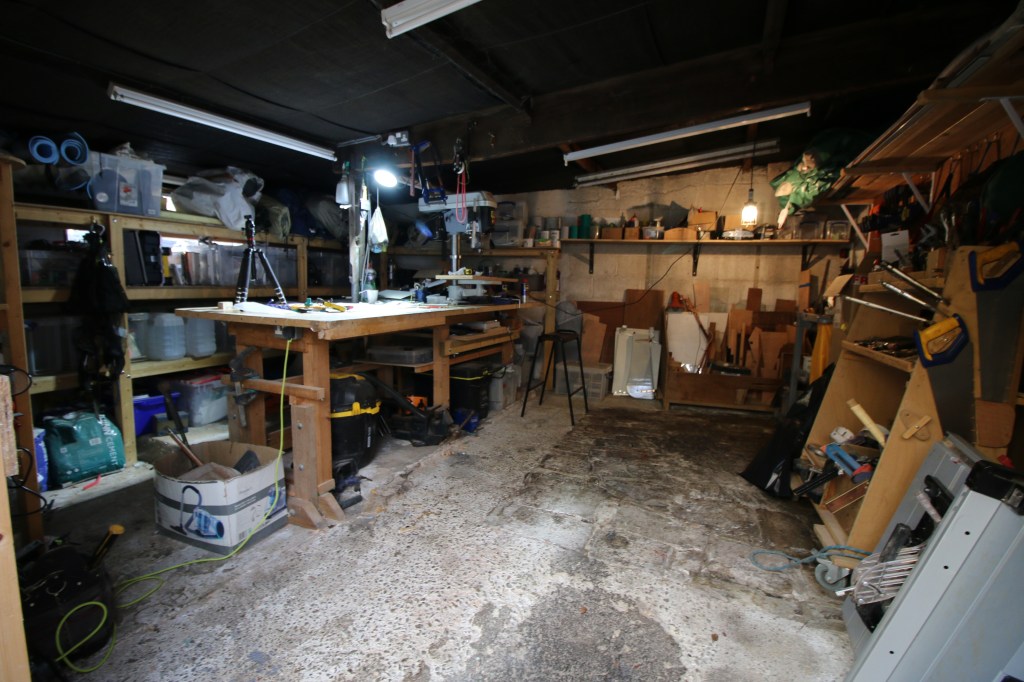
The damp (often wet) and cold version.
Right now it’s emptier than it’s ever been and my early summer project was to dig out two skip loads of heavy clay soil – about 11 yards worth to prepare for a new sub base of hardcore and sand. The space is unlikely to ever be a boatbuilding workshop again as i’m highly unlikely to build another boat and anything of that size and shape will get done outside on the boatbuilding strongback that I built under the outside shelter.
My old tool dolly which I hardly ever used for it’s intended purpose.
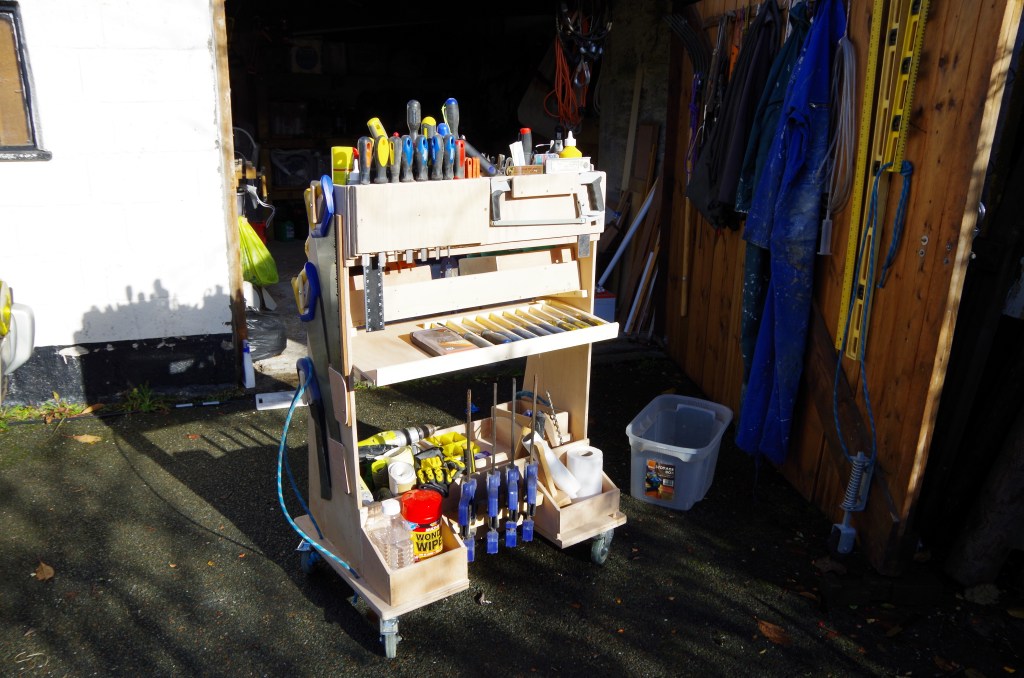
Many of my hand tools haven’t coped well with several wet and cold winters out in the workshop and as it is iv’e already set up my everyday DIY jobs tools in a square bucket-like tool bag so that’s the one I usually work from when I do simple outdoors jobs like the one iv’e been doing this week : setting up temporary guttering until we get the new roof on. Everything that only sees occasional use is now back in my rolling workshop cart that I used to transport around in the days when I had to keep my boats at a boatyard : at one time I had three functioning tool kits often with the same tools in them which is why I have at least three sets of molegrips and ratchet screwdrivers.
long term I intend to keep my nicer woodworking tools in a traditional wooden boatbuilders tool chest and stow that, on a rolling base, under either the main rolling bench in the workshop – which is why I am designing it without a dust shelf – or under the main long fixed bench which will carry the machine tools that I keep : my current plan for that side of the workshop is only to keep my pillar drill and bench grinder with most of my battery powered tools in a new custom storage (open fronted but with a sliding storage rack out front) on the wall above the main bench. I have to add that most of this is just pie in the sky ideas in my head and in quick sketches kept in my ongoing projects notebook.
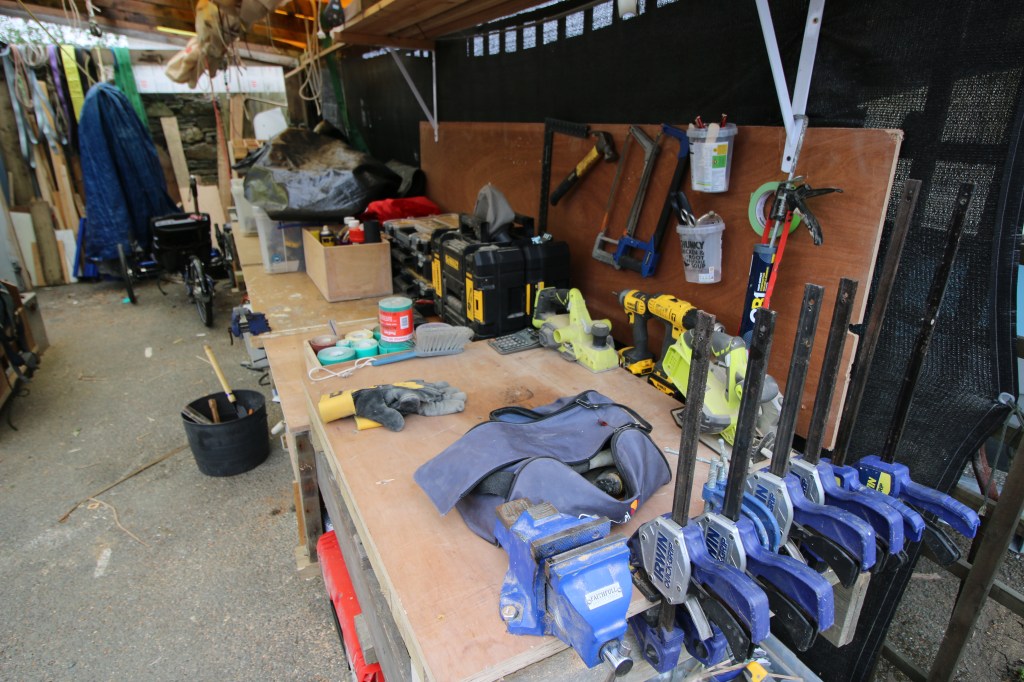
Mostly, what i’m working from here is memory – although it’s pretty obvious what a boatbuilder’s tool chest looks like plus that there are umpteen videos out there – my main memory is the chests that the actual boatbuilders had to make when they were apprentices and they varied from basic and rustic right up to fine cabinet making. As I pointed out at the beginning of this post iv’e jumped straight past the actual building stage by starting with a heavily built machinists workbox/chest.
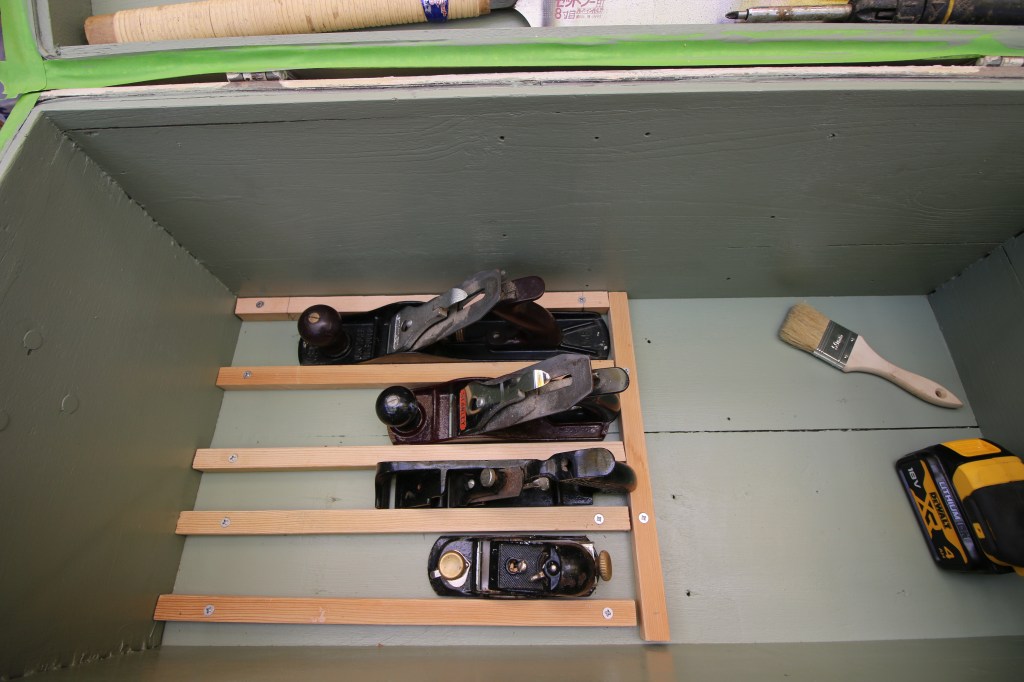
Below : the work in progress, the inside of the chest has been sanded and painted, bottom dividers screwed in place to hold my planes, and, as I write, iv’e fitted the cleats to mount the till.
In the next post of this thread I hope to be starting the next practical project and i’ll give an update on how the tool chest is progressing.
Best wishes Y’awl
Rex Kreuger (internet woodwork guy) says that a tool chest is a work in progress because it’s never quite finished and is often tinkered with for years : bit like a boat IMO.


You can never have too many pairs of M. K. Mole and Son’s finest Steve.
LikeLike
There’s many and then there’s many many……!
LikeLike
Yes, many many might be taking things too far.
LikeLike
And you should see my collection of adjustable spanners – so many that iv’e got metric and imperial ones now !
LikeLike