

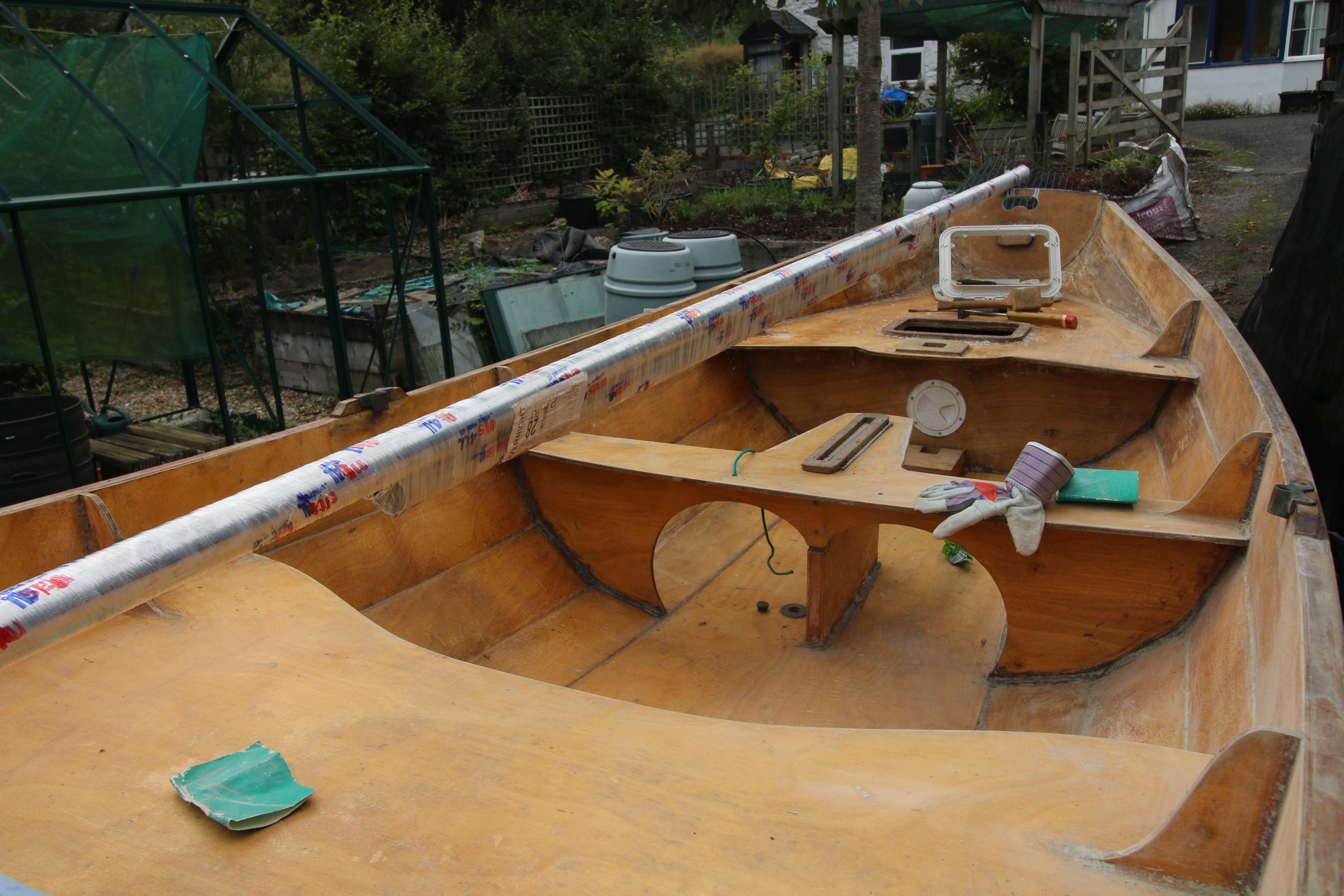
Taking a first look at the different types of dinghy used and useful for cruising
Sailing on a small income (my version) part two.
Note to readers (once more dear friends !)
The original work that inspired me to start this piece is a short book written as a first try at producing a longer written work by the late Maurice Griffiths. I have a very yellowed and dog-eared copy on my book shelf and as I understand it the book Sailing on a Small Income was part of a series of books intended for sale on railway station news stands. In this book Griffiths set out his ideas about what kind of boat he thought would work for the ‘young chap’ coming into the world of sailing for the first time and, reading between the lines about Griffiths own life and the boats he owned I think he was also expressing what worked for himself.
Griffiths went on to have a long career as editor of the sailing magazine Yachting Monthly and he turned his own desire to find a boat for himself (he bought and owned several) into the desire to design the boats himself, especially for the kind of sailing he enjoyed and the places he kept those boats and sailed.
When I started my own writing project it was in the form of an update of Sailing on a Small Income but one written knowing a lot about what happened during the last near hundred years or so and my attempt was to write for this time and this generation. I was quite literally standing on the shoulders of giants – not only Griffiths but every other sailor who’s work I have read, absorbed and enjoyed.
I scrapped that original work because, I thought, it wasn’t much beyond a poor copy and even when I finished it to the extent I did I can’t imagine it ever being printed and didn’t see myself as being in Griffiths shoes – I write yes but i’m a blogger and not a magazine editor and as I have pointed out here the comedian and writer Stephen Fry says that blogging is ‘Graffiti with punctuation’ – with me you don’t always get the punctuation and my late mother had sharp words about my grammar and syntax.
I should perhaps say a few words about my own writing and sailing so here goes….. As of this week iv’e had to make the decision to retire from sailing and sell my own self built boat, this because of health problems – I am no longer strong enough and fit enough for a small boat and a big sea. I still write, or at least blog and as it gives me a creative outlet it stops me going completely stir crazy.
Today we stand on the shoulders of giants.
There are times recently when I have felt that leisure sailing is somehow inconsequential and doesn’t have any great impact or meaning but then I am also reminded that to ‘go down to the sea in ships“, or in my case small sailing vessels is never an inconsequential thing because the sea never allows us that – on a bad day we can really get a good kicking and often I think that we need that.
I also happen to think that when it comes to these small craft and the sea itself that there is nothing new under the sun – that everything we do or attempt to do has been done before. Again, the flip side is that perhaps it wasn’t us doing it then but may well be now and in the process of doing it ourselves we gain competence and self reliance self reliance and perhaps even self discovery. I don’t know of any good sailor who doesn’t have a good story to tell and experiences to look back on at the end of their lives.
We who sail have always been inspired by those whom have gone before us and even more so those whom took the time and effort to leave records of their voyages and maybe even plans of the boats that they spent hours trying to perfect. Today I think back to my hero’s – Blake and Tabarly, Griffiths and Kennard, Dye and the Pardeys, many of them have already crossed the bar but along the way each in their own way have inspired this simple sailor.
Today I might well be at the end of my time as a sailor, it comes to us all eventually. I do have sea stories to tell and nowadays will build a blog post around something of my own experience, today though I take up the mantle of older and slightly wiser sailor and point others to the ways of going to sea that actually work and, in a way, as Maurice Griffiths set out to do point out the better boats to look for – in this instance focusing on a genre of sailing unknown in Griffiths day.
First though, why a good sailing dinghy might be the better boat for you part 2…..because reasons – second reason !
When Maurice Griffiths wrote his first mini book Sailing on a Small Income he didn’t have much to say about sailboat (yacht) racing because he wasn’t into that kind of thing himself. He would have been aware of the big yacht racing circuit that moved from regatta to regatta around the English coast : slightly disconcerting today that even the big boat class such as the J class yachts and larger held races in his well known east coast rivers such as Burnham on Sea – largely a working/fishing sailboat river and home mostly to small yachts.
Unlike Griffiths I come from a coastal and offshore yacht racing background – most of the better helmsmen and sail trimmers came from the dinghy racing scene which is one thing that I never had and I think which slowed my eventual development as a racing sailor. Today, at least two of my sailing friends go cruising in two very different styles and types of dinghy, of those one of them comes from a similar professional sailing background as the one I worked in for a while and the other came mainly from a more land based outdoor practice although he chose to build his own cruising dinghy as a project. It’s those two sailors whom I mostly build this post around and present the case for each type of boat as maybe a viable choice for the new sailor.
Case 1, The ex racing dinghy or general purpose dinghy used as a cruising boat
Over on the east coast of England I have friends who use an ex racing dinghy as a cruising boat and it seems to work for them -partly because they have reduced the rig and therefore sail area to more manageable proportions. The boat in focus is an Osprey class former racing dinghy – the class having been designed by Ian Proctor as an Olympic contender. As racing dinghies go it’s one of the longest and largest at 17 foot 6 inches long – I think that only the National 18 class is larger. The boat that I know has been given a reduced rig, if memory serves it came off a National 12 class dinghy.
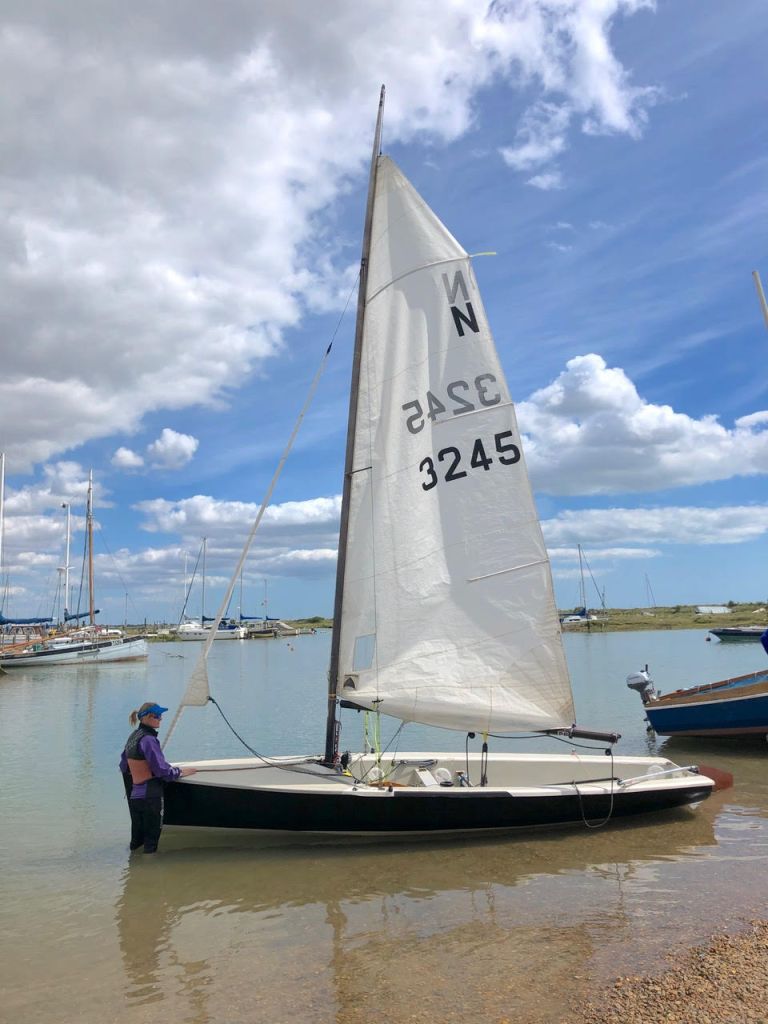
The owners tell me that it is an excellent sailing boat and very quick, the only problem they have is to sail slow enough to stay with most larger cruising yachts. Being a much lighter dinghy than say my 17 foot Pathfinder cruising dinghy/dayboat it can be hauled out of the water by hand onto a conventional launching trolley.
For a little bit of personal history here I was at one time taken by the idea of putting together a project boat in which to compete in the Everglades Challenge event over in Florida. For that to work as I intended my project boat needed to stow within a 20 foot shipping container, my main sticking point was the tall rig but then my actual plan altered to re-rig the boat as a powerful modern lugger along the same lines as the one I knew of on this coast. That boat is a converted National 18 racing dinghy that has a standing lug rig and is known to easily plane downwind – perhaps because it is owned and helmed by a former National 18 class champion.
For my project a friend of a friend offered me an old GRP Osprey hull and that would have been the basis of a great project I think only then the Covid 19 pandemic happened in this country and sadly we all had to forget about sailing for a couple of years. I don’t know what has become of the converted National 18 dinghy but that boat and the Osprey can both serve as examples of why that kind of boat can be a much better sailing boat than larger boats because, boat for boat, it will be a faster and more close winded sailing boat than say the average heavy and slow modern yacht.
Because reasons then.
Reason 2. Shortest version. Small sailing boats are more fun.
Reason 2. slightly longer version. A good sailing dinghy will give a much better and more aesthetic experience because it will be faster and more close winded in most conditions and usually sail better as well ie have more feel and sensitivity. It may also give access to a wider cruising ground which many owners would find more aesthetically pleasing.
Long version : I come from a background of racing yachts designed to the then International Offshore Rule (IOR) and although this kind of yacht sailed better, on average, than a similar sized production cruising yacht, it was often the case that they had better sails, a clean and sanded bottom and usually had some discipline about the extra weight carried aboard. My regular boat though was a 34 foot cruiser racer and we usually sailed with some 5 upwind headsails and a pair of spinnakers – not counting storm sails of course. That particular boat only sailed well while cruising or on race delivery because it had one trained idiot (me) dancing around the foredeck while ‘peeling’ genoas every time the windspeed altered by as little as 5 knots.
Today, most yachts that I see don’t sail well because their sailplan seems to be sized and orientated for moderate airs sailing and only upwind or when reaching. Very few seem to have the skill or equipment to carry dedicated light weather sails and especially not dedicated downwind sails. Instead, when it comes to a downwind passage in light airs, the usual and instant solution is to motor along in a personal cloud of smelly diesel fumes.
Most ex racing sailors value a bit of boat speed and close windedness in their boats and are thus often disappointed by the moderate or sluggish performance of modern cruising yachts – again most prominent or obviously apparent in light airs : most cruising sailing, at least in the UK and Europe is carried out in light to moderate winds (according to the British RNLI).
There is an often heard argument from cruising yacht owners that, ‘we don’t need to sail fast because we’re not racing”. This has always seemed, to me, an argument that actually says ‘we aren’t interested in speed or performance because we basically don’t care about sailing and can’t be bothered to make the effort to do it well”. Cynical yes but my observation is that this kind of attitude would also include baggy sails, a foul and rough bottom, and an excuse to carry all sorts of unnecessary dross on board, Not all yachts and not all owners of course – oddly enough it seems to be the owners of classic boats who are most taken up with an effort to sail well.
My conclusion on all of this is that the smallest viable craft is often the best boat because, size for size it sails faster, sails closer to the wind when needed, sails more sensitively and more responsively, can often sail in shallower water and overall is a more rewarding experience all round.
Alright then, now for a little piece of sailing story.
Around 2018 I was slightly ‘between boats’ and for some unknown reason I decided that what I really wanted was a small classic wooden yacht with a long keel and a gaff rig. From memory I think that this was when the lightweight centerboard liberty was often causing me mobility problems ; what I really needed was a one side knee replacement but I didn’t know that at the time.
I found what I thought was the ideal boat, a 4 ton Deben of about 22 feet plus 5 foot long bowsprit but it was based at a sailing club in Ipswich – quite literally the opposite side of the country from where I live near the south west coast. I made one horribly long drive just to go and spend a few days cleaning the little Deben as it was filthy inside and then a second trip to set it up for what I planned as a delivery trip style voyage home.
On leaving Ipswich I had one uncomfortable night at anchor in the river Orwell and the next day made the short passage around to the Walton backwaters where I spent at least half a day relaxing and another half day working out the navigational problems of crossing the Thames estuary to Ramsgate in Kent, I really enjoyed my short time in the Walton channel and spent some of my time there reading one of Griffith’s books about cruising in that area – one thing I learned is that he had lived aboard one of his larger boats (Afrin) with his first wife (Dulcie Kennard or ‘pete’) just a few hundred yards from where I was lying at anchor.
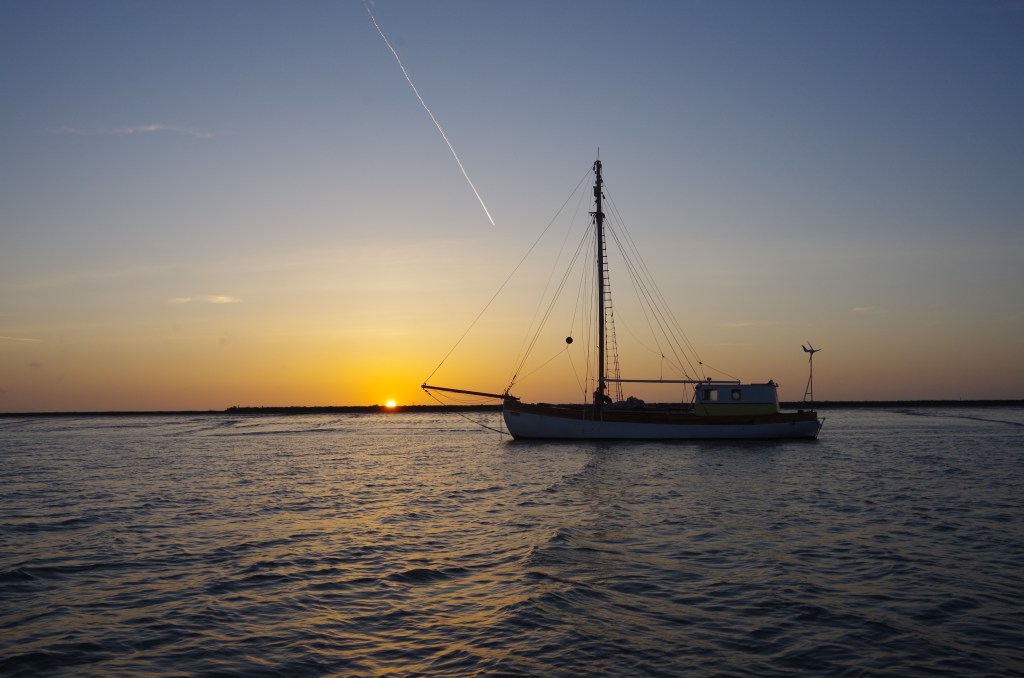
I consider myself lucky to have had a light airs crossing of the Thames -lucky in that the Deben would look after itself with a pegged tiller while I wrestled with the navigation : I found the Thames difficult and disconcerting but then I was mostly still a deep offshore and ocean racing sailor and sliding past visible sand and mud banks while searching for the next turning mark was a new experience. The Deben seemed to be in it’s natural element in the Thames where it sailed tolerably well given that I was struggling with it’s big gaff rig, tiny foredeck and jib furling gear that continually trolled me. The problems with the boat became apparent when we sailed out into the higher and steeper waves of the English channel and I also found to my cost that in the rain she her cabin leaked like a sieve.
The interesting part of this voyage, in the context of this post, was what happened when we sailed out of Darrmouth a few days later.
The brisk westerly that had been in my teeth since we came around the corner into the channel shifted into the east and the last leg of our journey towards Plymouth sound and eventually towards my home mooring in the Tamar looked to be an easy downwind passage. The first leg of this final passage was to cross the bay on a broad reach towards Start point, of note i’d checked my tides and concluded that the best route was to stay offshore and use the west going stream.
We left the Dart just behind a pair of larger modern cruiser-racers and with 2 other gaffers astern, one larger and one smaller. Both we and the larger of the 2 gaffers sailed quite high on the wind to get the best drive from our large gaff mainsails, both of us were flying small jibs so this was the only wind angle at which they gave us some drive. Both of us gybed almost off Start point and from there towards Prawle point tacked downwind like a pair of America’s cup yachts. It obviously became and impromptu race between the pair of us and the larger/longer boat slowly pulled past and the last I saw of her she was heading up into Salcombe. As they passed the skipper stood up in the cockpit and waved a friendly salute with his old style yachtsmans cap I like to think that the old boy driving the boat had enjoyed his downwind race against us.
I guess that we were just a pair of older cruising sailors that had once been keen racers, for me the basic skill of tacking downwind was something that had won races in the past and it’s a very good tactic for gaff boats with big mainsails ; neither of chose to fly spinnakers – for some reason I wasn’t able to at that time.
Anyway, the part of this leg of our passage along the south west coast that really amused both of us is that during that leg we both caught up with and rolled over (passed easily) both of the modern cruiser racers. After we overtook them under sail only I heard a load of angry shouting from one and the bark of an engine starting up from the other. In their case I assumed that the first skipper was expressing displeasure at being overtaken by a pair of old gaffers – the Deben was some 80 years old even then and I would have put the other at around a young 50. Both of us had sailed our tides well and concentrated on downwind boatspeed while the two cruising boats were dogging along in a slack or slightly foul tide inshore and both of them had sailplans that were poor for light airs downwind sailing – without spinnakers a triangular mainsail doesn’t produce much power and with both of them it looked as though they weren’t able to set their roller furled headails effectively.
A few hours later we hardened up a few degrees to head across Plymouth sound and through the feature known as ‘The bridge’ ; the old submarine barrier reef between Drake island and Mt Edgecombe and from there up through the Narrows, past the dockyard and eventually out into clear air in the Tamar.
We’d had a problem with the throttle cable on the old Deben so wren’t able to motor at normal cruising speed and as we started to clear the moorings area and pass under the two Tamar bridges (road and rail) I noticed that there was a smaller boat ahead of us and sailing the same course. I thought I recognised the boat from having seen it featured on a Youtube channel : it looked like local sailor and blogger Steve Parke with his John Welsford designed Navigator called Arwen. I thought to catch up with him and say hello but as soon as we got clear air past the bridges the little Navigator scooted off and for the next few twists and turns of the Tamar kept drawing ahead ; in fact I only caught up with Steve and Arwen when they pulled up at the boatyard where I had my mooring.
The home built ‘proper’ cruising dinghy.
This is, in terms of blogging and writing, a neat segue into the second group of dinghies used for cruising ; Arwen I know is a self built boat and her owner uses her for his cruising adventures around the south west rivers and creeks – he also video’s his adventures which are published on his own Youtube channel.
Sailor and blogger Steve Parke – owner’s photo
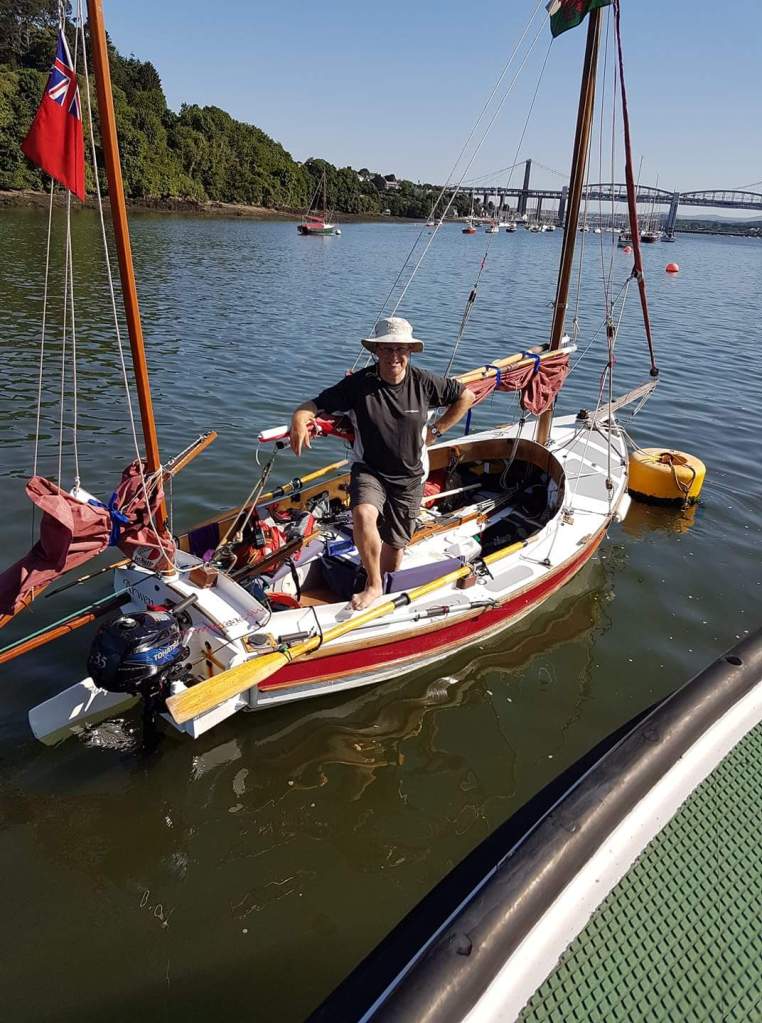
I said, earlier in this post, that I think of sailing dinghies used or suitable for us as being broadly in two categories. In brief those categories I see as first, general purpose dinghies that adapt easily to cruising, and as a second category those designed from the outset and built as cruising dinghies. In the first category, at least in the UK, I would give a respectful nod to the well known Wayfarer class as they are used routinely as training/starter boats by sailing schools, some owners race them and often they are used as cruising dinghies.
There are others of course although i’m not here today just to note an endless list of boats with which I have no experience. A favorite of mine, again in the UK, is the local (to me) Devon Yawl which, although they are mainly used as race boats they are a relatively large and stable boat that seems to deal well with coastal conditions and they also fulfill a personal requirement that the skipper and crew should be able to sit inside the boat rather than perch on the gunnell (Gunwhale) to provide some righting force against the rig.
Now, my main theme today is ‘standing on the shoulders of giants’ and part of what I mean by that is pointing out the sailors and their boats that have accomplished something a bit extraordinary. When it comes to the venerable Wayfarer I have to mention Frank and Margaret Dye who, in a series of voyages, sailed their Wayfarer genuinely offshore in that they sailed from the UK to Iceland in one voyage and the UK to Norway in another. Their story as written up by Margaret Dye is still available and well worth a read – I have to point out that Margaret Dye also wrote Dinghy Cruising, which in my opinion should be read by all small boat sailors.
I did say that in this post I would start to point out boats that make good, or at least acceptable, cruising boats. My problem is that I have to consider a long line of different designs and then rate their, on average, suitability for cruising. I would never have said that an Osprey class ex racing dinghy would make a good cruising boat but both the one I know of and the one I had planned myself seem to fit the category quite well.
We know that there are boats specifically designed as cruising dinghies, many of Kiwi John Welsford’s design fit that category and most of them seem to be excellent boats. Several of his designs come to mind immediately when I think about cruising dinghies : my friend Steve Parke’s navigator is one and my Pathfinder is another. Very popular right now is his SCAMP design, one of which was used to undertake an adventurous cruise down in Tierra del Fuego (Howard Rice and his boat Southern Cross). The great thing about these designs is that Welsford specifically designs them for being built in the back yard at home – his usual practice being to build each one himself.
SCAMP design Southern Cross, Howard Rice photograph

Although I can respect and even admire what the small craft sailors such as the Dye’s, Howard Rice and many others have done I don’t find it that useful to say that a Wayfarer is a good boat becaue Frank Dye made some heroic voyages with his boat, or that SCAMP is a great boat because of what Howard Rice managed with his boat. Howard for example seems to have put years of thought and then detailed modifications into his SCAMP and most owners probably don’t have that level of competence and eye for detail.
I have often said that it is better to look at less extreme challenges and then take a closer look at the boats which regularly turn up and that their owners do well with. My usual filter for this kind of way of looking at boats is events such as the Everglades Challenge in Florida, similar Watertribe events on the Gulf/Texas coast and the even more extreme colder waters Race to Alaska – set your boat up at that kind of standard, complete the event and I for one would stand you a beer or three !
In the third and final installment of this post series I would like to explore the idea of what makes a good, or at least acceptable cruising boat.
Until then …………


