


Further thoughts/afterword.
In this post, the follow up to my monthly polemic post, I want to make the case for declinism : the frame of mind and set of examples and arguments that make the case that everything is getting worse all the time and it might be the case that there’s not much we can do about it except on a small and local scale.
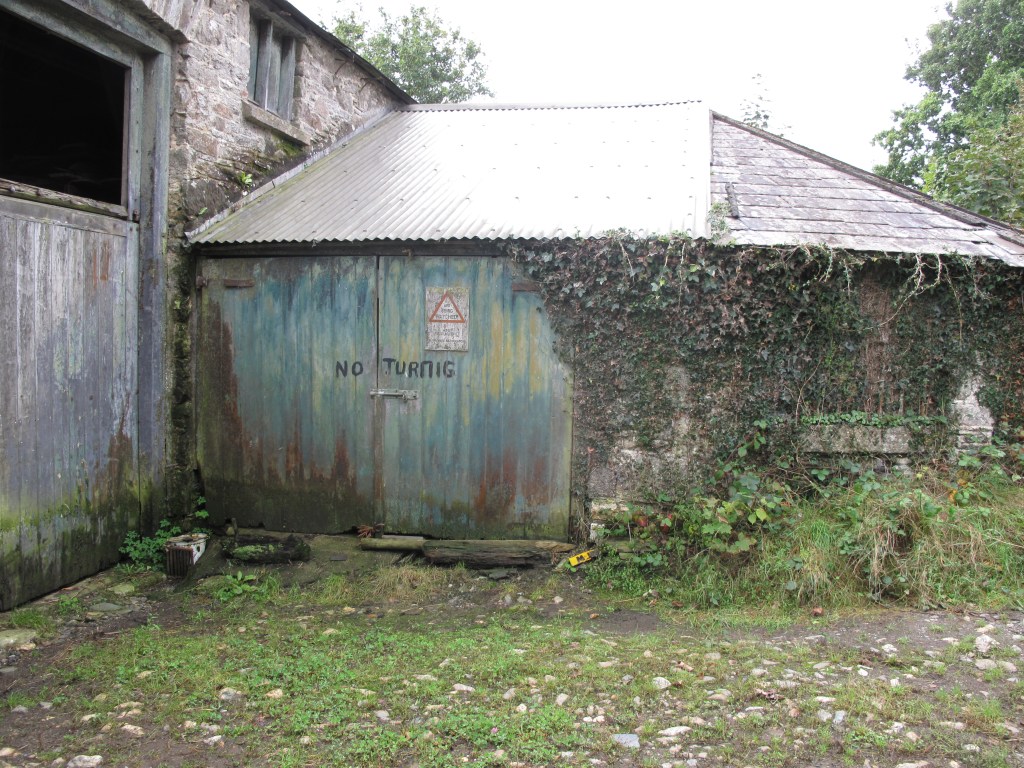
Some readers will recognize the photograph above as the inspiration for one of my small model buildings that i’m making at the moment in preparation for one day creating a model railway in my workshop. The photograph is of a partially broken down barn in a village near to us and I originally used a photograph of the smaller of it’s two doors for their uniquely Cornish spelling and the effects of Cornish weathering.
My main idea for a quirky model railway in my workshop was to work in a large scale/gauge (7mm or even LGB) and base my model on something local such as the narrow gauge line out at Barnstaple : Iv’e always had a soft spot for narrow gauge railways and at various times there have been small industrial tracks that served the Copper/Tin and Arsenic mines in this area. Keeping that in mind I did an internet search recently to see what other people are doing in the larger scales and where I fetched up recently was with a YouTube video that celebrated the use of ‘O’ Gauge (7mm scale) in small layouts : like this – below.
‘Offerston Quay. (above) is claimed to be based around Sheffield, where I lived at one time and the layout immediately jumped out at me because if it is then I think I know exactly the small part of Sheffield that it’s based on because that’s where I used to live. At that time I owned a little flat in a purpose built block of flats in Bard Street which is quite near the railway station one side and Victoria Quay (the Sheffield canal basin) the other.
From my bedroom in the flat I could hear, very faintly the rumble of trains running under the flats, Today, when I went for a virtual walk around the area using Google Maps I think I could piece together what the modeler has based his work on except that the area seems more immediately derelict around the roads and lanes that cross the railway. The flats themselves are as I remember them : 1950’s/60s modern that became abandoned/derelict and were then all upgraded and made into decent housing : just around the area though are still signs of urban decay and the ugliness of 1960’s housing in the shape of the urban dystopian madness of council planning – the Barnard street flats, Park Hill and others.

Using the very minimal genre of railway modeling to explain what I mean does seem to represent an extremely narrow view but then any form of miniature making will do that as it what it asks of us is to study something about the world around us in close detail. To model say, one of the Welsh narrow gauge lines or my local one – the Lynton and Barnstaple railway, is to see life through rose tinted glasses : the engines themselves are both brightly liveried and immaculately clean, even the stations are kept clean and tidy.
The real thing is much more like what is represented in the model of Offerston Quay or what you would see every day before the cleaners clock on in the London Underground : Graffiti, Rats and Rubbish….and far too many people all rammed into a tiny space. Offerston Quay, in a way, represents the end of an era – the one where brightly liveried locomotives in LMS maroon were replaced by functional, dirty and utilitarian British Rail diesel shunters : much more effective in terms of power and function but lacking in any grace and industrial beauty.
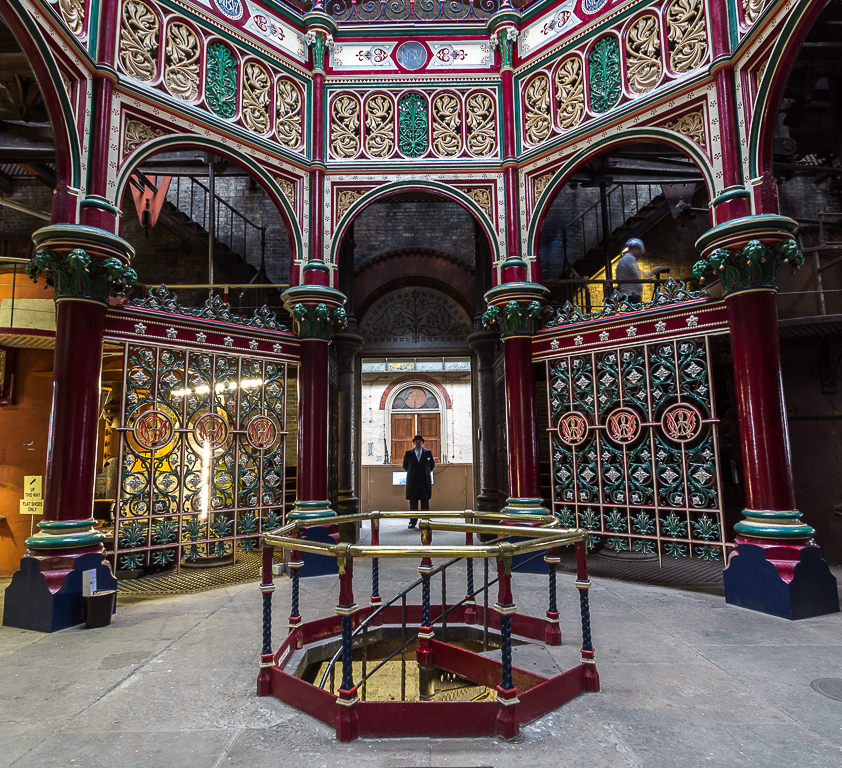
To use the phrase ‘industrial beauty’ might even sound like like a mistake or an oxymoron but then go take a look-see at how well industrial machines and spaces were presented in our near past : i’m thinking here of industrial steam engines and even sewage pumping stations .Below is an interior photograph from Crossness Pumping Station built in 1859. Even the exterior brickwork has been carried off with a sense of proportion and style.
It’s an oft used comment that we live in a world that is ugly and getting uglier by the day : so common that it’s almost used as a joke – that people of a certain class or type always claim that things aren’t as they were when the complainant was younger. Perhaps it is true though, take a virtual walk around most cities today using a tool such as Google Maps, take time to absorb the detail and you will see what the modeler sees : a burnt out van parked in a closed off alley otherwise stuffed with dumped mattresses and bags of unknown waste, the shop on the corner now with broken windows and gang tags. It all looks as though we’re shitting in our own back gardens and dumping our waste there too.
It’s not a new argument, even Wikipedia has a page dedicated to the principle of Declinism – the principle that everything is getting worse. I met it for the first time through the writings of J.R Tolkien himself and in an interview he gave in which he lamented the end of a way of life that was already dead or dying when he gave that interview : that must have been just post wartime and I have to wonder what he would make of England today. Tolkien clearly disliked modernity as is obvious in his writings, detested cars (I begin to agree with him) and hated factories for what they did to people and the products that they turned out en masse.
This week’s first video suggestion includes the legend of Thomas Crapper and the ornate temple of sewage : Crossness pumping station.
Wikipedia page about Declinism : https://en.wikipedia.org/wiki/Declinism
I’d like to finish this piece with one more example and then start to think about the push back or potential solutions. The example I had at the forefront of my mind is the recent one of ex senior Nurse Sarah Mullally becoming the Archbishop of Canterbury : essentially the head of the Anglican church. One thing (among many) that she is now infamous for is the ‘decoration’ of Canterbury cathedral with stuck on examples of modern graffiti, I don’t think I need to say any more about that but today I want to focus on more immediate and personal examples.
If anything at all I see a direct line between Henry 8th and Sarah Mullally : both, in their own way, presided over the destruction and desecration of churches. With Henry of course that included the state looting of anything valuable and the often horrific torture and execution of anyone that wouldn’t bend the knee. In her case, Mullally is known as the feminist that espouses the rights of women to have abortions as and when they desire : i’ll be blunt on this – anyone can make an error but abortion always also encompasses the murder of an unborn life. Cheery stuff to talk about today eh ?
I want to finish today by going down an entirely different route – one that might surprise many.
Among the abilities and skills of an ocean sailor was that of making and mending personal items such as trinkets toys and clothes : in it’s heyday the British Royal Navy would even declare a make & mend day when things were quiet during a long voyage. Iv’e seen some of the examples, for instance those in the Peterborough museum : elaborate bone carved models of anything from sailing ships to miniature working guillotines on carts – toys I presume.
With that kind of thing in mind during the Covid 19 lockdown years I had this idea of spending some time making some of my own clothes for sailing : what I had in mind was a set of traditional oilskins made from waxed/oiled cotton/canvas : at sea I almost always used to wear a pair of modern Salopettes but always disliked their clammy slick feel. Somewhere I still have a copy of a print of a traditional sailing fisherman wearing his chest highs and a long waxed canvas coat against the spray and cold air.
Ultimately, it never came to anything – I built a boat instead ! but I had spent some time watching videos about people, usually ladies, making hand sewn clothes as that’s what a seaman would have done and he probably had a ditty bag in which he kept useful things like needles and thread – I still have the one that was made for me as a birthday gift.
Today of course I probably count as the world’s scruffiest man as I dress purely for functionality and convenience rather than any sense of style or pride of appearance. At work my dress code was simple : my day started when I pulled on a pair of surgical scrubs and finished when I dropped them in the laundry bin at the end of my shift – I never thought about what I looked like as I was wearing essentially shapeless bags.
My thoughts and push back against some of these things is something very much like one of Dr Jordan Peterson’s rules for life : I don’t think it made the final cut of 12 rules although it’s close. Peterson says that the things we do every day are the things that we should learn and practice to do as well as we can. I think his reverse example was being served a very badly cooked breakfast by a chef that seemed to hate the world.
I cook most days – right now I have a pan on the hob with the base for a simple cottage pie slowly reducing. My example is that I grew up with parents whom could cook but were quite lazy about it : my late mother’s cottage pie was basically grey and tasteless – somewhere along the way iv’e picked up the very small skill of making an acceptable one and ditto with a Bolognese sauce and a basic curry. My partner won’t order a Spag-Bolog when she goes out because she says that they are always cooked with little time and attention.
I consider my main challenge of the week is to time things so well that I can serve my partner a hot meal the moment she walks in the door : she isn’t fussy but some days she comes home exhausted from all of the BS she has to put up with as a Sister in coronary care – the care itself is ok, it’s just the rest of working for the NHS that is so tiring. I often used to fantasize about one of the TV chefs turning up to run me through some simple, quick and tasty meal ideas but as it is I have to learn them slowly and just as slowly to make basic improvements as a cook.
That’s a small example of what, I think, Peterson was getting at – that a small and incremental change results in our lives being that bit better : I wish I could say that for everything that I have to do but it’s simply not the case. With clothes for example I often look as though iv’e dressed from the wrong end of the laundry bin. I guess that that’s the result of laziness and convenience on my part and I could make a quantum leap just by applying a tiny amount of thought and attention.
My eventual thought for the day (and this post) is that a lot of the ugliness of our micro-environments is the polar opposite of Dr Peterson’s slow incremental improvements : in brief that we let go and compromise in small ways every day and the eventual result is cities that become choked with dumped mattresses, burnt out or abandoned cars and tagged with graffiti – after a while we even stop seeing it.
Today, in a Petersonian kind of way i’m going to make a small start on cleaning my room !
Best wishes Y’awl….Wa-oh.

 Dirty Wet Dog, the great adventure.