

This month’s crafting work : carving and painting a miniature brick wall–rinse & repeat.
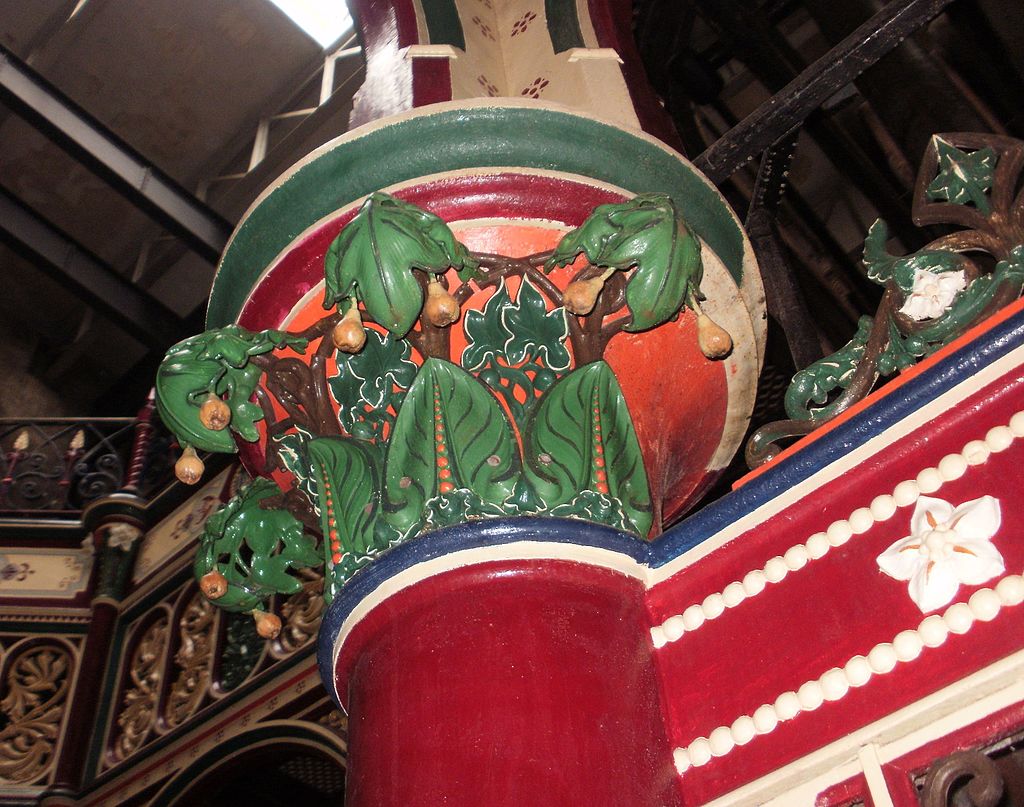
This post’s title photograph is taken from the Wikipedia page about Crossness pumping station : the actual Temple of Sewage !
This month’s work on the crafting table takes me away from sheer whimsy and towards some greater modeling realism in the shape of a section of brick arch wall. It’s partially inspired by someone else’s model railway layout – the one that is based around Sheffield – and partly from my distant memory of poking around a back street bike breakers business that Inhabited a damp space under a railway arch in Preston Lancashire.
It’s a model with a back story then and what I can see slowly taking shape in my imagination is the gritty reality of having lived, for a time, in both north midland cities : Preston when I trained as an SRN and Sheffield where I got my first Charge Nurse post in the intensive care unit at the Northern General Hospital.
This model’s back story.
Please excuse me if iv’e used this story before : I saw a program about railway modeling and in it musician Jools Holland explained that his layout was a bit like the contents of his mind laid out on a shelf. Having seen over his layout in a TV program it’s obvious that the scenes, vignettes and miniature dioramas that he has created all come from his memories : the streets that he grew up in (London) and some of the cities where he played in various clubs (Berlin) and even his visit to checkpoint Charlie at the Berlin wall. I bet that in his mind there is a personal back story behind every scene that he has made a model of.
The back story for this model/vignette is that the cold and damp bike breakers that I once had to visit to get some parts for my street custom turns into an actual motorbike dealership based on one also from memory : if anything it’s a bit like the little moped and scooter dealership in the street just behind the high street in Weymouth, Dorset. If I can get some 1:48 scale motorbikes and figures then it will become a small vignette memory. In the actual project i’m going to start with a laser printed MDF model of a brick arch with a shop underneath and my main challenge this month is to ‘copy and paste’ (copy and carve) using a piece of XPS foam – it might even have a section of model railway going over it as was the case in Preston – in my mind a WDT (worlds dullest town).
So : my railway modeling aspirations have moved north a few hundred miles – from the intensely dull fenland of my childhood to the gritty industrial northern cities that I trained in and worked in for many years. I may have once said that I had the outside plan of basing a railway model around Bourne in Lincolnshire and one thought for a structural model was the goods shed that my best friend and I climbed into one day – that would have been a brick built structure as well so the connection is that I still want to learn how to portray brick built buildings as well as I can.
With my vague idea of a Bourne based layout I got as far as researching that the original line would have been part of the GNR (great northern railway company) whereas Sheffield was at the eastern edge of the LMS (London Midland & Scottish) empire : at one time apparently the largest commercial enterprise in England. Preston, btw, would originally have been LNWR but got taken over by the LMS in grouping days.
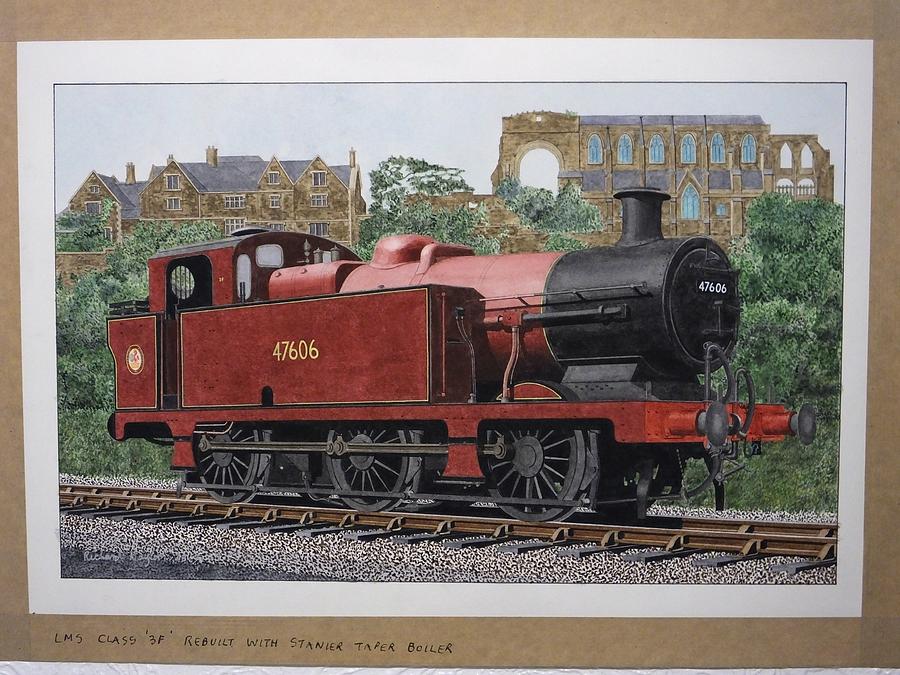
I’m sorry that this is all very nerd like and the kind of thing that some middle aged men buy books and videos about but it means that i’m a long way towards also defining region and period as well as simple time, space and story in modeling terms. What that might mean is that if this model works out then next year’s birthday present from me to myself will be a 7mm scale (O gauge) Dapol 060 ‘Jinty’ in handsome LMS maroon – very pre-British rail black and definitely the steam period.
Sorry about that : lets get started on the actual models.
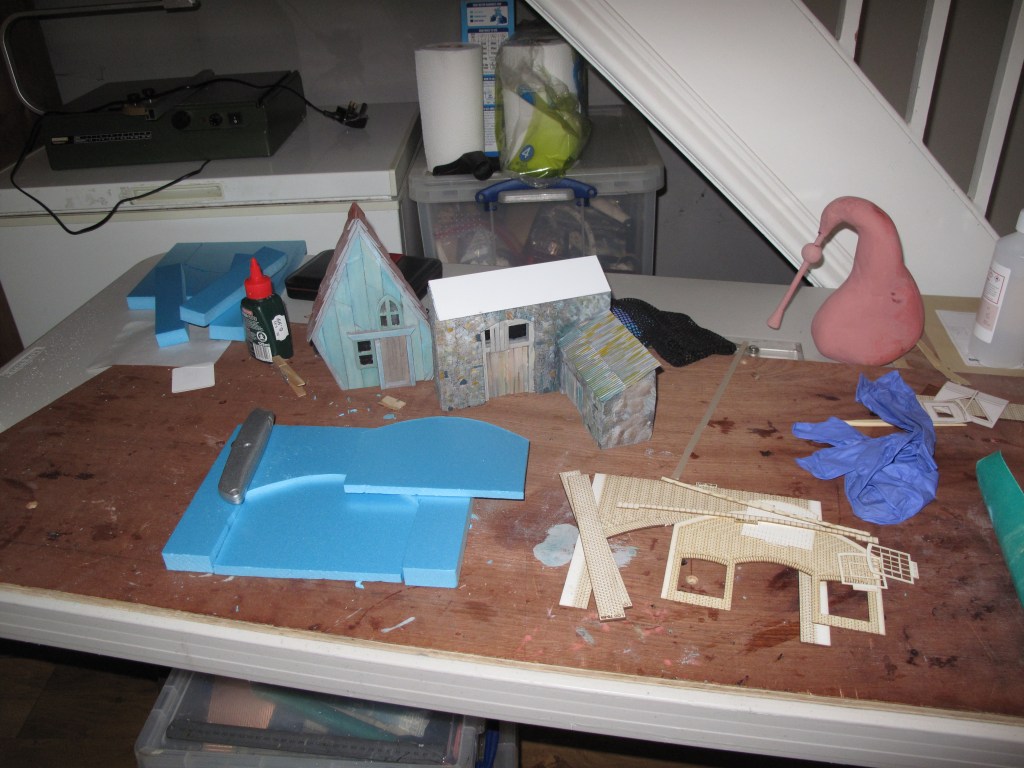
The start of this month’s projects involves the same kind of real structure – a business set in the space under a railway arch – but in two different materials and at two different scales. The basis for a 7mm (O gauge) model is a laser printed ‘flat’ of a railway arch that can be bought in several different configurations and the 1: 25 scale version (G gauge) i’m going to carve/emboss from rigid XPS foam.
For a little bit of total nerdery this month I now know, off by heart, the standard sizes of house bricks and can even differentiate between English bond and Flemish…..how un cool is that. My problem in trying to work with XPS foam at 7mm (1:48 scale) is that a house brick comes out at 3mm length by about 1.5mm, To draw that out, cut it accurately and then also create the mortar lines I suspect would be extremely difficult and I think that what most modelers do is to work with embossed plasticard : the flat,MDF, parts that I bought do have the brick courses already embossed although the scale looks more like 4mm (OO gauge).
Each post I do from the crafty table from now will include a highlight of someone else’s modeling work : last month the railway model was Offerston Quay, by an unknown modeler. As I said in a previous post Offerston Quay looks a lot like the area around Bard Street/Broad Street with a little bit of Sheffield canal basin thrown in for good measure. I almost ‘pulled the trigger’ on Bard Street becoming the working name for my own model and what I was starting to plan was the same split level idea with the rails on the lower section having a background of railway arch businesses like the one I think I remember from Preston (I went looking with Google Maps and couldn’t find it)
The actual models start with an MDF ‘print’ of a railway arch in 7mm scale that can be configured in various ways : one is simply a bricked-in arch although others represent shops and warehouses. My main work with this model is to see how it can be painted in varying types of brick – i’m thinking here of obviously pink/terracotta brick and the slightly more industrial looking yellow that is common in London. I don’t know how it will work as it’s a small enough size of bricks to create problems in creating the randomness that occurs in real brick buildings and the mortar lines are so fine as to maybe disappear entirely.
The second use of the print is to use that as a template to cut out the same thing at the same size but then use the XPS foam as a basis for scribed and penciled mortar lines (a standard pencil is a surprisingly effective tool). By cutting out the entire under arch section and then slicing it I get pieces that slot straight back in but can also be modeled in various ways : my first one is likely just to have inscribed bricks but as I have 2 slices I can play around with the spare piece.
This month’s featured modeler is Norm Charbonneau and one of his many models is the Bessemers Bar as shown above. My plan had made it as far as featuring another little vignette from my Sheffield days : my model/vignette was to be based on a cafe in Sheffield called The Edge Cafe although I was going to call my version the Broad Street Cafe in honor of the little corner curry house which I used to walk down to for my Tikka Bhuna – Sheffield was an amazing place for curry in those days including the famous Spital Hill Curry Cafe run by a family of Sikh’s with broad Yorkshire accents. Anyway, the Bessemer Bar is only one of several such models – there are several bars, eateries and an excellent cafe let alone an amazingly detailed machine shop which are the life and soul of Norm’s layout in O gauge.
I keep coming back to Norm’s model of the Bessemer Bar because it’s almost at the centre of the town that his layout wraps around. The embedded video is the model in it’s most recent form and seems to comprise of layer on layer in terms of his modeling skills. I could, just about, make something like it using the minimal skills I have right now : the kind of skills that I once had as a modeler. Miniature model building has changed enormously since I was a spotty teenager and it’s not just the simple skills – those haven’t and don’t change that much. What has changed is the available technology that Norm has obviously bought into and uses to full effect : in his case 3D printers, the computer skills required to model the super-detail parts on a screen and only then make the prints of people and fittings and finish them with the old time skills of painting and weathering.
Creating repeatability.
Repetition (repeatability) is very much the thought of the week, both here and on my workshop project : on the workshop project I have to dig, shutter and fill, several times until iv’e underpinned the whole front wall and here I have to be able to repeat the form, detail and rhythm of a brick built railway arch maybe five or six times and have each section harmonious with the whole. Knowing that, I paused with the actual building of the XPS foam arch section and instead of jumping straight in started instead by making some brick course templates first : that’s three simple measurement templates so that I can lay out the horizontals, verticals and the layout of the corner (quoin) stones.

Just look at the amount of care and detail in that brickwork – Crossness pumping station I think.
My final thoughts ,for an already over long post, is that repeatability might just be the key that pushes me over the edge to becoming an actual railway modeler. What is slowly coming together is a plan in which a series of railway arches form the scenic backdrop and a lot of the repeated detail, of the main section of the layout I propose to build. The more detail that I can pack in on these simple repeated forms the better the center section ‘reads’ as a depiction of a model of real life. Aside from doing the actual work on my crafting table (it’s raining hard outside) that’s about it for today.
Best Wishes Y’awl.

 Dirty Wet Dog, the great adventure.