
Part two of my post – Legacy.
In the first part of this story I recalled how I went down the rabbit hole a bit when I started to take an interest in (mostly) Cornish mining and it’s poisonous legacy : I did also take a bit of a mining detour in that I followed the adventures of the bloke in America who bought an entire abandoned silver mine in California (Cerro Gordo). I haven’t seen much of Cerro Gordo’s new owner (Online that is) for a couple of years but via his channel I learnt more about mines than is probably healthy : I know now that a tunnel isn’t an adit, I know what a stope is, what gobbing is and via Brent and one of his friends a little about collecting minerals down in the old mine and smelting it for Lead and Silver – the mine mostly producing Lead, Silver and Zinc.
In the first half of this post I was largely answering the first question that I jotted down when I first wondered what the physical and social (health and finance) problems of Cornish mining were. I mainly focused on the toxicity of the mining product and especially with what was left behind – in this case mostly Arsenic in the spoil heaps, in the soil and in the river due to slow leeching over time : the crystalline mineral Scorodite is said to have low solubility but it’s now been there for much of the last hundred years and has slowly leeched down into the local river – which is one reason why the local moorings should be lifted and inspected every year.
The dirty water problem, at least locally, is that the water table in the abandoned mines under the village goes up and down like a Plymouth Tart’s skirt and it’s the rising and falling water level that does a lot of the damage. One thing we had to get used to in living here is a couple of blokes in hard hats wandering into our drive to run a transducer down a pipe buried into the first adit coming off the main shaft – the access plate being in our drive. Over the last few years iv’e had several enlightening conversations with the mining engineer about the problem and last year they had to do some remedial work down in the shaft to clear some blocked drainage a bit further downhill (in mining terms).
Warning….segue incoming.
Water in the ground and thus water in the mine is a problem in Cornwall because lots of the stuff simply falls out of the sky and has to go somewhere. My not so clever segue is to the water problems of Cerro Gordo mine in California : to give a geographical hint then the mine is at least a thousand feet above Death Valley and doesn’t have a reliable water source aside from a small seep some 600 feet inside the mine and that has to be collected behind a dam and pumped to the surface.
If you know anything about that part of California you’ll know that the Inyo mountains, within Death Valley are a long way from reliable water and a good half day’s drive from the coast (Los Angeles say) and that’s in a modern car on today’s roads. The history of Cerro Gordo is that there was, at one time, a large population of miners (4700 at it’s peak) and their families actually living up there and everything, including most of their water, had to be hauled in by mule train. You might guess that such an undertaking was expensive and the businessman that ran most of the mule trains made a fortune out of it and I guess you might ask if it was all worth it ? – how was it viable ?. The answer is that it wasn’t the gold that financed Los Angeles but Silver, Lead and later Zinc and a lot of it came from Cerro Gordo and nearby mines : we’re not exactly talking small change either.
Note….Wikipedia gives the financial take as being $17 million which doesn’t sound a lot until you try and equate it to it’s value today. To follow the money as the current site owner Brent has done is to understand that the city of Los Angeles was built on the proceeds and outside of mine income LA doesn’t have any great and compelling reason to be there.
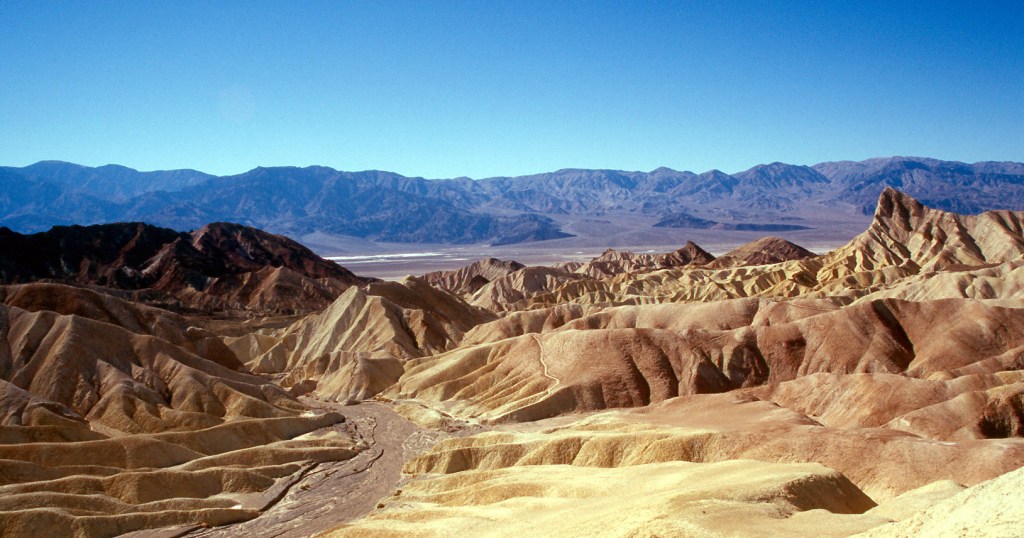
Now, iv’e been to the eastern Sierra Nevada mountains, (that side of the Sierra really rocked my boat )hiked in the Inyo national park and driven through Death valley on a road trip – we may have driven right past the access road ro Cerro Gordo without knowing it’s significance – I may have been more interested then to get to Zabriskie Point. We actually stayed a night in a motel in Death Valley and I can only think of it as Hotel California – it was that strange – a motel in a very dry desert. I had one walk that night, out on the mesa and when I got back I jumped in the motel swimming pool : the air was so dry that my hair dried seemingly within seconds when I climbed out.
After my long dive down the rabbit hole of environmental degradation that Cornish mining left us as a legacy I tried a similar exercise to follow the money and try to find out what if any of it had benefited Cornwall in any way. What I can’t find is a single cohesive account of the amount of minerals (Tin,Copper, Zinc and Arsenic) that were extracted and their financial value – the best I could find was records from individual mines but once again it doesn’t translate easily into modern equivalents.
What I can say is that Cornwall today is a very poor region – in one account it is regarded as the 4th poorest in the UK – the poorest btw seems to be Tyne and Wear in the north east. What I did get a sniff of is the fact that when any mine became economically non viable it was simply abandoned and left behind : then at some time – I have it as being during the Blair government the whole issue of who should do the clear up and who or what company still bore any responsibility was neatly swept under the carpet and the responsibility grandfathered– nothing to see here folks, move on.
You might view Cornwall as somewhere to go for a family holiday – allegedly ‘clean’ beaches and cute little fishing villages : well, the fishing industry is largely dead, most seaside towns that once had large privately owned (locally owned) have long since been sold off to wealthy Londoners as second or third homes and the locals now mostly live in cheapo, edge of town, housing estates. Most of the county comprises of decaying and depressing inland towns with a high rate of recreational drug & alcohol use and low employment.
And I still haven’t talked about Cornwall’s legacy with rotten boats……next post….maybe
Best wishes y’awl
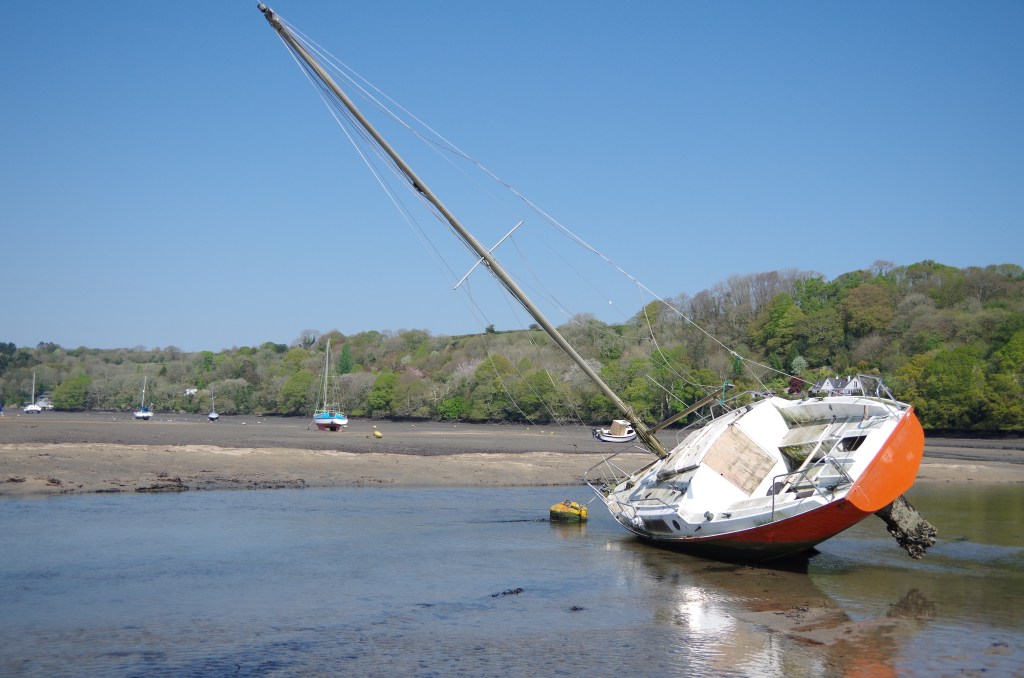
Above Golant…..Fowey.

 Dirty Wet Dog, the great adventure.