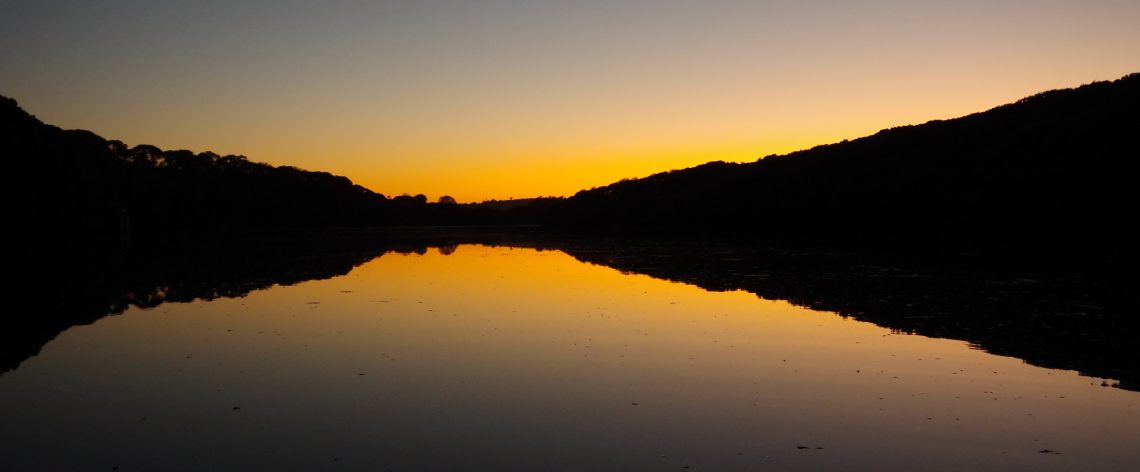


A Sail, Oar & Canvas project post.
Leathering the oars, making and fitting oarlock risers, altering the trailer.
Those readers that have been following my Skerry based project will know that I completed most of the work and have since taken the boat out for a couple of days of ‘sea’ trials ……ok then, river trials perhaps as so far it’s only been out on the river Tamar, close to home. The first day was mostly taken up with just getting the boat to water, launching it and then doing my best to not fall in (some days my balance is poor and some days it is awful !). For the second trip, with a little bit of confidence returning, I took the little Skerry for a longer row in slightly harder conditions in that it was upwind nearly all the time and quite a lot longer : anyway, I came back feeling that the boat, or at least the interface between it and me, weren’t quite right – a lot of that coming down to my lack of rowing skills.
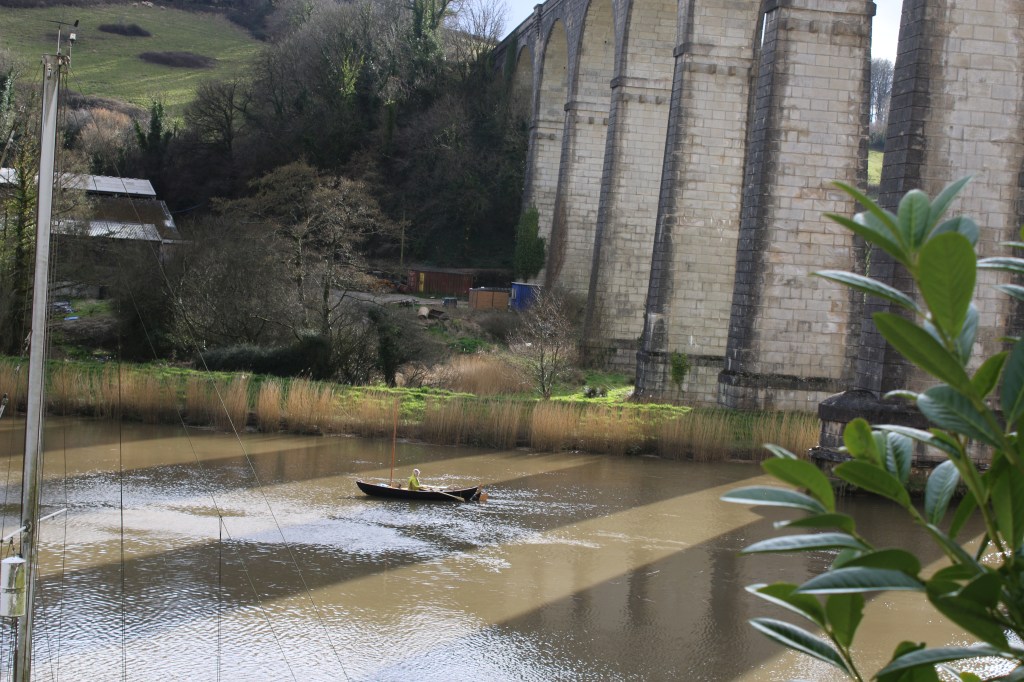
Passing Calstock viaduct on my way upstream.
As with performing actual sea trials with my previous boats I finished with a set of notes about what I thought the problems were and some thoughts about improving them. Our man Daryl advised me not tom change anything until I had a load more experience with the boat and suggested that I maybe didn’t need the daggerboard (as I thought) or the rudder (which someone else suggested). What I felt needed doing was some small changes and fine tuning – making the rowing position a bit more effective thus more efficient and more comfortable – my bum really ached at the end of the day !.
While having been advised to not go changing things I think there are a few small but essential changes to make right now so as to make the rowing more effective so : It might all be in the riser – or lack thereof as what I really wanted was some kind of pad for my sore butt and that would have created a slightly worse angle for the oars so fitting and experimenting with a simple pair of risers appeared to be the simplest solution.
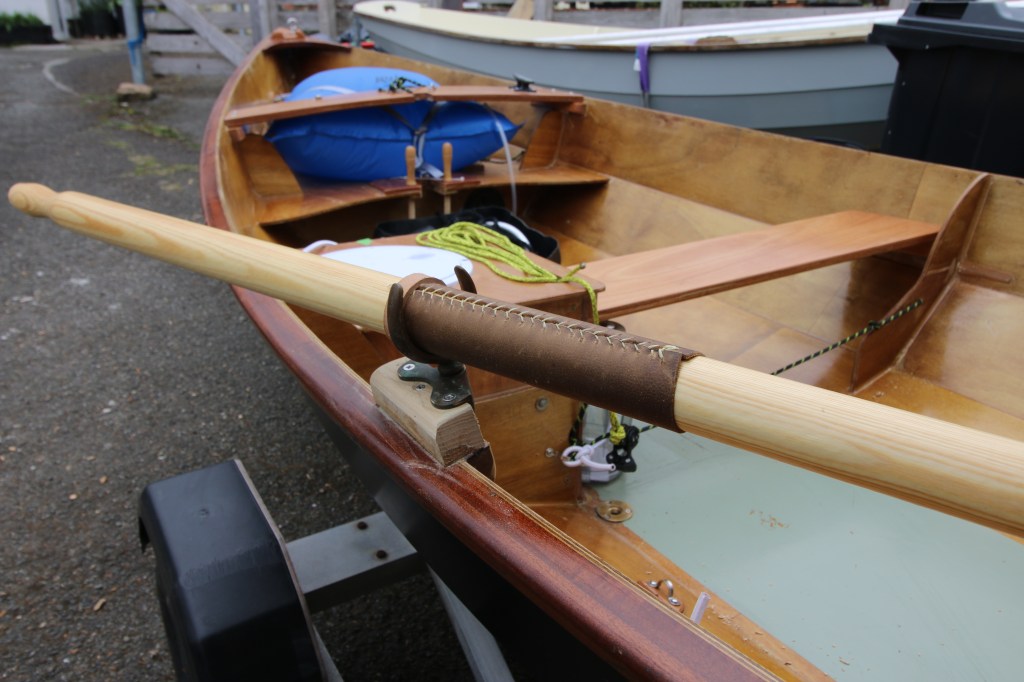
Change 1 – remove the hard plastic oar collars and instead add sewn leather ones plus ‘buttons’.
One of my rowing problems seemed to be that the original collars were in slightly the wrong position so I hope that with the much smarter leather collars I have corrected that – plus they look a whole load better.
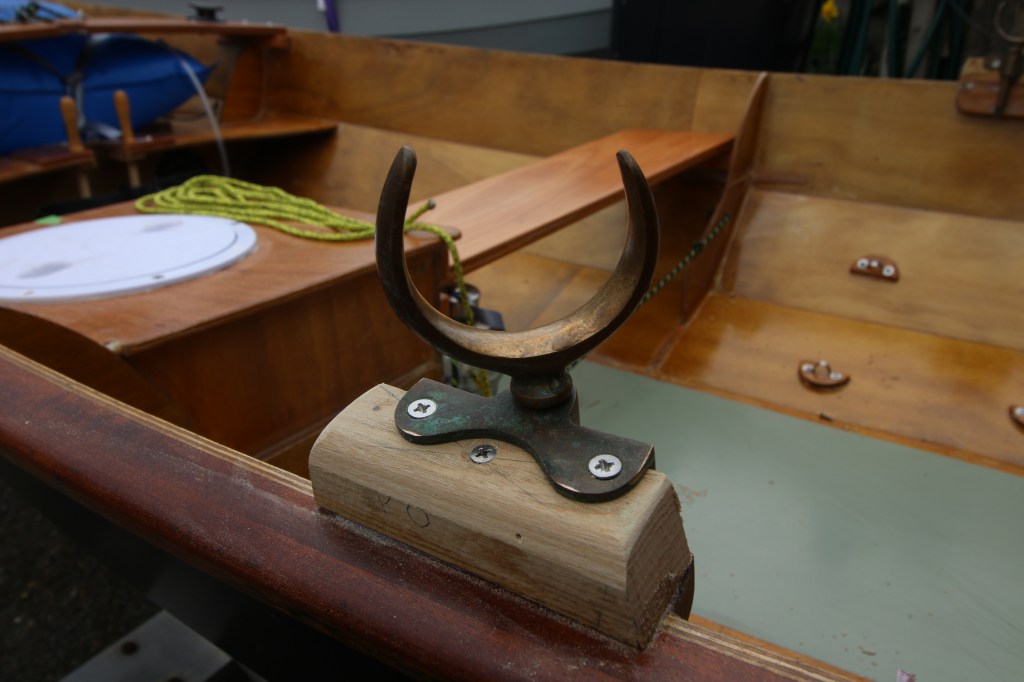
Change 2 -make & add rowlock risers.
I did buy a pair of risers from Fyne boat kits but when I got them they seemed both wider than I needed and not high enough to also allow me to have a seat pad – so I made some bearers and risers out of scrap timber. The actual risers are Ash and at this stage would be improved with a bit of shaping.
Change 3 – make a rowing seat pad.
Temporarily, my seat pad is simply a convenient length of rollmat secured to the thwart with some long cable ties : next time I go past the ‘country’ store I will replace the pad with a slightly thicker kneeling pad.
Change 4 – lengthen the trailer drawbar & add a lightweight jockey wheel.
While the principal changes are intended to make the Skerry a more ‘tuned’ rowing machine I also had to consider that I needed to make the whole rig (boat and trailer) easier to manage solo on the Cotehele slip and in the compound there – for that I felt it worth the effort to take apart the whole front of the trailer, add in a longer piece of Aluminium for the draw bar and then bolt the clamp for a jockey wheel in the new space created.
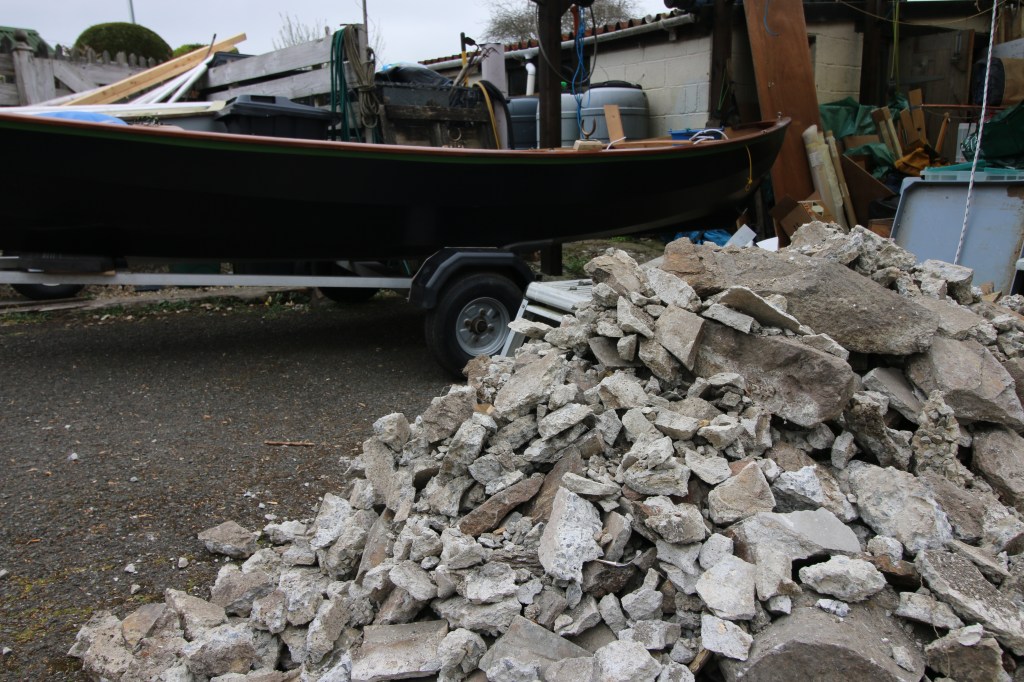
This is where it gets quite funny as what I really needed was my work bench in the workshop and my big pillar drill to bore the holes with : however, the pillar drill is now in parts under the bench outside of the workshop, the original bench is now just a pile of scrap lumber and most of the workshop floor is now a big pile of rubble out in the yard. The actual drilling turned into a bit of a nightmare as, even with centering holes punched, the drills still skated all over and I found it supremely difficult to drill a straight and vertical hole through 2 layers of alloy 50mm apart.
Post edit : my rowing skills – or lack thereof.
As with many sailors iv’e never become a very proficient oarsman, I think mostly because iv’e mostly rowed ‘soft’ tenders which are fundamentally bad boats to row in any amount of wind : the exception was the time I had a cruising boat on a deep water mooring and often had to row out into a strong tidal stream and at the same time I owned a hard dinghy which rowed far better than an inflatable. At most though the furthest iv’e ever had to row in that boat was around half a mile but that all changed when I built my big Pathfinder dinghy as a sail/row expedition boat and set it up with a pair of 10′ oars.
My first sea trials with that boat were under oars only and I ended up getting wind bound at the downwind turning point and I was unable to produce enough power to row back upwind against a 16-18 knot headwind – that’s when the big Pathfinder became a motor boat some of the time. At that time I thought that i’d made a mistake with the Pathfinder and instead that I should have built John Welsford’s then new design – Long Steps.
The last voyage I did with the Pathfinder did finish up with several sessions under oars only and one of those was a trip into my favorite place in the west country – Ruan creek – otherwise known as the true Fal river (most people confuse the Fal with the Truro river).

Until my third CVE (stroke) I still had an ambition to build a true sail/row expedition boat such as Long Steps, since that stroke iv’e really had to dial back on unrealistic ambitions although something such as Welsford’s ‘Walkabout’ might still be a future project as it’s an excellent sea boat and vastly more stable and capable than the lightweight dory form Skerry.
At present i’m trying to make the best I can out of the little Skerry and one thing that i’m trying to get a lot better at is rowing a fixed seat boat – at the moment i’m basically fine tuning the rowing position so the next time I go out I hope to have a better time of it and in the future I hope to have sail/row and camp expeditions in the local rivers.
Best wishes all.

 Dirty Wet Dog, the great adventure.