


A short post today
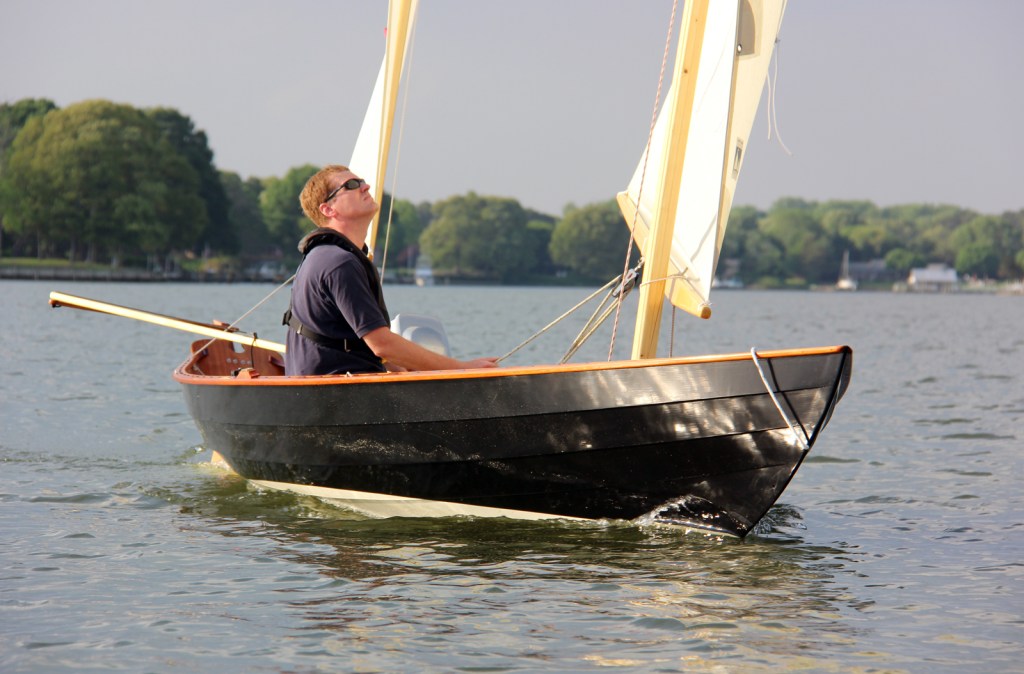
Ballast and buoyancy for the CLC Skerry.
Photo credit – Daryl Foster
The continuation post of my ramble about fitting additional buoyancy in the CLC Skerry – the question of whether or not it might be a good idea to carry ballast as extra weight low down inside the hull. With the buoyancy issue i’m undecided whether to use canoe style buoyancy bags, buoyancy blocks, or custom made buoyancy blocks which I would make from sheets of solid loft insulation (Recticel in the UK) encased in home made covers – again hand made. I am pretty much decided on altering the boat’s internal structure by removing the standard central daggerboard and moving it to one side to give a central open space to sleep in and part of that job would be to remake the board box as a side buoyancy tank – except make it as a pair and thus have a fixed kit stowage bin and buoyancy tank each side.
After my first post about the potential CLC Skerry project I got a nice email from the actual boat’s current owner and he told me that some Skerry owners do carry additional ballast either side of the daggerboard case ; Daryl stated the actual number of 2 x 20 Liter water canisters so that of course is an additional 40Kg of weight carried. He did also say that in his experience the little Skerry rowed better with additional weight on board.
As I said in my previous post I don’t have any experience with Dory form hulls and largely took as my starting point my experience with open canoes – in terms of capsize and recovery. As a former canoeist and sea kayer I know that both open canoes and sea kayaks can feel a little bit ‘corky’ and unstable when they are run light and both types of small craft can be a problem to paddle into a stiff breeze : I have to wonder whether the Dory hull of the Skerry acts in the same kind of way.
My own answer with boats is yes, weight always matters but sometimes it’s making a boat more stable and sometimes not. In my last post I kind-of mentioned how what is known as free surface effect can make a capsize recovery difficult : in fact, extending that idea out a bit it might have been the free surface effect of a lot of seawater washing in through the open bow door of the ferry Herald of Freee Enterprise that caused it to capsize. We were always extremely sensitive to ballast and stability with IOR race boats and even in the days when I raced there were boat owners and designers that did crazy things to get a boat to it’s intended rating – extra ballast attached to the underside of the deck-head anyone ?
Not the CLC designer but the designer of my own Pathfinder (John Welsford) kindly sent me an email after my previous post setting out what he would add in terms of extra buoyancy for the Skerry and that’s exactly what I am planning to do although along John’s own lines with his boats I am now thinking about additional ballast added to the Skerry – maybe John’s own trick of a couple of bags of sand low down.

 Dirty Wet Dog, the great adventure.