
My take on the late Maurice Griffiths first book.
Note to readers – several years ago my main effort in writing was to write my own book on the subject of sailing and cruising in small boats and somewhat based on the original book of the same name written by the late Maurice Griffiths and intended for sale on railway station news stands. What happened with my intended update on the subject is that I got mine as far as a first draft and then found that there was little interest from publishers : the best answer I got back then was nobody, especially sailors, needs to write a book these days because nobody actually reads books especially ones written by middle aged and middle class sailors and even more an especially not when it’s the small genre of DIY boats kept in small back lane boatyards and/or cheap moorings somewhere up a muddy river.
Well, I abandoned that effort and somewhat stupidly I stored most of what I had written in the file called bin which seems a bit silly now that I know I could use at least some of my own work to base my blog posts around. The other thing that I did and which I persisted with is the modern alternative which the world of publishing seemed to suggest : that most sailors who want to have their own say can just as easily do so with video. As I see it today I think it is mainly true that many sailors won’t bother with a book or even an advertisement loaded sailing magazine but will watch a video.
I find video a much more difficult medium than writing but then I have to be my own camera and sound guy, my own voice ‘actor’ and eventually my own video editor : it adds hours to a job to film it and then even more hours to edit the clips and make them cohesive in what feels like making small films. As I write I know that i’m at the end of my current methods of filming and producing video content for a small audience and that’s largely what I thought might happen : i’m coming to the end of my project at home and only have one more video using what I have learned so far – after that I have a whole different approach planned.
The other reason for revisiting this subject once again is that this week I had occasion to visit the professional riggers shop down in Plymouth and I was shocked by how much prices for marine hardware had risen : I only went in for a small double block and 25 meters of simple rope to complete the main halyard for my little lugger and came out a hundred notes (and a bit more) the poorer. At this end of the project I seem to be spending like it’s going out of fashion so my one small shop at the riggers was more than a sheet of BS1088 plywood and in terms of work time involved with actually fitting and setting up will maybe take me all of 10 minutes where a sheet of ply might have kept me occupied and happy for a week. As much as anything this post is a conscious rejection of the way that mainstream yachting is going and although a large part of that is the almost insane cost of hardware it does have something to do with the overall problem.
Dinghy/open boat cruising as a valid choice
In this post I would like to present a personal opinion – that cruising in a dinghy or open dayboat is a perfectly valid choice for a sailor – and not just because of the lower costs involved although, as I said earlier, cost is now a significant problem. The second contention that I would like to posit is that it’s not just the buying, owning and sailing but that the valid and indeed valuable choice starts with building your own small boat
I would like to begin with presenting modern yachting as I see it today and I begin by giving a big nod to the original work which is my jumping-off point ‘Sailing on a Small Income” by the late Maurice Griffiths. In that short book – I think it was Griffiths’s very first self written book the author starts off by considering the ‘young chap’ who wants to start sailing and specifically starting with his own boat. I sort-of kick off with the same idea although when I wrote my own book version which has become this post I didn’t assume boat ownership as a starting point ; I for one spent years crewing for other skippers long before I had my own boat and I still maintain today that the idea and practicality of Sailing on a Small Income might best start in the same way as I did – with having my own set of foul weather gear and having my sea going bag ready to go whenever someone needed an extra crewman for a race or delivery trip in the Irish sea.
As a note to modern readers I should also say that Griffiths wrote that original work as near as possible a hundred years ago and of course a lot has changed since then : not only has the most popular era of of leisure yachting been and gone but most of British boatbuilding has risen, had it’s day and died it’s quick death too. What I should also start this thread of posts with is to also mention my use of language ; the late Maurice Griffiths seemed to be mostly writing with a male audience in mind and therefore almost starts with he and him – I have no problem with that today while I also acknowledge that even a back then there was a move by women themselves to become small boat owners and skippers in their own right and not just adjuncts to their menfolk. In older posts I spent quite some time trying to track down the life of Griffiths’s own first mate who yearned to own a boat herself and was even then as much a yachting writer as was her first husband Griffiths.
‘Peter‘ as Griffith’s called her and as she wrote under that name was actually Dulcie Kennard but wrote under the assumed name of Peter Gerard and when their marriage broke down bought her own boat Juanita and wrote her own account of sailing it up and down the English Channel up until it’s enforced laying-up in the early years of WW2. Few today know that Dulcie/Peter was also a women’s pioneer in that she used Juanita as a practical sailing school and he own book ‘Who Hath Desired the Sea‘ can still be found in secondhand book dealers. If anything I would define Peter/Dulcie as more the offshore sailor while Griffiths first love seemed to be the rivers and creeks that surround the Thames estuary. As I spent most of my own sailing years as an offshore sailor and eventually an ocean going one I sometimes feel that I have more in common with first mate Peter than I do with Griffiths himself.
Now though I feel that I have done enough offshore and ocean miles, I don’t need or want that kind of yacht any more or that kind of sailing : instead I seem to have become more like Griffiths preferring my local rivers and creeks. My first, expedition style cruise with my own cruising dinghy/dayboat I intend to be in Griffiths own home waters and it is the sailing of those waters that is my own starting off point for the purpose and qualities of the boat that I am just finishing as I write.
Near where Griffiths and Kennard lived aboard one of their own boats (Afrin) – the Walton backwaters
Lets talk about the money and boat ownership
Let me first say that it is wrong to think of dinghy cruising as the cheap option, if you take a look at local buy/sell sites and internet sites such as Ebay it’s now common to find small cruising yachts offered for sale at very low prices ; I suspect that in many cases their owners have simply run out of interest, energy and possibly age/health. Even on this blog I have written several posts about acquiring and running small secondhand boats to refit and refurbish as small cruising boats and when it comes to boats that may be the cheapest option. When he wrote about what kind of vessel the ‘keen young chap’ should search for he was of course thinking about the same kind of small yacht that he was searching for himself.
Since then of course we have seen rise of leisure sailing as a briefly popular pursuit but that was mostly ended even in the 1970’s just as I started my own sailing life. By then the available boats were more the product of an industry geared to mass series production of GRP boats rather than something built even cheaply in wood. Most of those boatbuilding companies largely died out in the 80’s and 90’s with most series production being taken over by the large European factories.
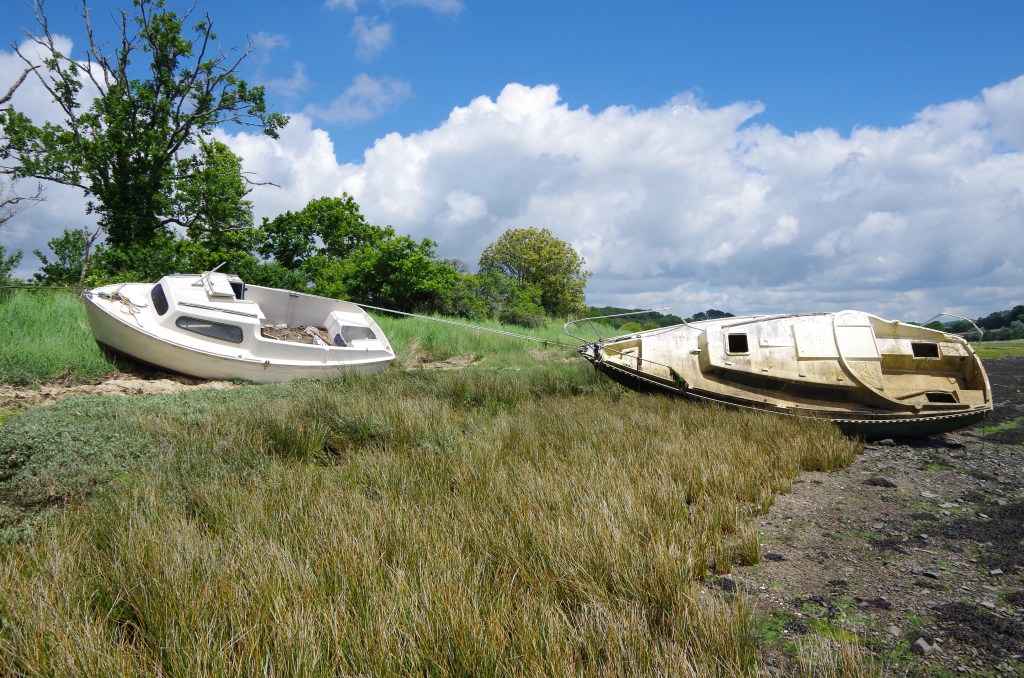
In Europe now many of those small and even medium sized yachts are being broken up on an industrial basis often because, once again, their owners have lost interest or nowadays because they can’t afford the marina fees and maintenance. Motor up and down any French river or creek and what you will find is many boats beached and abandoned, boats that could have another life but where there seems to be no great desire to rescue and refit the boats but cheaper to just tie them up on the foreshore and forget about them.
It’s a similar picture in UK waters, even in what I regard as one of my favorite all time quiet creek anchorages there is an abandoned Westerly (Centaur I think) that periodically goes walkabout near the shallow head of the creek and that one I know has been up there for the last five years. Now, a Westerly Centaur might be, in my opinion one of the worst examples of dull and mediocre British design and build although many people have had good experiences with them and sadly a GRP hull lasts a long time whereas something built of wood will slowly rot back into the saltings if left long enough – this isn’t a new phenomenon of course, go look in any Essex creek and you will find the rotting remains of once great sailing barges.
Iv’e trod this road many times, even to the point of claiming that ‘yachting is dead’ , it isn’t of course although that the kind of sailing/yachting that Griffiths wrote about has changed out of all recognition. Where once nearly all boats were relatively small and nearly all of those boats were kept on swinging moorings we’ve since had an overall size increase and most of those boats are now kept in marinas. If I were to try and point out one major change in the spirit and ethos of sailing it is comfort and convenience : instead of having to row out to a mooring in a small tender most owners now park their expensive cars and simply walk aboard their boat. I happen to think, but can’t prove, that while boat ownership continues, and maybe even rises, that boats get used less and less and out of that time sail and anchor even less frequently.
My recent experience in the south west (one dy and night in popular Fowey) is that every pontoon was rammed with boats often 2 or 3 deep and all that I saw came in and left by motor and then spent much of their harbor time buzzing about in under outboard. My experience there showed me how little modern boats actually sail even in light to moderate conditions – even when I was able to make passage under sail most yachts seemed content to motor long in a personal cloud of diesel exhaust.
Another change that I think I am seeing is that many of the larger yachts are also owned by people with larger and more powerful cars. That change I found particularly notable when the kind of person who ‘has to get in front’ – usually driving a high end German saloon car, also now owns a powerful RIB and drives it with the same lack of courtesy and seamanship as their aggressive roadcraft. Ok then, call me cynical and a bit of a grumpy old sod.
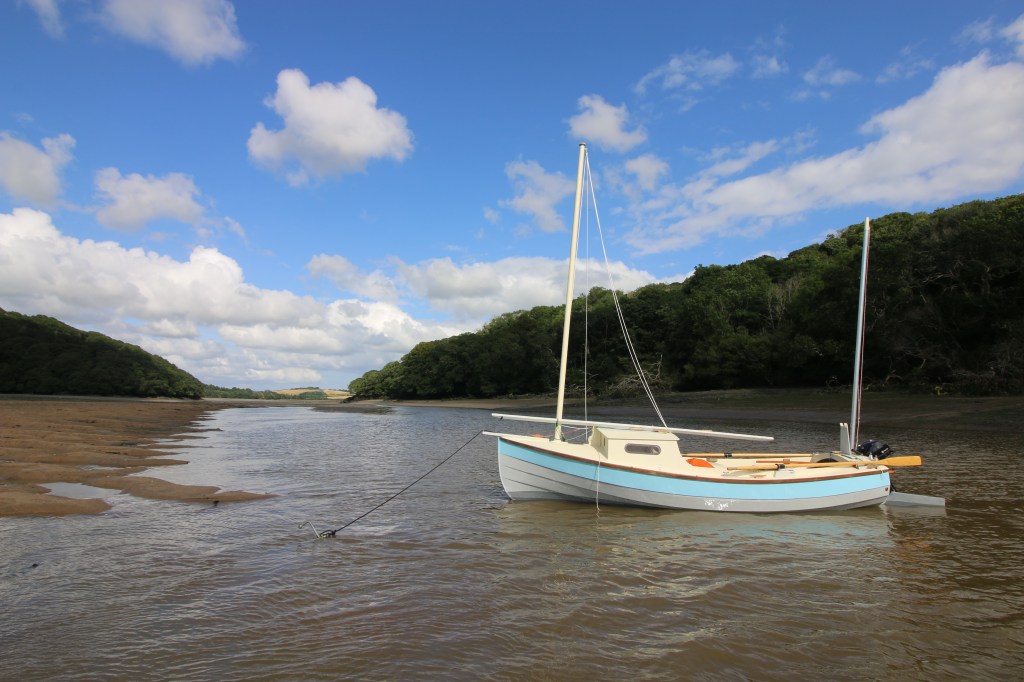
This kind of thing is something that Griffiths never talked about possibly because there was no such thing then – no marinas and very little high end car ownership as a societal norm. I would like to think that Griffiths wouldn’t like or enjoy, maybe not even recognise, the world that we live in today. By coincidence I was recently discussing another writer of that era (J R Tolkien) who detested the modern world, industrialization and modernity – he was said to hate cars for example. These are all things that we seem to have to live with but we don’t have to enjoy them : a large part of my escape from this kind of world has always been my precious (precious – Tolkien again) in the outdoors and in the last few years it’s been time spent at anchor in a shallow creek where the big modern yachts don’t or can’t be bothered to access. This is, in a way the start of my argument for cruising in small boats – in this case dinghy’s.
As good as it gets – Ruan creek on the central sand bank.
Maurice Griffths’s point of departure was in starting to tell us about the young chap whom he thought might want to own and be able to own a small yacht and from there he mostly concentrates on discussing the boat itself. I think he made the assumption that the potential new sailor and owner would be drawn from the then quite new middle class professionals who had both the time, inclination and disposable income to take up such a pursuit. I happen to think today that that kind of middle class professional is slowly disappearing or is spending it’s time and money with other interests. This is as much true of other middle class pursuits of the time including golf – many of the social yacht clubs and golf clubs of that era are dying as their active members age and the younger generation don’t pick up the slack of club functions – it’s as though we’ve all become a lot self centered and selfish, preferring our individual interests over social ones.
I know that I, and others like me, go into the great outdoors for times of peace and quiet, our man Dr Jordan Peterson says that people like me/us find great solace in the outdoors – I always have done. I like to do so in as simple a way as possible and in the latter few years my escape capsule has been a small centerboard boat with which I could slip into shallow rivers and creeks and thus escape the busier and noisier popular deep water anchorages. With my current boat I even hoped to get away from the need for a noisy outboard and instead rely on sails only assisted by oars and a simple paddle. My own solution was to build the best cruising dinghy that I could and yes, a large part of that response was also to build it myself – as much as anything that was my response to the utter stupidity of the Covid 19 lockdown years at which time I was effectively locked out of the boatyard where I kept my then small cruising boat.
Why the cruising dinghy might be the viable and effective sailing option.
I’ll come back to the cost issue later on because, as I mentioned earlier, it maybe isn’t the cheapest option for getting afloat with a first boat, instead I would rather highlight some of the features that make a cruising dinghy a much better option for the adventurous and Corinthian sailor. Like Griffiths in his true storytelling mode I would like to begin by telling the first part of an otherwise dry and wordy essay as a story – here goes.
Because reasons 1…..extending your range.
My first contention is that a cruising dinghy could extend your range – and here’s how.
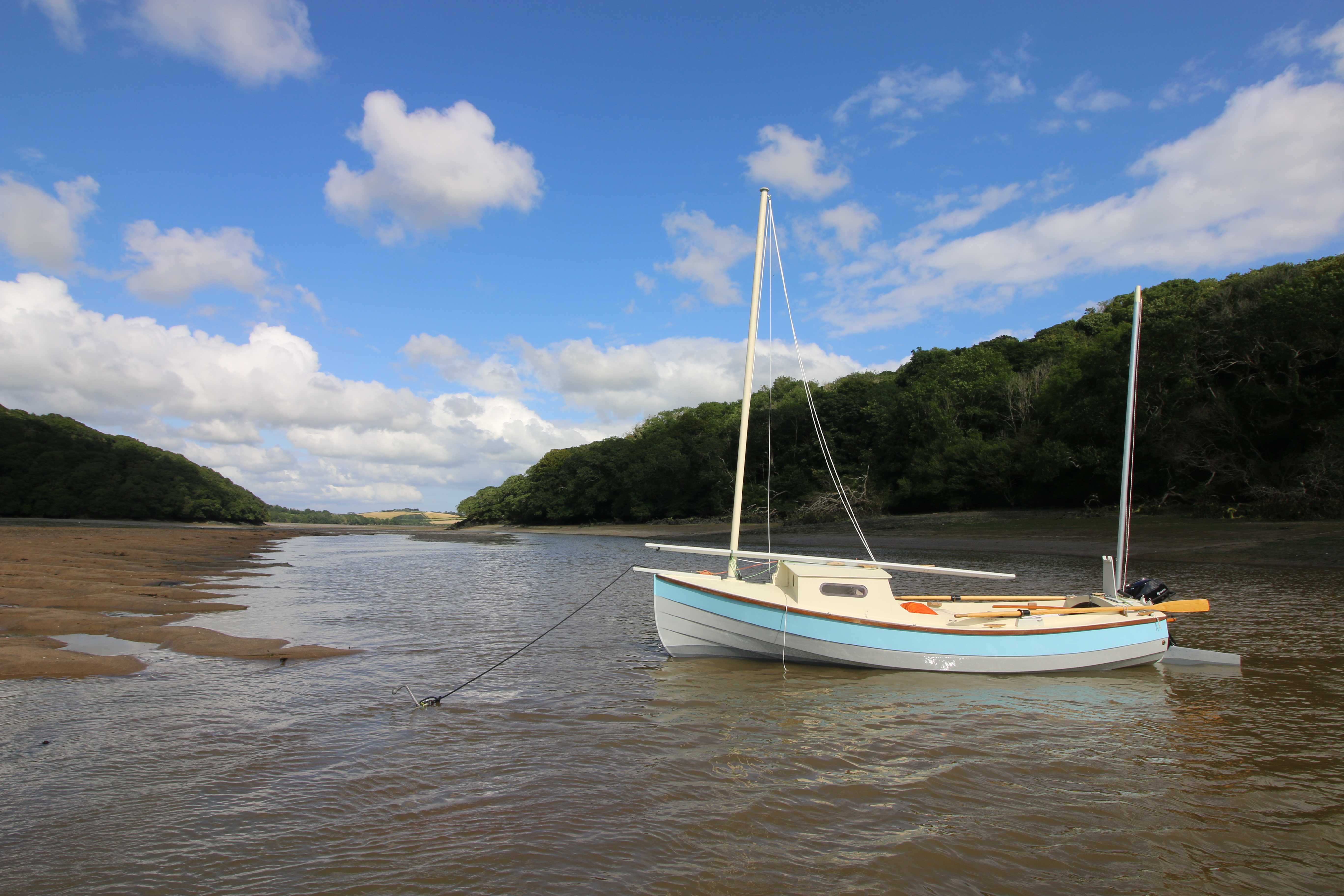
A few weeks past I just happened to be in the Falmouth/Carrick Roads area conducting sea trials on my newly completed Pathfinder dinghy and at the start of this tale I just happened to be alongside at one of the many marinas after first launching the boat. Given that this was my first time on the water in 5 years this was also where I updated my observations regarding modern yacht and power boat ownership. Some time during the afternoon I finished the various jobs I had to do, loaded up with food and drinking water and then headed out into the Carrick Roads with the intention of making for Ruan creek and anchoring there for the first night at least. The tide was almost at a neap low water but still dropping slightly so I motored into the first part of the creek and anchored near the first bend – where the channel splits into two but gets very thin at low water. At that time there was only one other boat anchored there and I was pleased to see that it was some kind of gaff rigged open dayboat.
I thought to stay where I was anchored, it was a sunny and warm afternoon and the company seemed seemed decent but then one, and then a second and third larger yachts motored in and anchored a bit close for comfort so I decided to up and leave as soon as I finished my coffee. I left the entrance anchorage just as the boat swung to the new flood. I knew that there would be very little water in either of the channels so I decided to mainly let the young flood carry me upriver and just used the oars to maintain steerage way. I often touched bottom with either blade and sometimes with the aft end of the dual skegs and sometimes had to wait albeit briefly for the slowly rising tide to carry me over the high spots.
For those that don’t know the creek it makes two dog-leg turns to get to the first of the nicer anchoring spots which is in a shallow depression in the central sandbank which is composed of soft granular sand. As I rowed slowly upcreek I was accompanied by a family of swans paddling up alongside me – the giveaway with depth is that as I turned the corner into the reach of the creek I liked to anchor in the shallow depression showed as a thin water ‘bay’ in the sand but then the swans really gave the game away by walking out of the shallow water straight out onto the soft sand. I gave up rowing too, had a feel over the side with my canoe paddle, felt down only a few inches into soft sand and immediately climbed over the side into a depth of water just over my ankles. I did what I have done before with my old centerboard boat ; lifted everything that would swing up – centerboard, rudder and motor – and then walked the boat up into the best spot in the bay and anchored there. After a while the boat slowly turned into the tide as the aft ends of the skegs floated clear of the soft sand.
By then it was early evening, everything went quiet except for some distant sound of boat engines in the main part of the river. I made my simple dinner just enjoying the silence until Owls started hooting somewhere upcreek – one time, in the past, I was moved to tell them to be quiet – there was one last ‘OO-WHOO’ – obviously a male Tawny owl and then quiet.
I was deeply tired, pretty exhausted in fact after the intense rush to get the Pathfinder to sailing status and then tow and launch it ; even the launch had turned into a fractious episode such that I was very glad when I finally got away. I remember that I slept heavily with my old British army bivvi bag protecting the bottom end of my sleeping bag in the early and heavy dew.
I woke up with the sun just peeping over the high ground to my east and the tide running strongly out. That gave me all the time I needed to bend on my new sails and experimentally hoist the lug mainsail on it’s new yard. The sail just sat aloft just shivering slightly in the light wind from the south and as the tide ran out I got off the anchor in the last few inches of depth and rowed my way slowly up towards the next bend in the creek – the section that has land closely on three sides and which I have used in the past as my gale shelter hole : a few years previously I sheltered there as a series of gales whistled through and boxed the compass.
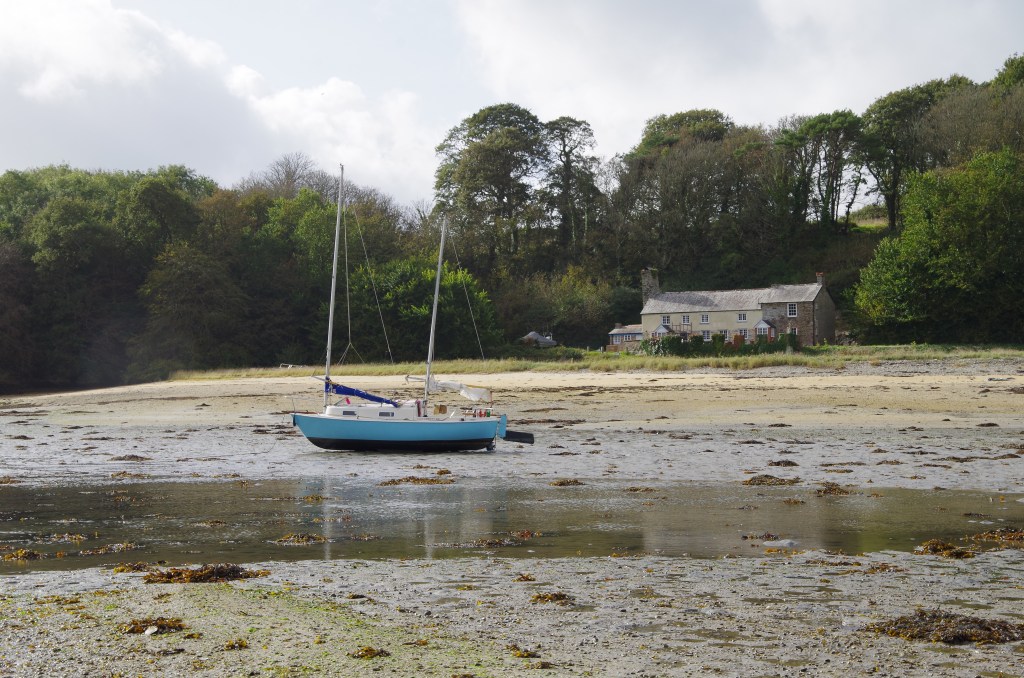
That time of autumn gales I spent my days sprinting between anchorages – wherever I could find best shelter : I was in Ruan Creek for at least three days, at the head of the Percuil river when the gales went easterly and then two days in the shallow bay at the opposite end of the Percuil river, just opposite the main moorings off St Mawes, as the wind flew back into the west and blew hard for the next two days. The fetch across the Fal at point kicked up a nasty chop in the St Mawes moorings but for much of the time I was happily aground in my little protected bay.
Different boat – in between gales at a place called Place
In the past I have heard yachtsmen disparage small boat sailors and dinghy cruisers as naught but ditch crawlers, arguing that they can’t be real boats because their sailing range is obviously poor – this usually from heavy deep keel yacht owners. This is clearly nonsense.
You might have a more limited ability say to sail to windward in hard channel conditions but why would you ? : instead of bashing to windward while cold, wet and miserable in say the English channel or maybe the Irish sea – I have experienced and suffered both at different times in my sailing life, why not load the small boat or dinghy onto it’s trailer and take it to Brittany or Ireland on the Ferry or just tow the boat to somewhere where sailing conditions are kinder. Fancy a week sailing around the islands of the west coast of Scotland perhaps ? – well just drive there in 12 hours or so with the boat on the trailer. I can pretty well guarantee that the big yacht hasn’t even left it’s mooring or nowadays the marina of course.
I am an ex offshore and oceanic sailor, my last ‘big boat’ was either a 76 maxi yacht with some 15 feet draft or a Nautor Swan of just over 60 feet and small change – the former as mate and later skipper or the latter as stand-in afterguard and navigator. In either boat I was pretty nervous when the available depth dropped below 20 feet. Nowadays I am inveterate ‘ditch crawler’ and my penchant is to poke into shallow rivers and creeks where the kind of boats that I used to drive simply could not get to. I delight in the kind of thing I have just done in my 17 foot dayboat/dinghy – that is to slip into a shallow creek at low water and sniff my way up it on the tide,or. as I did later on in the same trip to wake early in the morning with an ebb tide and still get out of the same creek with barely enough water under my skegs.
I used to look at sailing venues such as the English Solent mainly for where I had to go because of our deep draft – in real terms just the same as some of the smaller ships that worked in and out of Southampton docks. Nowadays I look at a chart of my local river and see the dozens of places I can sail and even more where I can anchor and hide away due to my small sea and air draft. If anything it is the small overall size of the boat, coupled with it’s minimal draft and low rig height that actually extends the range of the boat. Add to those features also that the capable dinghy sailor can load his small craft onto a decent trailer and drive to just about anywhere, Brittany would be easy for me because of living a mere 20 miles, or half an hour’s driving time from the ferry port down in Plymouth – that means Brittany as an overnight destination and just about anywhere in mainland Europe within a 24 hour drive……where now your powerful deep keeled yacht ?
The cost implications
At the end of this post, originally a part of my book project I would like to return to the implications of cost for the small craft or dinghy sailor because it maybe isn’t quite as you think.
Unlike Griffiths early book I want to leave it until much later to talk about actual boats, for now I want to just start with a rough generalization – that there are, broadly speaking, 2 principal ways to going about buying and owning a dinghy for cruising in. The first and lowest cost option is to find something already built and adapt it for cruising at minimal expense, there is perhaps equipment that you need but haven’t got – many general purpose dinghy’s don’t come with a decent anchor, some without the domestic gear that make living aboard viable and many won’t have a trailer orv only have a launching trolley as is often the case with cheaper buy/sell site boats (Ebay is an example)
It will cost, perhaps more than you have planned for, to buy a trailer, a small outboard motor, a new anchor and your choice of living gear. For a typical 16 foot dinghy, something like the ubiquitous Wayfarer, the boat itself might be acquired for less than a thousand pounds or nearabouts but it would cost something like £1500 to buy a new trailer and another 5 or 6 hundred to buy even a small outboard motor – it all starts to add up.
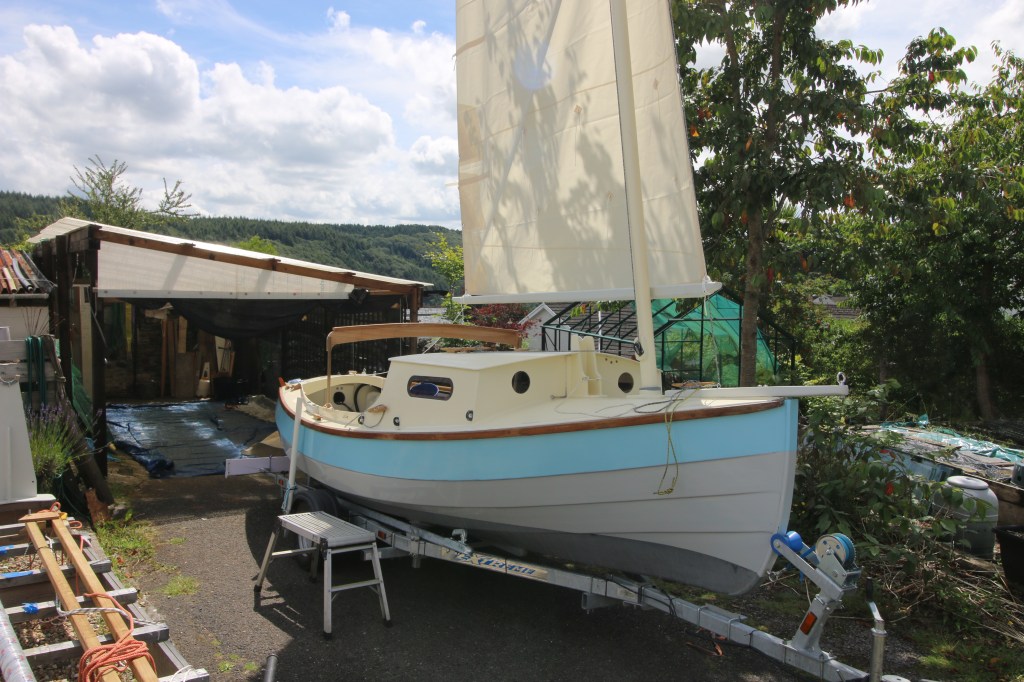
I would suggest that a dedicated cruising dinghy is a much better option although there aren’t many on the secondhand market as it is only a small genre of boats to begin with ; this can be why a smaller cruising yacht can be the cheaper option for a small craft. Something like the well known Drascombe boats range will often start off nearer 2 to 4 thousand pounds even without a trailer and would then need a longer and therefore heavier trailer to take the boat. My own cruising dinghy cost at least £5000 just to build the bare hull and top of that the trailer came to a tad less than £2000, a new 4hp outboard motor around £800 and the sails something like £1600. This of course doesn’t include any of the extra gear that cruising dinghy sailors tend to acquire such as a handheld GPS unit and a handheld radio.
The major thing to consider though is that the boat is only one part of a total package that would also include a larger engine capacity car and, as I have already said, a decent trailer and some new extra sailing gear. What initially looks like ‘less than a thousand quid’ could easily be more like ten thousand for a dedicated cruising dinghy and trailer – not to say anything about a towing vehicle.
In the next post, originally the first section of my book project I will start to discuss actual boats and the kind of voyages they have made, it will also be a lot of fun for me to continue to work on this theme of why a cruising dinghy might be the better choice…..plus I still have far more similar sea stories to tell.
Until next time then……..

 Dirty Wet Dog, the great adventure.
Hello,
We seem to have a lot in common.
Like you, a fan of Maurice Griffiths, I have a copy of ‘Who Hath Desired the Sea’ by Dulcie Kennard and many of Griffiths’ books, and like you a desire to write. I wrote a lot of stuff when I was editor of ‘The Mainsheet’ the monthly journal of The Coastal Cruising Club of Australia. I designed and built my own yacht, strongly influenced by the designs of Griffiths and sailed it for quite a few years. About three years ago I put all my sailing articles together including the design and building of my yacht, the cruises we did in it, book reviews, original cartoons and drawings by myself, etc, and self published. My book is available from Amazon, etc, and is called ‘A Passion for Sailing’.
In 1995 I wrote a fictional sailing adventure romance novel set in 1926. Only one of my characters, Elizabeth, is based very loosely on Dulcie Kennard, the rest of the characters are fictitious. This book named ‘In The Wind’ was self published earlier this year and is also available from Amazon. Subsequently, I have written a sequel, not so much sailing in it, that I will be self publishing later this year. Currently I am working on another book which has a lot of sailing in it and is set in the near future, making it, I guess science fiction, which will possibly be self published next year.
Still sailing in summer twilight racing but age unfortunately is catching up with me.
Best Regards,
Bruce W Walker.
Sent from my iPad
LikeLike
Thanks for that. I spent a fair amount of time in trying to track down what became of Dulcie Kennard, by then Mrs Charles Pears, at the end of her life : somewhere I came across the view that he ended up in Cornwall UK (that’s where I live) maybe around the Helford river.. I think there was an accident with Juanita (she fell over I think) and I get the impression that Kennard was very unhappy at the end of her life
LikeLike
Very much looking forward to then next instalment Steve — thanks.
LikeLike
I should warn you that it gets a bit strange at the end !
LikeLike
Intriguing!
LikeLike
buen día.
leo con atención sus relatos .
saludos desde el sur de Argentina
LikeLike