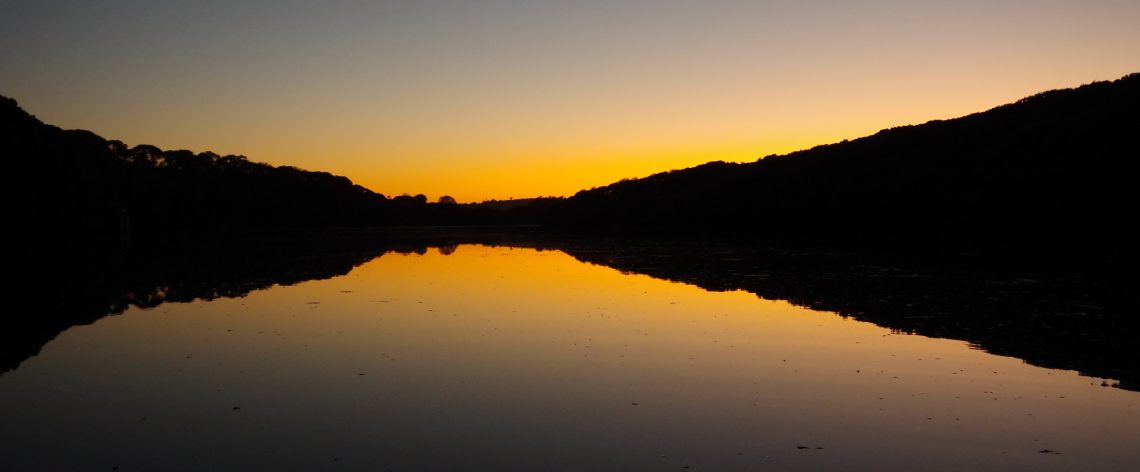

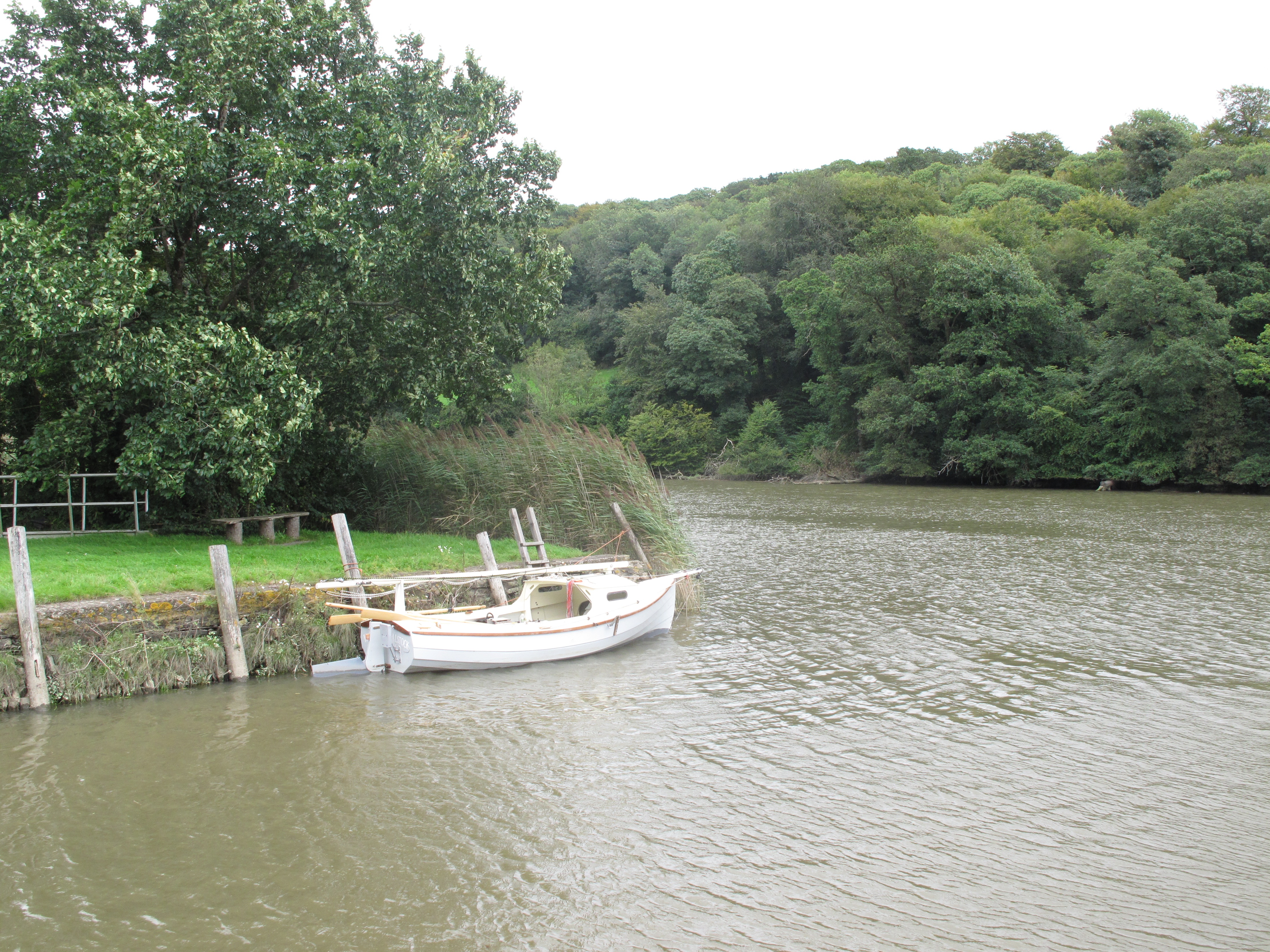
First time out with the Pathfinder.
Going out with a head first splash.
Launching, rowing, rowing again, swimming,sheltering and yet more rowing
Blog time : it’s mid morning of mid August 2023 and iv’e only just summoned up enough energy to prise myself off off the sofa and at least come and do some work at the computer. To be completely honest i’m beyond tired and more than a bit beat-up and actually bruised after my first time out with the Pathfinder. Readers might be a bit shocked but a couple of nights ago I was so near the end of my tether and limit of endurance that today’s first job was very nearly for me to put the boat up for sale and for me to retire from sailing completely – but more on that later in this possibly final blog post.

As of this morning the boat is back home and under it’s build shelter but only due to the help of my partner, my friend Steve Parke and the kind assistance of the local National Trust property at Cotehele quay down in the Tamar. In a couple of days time, once the bruising and physical tiredness has worn off a bit i’ll start emptying the boat out, cleaning it and all of it’s gear and then i’ll take a break before starting on my highest priority jobs.
In short my first time out with the boat was a miserable failure that ended with an actual bruising although most of the problems were due to having launched too soon, not being anything like well prepared enough and possibly having passed my ‘sell-by date’ for energetic cruising. The other difficult aspect was the weather and due to the fact that we seem to be having a wet and windy August : the actual problem being a brisk southerly wind in the river which mostly had me pinned at the downwind end of my route and unable to make back uptide and upwind.
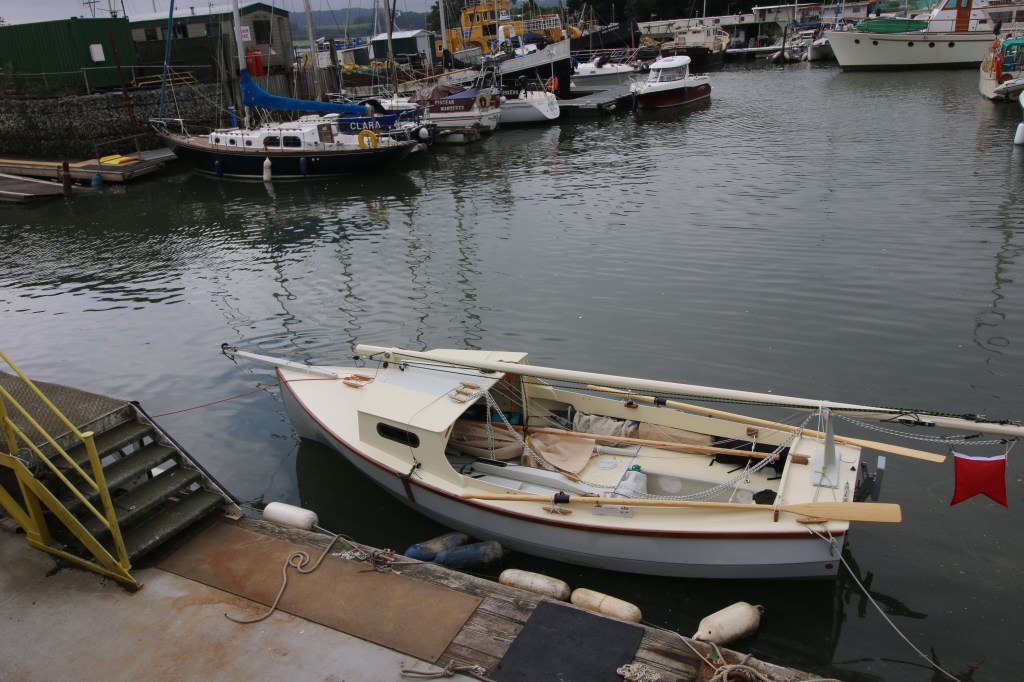
WABI 1V just after her launch at Huggins marine in Torpoint.
I was hoping, with this post, to give a full report on how well the boat sailed, rowed and anchored and what she was like to live aboard for a few days but I can’t really because all I did was to have one long row downtide and downwind, followed by a second (all day) session of the same thing and not having the strength and endurance to reverse my passage. As it is, all I did really was row the boat a lot – ending with the situation that I was simply unable to pull the boat against the wind even with the help of an ebbing tide.
Today I think iv’e got some version of DOMS (delayed onset muscle soreness) from the last 2 sessions of having to row the boat up tide and upwind – my back and bum are sore and my arms feel like leaden weights !. I never got to the point where I could set up to sail because my set-up so far would have only allowed me to sail in light winds, I have no way of reefing at this stage for example, so in the end I simply took the mast down to give myself reduced wind resistance and then ended up ‘hunkered down’ with a tarp set up over the mast to give me some amount of shelter as yet another front blew through.
The bruising then…..
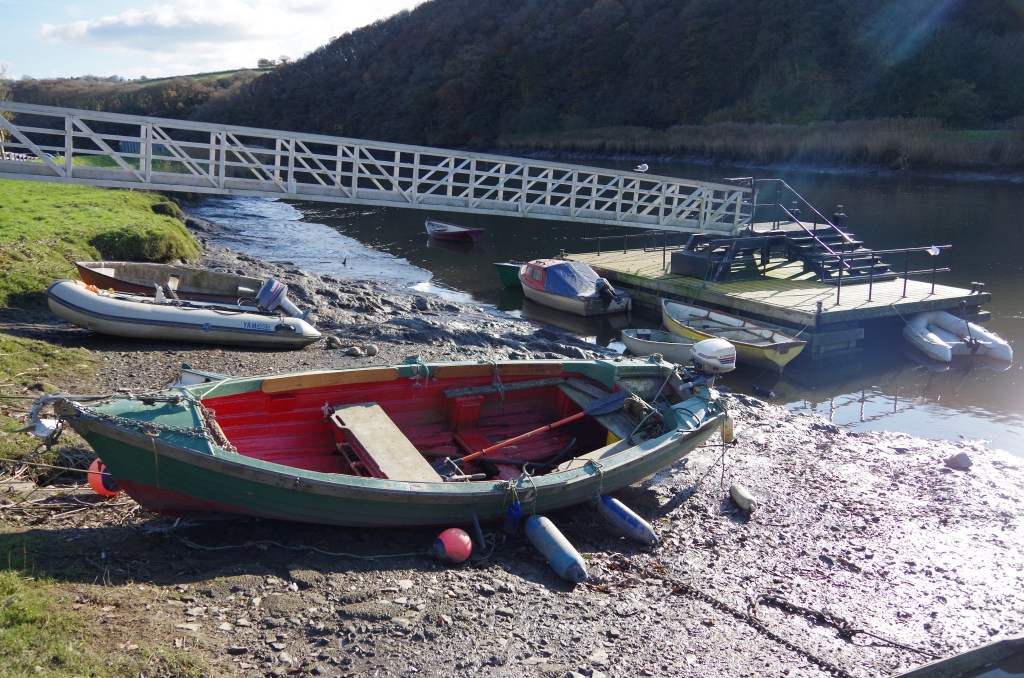
Well, that will be due to having fallen between the boat and a dock wall , hitting my back and bum against the rubbing strake on the way down and ending up doing a full on head down dunk into cold seawater. That turned the end of the trip into not exactly a survival exercise because I know how to manage myself in that kind of problem…..but an extremely unpleasasnt and uncomfortable one. In the end I kind-f gave up with doing things aboard the boat because, by then, everything was wet anyway, so I de-camped to what I think is an old ore oven structure, a bit like a railway bridge arch, changed into ‘dry’ clothes there and set up to make serial hot drinks and dash out intermittently to see the boat down again.
At that point it was blowing at least 25 knots (estimated) and due to it’s direction and the way the boat was laying there was a lot of rain getting in around and under the tarp…..my ‘hypothermia’ bells were all ringing (I seem to be unusually hypothermia prone) so being inside the hard shelter of a one-time granite ore oven seemed like the best option aside from simply walking out or making a wet weather bivouac in the woods……more on that later as well.
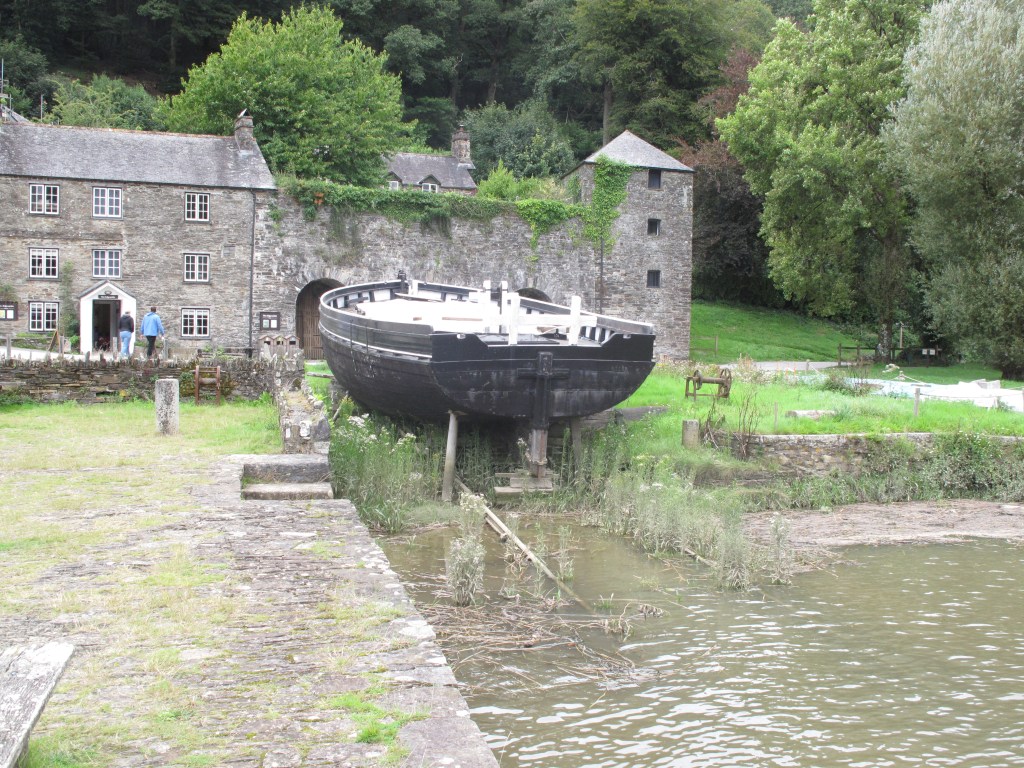
My temporary shelter position just visible behind the hull of the working craft Shamrock in Cotehele quay’s tidal dock – taken on a much nicer day of course.
The trip ‘practicals’ – just for the record
Launching. Given that we only live less than half a mile from the river and a mere 2 miles from the place where we eventually recovered the boat we actually had to drive for 30 miles and some hour and a half to get to the boatyard that let us use their slip for the first launch. That made for a more difficult day because the arrangement I came to with them was to launch and then take the empty trailer straight home again. That worked out but gave us an un-necessarily long driving session before getting me back to the yard just before the ebbing tide would have left me on the mud.
Our launch technique is to go for total immersion with the trailer and to just float the boat off, that works well enough because there’s no heavy heaving involved but it did need nearly every last inch of our drawbar extension.
Rowing.
My first task and problem of seamanship was simply in wiggling through all of the other boats in Huggins yard and getting out and across their little channel which gives access to the back of HMS Raleigh and Thankes lake. For visibilty I chose to stand and row facing forward – it worked but the body position required isn’t ideal for hard rowing upwind…..which was then what I had to do to clear the end of the Torpoint shoal and get around into the deep water of the Hamoaze.
The tide was still ebbing at that point but only the last couple of hours of a near neap and by standing I gave the boat a bit of downwind sail area which helped get me north up the Hamoaze and into the entrance to the Lynher where I eventually fetched up in a little shallow area to the south west of Beggars Island – which was the best point of wind/rain and tidal shelter at that time.
(note) in days past I often used to bypass that point and go anchor over in Sandacre bay (which is downwind) or keep going west past Jupiter point and the old minesweeper which is permanently moored there.
Day 2 was the main day of rowing and passage making in that I used the last hour of the morning ebb to get clear of the Lynher and then ride the new flood all the way north, past the Tamar bridges and across the tidal ‘lake’ there to the entrance of the Tamar proper and then just keep hard at it to pass Weir Quay to starboard, get around what I call the ‘toilet bend’ and keep going until I eventually passed Cotehele quay to port and briefly fetched up against the village pontoon at Calstock.
My first rowing problems started later that day at Calstock when I decided to start reversing my route with the aim of getting to a point in the river where I could get shelter from the increasing southerly. My problem was that after the first half mile I ran smack into a much firmer headwind which, even with the river ebbing nicely, I didn’t have the power or energy to row hard enough for long enough to make progress upwind.
The river is quite narrow at that point between Calstock and Cotehele and all that was happening was that the boat was sheering wildly across the wind and pushing me into the reeds each side – I guess due to the windage of the hull, cuddy and mast. The best I could do was to quickly anchor and put up with several hours of being wind-rode while the wind against tide slapped and slopped against the hull.
My conclusions were that :
First, that I need a slightly raised rowing position to allow me to use my body more powerfully and efficiently – one of Plastimo’s 50mm flat fenders is on my list for that job.
Secondly that I have a hard limit, with my current level of fitness (or lack of the same)at just above 15 knots of headwind…….unless I lower the mast when I estimate my limit to be somewhere above 18 knots of headwind. That became really important on day 4 when my partner came to meet me and found me at anchor just off the little boathouse slip at Cotehele house. It took me about 20 minutes of flat-out pulling to row the few yards upwind (and up-current) to get into the dock where ‘Shamrock’ is being worked on.
Now……I understand exercise, if only a little, and what I always thought that I would probably be able to row in ‘Zone 2 cardio’ for making passage – that would allow me to row ‘long and steady’. Instead of that I was easily into the glycolytic metabolic stage by the time I fetched up on Calstock pontoon and ‘hoovered’ the largest slice off cake that I could find. Then, in terms of whatever exercise zone I was in later on my maximum effort just wasn’t powerful enough even when I concentrated on every pull. I guess I don’t know much about power-rowing at this stage and thet both my technique and fitness would improve with practice………but I was giving it a maximum effort and going nowhere.
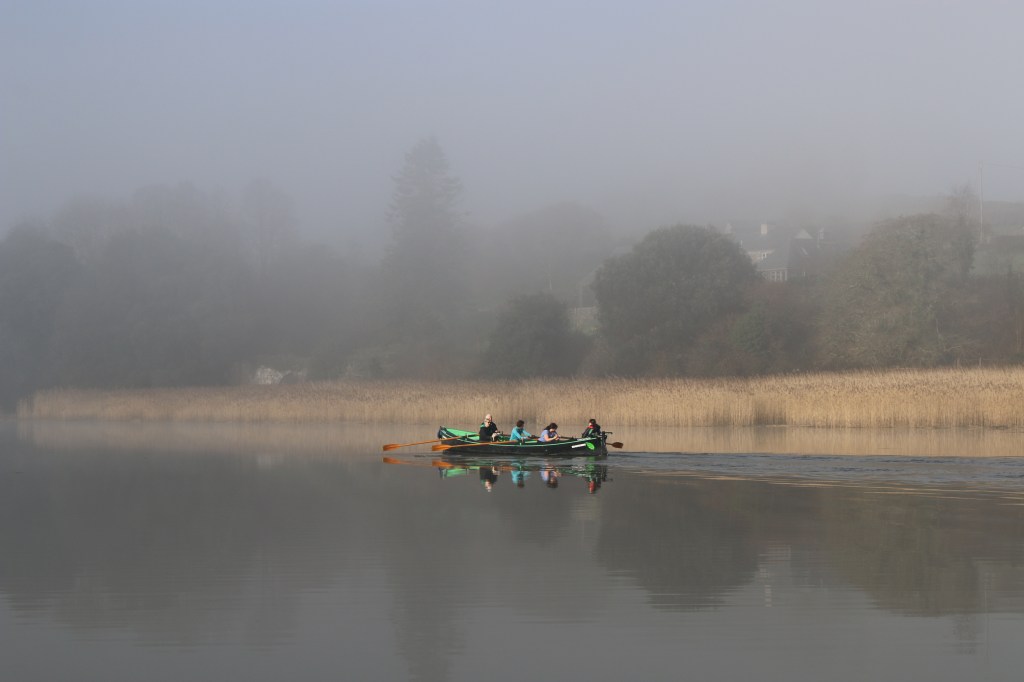
Cotehele is the usual base for the gig crews that regularly surged past me…….they’ve got 6 times the power and what I assume is an actual rowing boat of a hull shape.
Sailing.
I would love to be able to report on the sailing but I can’t because I never sailed except when I had a firm following wind on my back. As I commented earlier I just wasn’t set up enough at that point to get a small amount of sail up (reefed) and start heading downriver again to find a potential recovery point at Weir Quay.
As it stands my sailing set-up needs about another week’s work here back at base but my priority list is to solve several other ‘defects and ommission’s’ from the trip first.
ADL (activities of daily living….on the boat).
I won’t say too much about living aboard the Pathfinder at this stage but that it didn’t work out at all well and that was mostly down to my poor preparation for the trip. One small thing was that on the first day I found my ‘dry’ galley compartment (just outboard of the CB case, to be half full of water and that had ruined most of my food and I think flooded my alcohol stove. It was a simple enough remedy on the day to tighten the CB nut bit it’s one of my first jobs back at base to take the nut off completely and re-pack the thread with Lanolin.
My alcohol (Origo) stove never did light or run properly so I suspect that it’s wadding/wick is wet with water so job 2 (of 20) is to burn off the remaining meths and then dry the whole thing with my heat gun for a few hours.
Generally I had great difficulty getting to sleep especially as the weather got worse and worse. On the last night I tried to anticipate the weather by rigging a tarp diagional fashion (flying vee shape) using the lowered mast as a ridgeline. A much larger job is to make a proper tent for the boat or at the very least a simpler cover that shelters the open back of the cuddy.
Recovery.
After 4 days of dealing with a moderate to brisk southerly in the river, which gave me no lee or shelter, I basically realized that I would have to bale out and what’s more to do so from the northerly endend of my passage rather than making south again. Now, that’s a problem because the most obvious slip at that end of the river, the public slip at Calstock, isn’t really do-able with a ‘big boat’ like the Pathfinder because it’s a steeply pitched slip, usually muddy/greasy and covered in goose poo. What’s more is that there is usually a white van or BMW saloon parked exactly on the slip acccess and the road accesss is also difficult.
In normal conditions it should be possible to launch or recover a boat nearby at at Calstock boatyard’s slip although, once again, the lane access is difficult. The fall point with that yard is that I have previously had a row with the new manager there and am effectively banned from the place. I did ask, just in case they would let us use their slip at our own liability but the answer is not only a no but it seems that they are living up to their reputation on the river as being unhelpful, even to a sailor in a modicum of difficulty.
At one point in the ‘proceedings’ it looked as though I would have to wait for a weather slot and then go ‘balls to the wall’ in making an attempt to get back downriver to Weir Quay and try for a recovery on the yard’s slip or a public slipway nearby. Given what I had experienced so far that could easily have taken 2 tides and I think would have been an exhausting pull.
Enter our saviors at Cotehele quay
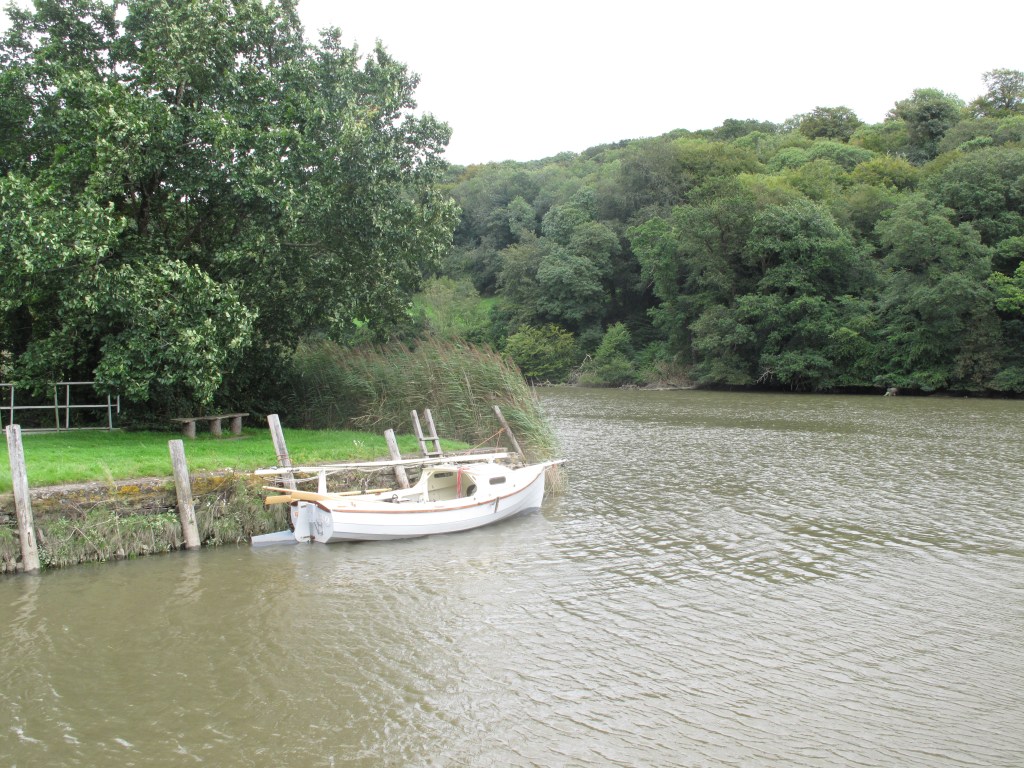
In all the time that we’ve lived on the edge of the Tamar valley iv’e never thought of Cotehele as anything but a pleasant place to go get coffee and cake at the end of a walk out from Calstock. Iv’e always known that there is a gig club based there because I often used to see them (and hear them) training on the river…..anyway they keep their boats at Cotehele quay and launch them into the river from a small slipway : during this problem my partner went and scoped it out for me and suggested that it might just go and the main problem might be the drive out which involves first a steep hill and then a couple of miles of narrow country lanes where you really wouldn’t want to meet a tractor coming the other way.
To tell a very long story short, we spoke to the admin guy at Cotehele NT and he agreed to us using the slip and then my good friend and fellow blogger, Steve Parke, offered us a hand with the job which was a huge bonus because what I was expecting was a difficult crosswind and the river flow also running across my line (by oar only) onto the trailer. As it happens there was the slick option and the much cruder option which is the one I took…..basically we semi-submerged the trailer’s deck and I just ran the bow onto it as fast as I could (full ramming speed engaged !)…..crude, brutal but effective.
Yes…..the recovery went well and yes, it was a challenging drive out but the boat is home and iv’e had one night in bed. Today, as I write, has been a nice one so most of my boat gear is either on the washing line or still soaking in a big garden trug full of warm and soapy water : the best part of the day was a long discussion with Steve as a kind of after-action review and that will be quite a long write up so here goes.
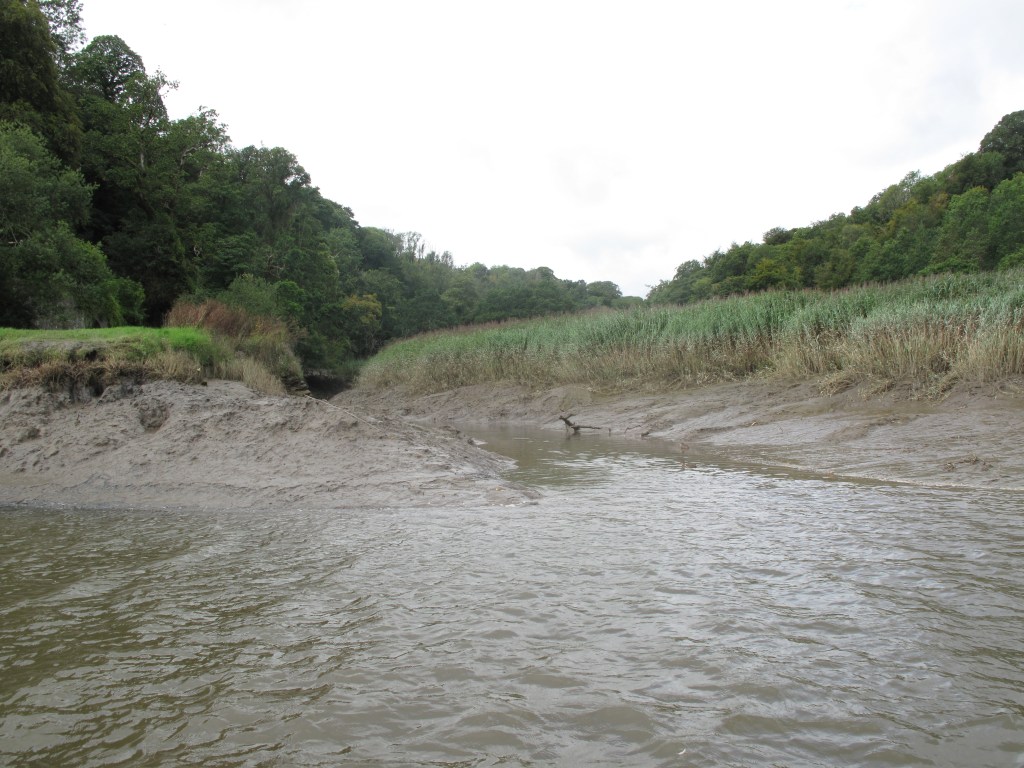
The little creek, I think it’s actually the Cotehele river where I anchored and sheltered for a few hours on night 4.
The after-action review with Steve Parke.
Even though I was extremely tired by day 5 of my bruiser of a trip the best part of it was catching up with fellow blogger and boatbuilder/sailor Steve Parke. A lot of what we talked about was personal in that we both seem to have run into similar health problems and both, I think, seriously questioning our future as small boat sailors : in short and to get straight to the point I think I may have already passed my ‘sell-by’ date as a sailor and blogger and am as seriously considering just retiring from the whole pursuit.
Steve, of course, is a deep-dyed educator and is convinced that what I have just had is a very good learning experience especially given that one thing I have come home with is a long ‘defects and omissions’ list of boat problems to solve ; my problem though is that my D’s and O’s list has to start with me and it’s possible that my own list of defects and omissions might well be unfixable by normal means. In short……I have simply got to an age where my fitness, agility and outright endurance have markedly declined to the point where what happened early that morning (falling between boat and dock wall) really happened and I think that only long outdoor experience prevented a worse outcome.
And so…..just a few nights ago, from when I write this piece, I was at the point where I was pretty convinced that I would get the boat home, clean it up a bit and then put it up for sale – given that it’s been a two and a half year project, and a good one too, that might sound like an extreme, even hysterical reaction to a bad time out on the water. To be honest it wasn’t even a particularly tough trip when measured against my own past experience as a sailor and general outdoorsman : iv’e had far worse trips in the past but coped with them far better than I did this one.
On the slightly positive side I found the physicality of hard rowing extremely tough but equally it was extremely good cardio and resistance exercise which is something I need in my life right now ; my main problem is that I think I could do that and get that with a much smaller and simpler craft than the ‘big’ Pathfinder and that maybe my future on the water, if I have one, would be more like that of a canoeist, doing a journey on the water but bivvy-ing ashore in a simple bushcraft style.
I don’t think it will be with an actual open canoe (Canadian canoe) because I don’t think that my operative knee would take that much of being kneeled upon : kneeling to do tasks on this trip was truly horrible. I still have this slightly strange idea of acquiring a retired racing dinghy and converting it to a simpler ‘bushcraft’ style sailing and rowing craft…..one that could be kept on a launching trolley somewhere and having my outdoor adventures with that. I might still start out on the ‘big adventure’ – to row and sail around England and i’m definitely going to start on my many jobs and problems with the Pathfinder – that’s the advantage with it living in our driveway at home.
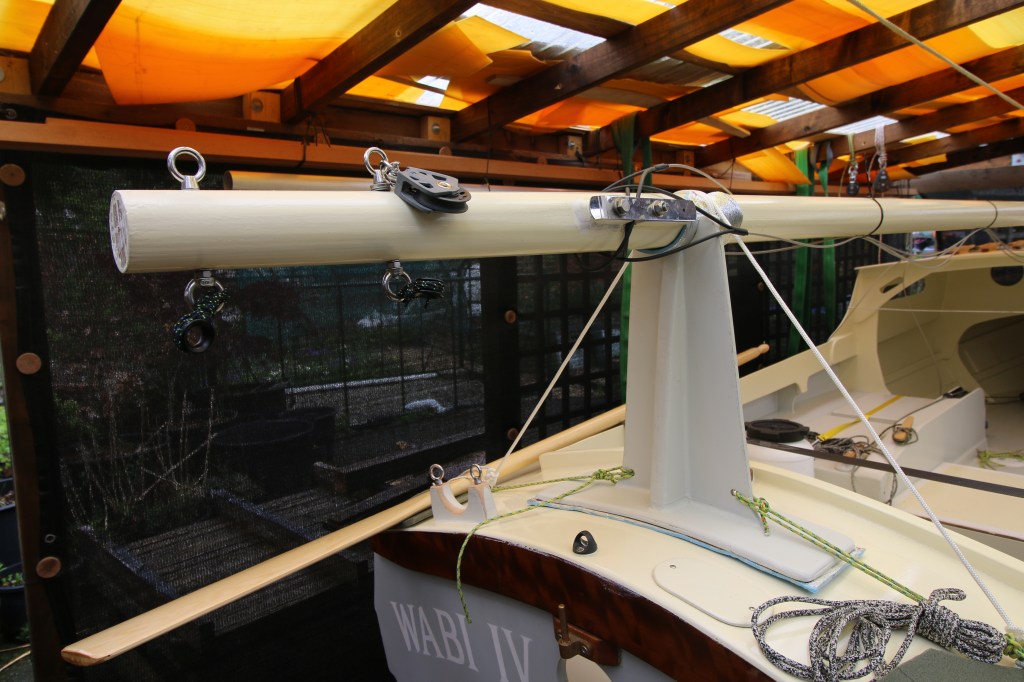
Day 2 back at home and part 2 of the post.
After 5 days of lots of rain and wind it’s a really warm and sunny day down here in Cornwall so the washing lines are all taken up with my salty and muddy gear and my sleeping bag us still drying out. Out front, in our driveway i’m slowly stripping the boat of all it’s loose gear and giving it a thorough wash down and clean out. Right now i’m running the Origo stove continuously to burn off the suspect meths after which i’m going to dry out the burner can with my hot air gun.
As for me, iv’e finally been able to have a recovery sleep and have a long thinking session about my future with the Pathfinder and in fact my whole future as a small craft sailor ; so far it’s been a morning of working ‘wet’ out in the drive and making notes in my logbook which is sitting with most of the other dry gear on my sewing table.
For those that are wondering, I did keep to my usual discipline of running a 2 part logbook ; my method being to use left hand half an open A5 notebook to record the sailing observations and the right hand page to keep my D’s and O’s list and some notes about how to fix the various problems and in which order – right now i’m only at the cleaning and sorting stage but the weather is due to go ‘full pants’ again at the end of the week so I’ll start in on fixing the problems then once the boat isn’t covered in black mud spatters from my little swim.
Final thoughts.
I’m going to finish this piece now and simply go and carry on with the jobs that i’m already doing and then sit and do the admin (ordering stuff) for the priority jobs. I think you all get the general story here and I can’t improve matters with more words : in fact and as I have already said I might be leaving sailing completely but I am definitely taking a break (perhaps a permanent one) from blogging.
Final thoughts then are firstly a huge thankyou to my partner Jackie for her side of the successful recovery and a very big thanks to Steve Parke for his help and considerable moral support. Thanks also to John at Cotehele house/quay who made it possible and couldn’t have been more helpful.
That’s about it.
Ladies and gentlemen Dirtywetdog has left the chat.

 Dirty Wet Dog, the great adventure.