

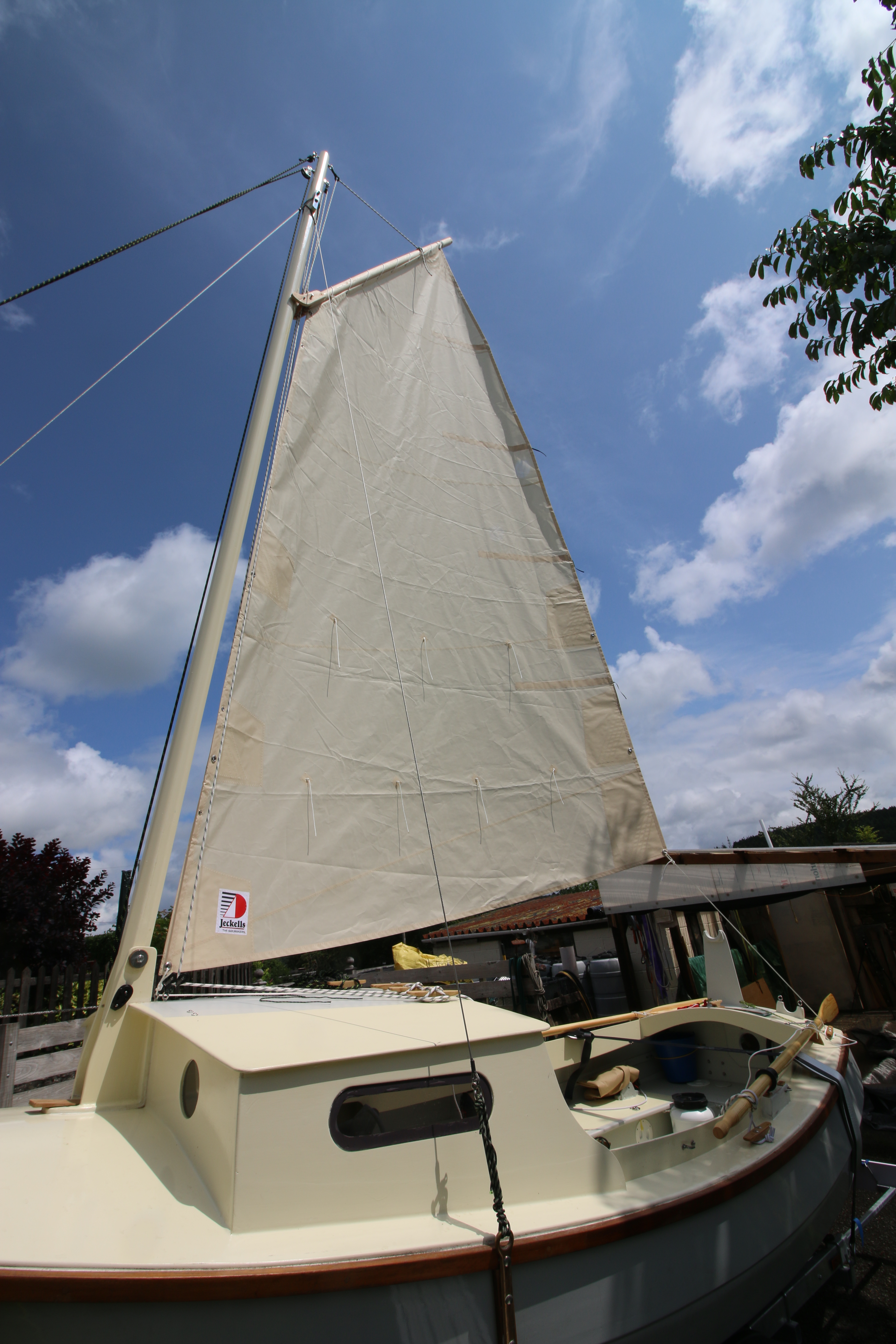
In fact, a whole organizer box of loose screws.
Back in the workshop, summer 2023
Today’s video :
As I write, there’s a whole pile of multiple different sixes and head types of stainless steel screws scattered over one end of the workshop floor and many of them are now stuck in the gaps between the granite setts. What happened was almost comical – I had my new gaff spar clamped to the bench but needed a couple of countersunk screws to hold the gaff jaw spacers in place so I took down my organizer box of screws and set that on the lab stool that I use when I get to sit at the bench and either film or make notes. Then, as I was working on the spar at one end the clamp popped off and the far end of the gaff spar jumped off at the other end and knocked the open screw box off the stool…..hence a couple of hundred mixed screws all mixed up on the workshop floor.
So anyway, we’re back from our Norfolk sojourn and I was inspired enough to get back in the workshop and start to work on the new gaff spar that I will need for the recut mainsail – with any luck that’s also on the road from Norfolk right now. The new gaff spar is quite a bit longer than the original one and because of it’s greater length it’s also thicker and deeper and has a completely different gaff jaw arrangement than my original one. The story here is that while I was wandering around the creeks and harbours from Blakeney to Brancaster I had a look at several of the modern versions of traditional Norfolk working boats and how they did their gaff jaws. I think that many of those boats are new, GRP hulled versions, of the traditional double-ended clinker working sailing boats as built by Charlie Ward – in brief the standard arrangement seems to be a curved cheek piece each side of the end of the yard making up the ‘jaw’ of the gaff.
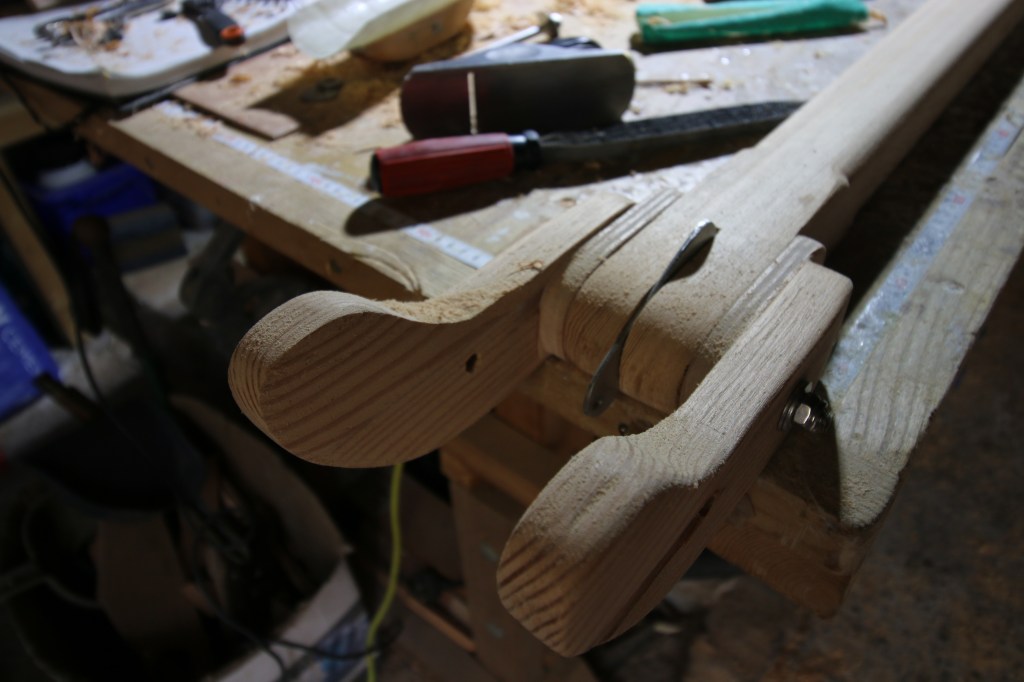
Below, is the gaff end arrangement minus it’s laminated rocker block : it all looks a bit heavy and clunky at the moment just as I start to shape the cheeks and the yard’s inner end. The rocker sits between the cheeks and pivots via the drilled holes and of note the halyards run in the space between the rocker and the yard end….it seemed to work ok in my original version. As I write i’m waiting on delivery of a larger round-over cutter for my router so that I can finish shaping and lightening the yard itself.
Cost and functionality once more.
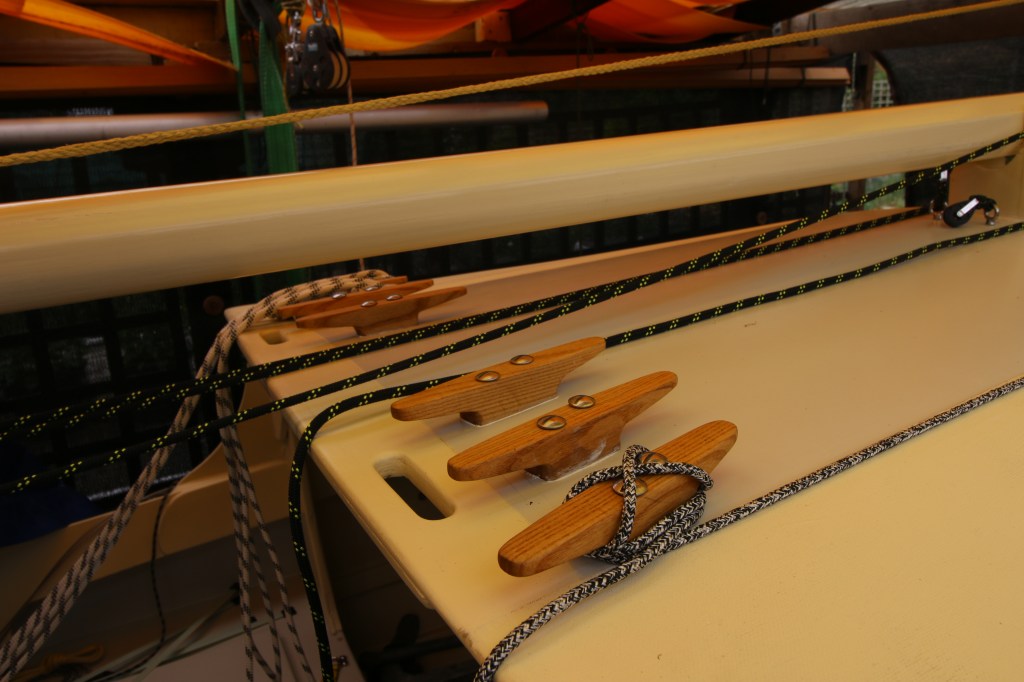
In a previous post I wrote about keeping costs down by not buying nice but expensive fittings such as cleats and blocks but instead making as many functional detail parts as I can – cleats for example. There have obviously been important parts that iv’e had to buy such as the rudder fittings but so far I have saved (or simply not spent) a large pile of cash just on the cleats alone as the Bronze cleats that would have looked nice on the build work out at £35-£40 per cleat and so far iv’e made and fitted some 14 cleats by making, in my opinion, quite nice ones from a stick of Ash once intended for canoe paddles.
There will soon come a point where I have to buy new blocks and cordage for the various sheets and control lines although a rummage through my various bits boxes and rope crate gave me enough bits and pieces to set up the halyards for now…..I had some nice cordage which I once bought but never used on ‘Inanda’.
With regard to the gaff fittings though I did an internet search while I was away and found a very nice Bronze gaff jaw online and almost ordered one but then remembered I would have yet another invoice coming in for the recut of my mainsail. As it happens that recut was shockingly expensive and that’s a pretty strong lesson in getting it right should I need to have more sails made in the future. Anyway…..gaff jaws made from scrap already in the workshop and to a pattern that a professional boatbuilder in Norfolk also uses.
The third gaffe.
So, I took the second version of the gaff to dry-fit complete and then realized that I didn’t like final shape, it still looked clunky and crude even when compared to the industrial looking galvanized steel one I had on Inanda. That one had a conventional metal gaff saddle that sat against the mast and then metal plates that joined the hinge bolt and hoisting gear to the saddle….a bit crude but it had obviously worked for it’s 80 years of life so….
Version 3 has longer side cheeks with a better end (Jaw) curve and are partially faired into the wooden spar on full length spacers. I also made new spacer pads and left a bit more space between the rocker block pivot and the rounded end of the spar ; that’s because my plan is still to run the halyards in that space just as I did many years ago with the little Wharram Tiki 26 that I finished the build of. As I write, the final job for this stage was to round off the edges of the spar instead with a 2″ round-over cutter in my 1/2 inch router…..the one tool that I own that i’m a bit intimidated by. The actual last job was sweeping and then hoovering the entire workshop which by then was covered in shavings and waste from the router.
This then brings me up to the crunch point of finding out whether the new gaff is long enough for the recut sail and I won’t know that until the sailmaker gets around to sending my mainsail back.
New gaff jaw end and new spar prior to rounding off and general tidying.

Day 3 of this job…..excessively tired.
I hope that those readers who find this post also see the video segment that accompanies it because it shows what I was trying to accomplish, which was trying to ‘fill the hole’ with the recut mainsail but doesn’t show the number of tries and fails that I had in one day just trying to get the sail to fit at tack, throat, peak and clew. Unlike the previous video and post on this same subject it wasn’t the minor disaster I had when I found that I had measured the luff length incorrectly – the sail does go ‘in the hole’ this time but thus far the three main ‘fixed’ corners of a four sided sail don’t meet and fit the spars as they should.
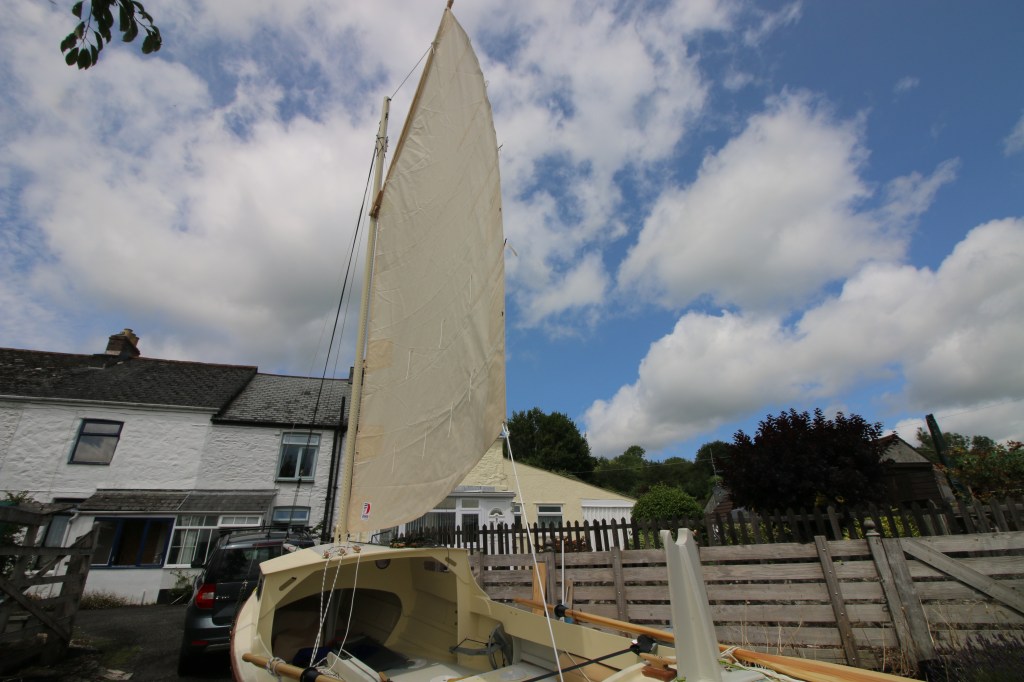
By the end of a long and pretty horrible working day I did end up with the sail mostly laced to the mast and the yard but only with a whole load of temporary solutions and with me getting more and more tired and fed up when the job wouldn’t come right. This should have been a pleasant day just bending on a new sail and it was anything but ; thinking about it afterwards, after a day off just sulking I thought out the whole job again and realized that it’s maybe not my mistake this time and I genuinely think that the loft has made a simple enough error but one which causes me a whole set of new problems to deal with. The main problem seems to be with the fit of the throat of the sail which doesn’t fit as it should and that error then causes a chain of problems downstream of it. Anyway, before I try to explain the main problem, the many side issues and the many small corrections I tried to make here’s the current ‘money shot’.

How to explain this ?
The design of the sail includes what is called a ‘tack-back’ at the throat to accommodate the fact that the the throat cringle attachment point isn’t in the corner of the angle formed by the mast and the yard by some 75mm along the gaff yard. How that works is that I made a stainless steel strap plate that pivots in a slot in the end of the yard and with a pair of bow shackles connects the halyard, via the gaff, into the throat of the sail. What the sailmaker has done though is that instead of allowing for that ‘tack back’ at the throat they have put the throat cringle exactly in the angle between the luff and head of the sail. In practice that creates a whole slew of problems in that the sail doesn’t work as it should either up against the mast or when laced to the yard.
The best solution I could find on the day was to drill a hole through the gaff rocker and use a cable tie to attach the throat cringle to that instead of to the metal strap which joins the throat halyard to the sail. Long term (even short term) that’s not a good solution and at best a temporary ‘bodge’ job. Having since thought about and made drawings of the problem I don’t think there is a single solution which will make everything fit – rather that it needs some detail work done in each part of the connections between mast, yard, gaff rocker and sail and which also changes where the luff of the sail goes in it’s relationship with both the mast and with it’s tack position. Basically the tack and luff of the sail need to be in a straight line between a new sail tack position back from the mast and not up against it and to a newly made connecting strap in the end of the gaff. The end of the gaff then needs modifying to reduce the gap between it and the the rocker and also needs a new connecting strap through the gaff.
For completion of explanation and problem solving at this stage – it needs a new tack position back from the mast by about 60mm and a series of made up mast parrels to hold the gaff against the mast, the throat of the sail back from the mast by whatever distance the new throat position needs and then parrel lines to secure each reef position around the mast and I suspect parrels at each luff lacing position….parrels might work better and be easier to attach and take off again when I am setting up to sail. It looks as though I am also going to have to modify the gaff jaw ‘cheeks’ as , like last time they are prone to bearing heavily on the shrouds when the sail is at full hoist. As of this post going out I have ordered a enough bits and pieces to start the job with but my work is currently limited by strong westerly winds and heavy rain ; what’s more it looks like staying that way for the whole of the next week.
As work days go that was a bad one because I went into it both excessively tired and expecting an easy day just bending on the working sails and finding out where the sheet leads need to go. I had been thinking for a while to sail the boat boom-less and just with a sheet from the mainsail clew out to each quarter. With the whole sail needing to move back a few inches I don’t think that will work so as an when I get the sail up and fitting the spars properly I think that I will also have to make a down-angled sprit boom to help control the sail shape and the position of the yard : my principle now though is to work through one small problem at a time and test each end result before rushing to new fixes.
As to why I was so tired on the day ? I think it was a combination of not sleeping well for several nights combined with the effects of significantly ramping up my new training regime which the day before had included 2 sessions of hard hill ‘rucking’, 100 press ups and a session of squats with my barbell……maybe I just pushed it a bit too hard early on .

 Dirty Wet Dog, the great adventure.
You’ve been putting in the hard yards there Steve (pun intended). The finish line approaches though 👍
LikeLike
Hello Steve, I have been following your build, having built three of John’s designs including a Pathfinder. I am based in Suffolk. I have a few observations with regard to your new gaff jaws- happy to share my experiences. Do get in touch.
LikeLike