
Responding to a sailing You-tuber : our man Terry.
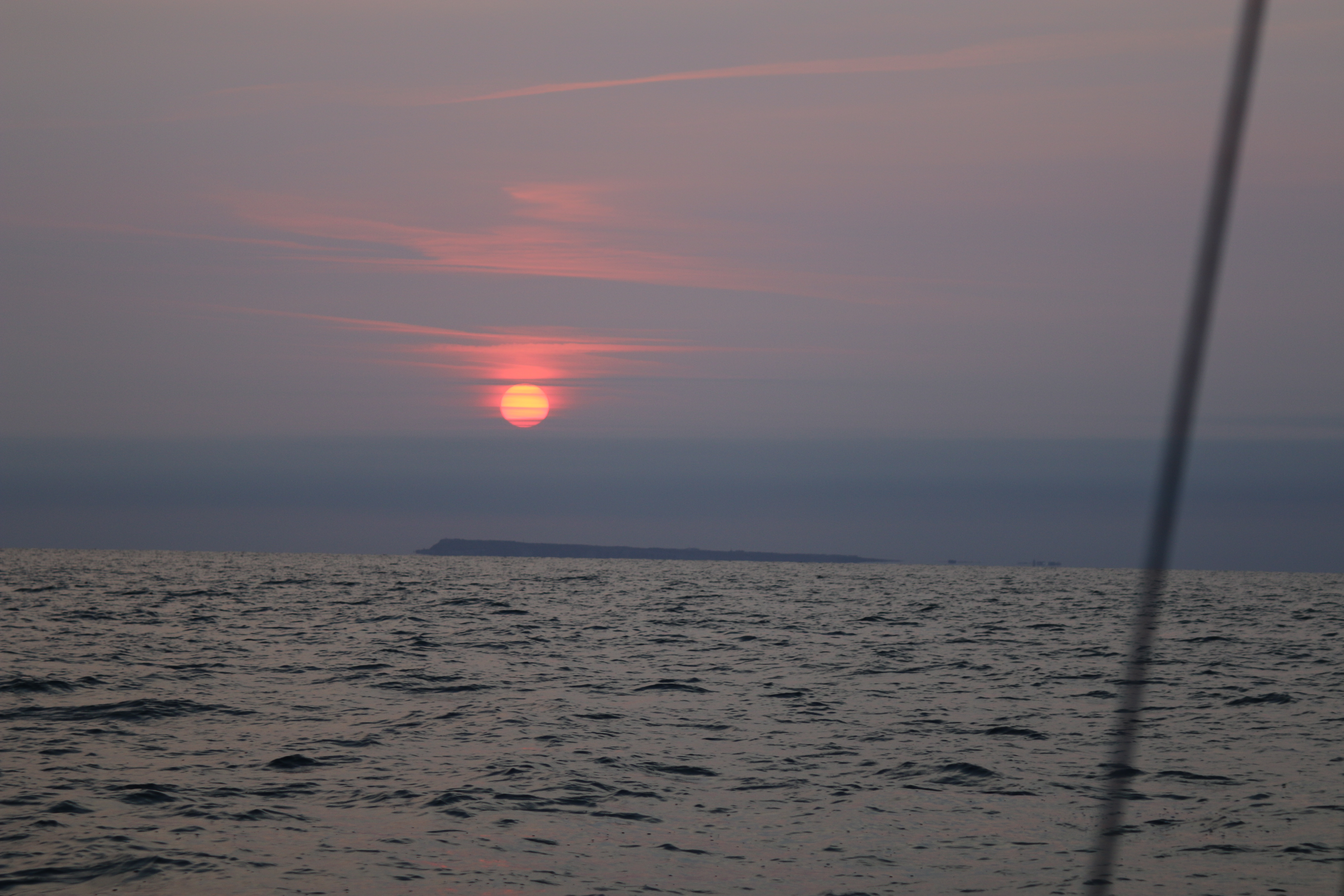
Lead photograph….coming up on Portland Bill after a night passage.
Note to readers – this is an unusual post, it’s the first time that I have ever done this and also my main work of the day, which was to first make a reaction and response video segment to a video put out by another You-tuber.
A couple of things are very important here I feel – firstly that I intended my response to be as kindly as possible and secondly that I don’t regard myself as any kind of sailing expert ; all I am is a much older sailor with a stack of miles and experiences under my belt and all i’d like to do is pass a few along to ‘our man Terry’ and the ‘Bumbling sailors’ FB page.
Today, in blog time (June 8th 2023) Terry put out a video titled ‘It’s all gone wrong’ and I felt that moved enough to go out for walkies, think about it a bit and then come back and make a reaction and response video. Now…evening time…the video has just finished loading and iv’e posted it first as a comment on Terry’s own Youtube channel and secondly on his Facebook page – the Bumbling sailors page. That way he gets to see it first and if I work fast enough and get this piece written and edited then this one will also appear on the same FB page.
Here is the original video and i’ll add my response video at the end – this way you get to see what it is that I am reacting to.
If my reaction and response goes completely the wrong way then I’ll simply take it down and clock it to experience ; my other thought is that iv’e been blogging for 5 years now so , generally speaking, i’m a better writer than videographer. To be honest I strongly dislike both my voice and my appearance on Youtube video’s which is why, usually, I try to appear as little as possible – this video is different in that it was purely me talking and filming at my sewing station so sorry about that .
Ok, with that out of the way lets get down to it.
Firstly then, I don’t think that it’s all gone wrong and to coin a sailors expression “worse things happen at sea” which I have found to be generally true. All that happened was a pretty normal event in which a couple of things broke, the wind didn’t play and the whole situation was made difficult by the geographical location and the headland/tidal problem that exists there . The Bill of Portland is simply a moderately difficult place to be at any time because the inshore passage has to be taken in a narrow tide slot and that usually means being able to scoot down there from Weymouth or Portland harbor in predictable time. With no wind and an unreliable engine it’s more of a problem – essentially the same problem as I had with my last 3 passages around the Bill.
Something I said on video was like this…..” boats always troll you if they can, the sea always trolls you if it can (and it really can) and on some passages everything will do it’s best to troll you or work against you”….it’s not personal, it’s just the nature of boats and very much the nature of the sea.
In a way what you need is something that the late Larry Pardey said and that being that you need the mind or mindset of a sailor ; I would add to that that you need a sailors mind to deal with the trolling and not a landlubber’s mind. It’s a bit hard to explain but you almost have to expect that everything that can go wrong on any given day will do so and what gets you past that is a sneaky set of sailor’s skills which can only come with lots of time and practice but even then old Neptune will give you a sound kicking once in a while.
Here’s a small example of father Neptune’s sense of humor.
In my last sailing trip, which was just as we were coming out of the BS of ‘lockdown’ I had in the space of a week an engine failure , a dismasting off Berry head in a ‘washing machine’ kind of sea and then when we successfully made port under sail (cat-ketch rig) and paddled up to a pontoon the damn boat then started to flood when a hose came loose somewhere in the stern locker. The engine failure was no biggie as I just paddled the boat like a big canoe all the way down the Dart using what wind there was , which was very little and mostly working with the tide.
On the day of our (mizzen) dismasting I did wonder how many other things could go wrong and the answer was ‘several’ ; my reaction though was mostly ‘boats…..doh’.
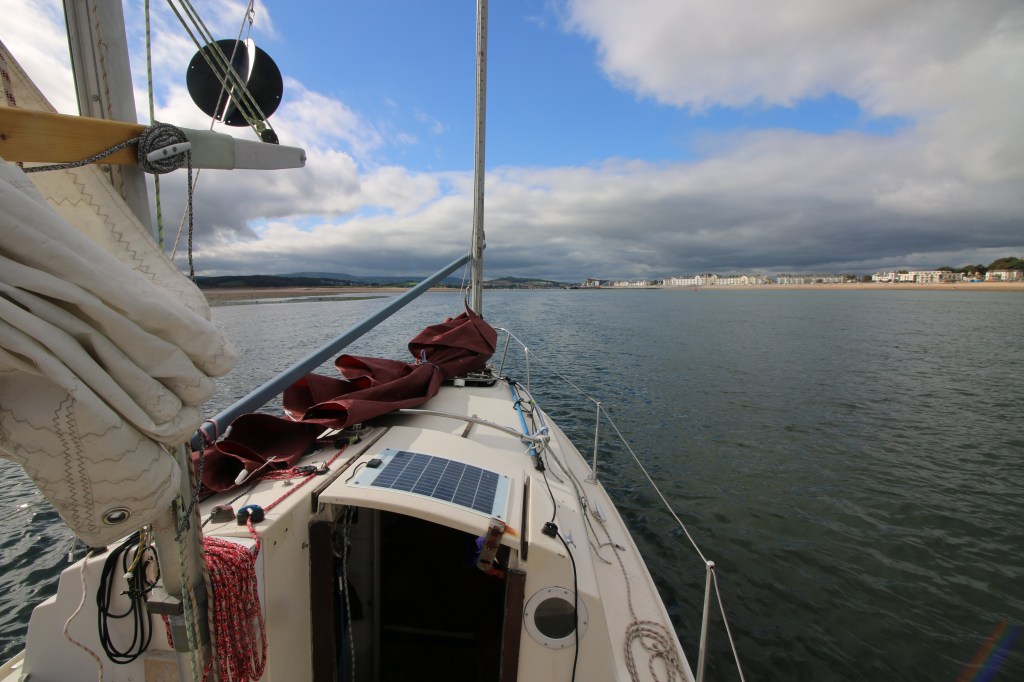
If I thought about everything that iv’e got wrong over the years and everything that has gone wrong on boats that iv’e crewed on, been mate or skipper on, or ones that Iv’e owned and sailed myself….and then tried to blog-post them or worse video-post them then, like going to confessional I would be here all day. As it happens I don’t think that recounting any of that would be of any use today and so I would much rather go off in two completely different directions – neither of which are ‘advice’ which is something that makes me cringe.
My first direction then is to draw on my recent experience of what worked for me a also a ‘bones of arse’ small boat sailor doing a long term cruise and liveaboard experience and the model of cruising and living that worked for me. This isn’t the same as my professional sailing life which only lasted about 5 years but which did rack up a lot of sailing miles.
In the late spring of 2019 I worked my last shift in the NHS ; at almost exactly 2 in the afternoon I dropped my scrubs in the laundry bin for the last time and all-but ran out of the hospital naked shouting freedom…..it’s ok, it was only all-but and not quite so…. At the same time the next day I was dropping my kit bag and a bag of food down onto the deck of my little cat ketch in it’s mud berth dock and then pushing out into the fast ebbing Tamar river. The day after that I slowly headed west along the coast until I had the boat stowed and myself sorted out for a harder passage. Another couple of days and early one morning I left a mooring in Fowey harbor and started the 110 mile sail, cross channel, to Brittany. The first half of the passage was ok but the second half was miserable – brisk close reaching over a ‘wind against tide’ had me cold, tired and very sick for the next 12 hours ; at the time it felt personal but it was just the sea doing what the sea does.
During that cruise I spent 110 days living aboard the 22 foot cat-ketch and sailing around western and then southern Brittany and my model of cruising became a 10 day independent cruise starting with a few hours alongside a quay or marina, or beached, to get my water and go buy food, ice and fuel. Of the 110 days I reckon that I spent at least 90 at anchor and a few hanging off a borrowed mooring buoy and perhaps 3 or 4 actually tied up alongside a marina…..mainly when my partner came out to join me and that was the best way of meeting up.
Of note – my boat was almost always the smallest one out there and when I wasn’t sailing the boat I lived ‘on the hook’ often anchoring more than once a day while I was waiting out a tide or just stopping in a convenient bay, river or creek for a break. Anyway, that’s what worked for me and my total costs were only what I spent on food, a bit of fuel and ice for my cool box…..even then I often managed to blag some off the fish counter in the supermarket when I shopped.
Notes…..smallest boat, maximum simplicity, living independently at anchor in bays, rivers and creeks.
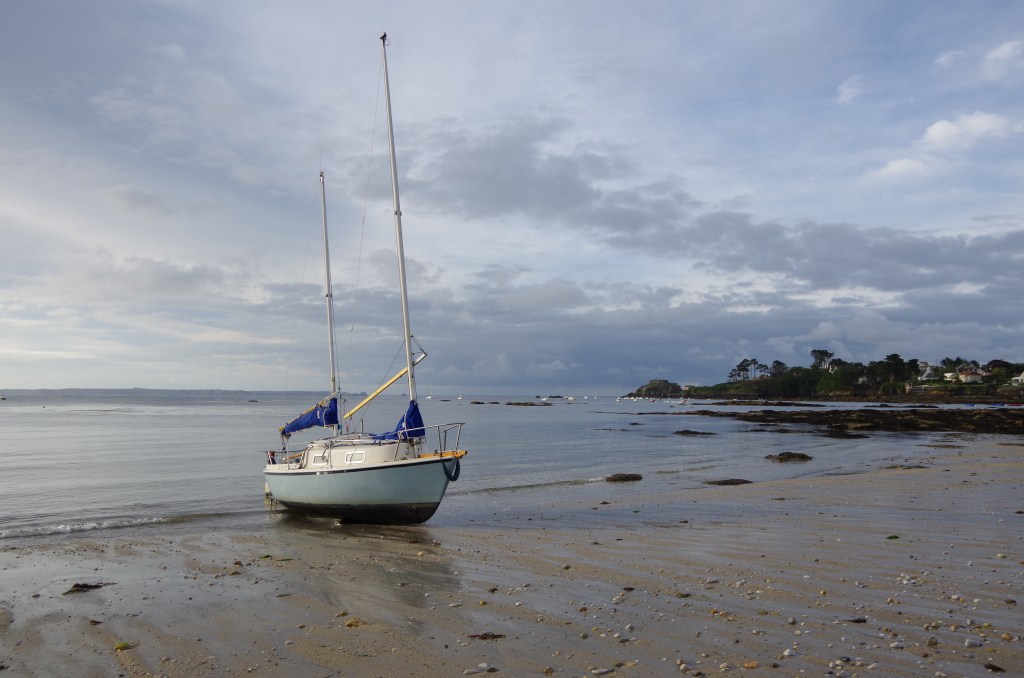
Parked on the beach and just about to walk up to the supermarket. (Plougonvelin I think)
Day 2 and part 2, not advice but……what works ?. How have and how do young , inexperienced and piss-poor sailors get around the world ?.
It’s day 2 of me working on this, yesterday the video and today I hope a much better written piece that I woke up thinking about this morning. Like I said, I not a great videographer and i’m far better in print because, like many sailors of my generation, we’re not the Youtube generation but one that read and enjoyed books.
The important thing about this section of my reaction and response is that I don’t want this to be seen as advice – advice given usually makes me cringe !. I woke up this morning with a fuzzy head due to working too long at the computer last night but at least with an insight about how to write this section and it goes like this.
Firstly, that any thoughts and opinions that I might have are pretty worthless : in the field of nursing/medicine that I worked in we used to say that “opinions are like arseholes……everyone has got one”. Instead, what I realized that I needed to do was to refer to the sum total of sea-going knowledge about the world of long term small boat cruising that has been left to us by other sailors in either written form or on video.
Here. i’m drawing on a huge library of experience out of which comes a kind of condensed knowledge and wisdom given to us by writers and videographers far more competent than myself. I’m talking here about writers such as Maurice Griffiths, Charles Stock, Lin and Larry Pardey, Annie Hill and Tom Cunliffe. Also, and as it’s the modern (Youtube) era we can also take a look at the world of sailing videographers such as Troy and Pascale of Free Range Sailing and closer to home the ‘Sailing Frenchman”. It’s their experience and wisdom of how to live and how to get from place to place on a small sailboat that I want to kind-off draw on and summarise.
Then……it’s not about me and definitely not advice.
Lets take a look at the life and times of Lin and Larry Pardey as a starting point. Larry of course ‘passed over the bar’ a few years back but his words are still very much alive in the series of books that he and Lin wrote during their 40 years of cruising aboard their 2 home made, wooden and engine-less boats, the 24 foot Lyle Hess Serrafyn and later the 29 foot Taliesin.
You could say that Lin and Larry were highly skilled and highly unusual sailors in that they built both of their classically constructed (carvel timber) yachts and then chose to sail both of them everywhere and without ever having an engine. Instead of engines they relied on, principally, three things : a boat that had lots of sail area for it’s size and the displacement to carry weeks of food and stores, secondly that they worked with the principle of maximum simplicity and ‘fixability’ with the hand tools that they carried and thirdly that they both had marketable skills.
They summarized their whole approach as “go small, go simple and go now” and then as they cruised they developed their reasons and arguments by also observing what other successful long term cruising sailors did in terms of what kind of boats they chose, how they managed their maintenence and finances and so on. Just to give 2 small examples here they found that most successful cruising sailors were only sailing relatively small (by today’s standard) yachts that tended to be around 28-32 feet for a couple and were almost always older and heavier displacement boats than the modern lightweight production yachts. They also said that there were 2 critical components in the sailors arsenal – those being effective wind vane self steering gear and heavier than average anchors……their boats being either at sea and sailing under wind vane control or at anchor on their own gear.
A slightly different, although remarkably similar approach, was one that I kind-of saw going on at Glasson dock up in Lancashire where a young couple – Pete and Annie hill were building a simple play and epoxy hulled and junk rigged sailing Dory ‘Badger’. Luckily for us they left us a great record of building and sailing the boat and, once again, how they managed their finances. Last I heard Annie has since built and lives aboard a sweet looking Junk down in New Zealand.
Small, simple and gone cruising an 80 year old gaffer being sailed home from the east coast.
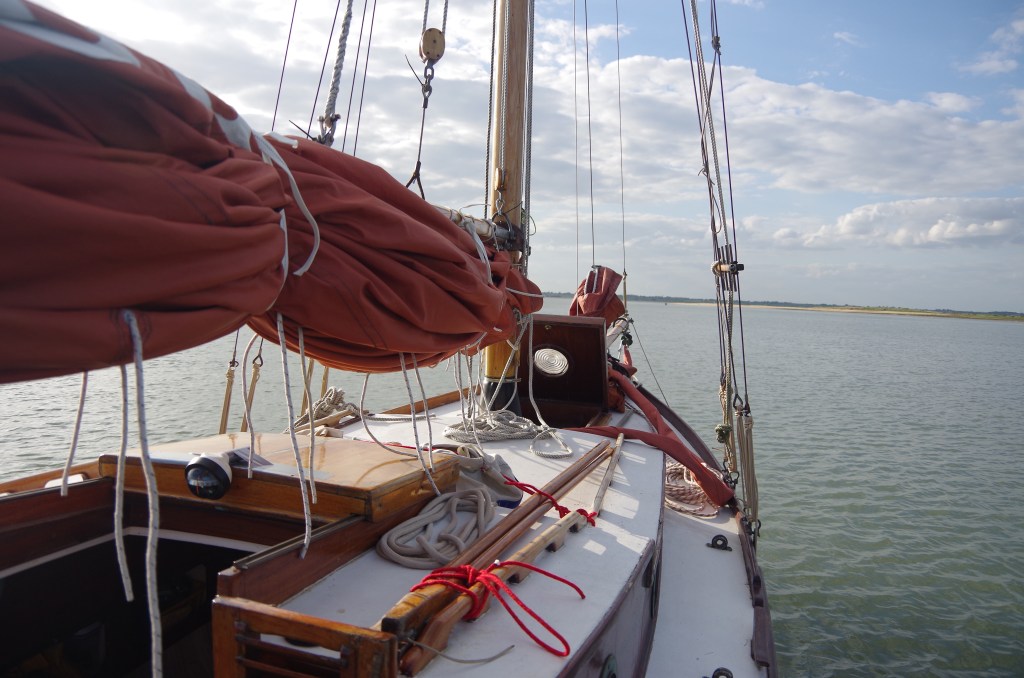
Lets take a look back a few more years at even earlier times and even simpler boats.
Maurice Griffiths. Today, most sailors would think of Maurice Griffiths being a highly successful yacht designer, yachting writer and long term editor of Yachting World. Even a quick dive into his books and then articles written about him show that he struggled financially in the early years and totally relied on the cheapest and least seaworthy boats that he could barely afford. Then, when he did get afloat it was usually in boat’s whose engines mostly didn’t work in shallow and narrow tidal rivers and creeks and without any modern equipment whatsoever – a huge contrast to today’s marina living, engine reliant and gear obsessed modern yachtsman.
Charles Stock. Very few modern sailors will have heard of the late Charles Stock and his tiny (16 feet) and self finished cruising boat ‘Shoal Waters’ -it was entirely based on the hull of a hot-molded dinghy built by Fairey marine. Charles Stock’s ‘thing’ was , once again, to sail his boat on hundred mile weekend cruises around the rivers and creeks of the Thames estuary and to do so without using an engine….just sails, oars and anchor.
Maurice Griffiths relied on ‘crap boats’ – to use a recent sailor’s more pithy description and Charles Stock relied on an improbably small and simple home made cruising boat to get on the water and go cruising. A much more recent film maker (Dylan Winter) ran with a combination of those 2 concepts and gave us a whole series of funny and engaging video’s about sailing around large chunks of the UK coastline in mostly small and ‘crap’ boats. Dylan also did it all with humor and without falling into the 2 most common tropes of the modern Youtube sailor – firstly he didn’t click-bait us all into sympathy for himself when things inevitably went wrong and he was equally scathing about the then boats and beaches ‘lifestyle’ video channels of basically boring privileged middle class cruising yachters…..he named one of them ‘La Vag’ out of sheer contempt I think.
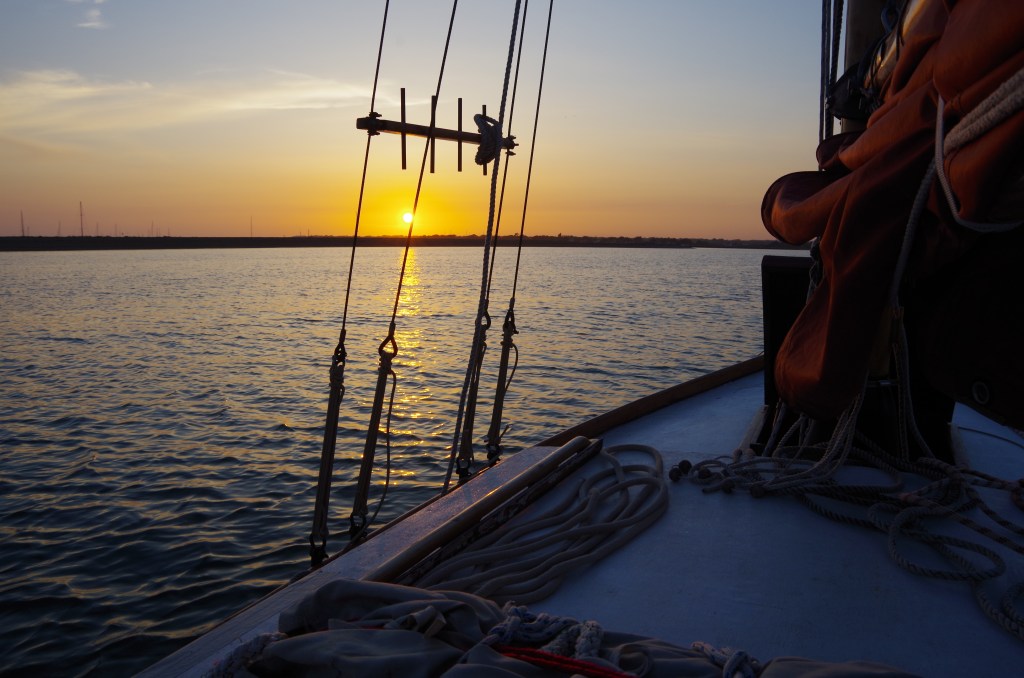
In brief then……we do need sails and we do need anchors but we don’t need engines and we certainly don’t need nearly everything, including over priced electronics and marinas if we want to go cruising and maybe sail around the world.
What we do need is a massive mental leap from being landlubbers to being sailors – and not mere yachtsmen either. Our boats are always going to break down but they do so much less often when we only rely on simple gear and basic skills. The sea is always going to troll us if it can and multiple things will always conspire to give us a hard time. Being a sailor is mostly about the mindset and the skillset, a lot about being a self reliant and resourceful individual and a lot about the deliberate learning of new skills over time.
I said that I won’t give advice so I’ll stick with that, rather I would like to point our man Terry to everything that has gone before and which is still mostly accessible from reading books……it’s all out there and it’s all still relevant.
Thus endeth the sermon for today…….however……
Day 4, the knife twists and cynicism sets in.
The other side to this, my ‘dark side’ if you will, says opposite so here goes with a totally different take on this and other Youtubers.
I noticed this phenomenon with another sailing based Youtube channel and I won’t name names because it’s a successful channel and his followers seem to get something from it so all well and good ; if it floats your boat then go with it. In that channel and now Terry’s channel what I see now is a kind of low grade disaster clickbait just to get views, viewers, sympathy and therefore income via Youtube advertising , Patreon followers and direct financial contributors.
The cheap trick, as I see it, is to post something dramatic as with “it’s all gone wrong” in the expectation that what is only a minor problem or irritation to a more mature, self reliant and resilient sailor but can be portrayed, and is portrayed as a major disaster for a generation that seems to thrive on cheap thrills and quick fixes.
Once, I think, you can get away with it especially if something of significance really does happen – I get it that things go wrong and that it can be instructive and even entertaining to see how the main man gets ‘out of jail’…..after all even Hollywood thrives on that kind of thing. When it happens two, three or four times in a row and the problems are still minor ones then there is an old expression that fits…..older sailors and readers call it ‘crying wolf’.
In the main part of my post I wrote about several sailors who succeeded with the difficult and expensive problem of building or fitting out a cruising boat and getting out there to sail it around the world. Well, one feature I didn’t cover as much was that each of them struggled a bit and had often difficult times living in less than ideal situations while they saved every penny, cent or hard earned dollar to build the dream. Maurice Griffiths for example, lived in cheap and poky London bedsit flats while bashing out articles for the yachting press and that affected his health long term. Annie Hill worked as a low end cleaner while husband Pete worked as a computer technician in the local uni while they earned enough to buy plywood and glue.
To take it to a personal level I worked every 12 hour night shift I could….often ten or more in a row, to get out of negative equity and to then put aside to eventually buy my little Frances 26. In each case of would be world girdling sailors working towards ‘the dream’ there were hard times, bleak houses and financial sacrifice to get where they needed to be and not, I note, the quick fixes of poor video production to get the next easy fix of comfortable marinas and a night out drinking with their mates.
In the space of less than a week, iv’e gone from being a kindly and supportive older and more experienced sailor to being an ‘eyes open’ deeply cynical one about this channel and another similar one, both of whom are taking the rest of us for fools.
The twin expressions ‘get a job’ and ‘get a life’ come to mind.

 Dirty Wet Dog, the great adventure.