
Note to readers…..I changed my plan !. This post originally formed the ‘tail’ of this week’s new video post in that my first filmed and recorded version used the Eyemouth fishing fleet disaster of what could happen to an open boat fishing fleet. When I did the original research however I managed to completely overlook that the vast majority of that fleet were larger and full decked boats rather than the small 2 man open boats that I originally thought. I actually think that I got 2 incidents mixed up including the parliamentary inquiry that I thought took place due to this one. So anyway I scrapped the talk section of that video and used an incident that I knew a lot more about and which dealt with what happened to modern racing yachts when the heavy gear hasn’t been fastened in properly so……
————————————————————————————————————————————————
The original supporting post….for the record.
This post represents a reverse blog experiment for me in that it forms the supporting material to my video blog post which I have scheduled to come out on the same day and round about the same time as this one. With regards to my video blog that’s also a bit of an experiment too – mainly because i’m trying to find my feet as a video-blogger and trying to find a structure that makes sense…..at least to me.
My current plan for the regular video blog post is to do a 3 part video segment once a week and the three regular sections i’m thinking of as the news, thanks and housekeeping, part 2 will be an update about whatever i’m doing with the boat (calling that the ‘on the bench section) and the last part will be some talky-talk from me about whatever ‘floats my boat’ in way of interest that week. For those of you whom are somewhat familiar with my written posts you will know that I like to work in threads or ‘themes’ and my intention is to carry that over to the video work.
My current theme is about developing my John Welsford designed Pathfinder as a full-on expedition boat and in that regard iv’e been taking a great interest in the things that go wrong with small open boats at sea. Now I know that most of my readers will recognize that my Pathfinder isn’t exactly an open boat because it has a closed foredeck and a cuddy so in that regard it’s almost a half decked boat plus it’s got a whole load of closed compartments for buoyancy.
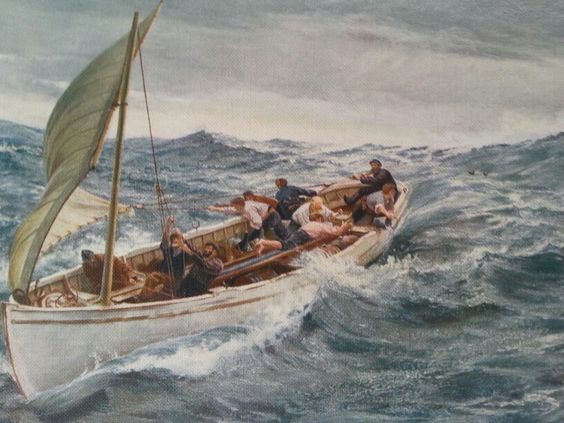
For me it’s of great interest where small half decked working sailing boats came from and part of the answer actually comes from a Parliamentary inquiry that was held after the Eyemouth fishing fleet tragedy of October 1881 in which 49 open fishing boats and 189 local fishermen were lost…..many of them within sight of the beach. I covered this in short form in today’s video blog but I have to realize that i’m not really a good enough narrator for this kind of work ; that’s why I made a big feature of using historical art to tell the story with and it’s also why, today. i’m backing up that piece with as much historical information as I can except…….
I basically got the video version facts wrong because most of the Eyemouth fishing fleet were in fact fully decked fishing boats with larger crews so that meant that I had to bin the entire first attempt at the video piece and record a new piece along different lines which mention one of the problems below but mostly concentrates on the 1979 Fastnet race disaster which I almost but not quite sailed in……hey ho. It still works as a blog piece so it may still go out on the same day in a ‘spot the errors’ kind of way.
From the local news of that time….
A severe storm struck the southern coast of Scotland on 14th October 1881, leading to the Eyemouth fishing disaster or ‘Black Friday’ as some locals call it. The Edinburgh Evening News reported the storm on Saturday 15th October:
A storm of extraordinary violence set in on Thursday night and raged for the greater part of yesterday all over the country, causing great distruction to property and loss of life. All telegraphic communication between Scotland and the Metropolis was broken down by the wreckage of the wires and in several parts of the country similar isolation has occurred. Hundreds of magnificent trees have been torn to pieces or uprooted and cast across the roads, rendering traffic impracticable. From all parts of the country floods and serious agricultural havoc are reported. Railway traffic, in consequence of the distruction of signal posts and wires, was carried on with difficulty and the drivers of express trains report that they could scarcely maintain their footing on the engines. Snow lies deep in the north and the lower ranges of the Grampians have also received a coating of snow.
Fishing was an essential part of the local economy in Eyemouth: the men went fishing and the women supported them by baiting the lines and repairing nets. The sudden windstorm in October 1881 blew up while the fishing boats were out at sea and caused the deaths of 189 fishermen, of whom 129 were from Eyemouth itself. Many of the fishing boats capsized; others were wrecked on the rocky coastline. There was an occasional miraculous story of survival against all the odds: the fishing boat, the Ariel Gazell, arrived back in Eyemouth harbour two days after the storm, having survived, but largely the stories were of death, destruction and loss.
The lives lost in this natural disaster are commemorated by a tapestry in Eyemouth Museum.

The first piece is a transcript of a telegraph sent just after the Eyemouth tragedy.
“Sir,
In addition to the information communicated to you by my
telegram of today regarding the lamentable loss of fishermen in the great
gale of yesterday. I beg to furnish you with more particulars of this terrible
disaster. The 41 line boats that were following the line fishing from Eyemouth
proceeded to sea between eight and nine O’clock yesterday morning, eight went
also from Burnmouth and a few from Coldingham, and as they all were Kept
ashore by bad weather from going out earlier in the morning as they invariably do
they shot their lines in the offing from two to 12 miles off shore with a light
north westerly breeze which continued until noon when it shifted to NNE and
at the same time broke out with terrific and awfully sudden violence and
accompanied with rain, completely obscuring the the boats from the view of the
people on shore and immediately raising a fearful sea along the coast. Between
one and four o’clock 4 boats got safely into Eyemouth harbour and three were
swamped a little east of the entrance when running to it and their Crews of 20
men were all drowned in the sight of many hundreds of people on shore who could
not render any assistance in any way whatever owing to the severity of the gale
and force of the sea. The boats were at once broken into fragments on the rocks.
One being a new boat launched here lately and out on her first trip. Another boat came in and ran up among the rocks on the west side of the bay, the crew were
all saved but the boat is partially wrecked, no other boat ventured in after this.
These were all Eyemouth boats. About the same time of day two Eyemouth boats
were overwhelmed close to the entrance of Burnmouth harbour and their crews of 13 men
drowned. Other two boats ran ashore about half a mile east of that harbour; their
crews were saved; another Eyemouth boat went down near Berwick breakwater and
all hands lost. Two Eyemouth and two Burnmouth boats got safely into Burnmouth
harbour. A Coldingham open boat foundered near that place and the crew of
three men drowned. Several hands were lost from the boats which got into
harbour. It is now certain that 54 Eyemouth 8 Burnmouth and 3 Coldingham
fishermen are drowned whilst 15 Eyemouth boats with 100 men and 5 Burnmouth
boats with about 25 men are still unaccounted for and the gravest fears are
now entertained for their safety.
Eyemouth cannot recover from the effects of this sad disaster for many years
to come and it will seriously cripple the important haddock fishing carried on
from the place. Of the 49 boats which left Eyemouth and Burnmouth on that
fatal Friday morning only some half dozen were open boats all the others were
full decked, from 44 to 51 feet of keel, most efficiently equipped and manned
by a portion of the best and most energetic fishermen on the east coast of
Scotland.
None of the Berwick or Spittal boats fortunately went to sea that morning as
the Barometer showed great indications of stormy weather which unfortunately was
unheeded by the Eyemouth and Burnmouth fishermen.
Meetings are to be held here and elsewhere immediately for the purpose of
collecting funds for relieving the distress occasioned by the calamity.
Note…..while I am obviously taking an interest in accidents at sea involving open boats it’s important to say that most of the fishing fleet comprised of fully decked boats ranging from 44 to 51 feet (as above) and from what I can gather were lost due to broaching in heavy seas and/or being driven onto the rocks in that area, once again in heavy breaking seas and extremely poor visibility. Another point expressed in early analysis of the tragedy was that of ballast, in the form of loose rocks moving about in the boats and adding to their instability. I would also tentatively add that the heavy displacement design of those full decked fishing boats wasn’t ideal for running fast in breaking waves and this possibly contributed to them broaching and capsizing.
Part 2, Analysis
A week after the storm, John Doull in the Fishery Office in Eyemouth was able to start drawing conclusions as to why so many boats and fishermen were lost in the storm and the effect their loss would have on the community. He wrote:
“It appears that the principal causes of the great loss of life and property arose from the fishermen not seeing the land when running for it in the thick of the storm until they were too close inshore and were then unable to work their boats into port, or out to sea again in the face of the gale. Some of the boats had their sails blown away or rendered utterly useless and were tossed about at the mercy of the waves and ultimately thrown on shore and lost with all hands.
It is also well known that most of the boats carried their ballast of stones not properly secured and that some of those saved had a narrow escape from destruction owing to it being thrown about in the hold by the heavy labouring they were subjected to in the storm…
The town and trade of Eyemouth continues to wear a very depressed aspect and will do so for a long time to come owing to the loss of such a large number of its fishermen and the paralysing of its only industry.
Many of the Widows and Orphans and dependents who are sufferers from the disaster are already receiving relief from the fund now being contributed throughout the Country on their behalf, and it is gratifying to know that there is every likelihood of such a sum of money being raised as will meet their wants in the future.
Other factors …….Taken from ‘The Fishing News’
“There were two warnings – one that they did not heed, and one about which they knew nothing.
The pier-head barometer – which had often been ignored in the past – forecast a sudden change for the worse in the weather. And in the local post office, a telegram warning of gales coming their way arrived too late.
Postmaster John Campbell McRae received the telegram from Yarmouth, where 56 Eyemouth men had been fishing in Norfolk for the late herring.
But even if he had rushed it to the pier – which he did not – he would not have been able to get the message delivered in time.”
Financial factors.
“Eyemouth put to sea, many other Scottish ports like Dunbar, Anstruther, Fraserburgh and Wick stayed put. But it was more than just doggedness that made Eyemouth’s fleet sail into a terrible fate that Friday. The men were driven as much by economic necessity as they were by courage.
For unlike those other ports, they had not received huge grants and investment from the Fisheries Boards and Whitehall, despite being one of the biggest fleets in the country.
Although fishing ports up and down the east coast had received government aid to improve their harbours, the port at Eyemouth remained dangerous.
Another reason lay with the kirk. The Church of Scotland had claimed a ‘tithe’ (one-tenth) of the men’s income for many years.
after a fierce campaign led by Eyemouth fisherman Willie Spears, it was agreed that the men could ‘buy out’ the tithe for £2,000. It was not until 1878 that the loan the men took out to pay the kirk was cleared.
With that background, the spring and summer storms of 1881 and the hunger of their bairns, it is clear why the men ignored the barometer.
The Times of 25 October, 1881 reported: “The storm signal was also hoisted, and so far there had really been some warning given of the impending strife. It is even said that the harbour master cautioned the fishermen against going out.
“But the men had been lying in enforced idleness for a few days, and many of them were anxious to earn a few shillings for their families.
“Besides, the fish were known to be plentiful near the coast; and tempted by the prospect of large hauls, and trusting their reading of the sky rather than the barometric indications, the fleet of handsome decked fishing boats put out to sea.”
That gamble was to have catastrophic consequences. A survivor later told the Times: “The storm and darkness came on like a clap of the hand.” Hurricane-force winds, lashing rain, looming dark clouds and massive waves caused chaos.
The tempest struck at noon, and as the Eyemouth fleet tried a dash for home, many of the open-decked sailing keel-boats foundered in mountainous seas in sight of the families still ashore. They could only watch helplessly as some of the boats were smashed to pieces on the rocks as they tried to reach the harbour.
A total of 189 men and boys, many of them from the same families, perished that day. Black Friday ripped the heart out of Eyemouth.
The storm left behind it 93 widows and 267 fatherless children.
Of the 189 who died, 129 were from Eyemouth, 24 from Burnmouth, 11 from Cove and three from Coldingham, all nearby.
A modern analysis……
It was a huge temptation to work through a modern analysis of the Eyemouth fishing fleet disaster and in a way by not doing so I perhaps finally escape from my years of seeing at first hand the smug and condescending hindsight bias shown by most NHS managers that I once worked with. Any and every smart-arse manager can always say what should have been done when something went wrong and when they weren’t in the thick of the action.
We weren’t there and didn’t, for example, take any part in the pierhead discussion about going out that day or not and nor are we the tough and capable sailing fishermen that they were. My modern designed dayboat cum expedition boat might be a better boat in some regard than was a small open fishing boat of the late 19th century but most of the fishing fleet weren’t as I first assumed small open boats but much larger and heavier fully decked and fully crewed ‘offshore’ boats of their day. That mistake is largely why I binned my original video blog piece.
It would be the modern management way to blame the fishermen for their own demise because they did make a fundamentally bad decision (To sail that day) but then they were under enormous personal financial pressure to support their families firstly and then to pay the established church it’s tithe rather than that money going towards improving the harbor. If anything I find the action of the church in making the fishermen’s tithe an obligation a total disgrace – almost like a gangster today demanding ‘protection’ money.

 Dirty Wet Dog, the great adventure.