
The joy of small craft, post 3…..even smaller.
In the first post of this new thread I introduced the little cruising boat that I owned at the time of writing the original material that the blog post derived from ; this being a few years ago, 2019 in fact when I was cruising around western and southern Brittany aboard my 22 foot, centerboard cat ketch. Having spent 110 days living aboard and cruising that little boat I felt that I had something to say about small boat cruising although even now i’m nearing the end of building the even smaller boat that I will (hopefully) go cruising in next.
In post two of the series I talked about the boat I owned before the cat ketch ; that was the 26 foot Frances which I had restored and refitted to be a full-on offshore and ocean cruising yacht along the principles laid out in Lin and Larry Pardey’s series of books about their two cruising boats Seraffyn and Taliesin. At the end of that post I left it at the moment that I was leaving home and harbor on my first ever solo offshore voyage . In this post i’m going to begin by telling you a little about that first voyage alone in the English channel and why, during the cruise that followed, that I began to think that the Frances 26 was too big a boat and what I really wanted was something smaller.
To misquote the famous line from ‘Jaws’……we’ll need a smaller boat !
A couple of days after arriving in Brittany, WABI” on one of the visitor moorings at Paluden quay (L.Aber-Wrach)
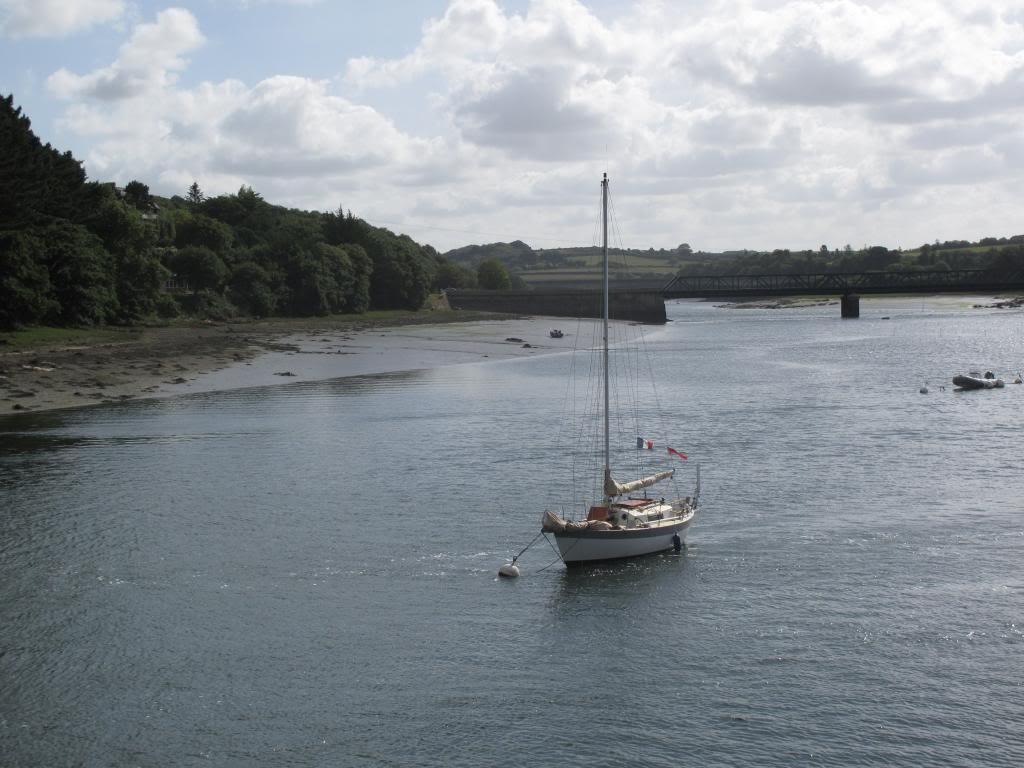
I left the previous post just as I was having a bit of a ‘wow’ moment in that I’d left port, cleared a few hazards, got sail up and was sailing along nicely, quietly under control from the wind self steering gear. What actually happened next was that the wind died away as we cleared land so around sunset I dropped the genoa as it was slatting around a bit , there were no other boats around so I simply went below and made my dinner while keeping intermittent watch from my seat on the engine box. After dinner the wind filled in gently again from the west so I made sail again just off the wind and towards the north western corner of Brittany – some 110 miles away.
That first night I was far too ‘wired’ to rest or sleep properly – the inexperience of my first solo offshore passage making itself felt but it was a nice night spent mainly sat on a cushion on top of the engine box keeping watch . During the next day I made myself take up the discipline of a 20 minute cycle of relaxing in the leeward sea berth with a couple of minutes stood in the cockpit doing a ‘360’ look around. Every 2 hours I marked our position on the chart, had a drink and a snack and after a few cycles of that started to try and predict my tides at the France end. For those not familiar with the English channel most passages are heavily orientated north-south in direction but the strong channel tides run mostly east-west so the eventual line of course made good on the chart is a lazy ‘S’ .
I motored twice to cross the two traffic separation zones as quickly as possible although there were few ships in either lane compared to my later voyage in the little Liberty in 2019…..at one point, between the 2 lanes I was able to count the navigation lights of some 14 ships……rush hour in the western English channel !
Some time during the second night at sea I first picked up the loom of a lighthouse down to the south west and once I could see it often enough to count the flashes I realized that it was the high and powerful light on the Ile D’Ouessant (Ushant) and not the one I was heading for – the even higher lighthouse of Ile Vierge which marks the huge area of rocks and reefs outside L.Aber-Wrach. Once again, for readers that don’t know the Brittany coast it’s an extremely rocky and ‘bold’ place with narrow, reef-bound channels into deep rivers……in a way it’s one step of difficulty up from the Devon and Cornwall coast that have the high and rocky nature but without the offshore rocks, reefs and Islands. Speaking of the offshore reefs, rocks and islets off the Brittany coast many sailors will probably seen the iconic photograph of a wave breaking over the Ar-Men lighthouse which sits on a tiny rock at the wild end of the reef that runs out from the tiny Isle De Seine.
Not my photograph i’m sad to say but when you have time go and check out one of the recent Atlantic storm video’s filmed from the air on that coast.

I’m glad to say that my second night at sea was still a quiet one and my problem wasn’t big waves and wind but sheer fuzzy tiredness as I slipped past the rocks and reefs below the huge Ile Vierge lighthouse trying to find the ‘Libenter’ shoal mark which is the best guide for turning into the main channel at L.Aber-Wrach. Once again, and for those that don’t know the Brittany coast at all it’s worth loading up Google earth and looking at it in satellite view – there are 2 channels into the estuary, one being regarded as the ‘easy’ main channel which is both wide and deep and the tiny ‘Malouine’ channel which is almost improbably tight. While making my way south along that section of coast i’d actually seen local fishing boats inshore and at one point their lights would suddenly disappear for a few seconds and they were occulted by the rocks at the entrance to the Malouine channel.
In my later voyage with the smaller Liberty I left the estuary via the Malouine channel and I had the distinct sensation of knowing that the channel was there but still finding it improbably narrow right at it’s exit into deep water.
Somewhere between the Libenter shoal marker and the ‘butter pot’ mark I was so fuzzy that I became disorientated by the channel marks and the lights of the town to the east ; I had to stop for a moment , splash some water on my face and try and work out where I was because I could hear the suck and flow of the sea over rocks. I’m glad to say that I sorted it out and motored quickly to the nearest marked anchorage just to the west of the river entrance proper and anchored there in a small bay. I don’t remember much else…..it was still dark when I anchored and I think all i’d managed to do was throw a couple of sail ties on and hoist my anchor lantern.
This post and this story isn’t really about my first solo offshore voyage as much as it is about a couple of things that happened while I was cruising around Brittany in the Frances 26……while being several years later the ‘what happened next’ also refers back to my later voyage in the little Liberty and in a way this post brings the 2 boats together.
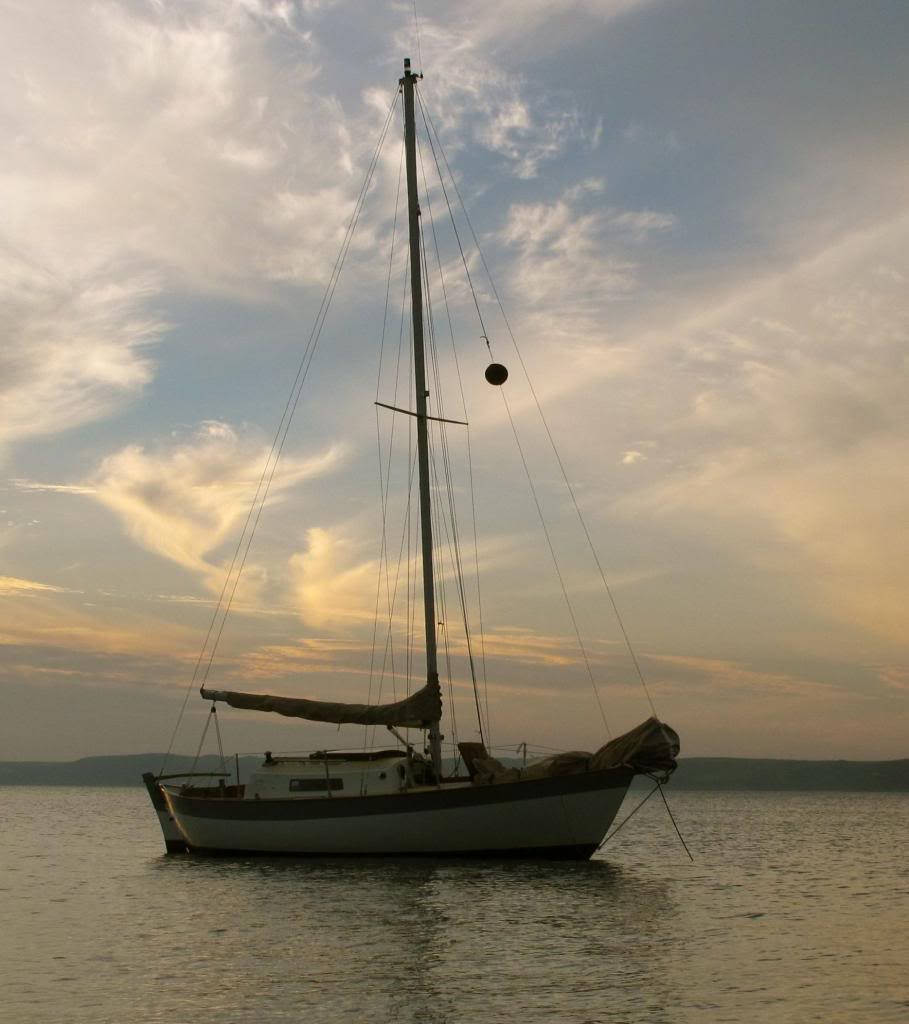
Soon after arriving in Brittany I cruised down the Chenal de Four and around the headland at Ste Mathieu to then run east into the channel that runs into the inland sea (Rade de Brest) within which is the city, port and naval harbor or Brest. The northern side tends to be very industrial/commercial except at it’s far eastern end where the bay becomes the river Elorne – I found a nice anchorage there off a small beach but much nicer and in a way more natural is the southern half of the Rade de Brest. Not on this voyage but later on with the little Liberty I once spent an entire 10 day independent cruise mostly in the Rade and putting into the many bays and rivers that form the ‘crinkly’ edge – in this part of the story i’m thinking back to my first time in the river that cuts deep inland from the south east corner of the Rade at a small village called Llandevenec ….the Aulne or as I should more properly say L’Aulne.
The entrance to that river I sometimes joking refer to as the ‘double toilet U bend’ because the river turns strongly twice at the high ground below the Abbey at Llandevenec and just after the double bend is an excellent sheltered anchorage – it’s also the place where the French navy store several decommissioned warships. That first time in there with the Frances 26 I couldn’t quite work out where the deep channel was after the famous curved suspension bridge but there again I didn’t have the local chart. On my second voyage there with the Liberty I felt that it didn’t matter as much because when it’s board scraped along the mud I simply lifted the centerboard, rudder and engine and just drifted upstream on the tide.
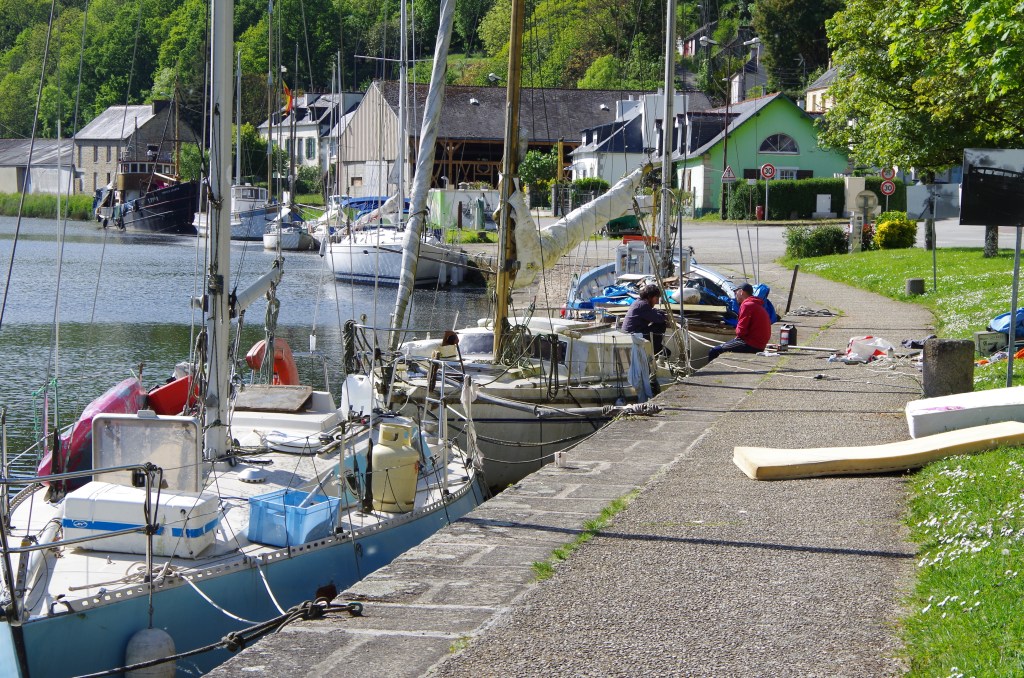
Here’s what it’s like up there near the head of navigation at Port Launay (Chateaulin)
Back to that first ‘Frances‘ France voyage (see what I did there ?) though.
In case you’re wondering I didn’t just finish the Frances 26 refit and immediately leave for a 110 mile cross channel voyage ; rather I did a couple of trips up and down the Cornish coast to try out the new sails, the Windpilot and the refurbished engine. One of the oddly coincidental things that kept happening during my sea trials was that I kept meeting the same two other boats somewhere in between Plymouth, Fowey and Falmouth ; one of those boats was a local , home made chined steel yacht originally designed by a local sailor and the second boat I kept seeing was a small , dark blue production boat of about 20 feet length which was notable due to the comically large windvane self steering gear attached to it’s transom.
The coincidental thing was that both boats also turned up in France and both of them were at anchor in ‘double toilet bend’ at the same time as I was there in the Frances 26 – in fact the evening that I pulled into the river the guy who owned the little blue boat was sat in his cockpit so I motored up alongside to say hello. I think we both found it funny that we seemed to be stalking each other and in fact we’d both done our channel crossings within a couple of days of each other and he was at anchor in the Aulne because he was heading up to Port Launay the very next day. This part of the small boat’s post is very much inspired by that guy and his , to me, tiny production boat – the kind of thing you might expect to see knocking around local waters but a bit of a surprise to see having also one a 110 mile channel crossing.
To this day I still don’t know the make, type or design of that little blue boat – the nearest thing I can find is the Hunter 19 Europa designed by Oliver Lee and apparently like a ‘Squib’ with a lid. On that evening the flood was running fast in the Aulne so once i’d turned in the tide and ranged up nearly alongside I had to carefully juggle tiller and throttle to stay there so we didn’t get to talk for long and after a while I let the tide carry me upriver a short distance while I prepared to anchor.
The impression I got was that the boat’s owner was retired, separated and living a simple bare bones existence and that the boat functioned as his home a lot of the time but he seemed perfectly content with his life and comfortable aboard his tiny boat – later on and after i’d owned the slightly larger Liberty for a while I began to realize that I was perfectly comfortable aboard a 22 foot boat and maybe even that it was a better boat for me than the more offshore capable Frances. I thought that with a 26 foot boat my cruising would never be limited by having a too large yacht but in fact it did limit my cruising range down to about a 4 foot minimum depth whereas the Liberty would be afloat in calf deep water and then crucially settle upright on any reasonable bottom.
The Liberty on the soft sand at the head of the harbor in Camaret sur Mer.
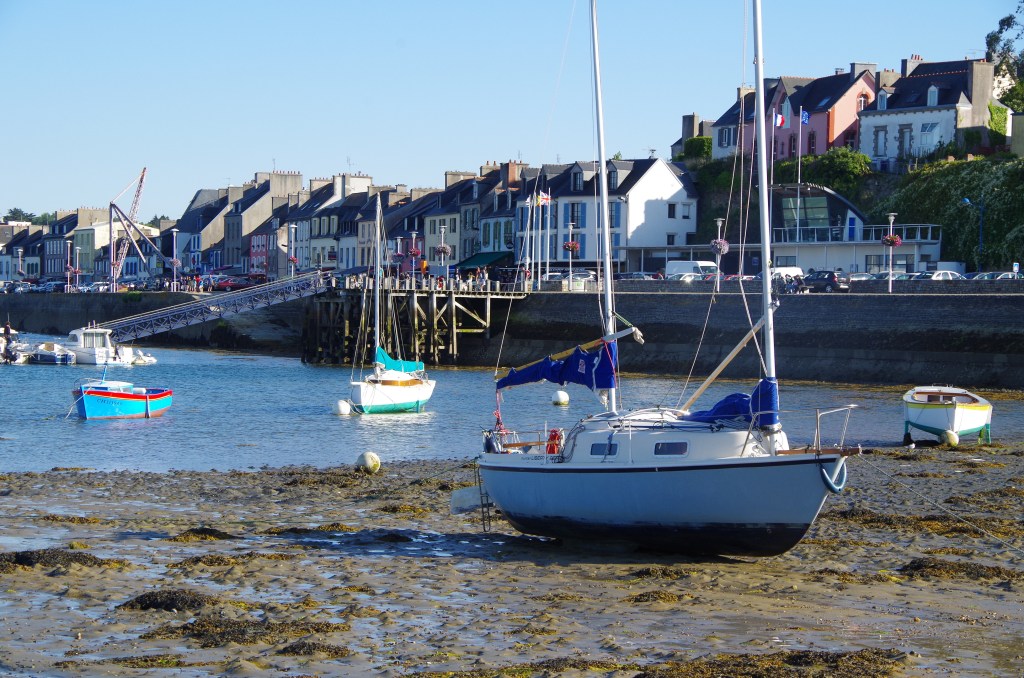
I think that iv’e always been aware (as a sailor) that some sailors went off and did things in small boats that seemed somehow outside what was average , everyday and ‘normal’ ; one small example of this came about when I was crewing aboard a big old maxi yacht with the late Bob Salmon. Several years before that race Bob had created the first iteration of what would become the Mini Transat race and if I have this right also sailed the race twice once in an ‘E’ boat one design and once in an Anderson ‘Seal’ design. At that time it was still also possible to compete in the actual Transatlantic race as an amateur in a small and basic boat – one sailor I actually knew sailed the race in a 26 foot production yacht and later on another sailor who I knew through a friend sailed the same race in exactly the same boat as I had at that time – a 26 foot Wharram catamaran.
On that first France/Frances voyage I occasionally went alongside a couple of quays and marinas to both get water and go do my food shopping ; when I was alongside with other boats the Frances always seemed to be a smaller boat (although much better equipped) than the other boats that I was alongside with. On my own or with my my partner the Frances seemed like a very large ‘small’ boat and several small incidents made me start to wonder if I had over-boated myself and whether I would be genuinely better off with a smaller, simpler and less costly boat. For it’s size the Frances is quite a niche boat and very expensive for it’s length – one of my main areas of disquiet though is that it did limit my cruising area to a depth greater than 4 feet…….and I thought that I could do better than that and at a lower budget.
Several things happened…..I know that I made a whole bunch of notes in the Frances’s logbook about what I thought were the problems inherent in owning a ‘deep’ draft yacht and in my own terms quite a large and heavy boat. After we came home from that voyage – I say we because that was also my partner’s first cross channel voyage coming home – I put the boat up for sale because our lives were about to change as we were using all of our funds to buy the small miners cottage that we live in now. I put sailing aside for a while because I had plenty of work to get on with restoring the cottage and it’s gardens but during ‘time off’ I spent my time studying again the world of smaller boats and what had been done and was being done with them.
To cut a very long story short I solved several problems by learning my lessons about the large, deep draft and expensive Frances 26 and buying the little Hunter Liberty, which, at 22 feet is a much smaller and lighter boat plus it doesn’t need 4 feet of water to sail and it sits upright with it’s board and rudder up. The odd thing here is that the Liberty was probably the perfect boat for me at that time except that there were many times when I felt that it too was more than what I needed and what I really wanted was a boat that I could keep at home and yet still go voyaging with. It’s maybe a strange way to go about deciding what boat to have or to build but what I did was to spend some time working out ,roughly, the maximum size of boat that we could accommodate in our own driveway.
Having had a heavy Devon Dayboat/Yawl in there (16 feet) and a slightly longer but much lighter Osprey class dinghy I knew that the maximum size would be somewhere around 18 feet so my first search was to find a retired National 18 class dinghy and do what another owner had done and convert one into a modern lugger. That didn’t work out but as we know then the senseless and suspect Covid lockdown happened and it suddenly made a lot of sense to put my time and effort into building a boat from the ground up. The Pathfinder does feel to be about the largest boat we can have on a trailer in the yard and even then it’s taken some modifications of the drive and boundary to make it work ; i’m extremely glad to have done it though and to have the boat at home and not sat locked away behind the fence of a boatyard and at the whim of an unhelpful yard owner.
There are still times when I think about a smaller boat though…..maybe I should build a sailing canoe ?

 Dirty Wet Dog, the great adventure.
Ha, a canoe! I just finished building a wood strip sea kayak, it’s fun and good exercise but I still can’t wait to start my Pathfinder build. My current Phoenix III is just a tad too small for sailing comfortably if I take the dog, or another person, along.
LikeLike