

Pathfinder fitting out post minus engine.
In the original Pathfinder design pages there are drawings for an engine well (port aft) to take an outboard motor, some builders do that and some take the simpler option of fitting an outboard bracket on the transom : I didn’t do either during the build because I thought that it would be much more interesting to have an engine-less boat . Later on I might need an engine because crossing the English channel in light weather can involve a sprint across the traffic separation zones – which is a bit like trying to walk across a busy road on a bad day. During my last channel crossing I counted the lights of some 14 ships while I was between shipping lanes, it seemed like rush hour !.
One reason that I didn’t fit the engine well is that the well cut out could cause drag which will make the boat a slower sailing boat and the other reason is that I would have the same problem as I had with the little Liberty in that the engine was in the cockpit but in the stern well directly in front of the round/curved transom and which acted like an almost parabolic reflector so the engine noise in the cockpit was almost unbearable at times.
Before I begin the meat of the post I want to say something about blogging, about video’s and about my efforts with both .
Last year there was a post on sailing based social media in which the OP was complaining about the low quality of blogs and video’s, notably as being uninformative about sailing. Now, I thought about my own work and wondered if I was failing to be as informative as I could be and while my content is all free and produced in my own time I did wonder if both my written posts and my video segments should be entertaining, engaging and informative so in this post and it’s companion video I set out to be informative about this subject.
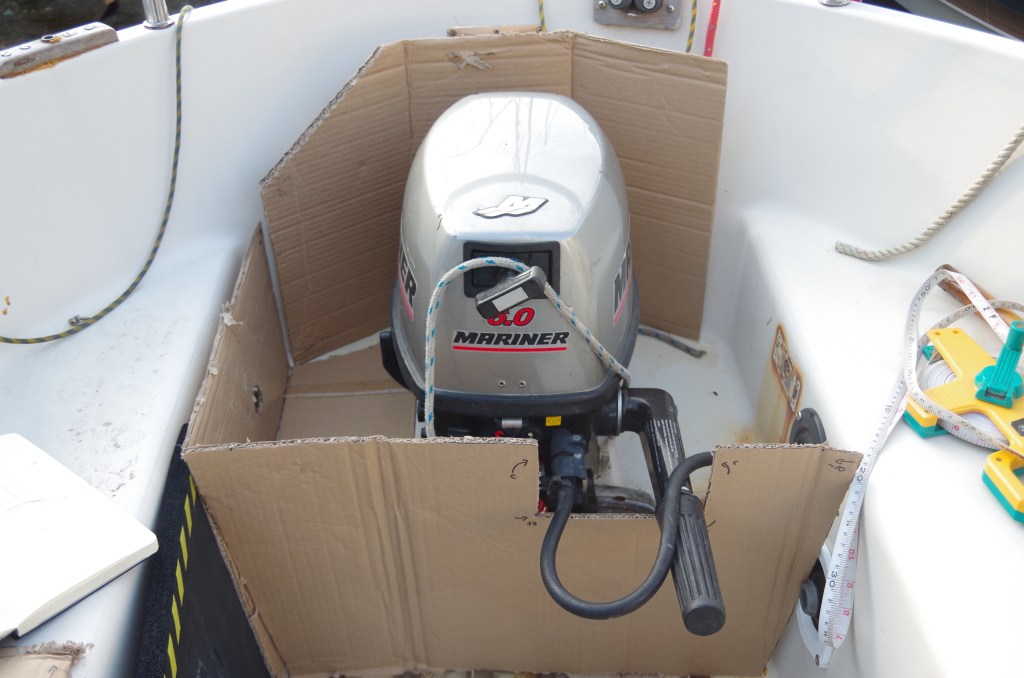
My templates for an engine box on the Liberty but you can also see how the inside of the cockpit reflects all of the engine noise forward.
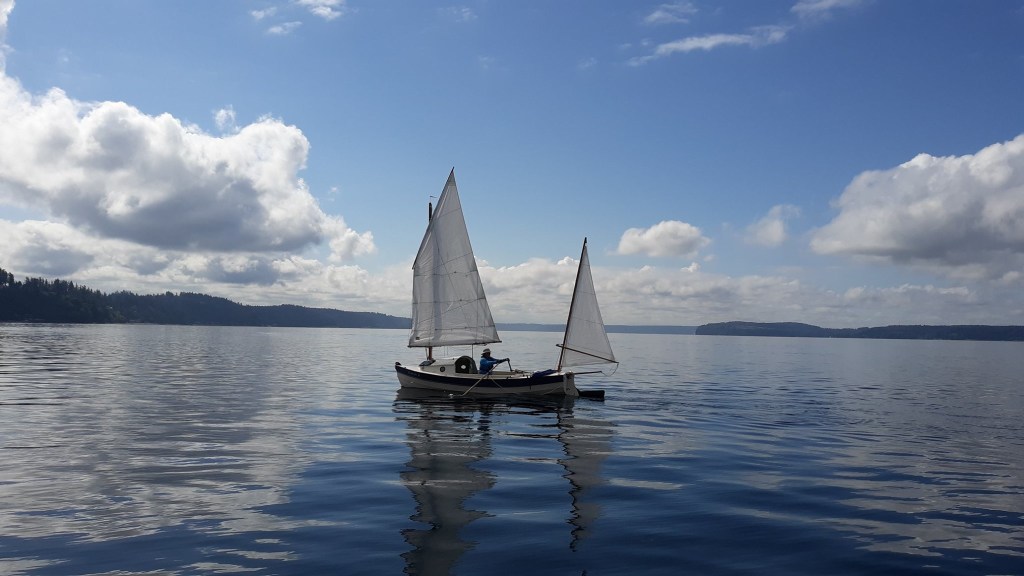
Nowadays I prefer my boats to be quiet, the Pathfinder should be a very good sailing boat which is already destined for a bit more sail area than the standard boat anyway but I am still going to need an alternative source of power – in fact i’m setting up to have two alternative means of propulsion : long canoe paddles a, pair of oars set up for standing ‘push’ rowing and where one of them can also be used as a single stern sculling oar just like the Breton’s do. In fact the Breton’s are really into their sculling and I think it’s the case that all dinghies and small boats have to be fitted with a sculling notch in the transom.
Design considerations.
Right now I have open on my desk a copy of John Leather’s excellent book about sailing and rowing craft , appropriately titled ‘Sail and Oar’ and it’s an excellent reference guide as, by the way, are his books about Gaff rig and another of his book ‘Spritsails and Lugsails‘. Each of those are vital reading for anyone who is playing around with small craft with alternative rigs and ‘alt-power’ so I will set up some links at the end of the post : all of mine I acquired secondhand either through a local secondhand marine bookstore or via the internet.
Very very crudely put a good boat for rowing doesn’t make a good sailing boat and vice versa, again and over simplified a rowing boat needs to relatively slim for it’s length whereas a small sailing boat that doesn’t rely on fixed ballast relies partially on it’s beam for ‘form’ stability. I’m pretty sure that the Pathfinder designer (John Welsford) would slap me around the head a bit for that description but that his design, and therefore my build, of the Pathfinder is very much the dedicated and ‘powerful’ sailing boat and not primarily a rowing boat. It can apparently be rowed over short distances which is mostly all I will need but John himself recently drew the hybrid sailing and rowing expedition boat LongSteps which is both longer and narrower than Pathfinder.
Given what I intend to do with my Pathfinder – a sail and oar voyage around the UK – I sometimes think that I have made a mistake and that maybe I should have been building LongSteps right now. My main problems with that are that I am nearly at the limit of what will fit at home and Longsteps is another 2 feet in length. I would also be having worse problems acquiring a decent trailer – anyway iv’e made my choice and I can’t really justify building a second boat just to find out.
Longsteps (unknown photographer)
Pathfinder vs LongSteps (length and beam)
Pathfinder : length 17′ 4” (5.2 M) Beam 6′ 5″ dry weight around 220 Kg LongSteps : Length 19′ 6″(5.8 M) Beam 5′ 7″ If you’re wondering then my boat is going to carry about 130lbs of dry ballast but LongSteps is designed to take on around 260lbs of water ballast.
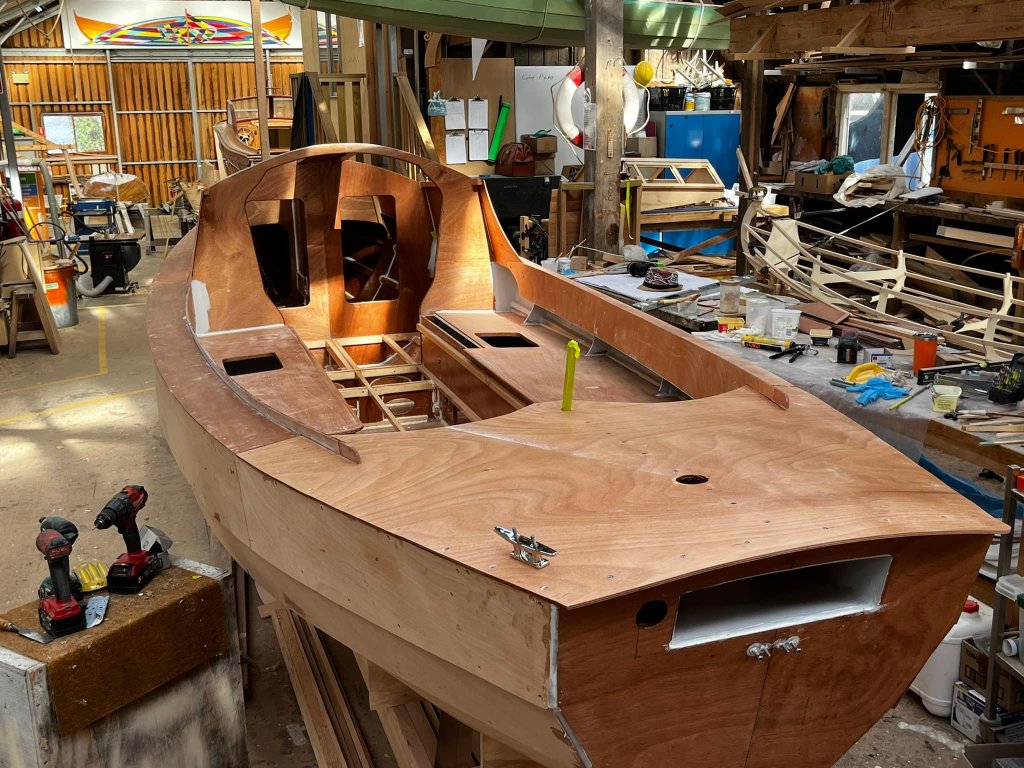
Just for an impression of both boats here’s my Pathfinder and Audrey Laser’s LongSteps from the same angle and at a similar state of build.
Pathfinder

LongSteps (Audrey Laser)
A little bit of history.
I have had one heavier displacement and double ended cruising boat (Frances 26) that I set up with a single lifeboat oar to use in the event of engine failure, that project didn’t work out too well although I was just about able to move the boat under oar but then more recently I equipped my last boat (Hunter Liberty) with a single long canoe paddle which was far more effective but then the boat was only a third of the weight of the Frances 26.
In 2020 I was at anchor in the Liberty, way up the River Dart off a small side branch called Bow Creek, my plan that morning was to carry the ebb down to Dartmouth and then sail around to Torbay and put into Torquay harbor to meet up with my partner. Fine…..except that my outboard motor wouldn’t start and there was all-but no wind so I just retrieved my anchor and started paddling energetically down tide and luckily with what little wind there was. Under paddle only I could make about a knot of boat speed and once in a while 2 knots under sail for maybe a hundred yards or so – my main advantage was the ebb tide which was giving me maybe half a knot over the ground all of the time.
So….canoe paddle paddling first.
To be successful with a canoe paddle and canoe style paddling (rather than rowing) you need first a boat with low freeboard aft, removable guardrails and as long a canoe paddle as you can get, my cruising paddles are about 153 cm and 162 cm respectively – the longer paddle is more effective. To paddle a dinghy or small dayboat effectively you need to drop the guardrails, at least at the cockpit, and adopt a kneeling position on the cockpit seat facing forward – my favored position is a one knee position with the other foot (inboard foot) on the cockpit sole. The best paddle stroke is simply a short power stroke but using a fast cadence to get the boat moving, after 10 strokes one side the trick is not to apply a steering stroke because that just wastes forward power but to quickly swap to the opposite side of the boat – once moving the boat can then be steered although what I liked to do was to always be paddling on the ‘long’ side of a curve in the river because the boat will always be trying to turn away from the blade slightly.
Having been a canoe coach my observation is that most British canoeists don’t know how to paddle in open water (big lake) conditions especially in upwind conditions. What I used to see with canoeists was an inability to use their body to power the blade but instead to adopt a fixed sitting stance when only the arms or shoulders can be used ; a much better technique is to first adopt a high kneeling position and then to use both a fore and aft motion with the body and also rotation at the waist which then brings the back and abdominal muscles into play. The other technique is to always consider the ‘boat, body, blade’ routine and to first cock the boat such that the wind is blowing on one side of the bow and to paddle on the opposite side just using power strokes and never using a J stroke which wastes power.
The difficulty with the little Liberty is that in any headwind at all the bow will fall off the wind because of the windage of the fore mast right up in the bow – in any wind though I would simply be sailing but it might have been a consideration when coming alongside a pontoon against a headwind with no engine.
Rowing.
Up until now iv’e never been much of an oarsman because iv’e never really needed to be except for a short time when I kept the Frances 26 on a deep water mooring and rowed out to her in an 8 foot Walker dinghy. The only other ‘rowing’ experience I had was when I tried training on an ‘Ergo’ rowing machine because my trainer thought that I would make a good rower , even a competitive one – something to do with having long levers – but it was a failure because too many years of back injuries I can pop a disc as easily as anything and that’s all she wrote.
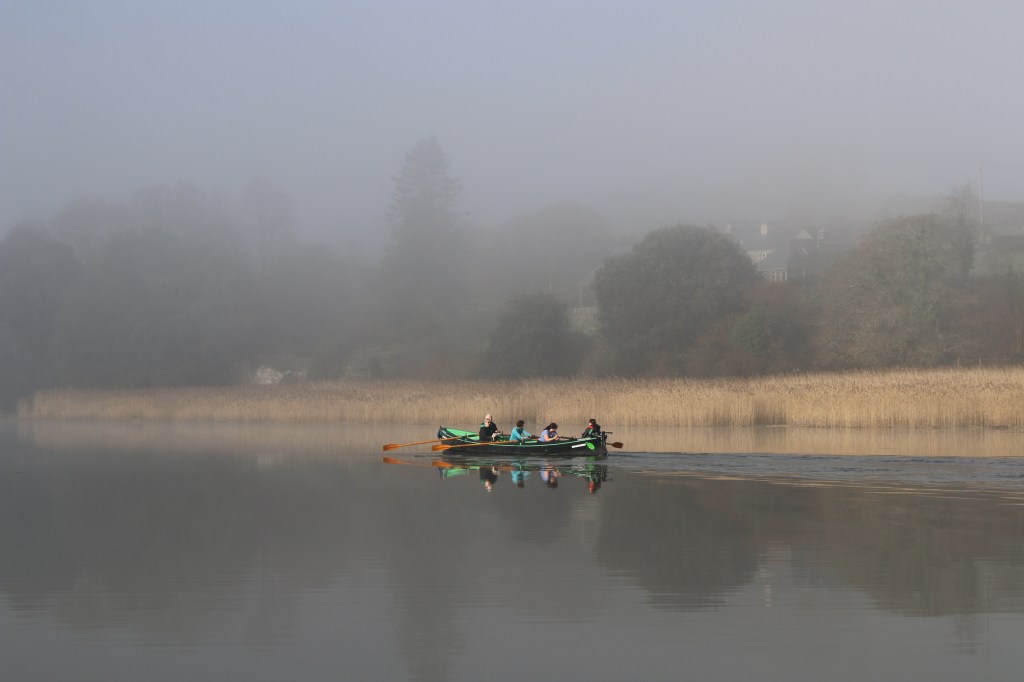
Today I have to reconsider rowing with the Pathfinder but I have the cunning plan of adopting the standing and forward facing rowing stance used by anyone from Japanese fishermen to Venetian racing Gondolieri. I guess that most sailors will know that the true way to apply force to water via a pair of oars is by using primarily the thighs and back by way of a sliding seat although around these parts we have teams of competitive rowers who race fixed seat Cornish Pilot Gigs, at speed, up and down the local river.
Calculating oar length 1. (taken from Shaw & Tenney.
“To determine the correct length oar for your boat measure the distance between the port and starboard oar sockets. Then apply the Shaw and Tenney oar length formula to determine the oar length that will provide the correct 7:18 leverage ratio. This length will provide an oar where 7/25 the length is inboard of the oarlocks and 18/25 of the oar is outboard of the oarlocks. It is the ideal ratio to row almost all boats. Sized correctly, when rowing your hands will be 1 to 3 inches apart and you will be pulling directly towards your abdomen. If you are popping out of your oarlocks when rowing your oars are far too short. If you prefer an overlapping grip, add 6” to the calculated oar length. “
Oar length 2
“To help our customers size their oars correctly, we’ve been using the same formula since 1858: Measure the distance between the center of the port and starboard oar sockets, which hold the oar locks on each gunnel. This is called the “span” between the oarlocks. Divide the span by 2, and then add 2 to this number. The result is called the “inboard loom length” of the oar. Multiply the loom length by 25, and then divide that number by 7. The result is the proper oar length in inches. Round up or down to the closest 6” increment”
This came as a bit of a surprise because it suggests that I need a pair of 11 foot oars – which sound massive, also when I had a look at oars for sale the longest ones I could find were 10 feet interestingly though the company that make those have a different method of calculation which gave me a calculated length of only 9.25 feet – so either I am crap at measuring , maths (or both) but maybe I can get away with a pair of 10 foot oars and so not have to make them.
Oar positions.
I am thinking to avoid the back problems that I get from sitting rowing by rowing facing forward in a standing position – either way what I have to do is work out where the rowlocks are going to go and whether or not the rowlocks need risers. There is a standard accepted position for rowlocks which are set for aft facing sitting rowing – that being about 14 inches aft of the seat but it’s not quite so clear with the standing position ; right now I am playing around with mocked up positions and my experiments seem to suggest that they need to go about a foot ahead of the forward end of the cockpit – this may change when I buy all the bits and pieces and set the whole thing up with the boat outside of the shelter. The final position relates to the next section which is single oar stern sculling.
Single oar stern sculling.
Using just one of the ten foot oars I should be able to stand roughly centered in the cockpit and scull with the sculling oar resting in a notch on the transom. Having already built and finished the boat’s transom I can’t retro-notch the actual transom board so one of my projects is to design and make a raised, and built up sculling ‘notch’ – that’s on the bench as a project right now – the alternative is simply to fit an extra rowlock socket in roughly the same position .

Yuloh.
The alternative to rowing is to use a manually powered propeller – otherwise known as a Yuloh and which some boaters make and use on surprisingly large boats. I guess that most visitors here will either have seen, used or at least know about the Yuloh in theory ; that basically it is a kinked or curved form of single scull deployed over the stern and often with a short vertical line inboard that helps cock the blade to the right angle when swung from side to side. I don’t think I need to dwell on the Yuloh so much because for boaters that want one there are some good resources available and each one is going to have to be built and set up for the boat that it is intended for – crudely put , oars are simply oars some slightly better than others.
Now, I was briefly very enthusiastic about designing and making a Yuloh for the Liberty because I quite liked what I saw in the video that I have created a link to below. The opposite side is that I happen to believe that using oars in a forward facing position is bio-mechanically more powerful and probably less of a risk of further back injury – also that an oar can be deployed to stern-scull with and the slight technique issue can be easily sorted with a short line or lanyard to help set the blade pitch.
Yuloh video link here : https://www.youtube.com/watch?v=P3pbYMOK8Us
Practicalities.
Given the amount of time between writing this post and it going live I am likely to have already ordered a ten foot set of oars from Fyne boat kits in the UK plus a pair of handsome Bronze rowlocks and sockets, right now i’m working on the stern arrangement which in it’s first version is a bit of a clunker but version 2 might be ok. It’s most likely that this post will also appear as a segment in my spring video about the Pathfinder fitting out stage as just one of many jobs that I will be working on this spring.
Fyne boat kits oars UK : https://www.fyneboatkits.co.uk/accessories/oars/lahnakoski-seagrade-oars/

 Dirty Wet Dog, the great adventure.
This should get you in the mood Steve — deserves a wider audience, just like your blog and videos:
LikeLike