
What is WABI IV (four) for ?…….see what I did there ?
The joy of small boats posts…..what is the ‘mission’ here ?.
Blog time : it’s Spring 2023 and as you can gather from my previous post I am hard at it finishing the fitting out stage of my John Welsford designed Pathfinder ; now named as WABI””. If you’re wondering what it means and how to pronounce then go and check out my companion spring post ‘What’s in a Name’. Just in case you don’t then it isn’t pronounced ‘Wabby’ which some tend to do but rather the A is a long A so the first component is ‘Waa’ .
The meaning is a bit Zen and I know of several different versions , one of which refers to a sense of austere simplicity while another one is based around and simplicity and melancholy. My chosen version is, I think, the ultimate definition of a boat because my version of the translation of WABI is as follows : Nothing is complete, Nothing is perfect, Nothing is permanent which in boat terms means that it’s never finished,never quite right or finished and it will always be breaking down over time.
So anyway, what is WABI”” (IV) for ? and not just for the obvious reason of going sailing in a self built boat that I can keep at home and tinker with for the next few years.
In previous posts in this small boat thread I have alluded to the idea that a boat at it’s best for us when it most closely matches what we want it to do so one of the things I started with when thinking about building WABI IV was what it’s purpose, function or ‘mission’ would be. If that sounds stupidly obvious then I don’t think it is the case that many boat owners actually do work out what their boat will be for and instead I get the impression that many of us just buy the boat that we like the look of ; as with my previous post about this subject I fully admit to having bought the Frances 26 because I had always wanted to own one plus I had some pretensions to being a live aboard long distance cruising sailor.
What I found with the Frances was that it was great boat for sailing up and down the south west coast and across the channel to Brittany but against that I found two or three things that worked against it being the best boat for me at that time. The first thing I discovered was that a 26 foot boat seemed unnecessarily large, deep drafted and of course expensive to keep when I wasn’t using it much. The second was that I had developed a desire to be able to put into very shallow creeks and rivers on this coast and I liked the idea of being able to dry out and just step out, over the side and onto the sand.
A couple of years later I went back to a part time job so that I could buy and run a smaller boat again – that boat I largely chose for it’s location which is a strongly tidal river where the boat would spend a lot of it’s time in a mud berth. It was a strangely satisfying time when I ‘parked’ it over a sandbank for the first time and let it dry out and that I felt would have to be a feature of any future boat that I owned. The little Liberty was a much better fit for me in it’s role as a local cruising boat plus it gave me a much greater sense of adventure when I took it across the channel ; naturally it was a much less capable and sea kindly boat in lumpy wind against tide conditions in the channel but once I was there I gained the breath of cruising ground that I missed with the Frances.
The Liberty was the nearest I had come to a boat that actually did it’s job well but it’s limitation ultimately was that it either had to live in a boatyard some of the time and like many I woke up one day to find that it was locked behind the yard gate and I wasn’t allowed to even go aboard. A viable solution might have been to buy a trailer for the Liberty and bring it home but it was honestly a few feet too big to manage in our drive and really needed a powerful towing vehicle as part of the package. My feeling then was that “we’ll need a smaller boat” so I started to make plans to build a boat at home and with the beginnings of an idea what I would do with it.
It’s not quite the case that I first defined the mission and then chose my design based on that…..rather that everything that I was inspired by in small craft voyages all seemed to need a similar kind of boat.
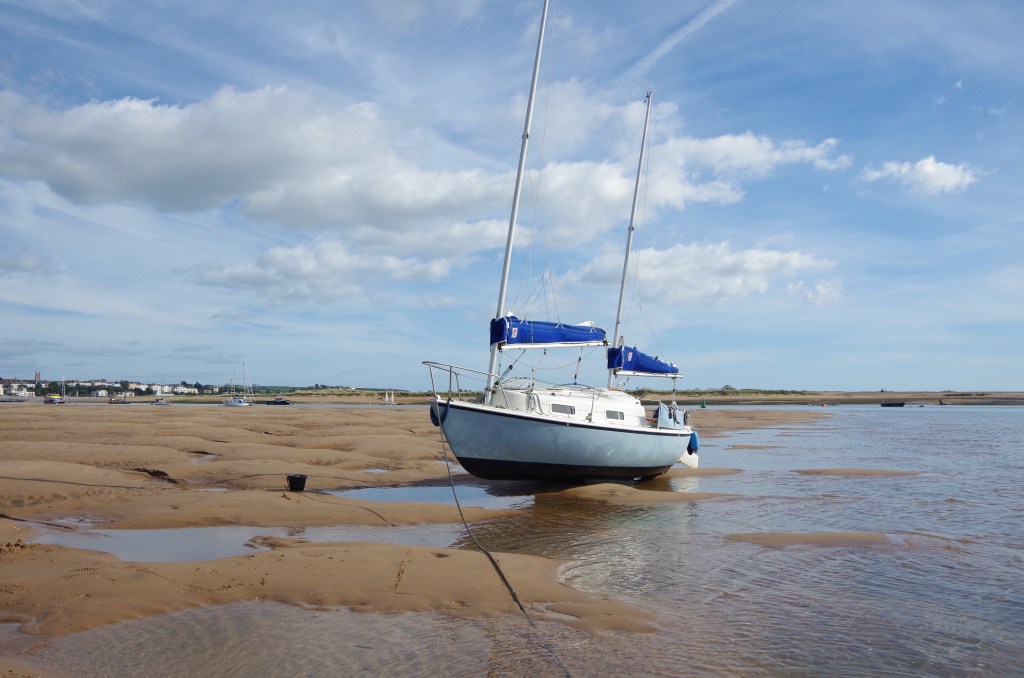
What I have is a kind of ‘5 year plan’ for the Pathfinder and the main part of that plan is to take a long slow wander around the UK’s coastline via any and all of the small ports, harbour’s, rivers, creeks and estuaries that I can get into under sail and oar and starting at the west end of the west country and proceeding eastwards. In fact in the first year I don’t think I will go all the way down to the far west and kind-of push her off the edge – at this point I can’t see an obvious place to launch her in Penzance/Newlyn so i’m more likely to trail her down to Falmouth or the Helford river and find a friendly yard with a slipway.
For her launch and sea trials I quite fancy Mylor because there’s a slipway I can use and we could most likely put her alongside one of the pontoons there while we sort out any teething problems – with a new boat there’s bound to be a few.
My overall plan for year one is something that I call the nine rivers tour , which is to visit the main 9 rivers, obviously, of the west country : there are in fact more than that but many of them are just named for their main branch and it’s outflow to the sea but in fact many of them are formed by several smaller inland rivers. Just as an easy example the Fal actually comprises of 3 main rivers ; that’s the Fal, the Truro and the Percuil – sometimes in jest I refer to the Fal as ‘Percuiliermouth’ because the Percuil is the first river upstream of the wide harbor entrance.
Sailors please note ; just for a bit of fun and without looking at a map, chart or Google earth then quickly name the 9 main rivers of the west country.
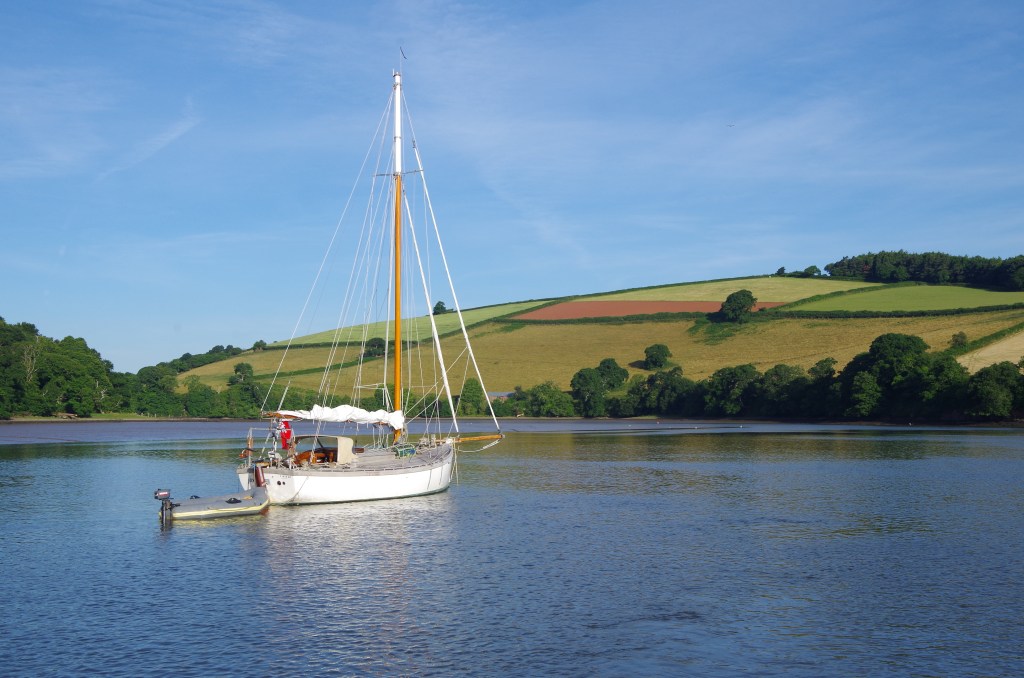
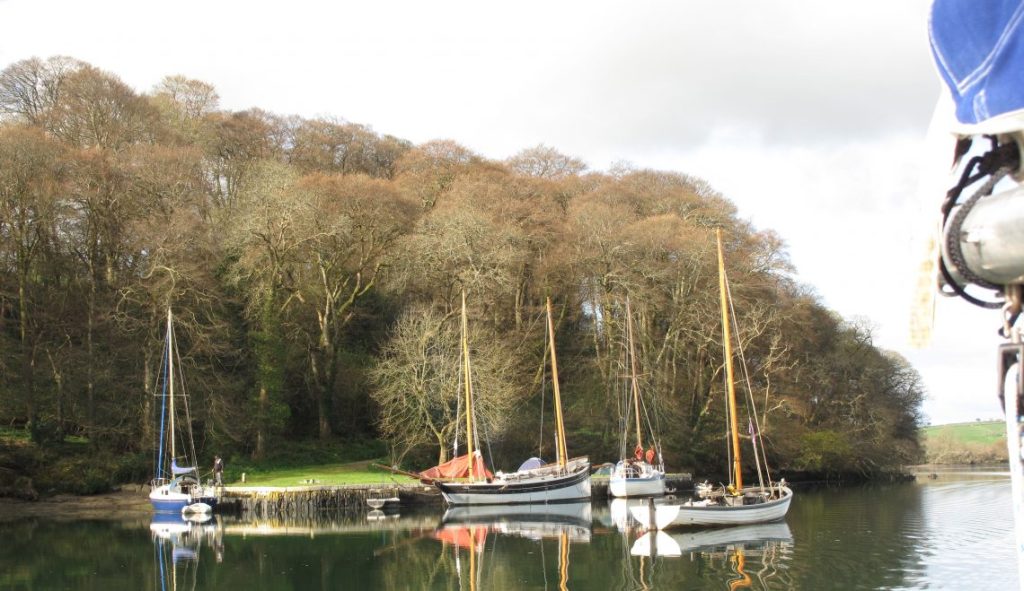
Go on then – which west country river is this ?
The third element.
So, the first two elements are to explore , by sea, the west country and to do so only under the power of the wind or my own muscles ; the ‘third element’ is to also explore the wild margin of the west country rivers and creeks by spending some time ashore – in fact by camping, cooking and bivouacing ashore in a ‘bushcraft’ style.
A simpler way of saying this would be to use the American term ‘camp-cruiser’ in which the boat is the vehicle to get from A to B and then sometimes everything else is done ashore – in my case I will often have to sleep aboard the boat because the access onto shore is made difficult by thick mud but equally often I will be able to ‘park’ the boat on a tidal foreshore and make my camp . The trick here is to be quiet and stealthy – by which I mean not very visible but then a lot of the places I intend to visit and anchor in are small tidal creeks and rivers where the standard fin keeled yachts just can’t or don’t get to.
The second part of the third element is to do all of this as independently as possible except for when I really have to haul the boat back onto it’s trailer or when I need to do a re stock of food and water. In many places a quick word with a harbormaster and I should be able to tuck away somewhere and tie up against a quay without anyone demanding a mooring fee. For anyone who has been following my posts for a while then I did a whole series of posts about independent 10 day cruises in a small boat – that was all based on my last boat but I see no reason why I can’t do the same with this one because it’s just the same kind of thing we used to do out of a canoe or on the trail with a rucksack.
Tremayne quay in the Helford river – a good place to set my swag perhaps.
The fourth element.
The fourth element is the story, more specifically the story of the sail and oar voyage captured as a kind of running sea story on film…..or at least on video.
In a recent post I said that I spent hours of my ‘slack’ time in front of the computer and watching hours of other people’s video’s just to see what made , at least in my mind, a successful , great or poor video : it turned out that I took far more from non sailing video channels than I did from the ‘usual suspects’ but at least I could see my own mistakes and failures more clearly.
As the year begins I think that I have a much better idea of what I want to achieve and as I write i’m filming and editing the last few build and fit-out video segments just to keep in practice until I get out on the water for the first time. Something I realized is that I need to work in at least two different video styles because all I have learnt to do so far is film in the workshop and around the boat and I even begin to see with that what kind of pattern or habits that I fall into as in “hello from the workshop once again”.
Filming on the water is something that I have never done successfully and I think mainly because I hadn’t done the practical work of setting up my previous boat as a filming platform – having spoken to local video producer Steve Parke about cameras and set up I can see that I really need a couple of sport/action cameras (essentially GoPro or similar) and several different clamps and tripods so that I can sail the boat and not try and balance a delicate and expensive DSLR in a seaway at the same time.
It’s a bit too easy to focus on the equipment and on technique when I think that the real necessity is to create and focus on ‘the story‘ but I think that over the Christmas holiday I worked out that the story already has a base and a title – something like “Around England by Sail and Oar” – I even played around with some intro clips using favorite photographs and th
Rolling out the Pathfinder.

 Dirty Wet Dog, the great adventure.
Looking forward to living vicariously through your films Steve. Just a thought on cameras. If you have two cameras you at least double the amount of editing work you have to do, especially if you have them both running at the same time! Not to mention the problems of syncing-up the audio. You could use just one action camera on a flexible “goose neck” arm with a clip/jaws on the other end you can hold and point but also attach to a stanchion etc as you see fit? Anyway, great information on using a GoPro in the outdoors here from someone who has been there, done that and got the t-shirt:
LikeLike
There are slipways at both PZ and Newlyn if you want to get down there, and pontoons in Newlyn harbour regularly used by visiting yachts, plus a chandlery and marine engineers.
LikeLike