

Pathfinder build project……boat and trailer.
Blog time : it’s mid February 2023 and my project has taken a big step forward in that we collected the trailer last week and iv’e just spent most of two days lifting the boat off of it’s building frame and rolling the trailer in underneath it. The ‘mostly’ was because I spent a lot of the first day doing the groundworks that should make it possible to drive in and out of our yard with the boat actually on it’s trailer – so far all we have done is taken the trailer out a couple of times so that we get used to driving with it. The ground works basically mean cutting part of our fence off, turning that into a hinged section and then making a kind of ramp on the drive that side.
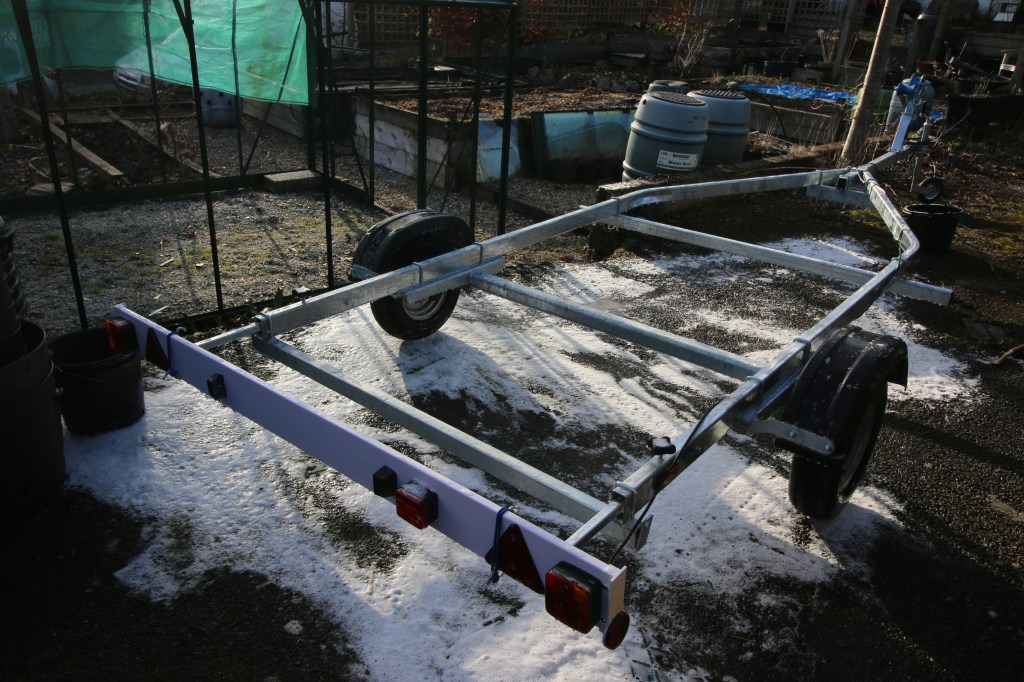
As to the boat and trailer …..at the end of that first day I eventually lifted the boat high enough to get the frame out and the trailer in but I then had a bit of an unwelcome surprise when I couldn’t lift the draw bar/tow hitch by hand at all. Now, I know from my days of training with weights that I used to be able to deadlift a good 130 Kg – ok so that’s with a barbell in an ideal position but there was no way that I was going to be able to lift the front of the trailer so the next morning I jacked up the front end and slipped our bathroom scale under the jockey wheel and that gave us a weight of 120 Kg on the jockey wheel. Having asked around I found that the ideal weight to have on the tow bar is around 10% of the total weight of the boat and trailer which at a rough guess would be around 450 Kg thus to have 45 Kg or so on the tow hitch.

Obviously and clearly that was way too much weight forward and I suspect a long way above the safe working load of the car’s tow hitch. When we collected the trailer I did think that the axle seemed a long way back so I figured that by moving it forward a bit it should start coming into balance ; it did but I wasn’t prepared for how much work it was to get there. It was also pretty obvious that with a heavy boat like the Pathfinder that I was going to have to add one or two extra cross members and add a spacer to the axle box for that to act as a ‘deck’ support as well.
The job was simple enough ; lift the whole boat on a pair of tackles with a lifting strap at the front and jack the back of the boat up and then hold that with a longer safety strap – in retrospect and even though I turned the forward lifting tackles to advantage I now think I should have used my jack at the bow , where most of the weight is and then more easily heaved the lighter stern aloft on tackles…..I only had 4 suitable blocks (doubles and triples) although I was able to make up 6 : 1 purchases with a pair of old snatch blocks that I had kicking around.
In reality it was a heavy day and an uncomfortable one because to use the jack under the stern I had to lay on the tarmac there…..last night , when I was working at the computer I couldn’t work out why my clothes all stank of cat wee….until I had a sniff around that end of the building space which smells as though that’s where the bloody annoying local toms all ‘mark’ their territory. This morning, when I caught up on the filming for my nest video I actually started with sweeping out and washing down the entire build space.
Anyway, the job itself……Lift the boat, roll the trailer out a ways, measure and mark the new position for where the axle is going to go, slacken off 8 bolts and thump the axle forward with a lumpy hammer and block of wood. Then, settle the boat on the trailer again and measure again the weight on the jockey wheel ; I lost count but I reckon to have lifted and lowered the whole boat 8 times and at the end of day I had the tow bar/jockey wheel weight down to 60 Kg which is where I am going to leave it for now.
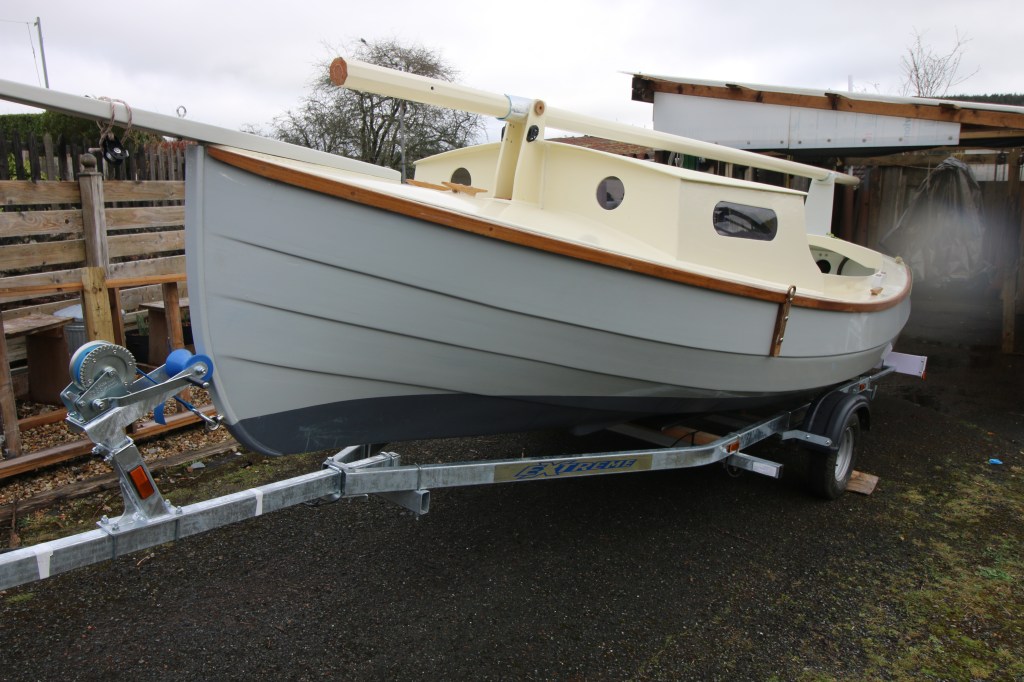
This morning I had the simple pleasure of backing the car up to (down to) the boat and trailer, hitching up and towing the whole rig all of 6 yards up the drive. What also happened is that the extra trailer cross member I ordered, plus it’s U bolts, plates and nuts all arrived so I had a much more pleasant job bolting that on so the trailer ‘deck’ now has 4 supporting cross members : in this post I want to explain how I have set up the trailer, what I have to do next and how I think we are going to get the boat on and off the trailer for launching and recovery.
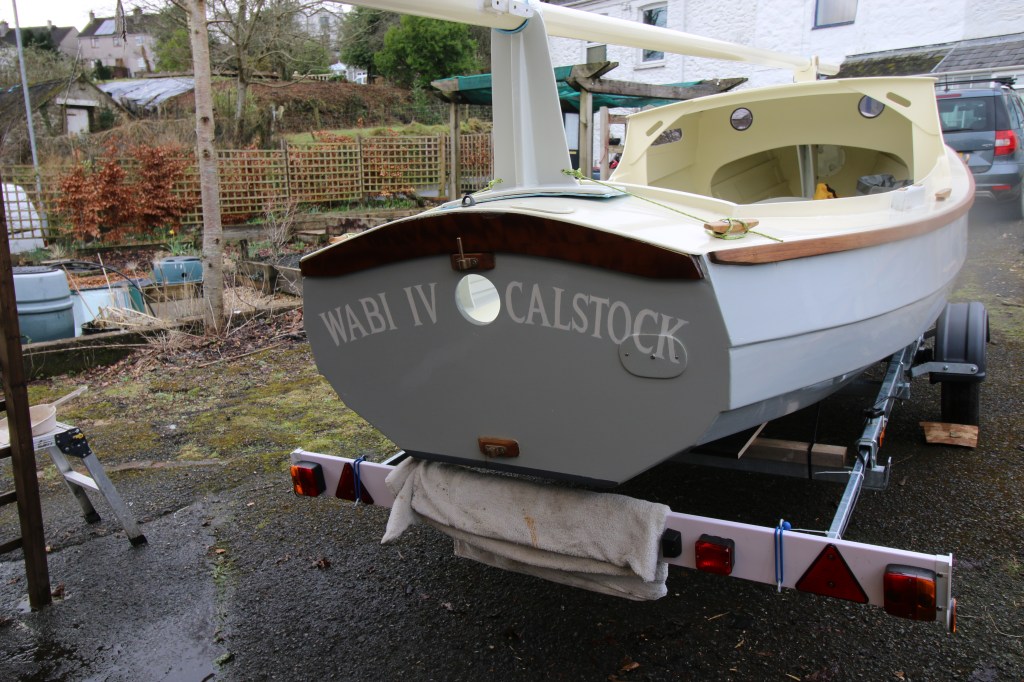
The actual set up so far.
The trailer was built with the axle box (torsion bar box) quite far aft and with one cross member right at the back of the trailer and one just behind the point where the side members of the frame bend in towards the draw bar. It was obvious when I felt the amount of weight on the jockey wheel that the axle box was going to have to come a long way forward – for those that know the Pathfinder design the trailer wheels are now about level with frame no 4. In a way that’s logical because that’s very near the center of balance of the boat.
With moving the axle box forward I felt that there was a large unsupported gap between it and the rear cross member and that I wanted extra support directly under the part of the boat where there will be a lot of weight in the near future. Although I haven’t been able to do it yet, because of cost, I will (one day) have a large fixed battery of 60 Kg weight in the compartment between frames 4 and 5. Right now the axle box sits almost directly under frame no 4 so I have added an additional cross member under frame no 5.
The important thing though is that because I built the boat with twin skegs it will sit flat on a level surface – like for instance a flat bed car transporter. What I have done thus far is to give the trailer a ‘deck’ wider than the width between the skegs and supported now over the axle box and three cross members – each cross member and the axle box needed wooden packing pieces to get the hull clear of the mudguards. In time that might go up to the axle box plus 4 cross members as I replace one existing cross member for a longer piece of box section steel which should also take a docking arm.
Week two/step two.
This week my main tasks are to firstly build the side supports that will sit under the first (garboard) plank and basically to take the ‘body roll’ of the boat on the trailer during cornering given that the overall width of the boat is 1.8 meters the skegs are only 500 mm apart so the boat is a bit ‘pigeon toed’ on it’s trailer. My plan isn’t exactly bunks but to use pre-made bunk risers clamped to the cross members and fit shaped pads to suit the rise of the bottom plank. The second part of that whole job is to lift the boat off the trailer once again and then reduce to minimum the height of my temporary packing pieces and then attach those firmly to the steel cross members and the whole deck to the cross members too.
As I write the boat is now as low as I can get it on the cross members and ‘deck’ and with just enough clearance between the hull and the mudguards. I feel that having the boat as low as possible will make it more stable on the road and easier to launch and recover.
The trailer also needs an additional support under the bow of the boat because at the moment it seems easy to rock the boat fore and aft : after that I move on to building some form of docking arms to help center the boat when I recover it onto the trailer and then work where the tie down points are going to go.
Fitting the first of the bunk pad ‘risers’…..current plan is to have 4 of these with shaped wooden pads situated under hard points (as where the skin meets a frame) and which can be dropped a bit while recovering the boat and then lifted/tightened before driving off. As I write i’m just working out the basic design of a tongue extender because we will be going for full immersion with the trailer when we launch and will need a bit more length between car and trailer.
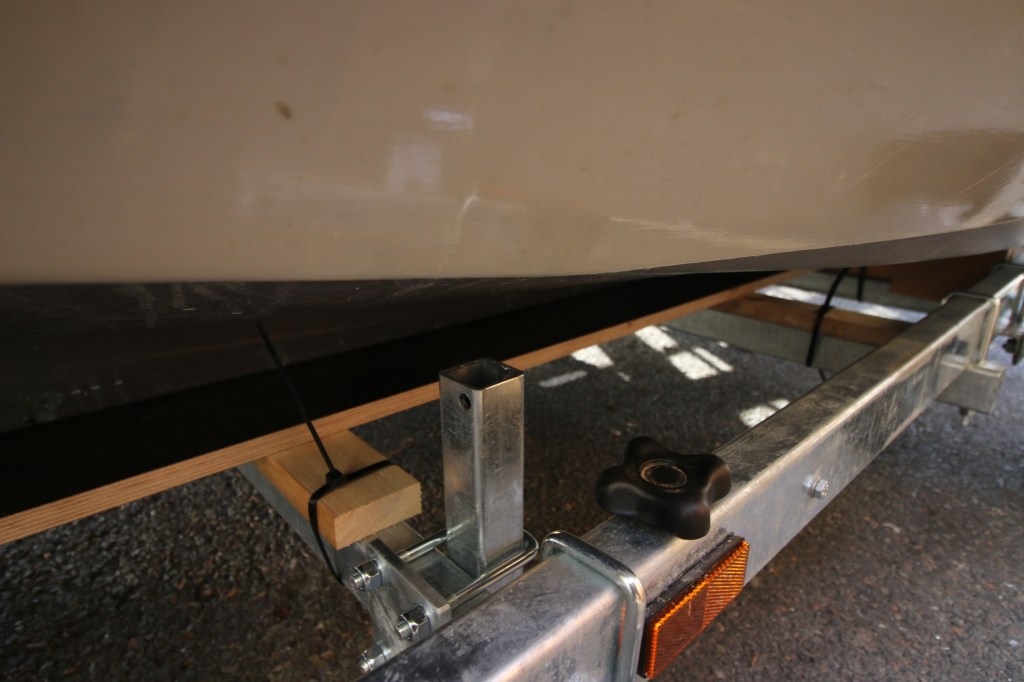
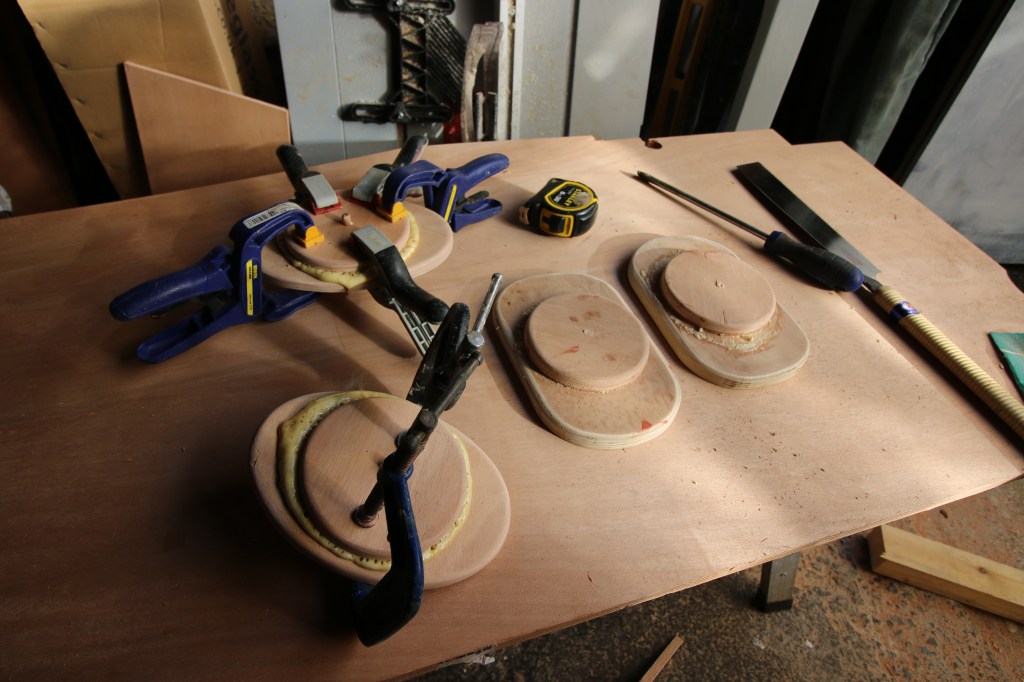
Making the pads for the risers….with luck the cleats will arrive ‘today’…..in blog time.
This week’s video post, trailer trash talk.

 Dirty Wet Dog, the great adventure.