

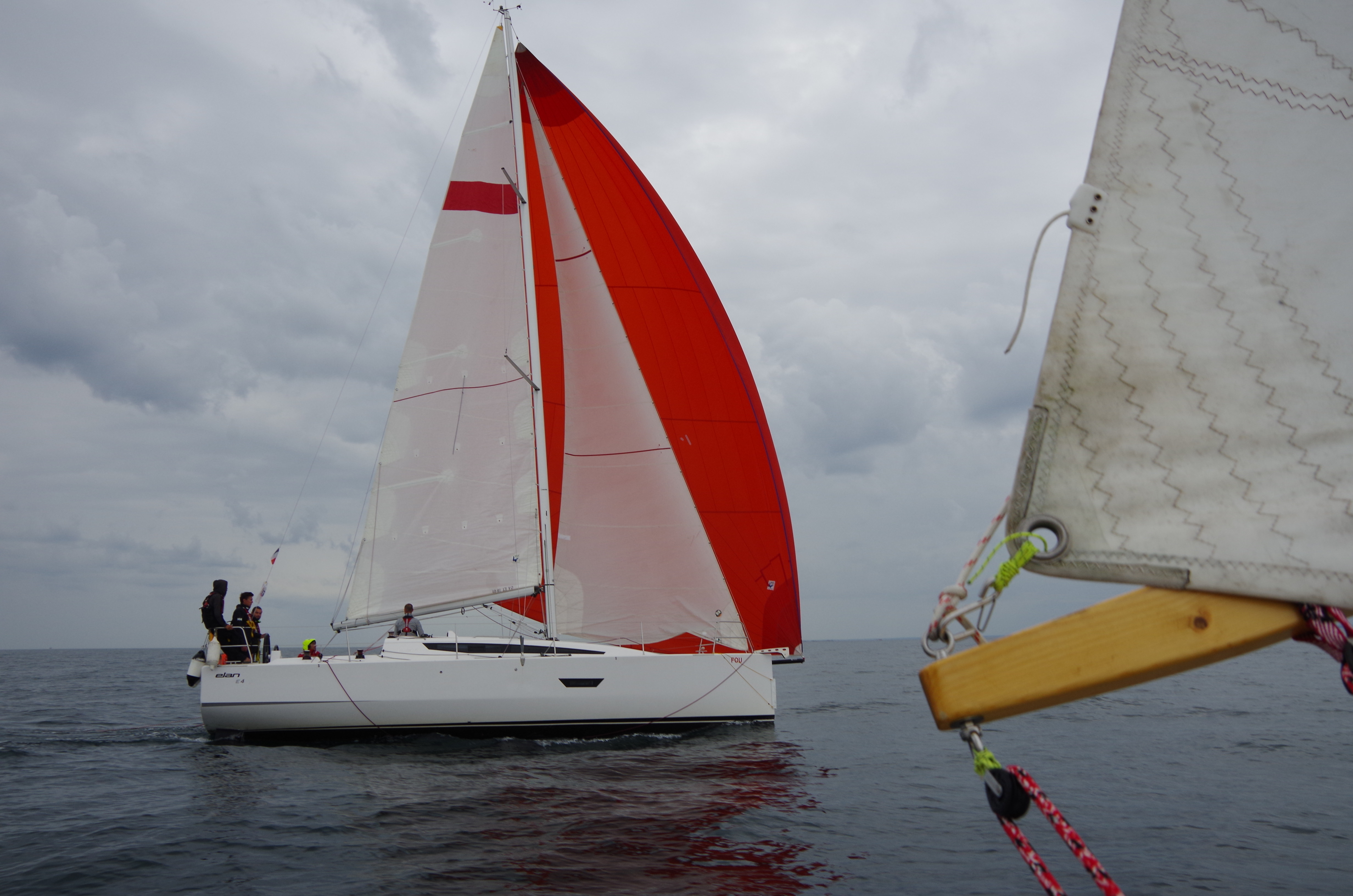
Talking about small sailboats and their inherent lack of ‘performance’.
Why it pays to learn about sailboat racing.
So….I was at sea aboard my little Hunter Liberty having just threaded my way through the incredibly narrow and rocky final part of the Malouine channel – for those of you who don’t know it the Malouine channel is the alternative way in or out of the main channel at L.Aber-Wrach. I would apologize for not posting a photograph but I just don’t have one on account of having to concentrate on the navigation and steering at the time. I think that it’s the tightest channel that iv’e ever taken a sailing boat through and I would love to hear of any other one which is narrower and rockier and the same time.
A couple of hours later and I was slowly making ground towards the north while being mostly swept up channel by a fast flowing flood : it was the start of my return passage from Brittany and it was shaping up to being a much more pleasant one than the outgoing trip even if a little slow. It was July so it was a long day and much shorter night and of course I was well used to the boat again having cruised and lived aboard for the previous 3 months. I still had a busy night though because I crossed the two traffic separation zones during the night and at one point I counted 12 or more sets of ships lights going up and down the channel, out of all of them I only had to duck around the stern of one of them.
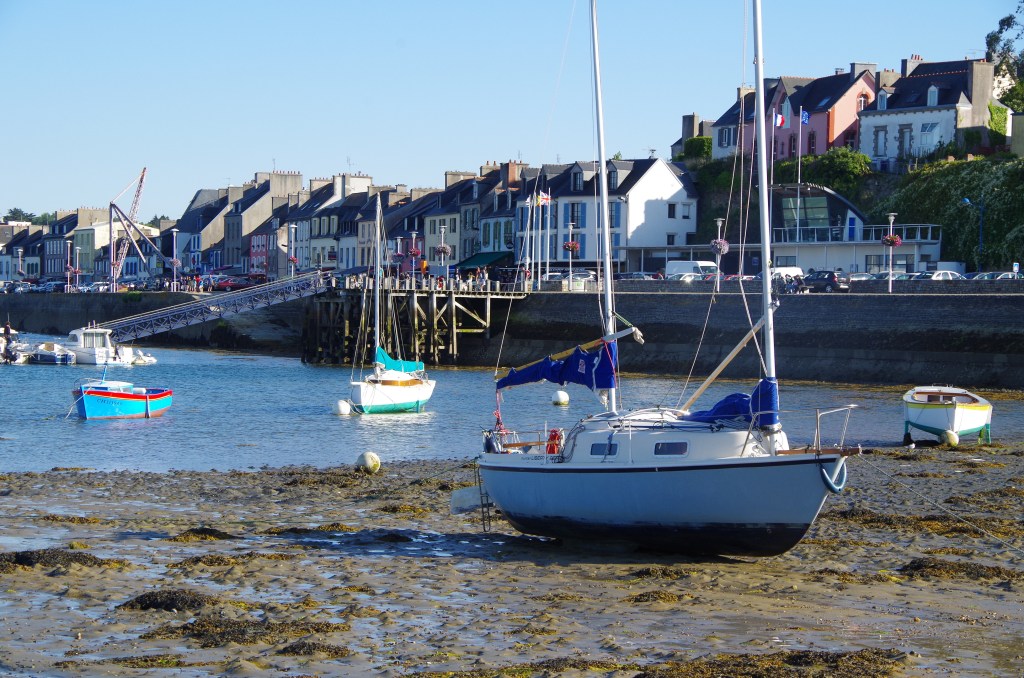
Aside from crossing the shipping lanes it was a ‘quiet’ and quite slow passage and I didn’t have much to do aside from keeping watch, the tillerpilot did the steering while I mostly stood in the companionway with my head out of the hatch – in between making drinks, cooking my dinner and keeping the log. There was certainly enough wind for a near boatspeed passage under sail only except that our speed through the water was down a good knot or so – that’s about a 20% reduction in boatspeed for the little Liberty and I suspect that was because of having a ‘dirty’ bottom ; I had done as much of a scrub as I could with the boat sitting on the soft sand at the top of the harbor at Camaret Sur Mer but I couldn’t get at the section between the bilge skegs so I suspect that there was weed and barnacles under there.
Do the maths if you like but the practical outcome of losing that much boatspeed was that I was at sea for several hours longer than I planned for and because i’d already had a later than planned departure from Brittany it meant that I had to be awake for much longer than was good for decision making : that and that right at the end of the passage the wind started to freshen and flew around to the west which gave me a much harder beat over the tide up and into the Helford river.
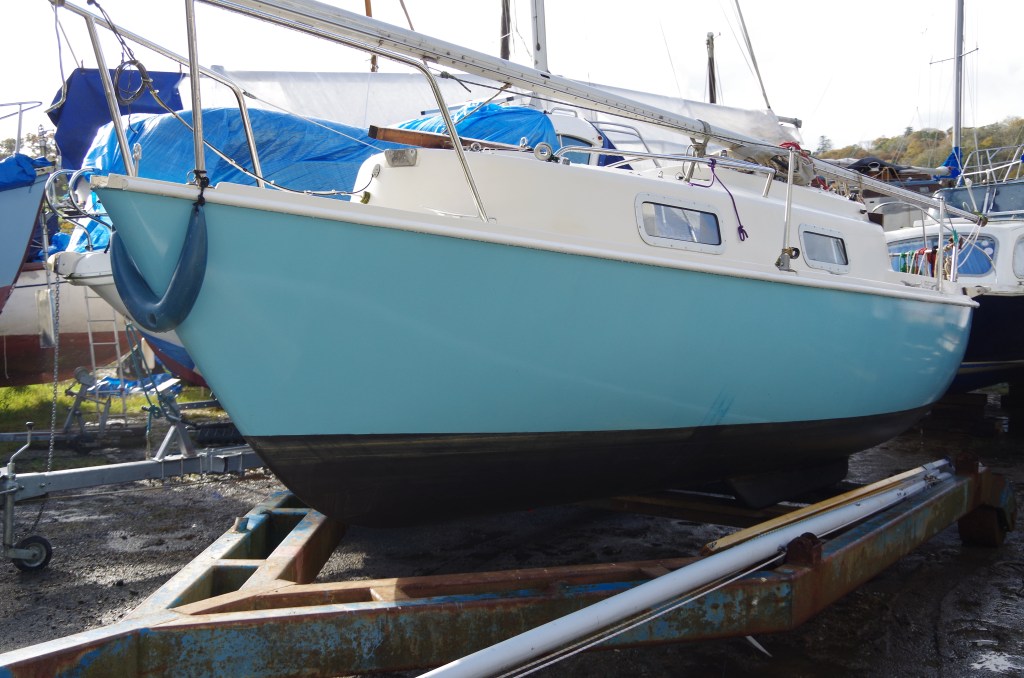
A week or so later I was mostly to be found under the Liberty where I scraped, sanded and sanded again until the underside was ready for new primer and super smooth antifouling. Just that job alone was several days filthy work lying on my back underneath the boat and even with mask, goggles and hood I came out looking like a 1930’s miner. It was worth the effort though because a few weeks after that I made a fast and slippery passage downwind from Falmouth all the way back to the Lynher in an easy daysail…….what a difference it was !
Back to the boatyard though….
There was a polite knock on the side of the boat and then in my view a pair of shoes and ankles the other side of the yard trolley which I was lying mostly underneath of – my online friend and fellow boat blogger Steve Parke had turned up to give a kind-of interview for my then book project which I had started during my long Brittany cruise.
Just to say that the same book project is still festering on my computer’s desktop but it’s on about the third or fourth iteration and basically stalled because my main attention for the last two years has been on the boat that i’m building in our drive. I hope though that the connection with Steve came good to some extent with the blog piece I wrote here about ‘Arwen’ – the slightly smaller Navigator design that Steve built at home and sails locally. Having featured in one piece I hope that I can get away with Steve being the fall guy for part of this post.
https://dirtywetdog.co.uk/2022/07/18/meandering-with-arwen/
I said then and I’ll say again that I greatly enjoy Steve’s video’s and I hugely respect that Steve built his boat ‘Arwen’ at home with very little woodworking experience and as far as I can tell learnt to sail her on the basis of no practical experience. Steve sails, films and blogs locally so I get to see my own home cruising ground through different eyes and with a very different perspective – Steve himself describes his approach as being micro-adventuring. He seems to enjoy himself out there which is the whole point really but I want to say this in as friendly and respectful way as possible – his sail trim is absolutely pants !.
Steve recently filmed a 2 part post in which he finally got around to setting up the Navigator’s mainsail so that it actually sets like a sail should instead of looking like a bag of………and not producing any worthwhile power. It’s only been, what, 8 years sailing like that and as I commented on his video that his sail trim kind-of has me twitching a bit : for me Steve’s sail trim was a bit like being subject to Vogon poetry or more extremely anything with a mathematical equation in it. I have a special chair for that just like the Vogon poetry appreciation chair in the Hitchhikers guide – for Vogon poetry, maths and Steve’s sail trim I always found it best to be tied firmly into a chair, gagged and lightly sedated…….that way the neighbours don’t complain about the screaming quite as much.
Sorry Steve ……….but Arwen is going so much better now as you can see in the first of his recent video series.
If you’re wondering what this is all about then i’m making a few simple observations about small sailing boats, their ‘performance’ and how easy it is to lose the small amount that we already have hence the title suggesting that maybe we shouldn’t throw away the little that we have.
Most of my readers will know full well that the boats we sail are both small and often a bit old and tired just like their owners and secondly that they usually have a hard limit on their hull speed which is defined by their waterline length. Having admitted that maths make me twitch I have enough to be able to quote, write out and use the waterline length/speed equation – I can’t do it here because , as far as I can tell, my keyboard doesn’t have a key for square root and that’s needed in the equation. Several years back in the blog when I was considering moving up a size in cruising boats I spent a long time calculating the theoretical hull speed of several boats that I was thinking about going to have a look at.
Our boats are mostly displacement boats as well and what that means is that they are hard-limited by their displacement wave except for the rare few moments when they catch a wave and surf for a few seconds. I’m not sure whether Steve’s navigator design can plane although designer John Welsford states that my Pathfinder design, which is similar, can do ……and I’m up for giving it a go although I do anticipate getting wetter than usual.
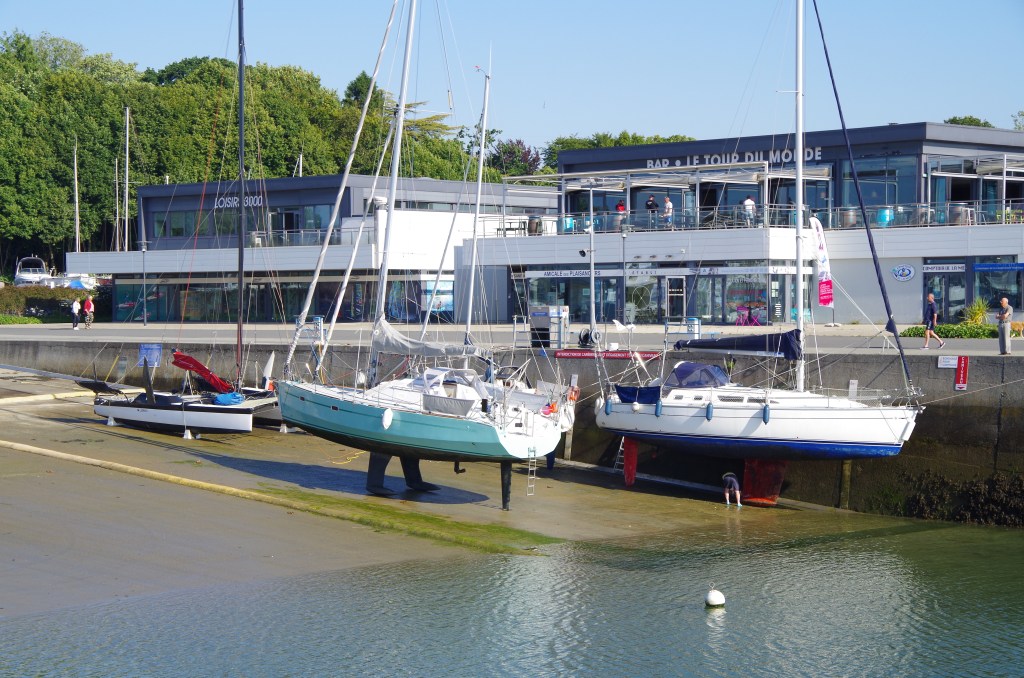
Lets say though that in normal conditions my previous cruising boat had a hard speed limit at around five to five and a half knots in ideal conditions but that it was very easy to lose a big chunk of that just by having a growth of barnacles and weed where I couldn’t get at it. As I said earlier I gave as much of the underside as I could get at a good scrub but had I stayed on in Brittany I would have dried the boat out on the big slipway in Brest, quickly wet sanded the hull and given it a fresh coat of antifoul there. In practice though I knew that the bottom of the Liberty was at that stage of it’s life that it needed all of the old paint off and all new priming and new hard antifouling applied – no way that I could have done that between tides.
So……our boats don’t start off with much performance anyway and then it’s stunningly easy to throw a large proportion of that away by just having a dirty bottom (in my example) poor set-up of the rig and sails as much as dynamic sail trim on the water (in Steve’s case). There are however several other really common ways of inadvertently making a slow boat into a really slow boat so I thought that what I would do for this post is to make a top ten list of reasons as to why your boat is on a go slow.
From the bottom up – from the smaller speed problems to the greater ones.
Not doing tasks fast enough or when needed – I put this one at the bottom of the list but it’s also going in a separate post about the problems of being around racing skippers. Here it’s just about the all too familiar problem of skippers that get ‘shouty’ when they think that tasks aren’t getting done quickly enough ; be that hoisting a spinnaker at the mark, reefing/unreefing or whatever. Where it does make a difference though is actually reefing and usually not reefing early enough and this relates to the first 2 dynamic problems (next)
Sailing with poor rudder trim – related to the above but iv’e experienced skipper after skipper who thinks that they are driving the boat hard because it’s well heeled over and they are heaving on the tiller – meanwhile the rudder is dragging through the water like a brake and the bigger the boat the more speed is lost……..just take the fekin handbrake off and go a bit faster !
Poor sail trim and/or poor sail set-up. Of all the reasons for having a slow boat it is sail trim that is the one that has most impact dynamically on the water whereas the other ones are usually problems of poor preparation. Sometimes poor sail trim is simply down to old and saggy sails on old and stretchy halyards and then rigs not set up with the appropriate shroud tension, mast bend and so forth. On the water it’s often the case of not even having the right sails for the job – that’s partially the modern cruising sailor’s curse of the roller furling gear creating a terrible sail shape in a breeze…..or at the other end of the spectrum not having dedicated sails for light wind/downwind sailing. In the 80+ year old gaffer ‘Inanda’ we and another gaffer clearly and easily out sailed a pair of much larger and much more modern cruising yachts simply by using our big gaff mainsails an tacking smartly downwind…….that’s partially a sailing knowledge problem too.
Carrying too much weight or having weight in the wrong place – many cruising sailors don’t attend to the amount of unnecessary junk that they are carrying and more importantly where they are carrying it. With the little Liberty I made a distinct improvement with the way it sailed just by taking the weight of a heavy anchor, chain and warp, off the bow and stowing it in a wider part of the boat aft. At the same time I moved all significant weight in and down towards the center with the result that the boat became a lot more ‘lively’ and tended to lift to waves rather then trying to go through them.
Dirty bottom, from my own experience I calculate that I lost a fifth of my boatspeed (20 %) just by having a growth of weed and barnacles between the bilge runners where I couldn’t get at them. Over a 100 mile passage that may have added as much as 4 hours to my time at sea.
Lots of the relatively minor stuff that many racing skippers get stressed and shouty about on the race course often have little impact on boatspeed – except that while they are stressed and shouty they usually aren’t concentrating on sailing well. The basic lesson of sailboat racing is that boatspeed happens during preparation and not so much on the water – having a super smooth bottom happens by long and dirty work in the yard – hours of filthy wet sanding being a specialty of mine. What else happens there, or at least before taking part in a race is trimming the boat by getting all of the weight out of the ends of the boat and where possible getting most of it off the boat.
Racing does teach some good lessons though ; a season or two of dinghy racing will teach far more than I can say about sailing by feel, about experimenting with sail trim and so on. In offshore boats it relates even more back to cruising boats because offshore races are held in nearly every condition possible from ghosting right up to sailing through a gale. What that teaches is how to sail a cruising boat in all conditions – that’s a good start for the cruising sailor – and it teaches a lot about patience and endurance sometimes too.
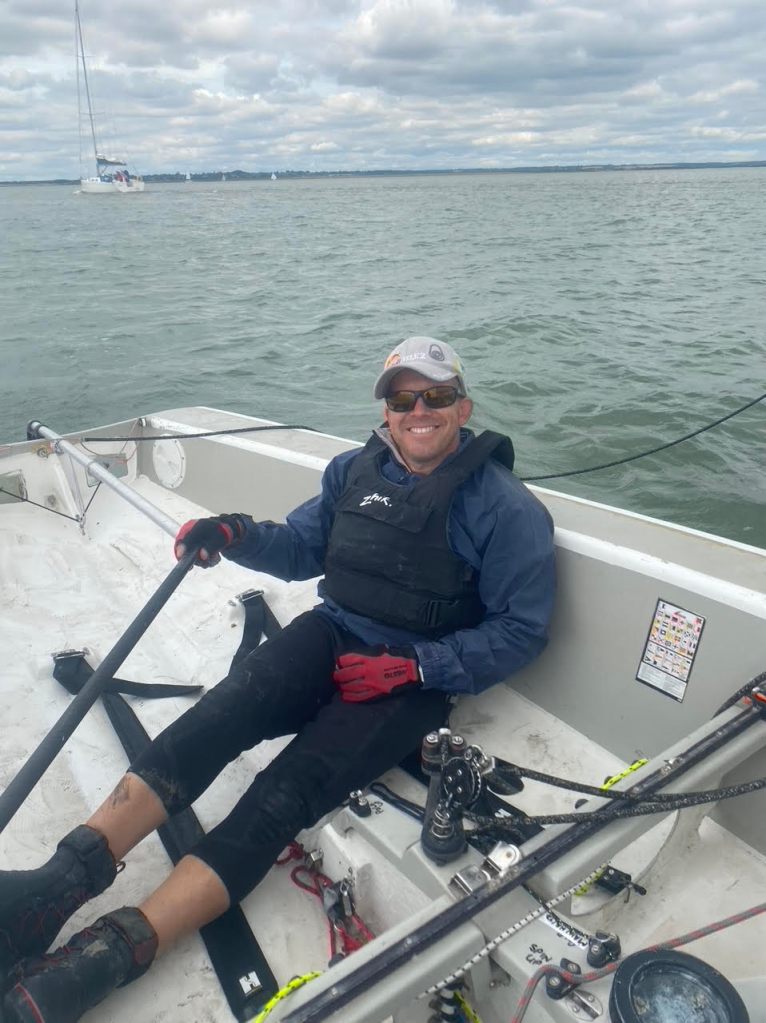
Our man Gavin cruising along in his retired Osprey class dinghy.

 Dirty Wet Dog, the great adventure.