

Pathfinder project build, Autumn work 2022.
Title photograph : Capucine Trochet and TaraTari ( Capucine Trochet photograph)
For a bit of fun today let me start this post with a sea story so obviously……
It was a dark and stormy night……
It was in fact as dark as it ever gets in open ocean, there was no moon or stars and a heavy overcast of thick cloud – what’s more it was blowing hard, about 40 knots in the gusts and with that the sea state was going from the typical long swell of the Southern ocean to something a lot more chaotic.
We were down in the Southern ocean, not far west of the Horn only a couple of hundred miles under our lee – we were just about at the right latitude though but the wind direction was such that we were running almost square so that we clear the small group of awash rocks that lie just south and west of the great headland itself in the next day or so. Rather than risk a heavy weather gybe in those conditions we were only using the best experienced helmsmen and only taking short tricks at the wheel.
Down aft in my comfortable quarter berth I was warm and relaxed in that state of semi alertness that comes from the slipping and sliding of the boat down and through some big waves – that and the cold Southen ocean hissing past the hull just inches from my head. At a quarter to midnight I was already rolling out of my bunk and clambering into damp and chill foul weather gear and in total darkness below because the driver up top didn’t want the distraction of harsh light as anyone opened the companionway hatch. I grabbed my mug of tea and made to stand on the hatch ladder with my head under the dodger but it was a clear order of either up or down and keep the companionway hatch closed.
Up top then it was much colder as I worked my way around a couple of crew in the pit and stood behind the wheel alongside the helmsman who I could hardly see except in the tiny amount of light from the compass and wind instruments. He said to put a hand on the wheel to get a sense of how and when he was steering the boat ; in the near total dark and running nearly dead downwind there was little to go on so I pushed the hood of my jacket back so that I could at least feel the wind direction on the back of my head. After a few moments I took the wheel while the previous helm called out advice as I got used to the feel of the boat and what the waves were doing – it was all a bit chaotic but after a few minutes I sent him below, asked for ‘dark ship’ and only to have one person on deck with me and clipped on ; the rest of the watch was to be fully dressed and on standby but not on deck.
I steered for an hour and it was one of the wildest runs I have ever steered at night and in total darkness, at the top of the hour I was wondering who of my watch to put on the wheel but just then the hatch slid back and it was the skipper who came up to take a trick…..he told me to go below, get a hot drink and relax for an hour. At the same time we rotated my watch members so the ones below went on deck one by one and the other ones came down to have a brew with me. My oilskins were streaming with water so once I had made a coffee I just sat on the soleboards with my back against the galley bulkhead.
The motion of the boat was steadily becoming more pronounced – it felt to me that there was a new wave direction coming in over the top of the deep westerly swell and the skipper was having to correct for that. Just then a different sound became apparent, like a low rumble from aft and then suddenly an almighty BOOF at the transom and then the sound of lots of water sluicing down the deck just over my head. Looking towards the companionway hatch and washboard I could see jets of water coming into the boat and I could hear water gushing in somewhere aft.
When the gush of water subsided a bit I pulled the companionway hatch back enough such that I could stick my head out and see what problems there might be…..there seemed to be a tangle of bodies in the cockpit and nobody at the wheel…..the skipper having been thrown right over the wheel and he was trying to disentangle his safety harness. There was a lot of water in the cockpit but the deck watch was sorting itself out and as far as I could tell there were no obvious injuries. Below, I went forward and set-to pumping with the manual bilge pump, after a few minutes it sucked dry so I went back to the galley and did the most important job of all…..put the kettle on.
Sadly I don’t have any photographs from that time, it was a long time before digital photography and the wet salty conditions had already killed one camera – not that it would have showed much by the time we got everything sorted out. In real time that must have been the back edge of that storm because when I went out on deck to take over again the wind direction had shifted around to the north and I could see a few stars and the white tops of some very big waves.
In this post I don’t actually want to dwell on hairy-arsed heroics in big boats in the Southern ocean – BTDT – as some would say. Nowadays I sail small boats and my usual longest passage is just over a hundred miles ; nowadays I don’t choose to go to sea in heavy weather because the greatest danger isn’t being out in the ocean with sea room to leeward but rather inshore and close to land where the swell heaps up and the waves shorten and break.
When I looked at the statistics for RNLI lifeboat callouts a few posts back I noticed that there are very few callouts to boats or ships in difficulty due to heavy weather……..most callouts happen in light to moderate conditions, partially I guess because most boaters stay in port during a blow. Getting caught out in hard conditions can still happen though – a few years back for example I got caught out in blizzard conditions on the wrong side of Lyme bay and that was as near to a Southern ocean experience as have ever had in UK sailing conditions.
The reality of sailing in British (and Breton) sailing conditions is that i’m going to have to deal with a lot of light weather and moderate conditions, some ‘brisk’ days and a very few heavy weather days where I might just decide to stay at home or shelter at anchor somewhere. In a way, what’s important as I start to fit-out the Pathfinder, is that I set the boat up to sail well in light to moderate conditions but also set up really well to anchor. My experience from observing most modern cruising yachts is that they can neither sail well in light weather and run for the marina rather than make for a secure anchorage during a blow.
Anchored and beached in shelter…..and blowing a full gale in the river.

Having spent two years definitely building a Yawl and knowing that one thing I would be able to do is to heave-to easily I changed my mind almost overnight and am now almost definitely now building a sloop. According to designer John Welsford it should be a faster sailing boat than the Yawl option but will need different setting up for heavy weather – the enjoyable part of rigging this boat will be piling on as much sail area as I dare for light conditions ; the necessary part will be setting it up to still be able to sail in hard conditions. The kind of thing I have in mind here is coping with the blizzard-like conditions I met in spring a few years back in Lyme bay – I had no choice but to sail as hard and fast as I could and that day is now a kind-of benchmark sailing day for small craft in my mind.
My initial sailplan with the sloop option will be based on a slightly taller but shorter gaff mainsail and a correspondingly taller jib to be set flying out on the bowsprit. I’m tempted to have a choice of jibs – starting with a standard ‘working’ jib and maybe an overlapping genoa as well – i intend those sails to be free flying or set on a jib furler but either way they would be doused into the cockpit and swapped over . Some sailors do that with an old style Wykeham-Martin furling gear or a more modern jib furler ; having struggled with a Wykeham-Martin gear on ‘Inanda’ I would bever consciously buy one and I might just have simple free flying jibs which is how I ended up sailing that boat.
For heavy weather I intend to bring my sail area both down and in….in towards the center of lateral resistance and low of course because the Pathfinder will only be a lightly ballasted boat. Rather than the Yawl option in heavy weather (Jib and Mizzen) I intend to have a small jib, essentially a stemhead set staysail and a mainsail built with 3 reefs. I don’t know how much of a wind and sea state range that will give me but in the kind of blizzard and force 7 sea state that I experienced in Lyme bay I could maybe sail under just the deep reefed main or in the extreme just the staysail in downwind conditions.
An interesting thing came up recently concerning the beautiful bright yellow Bolger Chebacco that I photographed several years back during my Brittany cruise – I have since spoken with her owner online and found out that he is also building a Pathfinder. In his FB page he showed a picture of the Chebacco sailing in brisk conditions under a Trysail and I wondered about also having one made for my Pathfinder. My plan, if I do, would be to hand the main completely and attach the trysail with a few parrels around the mast.
In this photograph I think that Didier’s trysail is the red bundle possibly on a furler next to the mast.
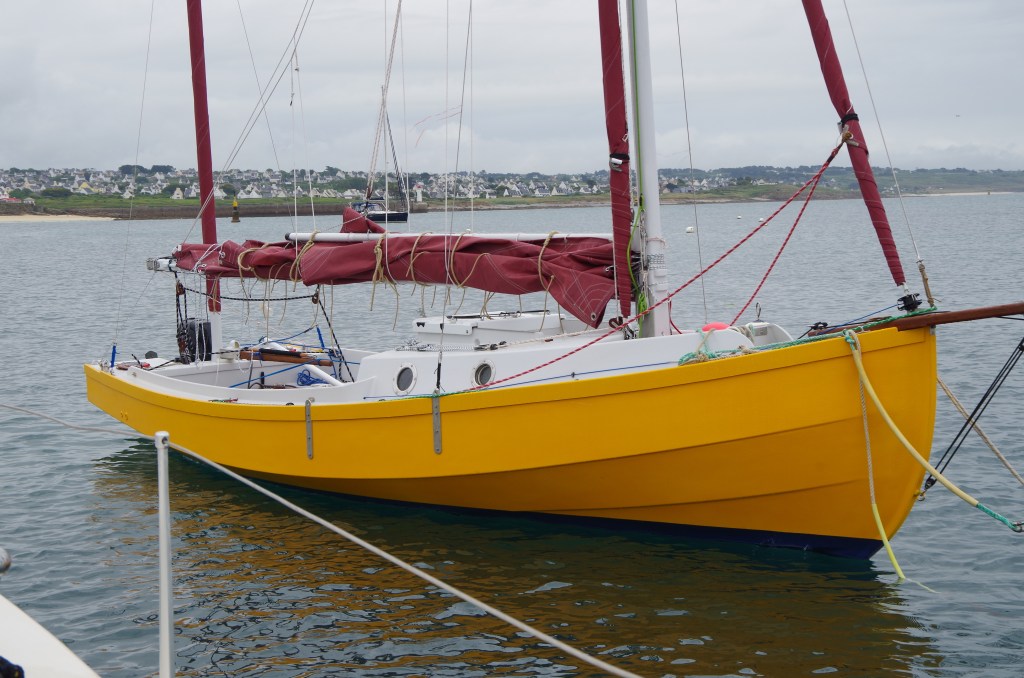
This is the recent photograph that owner Didier Carou posted on his FB page.
Didier Carou photograph.
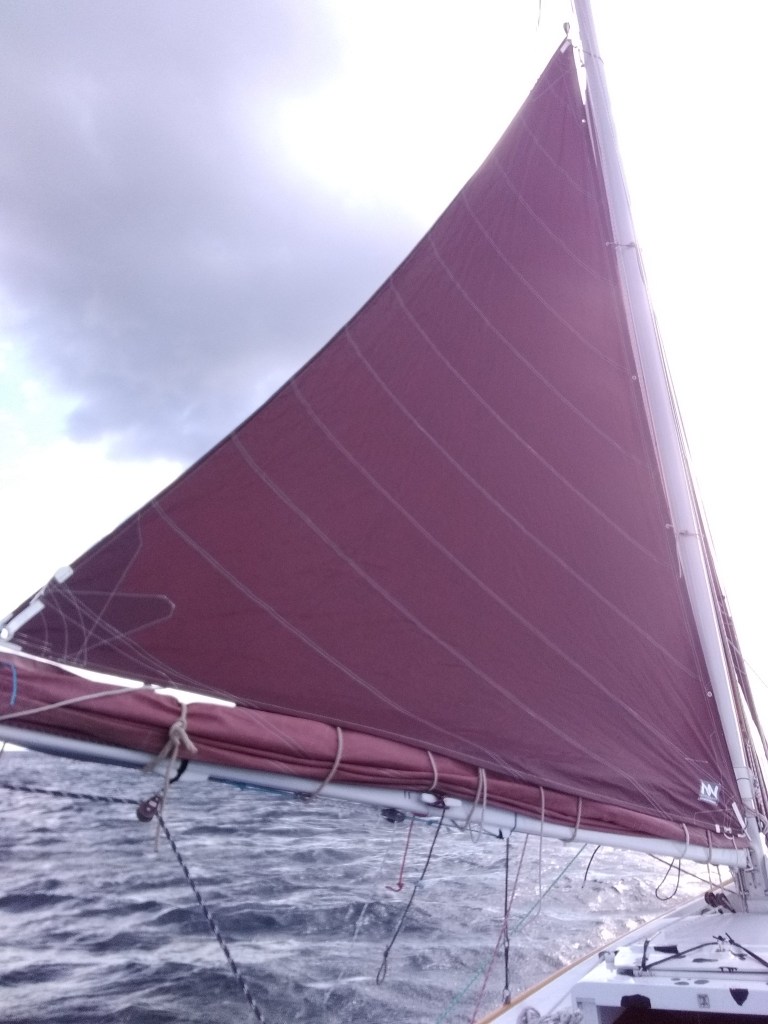
With Didier’s permission I posted the above photograph on the John Welsford designs page to see what other builders and skippers thought about sailing with a trysail on the Pathfinder design – most members seemed to be either against the idea or had little experience with trysails. In my case I only ever rigged the trysail on the Horn rounding maxi once – and that was only in harbor to work out how I might do it in anger – in practice it was extremely difficult and we never rigged it to sail under it .
Many years ago I sailed with a former master mariner who’d owned some older gaffers over on the east coast – this would have been in the early post war years – and he told me that some yachtsmen who kept their boats on river moorings and sailed throughout the year used to stow their big gaff mainsails away (or send them to the sailmaker) and instead bend on a winter trysail. Iv’e never come across any written reference to that even in east coast writers such as Maurice Griffiths who sounds as though he was an all year sailor ; the only small boat reference in my entire library is the late Charles Stock who states that he carried and used a heavy weather trysail on Shoal Waters.
I checked in his book (Sailing Just For Fun) and in his section about the rig he talks about his trysail which in fact was a small gaff sail of 45 square feet and set on it’s own yard. He says he used it when the wind strength/sea state went over a Force 5. That doesn’t seem to be a lot of wind but then sea state isn’t directly wind strength and also his boat ,Shoal Waters, was basically a 16 foot sailing dinghy with some ballast and a cabin ; he doesn’t say how much ballast.
The Pathfinder cruising dinghy that i’m building right now is both longer and wider than Shoal Waters so I should be starting off with higher form stability and she will have functional ballast in the form of a 60 Kg battery in it’s own box and compartment plus I may add some extra ballast in the form of water bags under the sole. Thinking about it now one of my winter exercises should be to work out the sail area at each stage of reefing and changing down jibs – I can see that I would get to a point of having 3 reefs pulled down and a staysail set on the fixed forestay and maybe still being a bit overpowered. At that point having a trysail or a ‘square’ (gaff) trysail like the late Charles Stock’s might be a very useful tool to get me home in a blow.
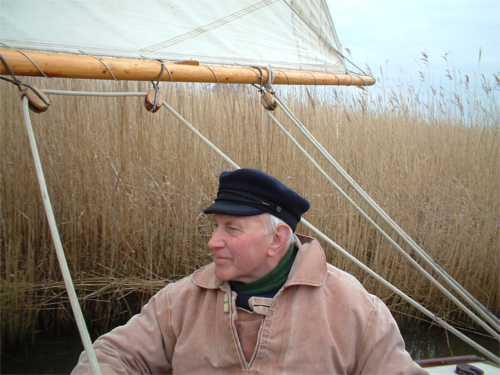
Below…..the late Charles Stock (photographer unknown).
Heavy weather postscript.
My sea story at the start of the post doesn’t represent the worst weather we had during our transit of the Southern ocean during that circumnavigation – for that we were amazingly tied up to a ships mooring in one of the sounds of the Kerguelen islands …….ok then, go and Google it !.
Heavy weather downwind sailing is par for the course down in the Southern ocean and the best way to deal with them in boats that will run fast is to keep the pedal to the metal, have good downwind drivers taking short tricks at the wheel and basically to run as hard and fast as possible.
Very different and I think more potentially dangerous was meeting heavy weather in the North sea, close to home near the end of that trip. As I remember it we were coming back from arctic waters and were closing the English coast somewhere north of Holy island but in a hard and cold easterly gale ; we felt it best to stay offshore because we were essentially on the lee side of the north sea with enough fetch for the waves to heap up and break. Looking ahead we really didn’t want to be running up the Thames in a hard easterly gale (strong gale by then) against an outgoing tide so we ran off and surfed into Hartlepool harbour where we slapped the big boat up against the wall for the night and as I remember it headed off to the pub…….first time back on English soil (or concrete at least) for a whole year.
Bloody miserable place too …….(voted one of the worst and most depressing towns in the UK)

 Dirty Wet Dog, the great adventure.