
A small boat cruising post.
The follow up post to my previous one about setting up a small cruising boat for an independent and self reliant ten day cruise.
In my previous post I wrote about an experience I had with my last cruising boat , a 22 foot Hunter Liberty cat ketch, in which I lived aboard and cruised for 110 days mostly around the western and southern coasts of Brittany. That was a slightly unusual thing to do in this day and age when cruising boats seem to get bigger every year but don’t seem to spend much time out of their marinas and actually cruising ; even more unusual was that I did a small boat cross channel passage of 110 miles each way and solo too.
During that summer of sailing I also experimented with setting up and provisioning the little Liberty for a series of ten day independent cruises as a kind of training exercise for potentially longer voyages in that boat. In the previous post I said that I would talk about the cruising and the provisioning , I had a look for my log book from that time because I kept extensive notes about what I bought, what kept, what worked and what didn’t – and all of that alongside the actual cruising log. Of course……I can’t find my logbook so this is a lot from memory and some of those ten day cruises blur into each other a bit three years and a pandemic later.
Anyway this is a sailing, cruising and cooking post so lets begin with a cruising story ……and a bacon sandwich – hands up anyone who starts salivating whenever bacon sandwich is mentioned.
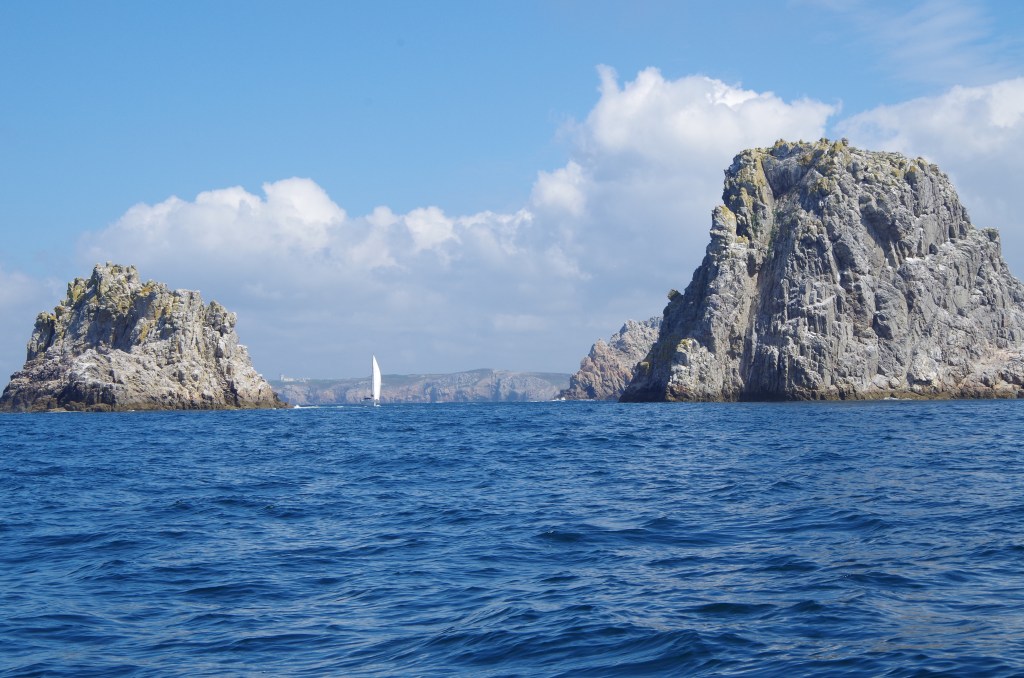
There is a small bay with it’s own beach a few miles, by land, south west of Camaret called the Anse de Pen Hir, by sea it’s a bit further because of having to get around the rocky headlands of the Pointe de Grand Gouin, the Pointe de Toulinguet and to then thread the needle of the passage through the Tas de Pois. Turn back to the north east there and in the right conditions the Anse de Pen Hir makes for a lovely anchorage over a clean sand bottom – near low water I anchored there in less than a meter of water with the boards already up and later on went for a wade and swim in the clear water.
The passage through the Tas de Pois…..it always feels tighter than it looks but it’s a deep water passge.
After a quiet and settled night there I woke up with the sun and when I stuck my head out of the hatch I noticed that there was a light northerly wind blowing off the beach so as soon as I got the kettle on I stripped off the sail covers, hoisted the mizzen and shortened up the rode for a quick and quiet getaway. With my morning coffee made and set in a corner of the cockpit in my favorite insulated mug I quickly hoisted the mains’l and as quickly I plucked the anchor off the sand and stowed it in it’s bin at the back of the cockpit. The little Liberty started backing down through the anchorage still head to wind until we were clear of the yachts in deeper water and then I let the mizzen out and sheeted in on the main…..the Liberty then pivoted on the spot and started running off downwind towards the tip of the Crozon peninsular – some 8 or 9 miles to the south.
The little Liberty was a very good sailer in light downwind conditions and it looked like being an easy but slow passage so instead of just sitting at the helm for a few hours I set the Tillerpilot to do the work and set to with making breakfast while standing in the companionway with my coffee and a couple of rashers of bacon sizzling in the pan. I finish my bacon sarnies, by the way, by giving them a couple of minutes in the pan in the hot Olive oil and bacon fat and then giving them a splodge of ketchup – that first one was so good that I had to check and make sure by having a second one and then a second coffee just to wash that down with.
Tough life and hard rations on this little sailboat !
Start and finish….on the foreshore at Camaret sur Mer, possibly my favorite port of all.
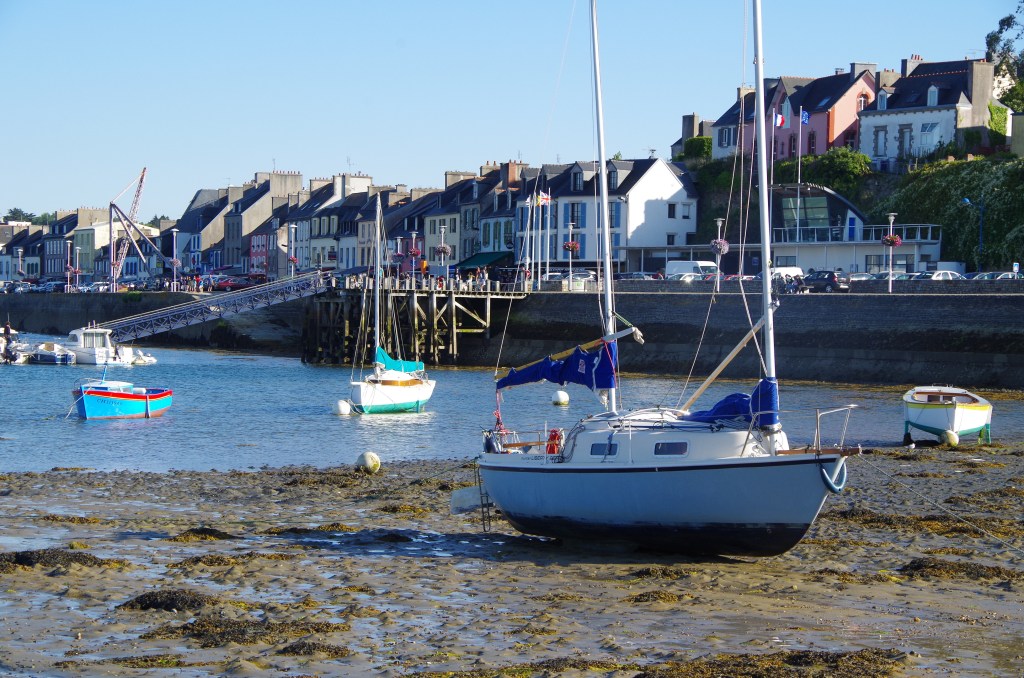
In the follow up to the follow up i’m working on a post about anchoring and beaching the Liberty because I often ‘parked’ the boat on a beach , foreshore or alongside a quay, often on an unknown bottom, so that I could get ashore and go do my food shopping . In the photograph above the little Liberty is ‘parked’ at the head of the inner harbor at Camaret sur Mer only about 50 yards away from L,Espadon bar where I often waded and walked ashore to in the evening to have a beer……chosen carefully French beer isn’t that bad but good fish and chips are nowhere to be had !.
I do remember that I was right there, at the northern extremity of Camaret’s inner harbor because the wind was blowing briskly out of the north to north east and that was kicking up a short and breaking chop in the bay. I needed to go both north and east a bit because I was waiting to sprint up the Chanel de Four and be in position in the estuary at L.Aber-Wrach to make use of a short weather slot to make my return channel crossing.
Being on the foreshore at Camaret sur Mer was the best place to be for a few days because , aside from the natural shelter here, I could just walk through the town to do my food shopping and water stock up, check the meteo reports at the harbor office and have an excellent coffee at my usual spot on the harbor front. The significant part of all of that was that I was leaning on my experience of a series of ten day cruises and this would be the final one that would get me back across the channel and into either the Helford river or the Fal and then home to the Tamar without having to stock up again.
As it worked out I had a much better channel crossing on the way home and I made the entrance to the Helford river just as the wind came right around to the west and we had a harder beat up into shelter again. After a good rest – I had been on the go for 30 hours and at sea for 24 of those I made the short run back downriver and across to Falmouth because what I really really wanted was proper fish and chips just up the lane from the town marina.
Back in the Helford river, UK.
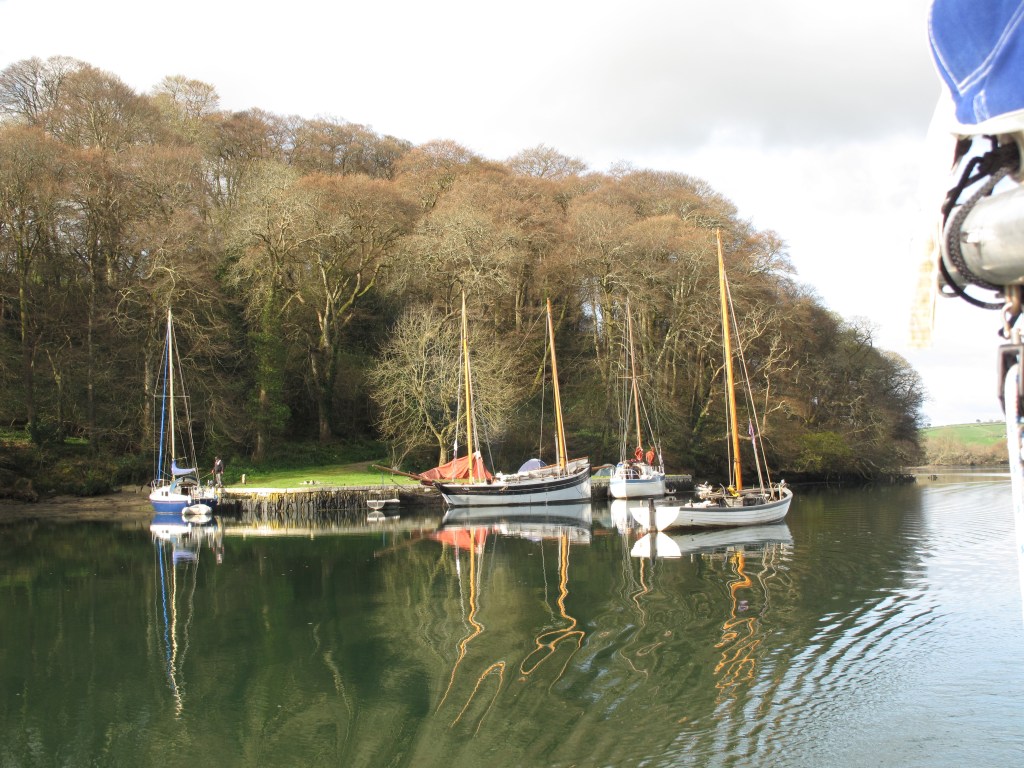
Small boat…..weight and stowage recap.
Something I discovered about the Liberty is that it was very sensitive to where weight was in the boat, it almost seemed to behave like a small IOR race boat that really didn’t want weight in the bow – that discovery came about when I moved my relatively heavy anchor and chain out of the bow locker and kept it instead in the cockpit. After that I really had a long thinking session about re ballasting and re balancing the boat with much less weight in the ends and much more weight in the center and low down around the centerboard case.
Several practical outcomes came directly from that, firstly that I added a large AGM battery (160 Ah) in the space just under the companionway, three twenty litre containers of drinking water next to the centerboard case just inside the heads compartment and my second anchor, it’s chain and any other heavy gear in my centerline stowage compartment under the permanent bunk infill.
During one season’s cruising, when I ended up over-wintering the boat in the Exe I gradually worked out that the boat would carry a significant amount of water, fuel and food as long as it was in the right place. I also found that it was convenient to store fresh food in a pair of plastic crates in the former heads compartment – that also meant that I could remove the entire ‘wet’ and dry crates to transport them to and from the boat and notably to wash the ‘wet’ (cold box) crate right out at least before a re provisioning stop. Just like at home I also stocked a long term dry food larder under the bunk infill to take the heavier stuff like tins and jars…..if that all sounds like a lot of food stowage space then yes, it is, but I liked to keep the boat ready to go to sea at any time and thus kept fully stored most of the time.
Happy days…..autumn and winter at Trout’s yard on the Exe at Topsham.
Meanwhile….back in Brittany.
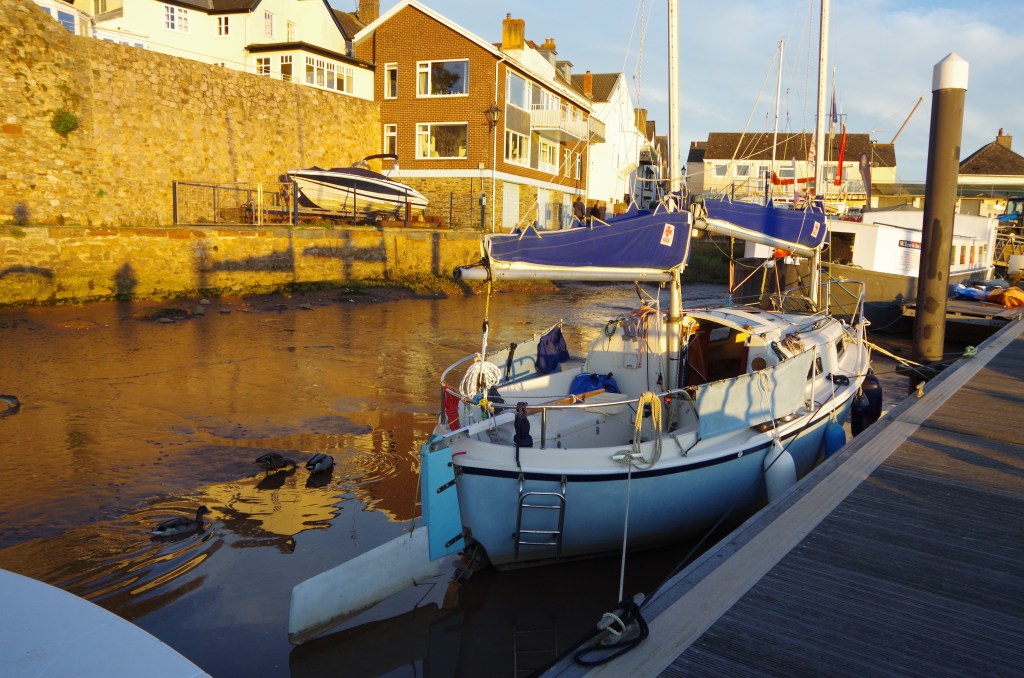
It might seem that way but i’m not specifically anti marina and I will use one if I have to where I can’t come alongside a quay or ‘park’ on the beach , in Brest and then again in Benodet and nearby Loctudy one or other marina was just about the only viable place to leave the boat, find drinking water and to then walk up to the nearest supermarket. Maybe it was too early in the season but I often found the marina office , where there was one, unmanned – only in Paluden did the harbormaster come and find me and that was just to advise me about the slope of the foreshore next to the quay and I was only just about able to tell him in my far less than competent spoken French that the little Liberty had two short external keels that it would sit on.
Paluden quay.
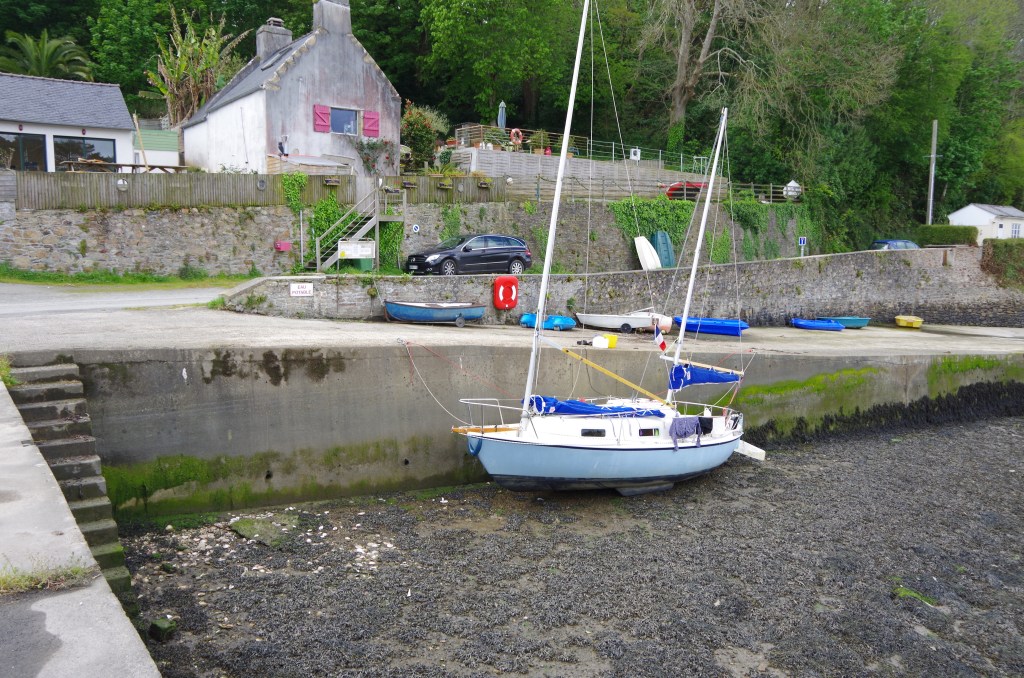
Paluden quay was the first place that I went ashore a few days after making my ‘frisky’ outward channel crossing – for frisky just read brisk south-easterly versus big spring tide and you get the gist of it. Anyway, after a couple of days catching up on food, drink and sleep I had to go and find a supermarket as Paluden has a quay with a tap and a creperie but no shops , it’s also a good mile uphill to Llanilis that has very good shops, an even better cafe and where the best supermarket is out at the far end of town.
There is a general outdoorsman’s method of calculating the weight of food and cooking fuel required for any outdoors adventure and depending on what type of food is carried and what the caloric requirements are ; clearly, basing my sailing diet on mostly fresh food rather then freeze dried gloop will give a heavier shopping trip especially when combined with carrying a block of ice for the cold box plus a 5 litre can of alcool brule’ (meths spirits).
In case you are wondering I’m used to doing heavy carry’s for several days in the mountains but in the Paluden situation I did my big ten day stock up in two trips and enjoyed the exercise – there is a bus route between Paluden and Llanilis but I never worked out the times or saw a bus so…..
A ten day/one person shop plus ice and fuel comes to about 30 pounds in weight so I tended to use the combination of a rucksack for the heavier stuff and two heavy duty shopping bags for the lighter stuff in one and the block/s of ice in the other.
In my past as a racing sailor I spent several years as BN aboard a one ton IOR yacht and used to do the provisioning and stowage for that boat, an overnight channel race with 6 or 7 crew is close to the same amount of weight but obviously it goes up and up with bigger boats and large crews. When we first stocked up a maxi yacht with our major stores for the first leg of a circumnavigation we filled 10 supermarket trolleys at the Bursledon Tesco and thankfully they closed an aisle for us but then apparently they’re used to big boats doing their shopping there. It took me several days to do the food stowage and that was even before we got to the fresh meat and vegetables – small boats are a heck of a lot easier.
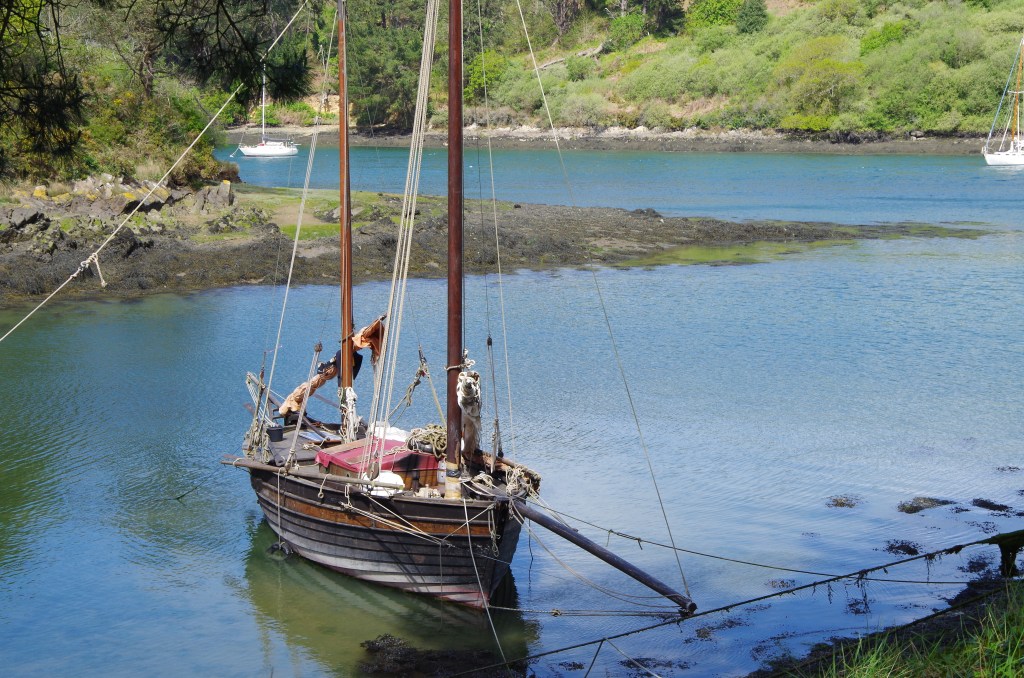
Walking out from Paluden quay, back downriver, I found this little bay (L.Anse de Enfer) with Rose of Argyle moored there.
My ‘main food’ cycle.
As both a long distance hiker and cruising sailor I have been somewhat conscious about weight carried, that’s a lot more important when it’s in a rucksack on your back and you’re carrying it over long distances in the mountains – in fact it requires training and careful ‘stowage’ of the rucksack just like a boat does. We’re a lot less conscious about the way weight is affecting our boats, generally speaking, and all boats have a certain weight carrying capacity and that’s one thing that determines their cruising range ; as a rough guide for the Liberty’s weight capacity I usually worked with it being effectively a 3 bunk/3 person boat so I allowed for the normal weight of 3 adults and their gear.
In practice I used the weight of one person just as my drinking water capacity (60 liters) and when doing these solo ten day cruises reckoned on about 30 Lbs of food (sorry to use imperial rather than metric but that’s the way I think about food weight) and then I usually had at least 10 liters of cooking alcohol and around 20 liters of petrol for the outboard. Fresh food, cans and jars are a lot heavier than dried/freeze dried hikers food but honestly there is no comparison in food quality and food enjoyment although when I was thinking about voyages longer than about 15 days in a small boat I would find it more difficult to keep fresh food in good condition and would have to lean more towards dried and otherwise prepared/sealed foodstuffs.
Our actual food cycle for both hiking, canoeing and sailing is heavily based on two similar things which are meal cycle planning and carbohydrate cycle planning – there is a different approach put forward by one of the USA based outdoor schools and that revolves around weight of main food types (carbohdrate, fat, protein) carried and although I experimented with that I never got it to work solo or with just the two of us.
The meal plan/carbohydrate cycle is simply based around a 3 day cycle which goes ; pasta, potatoes, rice as the meal base and then whatever goes with each one on the day and with whichever other foodstuff needs using first. A simple example is that we usually carry 2 forms of dried pasta and sometimes one pack of fresh pasta in the form of couscous ( a form of pasta) penne and when available something like a ravioli pockets with filling. We often bought a pre made couscous in French supermarkets and that was often a first and later meal base as the first one would use up salad leaves which hardly last at all aboard a boat , chopped up to make the basis of a couscous salad.
My mealtime thinking was then based around which carbohydrate base I was going to use that day and what to put with it – neither of us are vegetarians but both of us like similar tastes and textures when it comes to main dishes ……plus I enjoy camp and boat cooking and my partner seems to enjoy what I make as long as it doesn’t contain a few specific things (Olives as one example).
When it comes to Brittany and food most people will think about fish and shellfish but as it happens I am strongly allergic to shellfish and I don’t buy and cook with fresh fish because I just don’t know what I am doing with it and am wary about stowing fresh fish on board – on the other hand I’m a total peasant when it comes to tinned Tuna which I just treat as canned meat. While I am thinking about meat our diet at sea isn’t heavily meat based but some products I always look for in French supermarkets – one being a cooked and vacuum packed chicken breasts labelled as ‘Poulet Roti’ which keeps well for days in the coolbox – I often use that, sliced up and quickly seared in the pan to add to a couscous or potato dish.
Jackie steers……I make bacon sarnies.
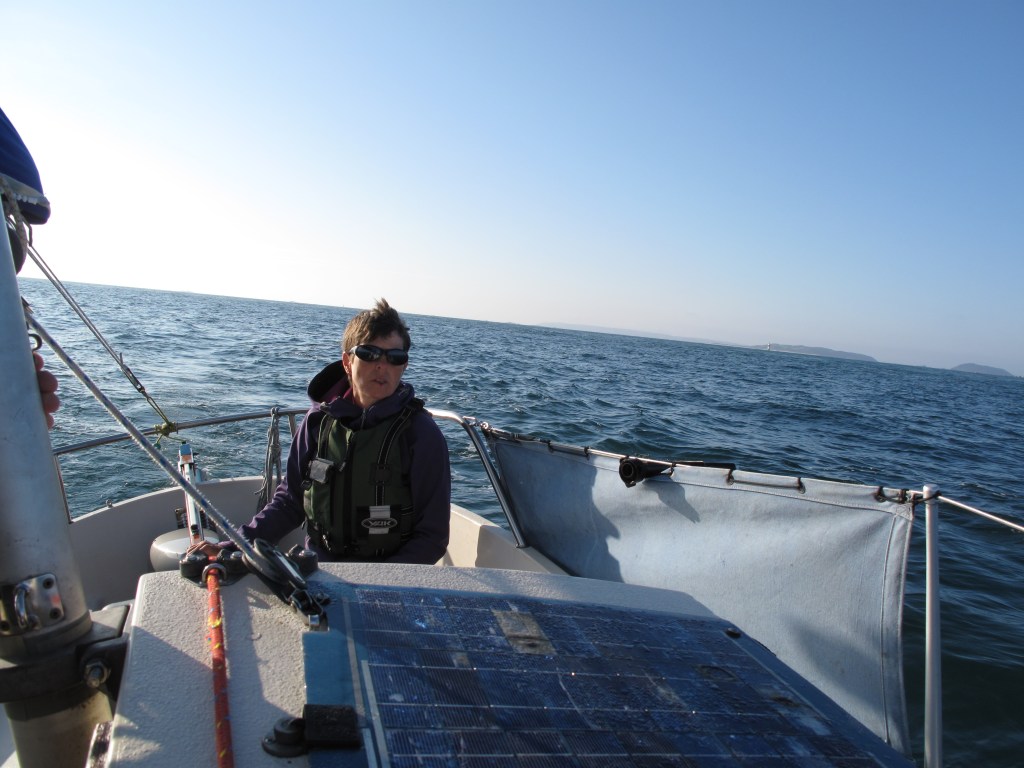
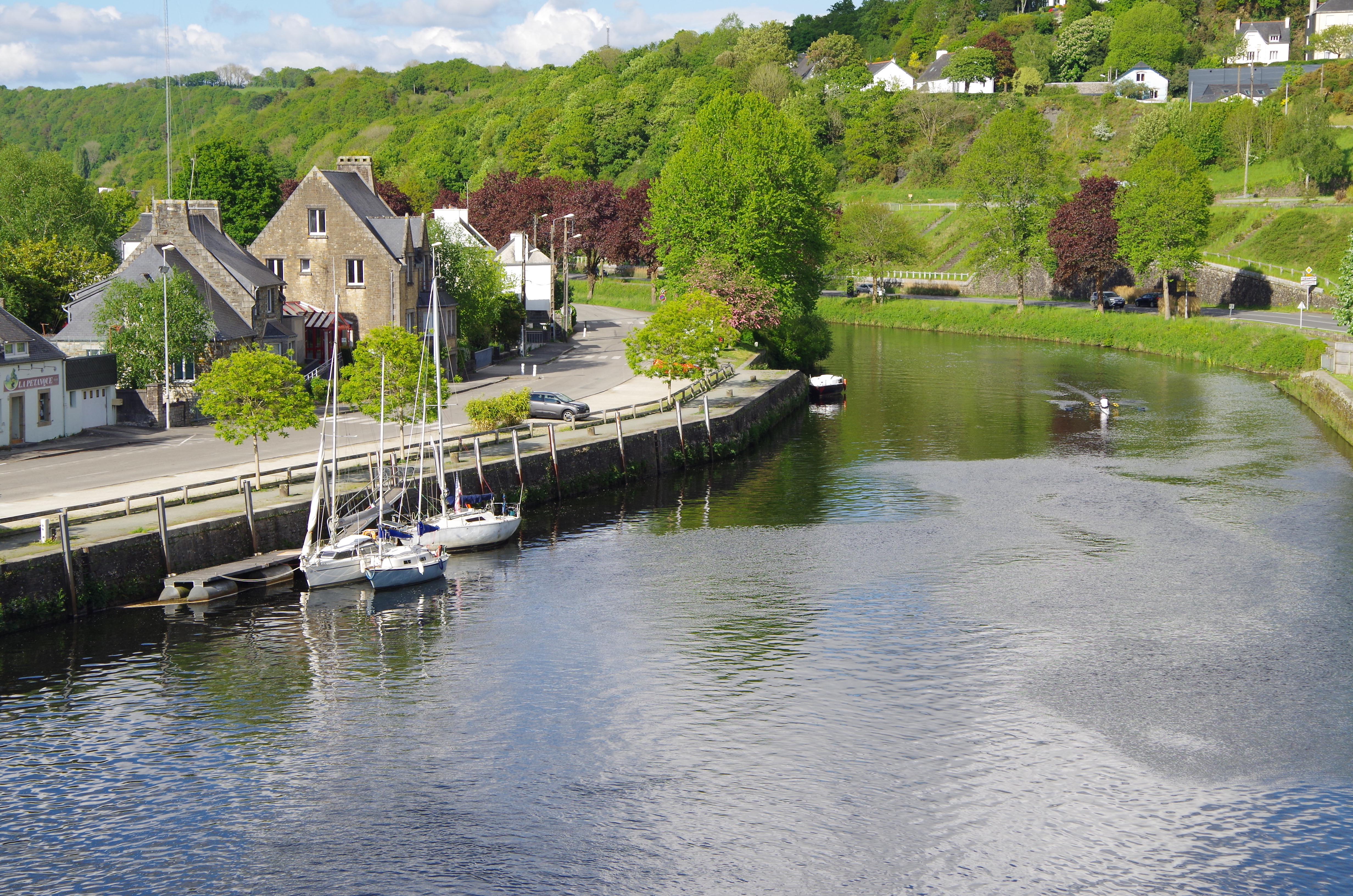
I started this piece with cruising and cooking in mind so I’d like to finish in the same way and this time we start off way inland alongside the quay at Port Launay , the boat is fully stocked with water, food and fuel so we’re ready to go and i’m just waiting for the start of the locking through session at the barrage and tidal lock just downriver.
Briefly though, back to Llanilis and market day.
That first day when I walked up from Paluden quay to do my shopping in Llanilis just happened to be market day so I had a look around the fresh produce stalls before walking across the square to the excellent cafe there. My spoken French is so bad and i’m so under-confident a French speaker that what I have to do is work out a set of phrases that get me through most situations , something like smile and hello and can I have , in the bakers for example mostly gets the job done.
In the market though I’d noticed a street vendor with a huge open dish over a brazier and what was cooking seemed to be a local sausage, potato and onion dish and so not having eaten well for a few days because of being so sick on passage my appetite came back with a bang and I thought I really really fancy a portion of that. You would laugh but i retired to the cafe where I did my usual routine – smile, hello and can I have (coffee and croissant) while I got out my phrasebook to work out how asking for a portion of the sausage dish for one person would go.
Funnily enough , one of my main problems in spoken French is the simple ‘hello’ stage and especially when it comes to addressing a young-ish female street vendor – should i use Miss or Mrs or just hello. On the day I think I used the more formal Mrs (Madame) and seemed to get away with it but failed a bit on portion because my 4 language sailors phrase book does boat terms very well but was poor on the practical street stuff. Now, the nice lady probably gave me a 3 out of ten score for at least trying and at the least saying good morning so rather than getting the one big sausage and the potato onion mix she gave me an extra half sausage…..how good is that ?
The actual story here is that I took my ‘portion’ – it’s actually the same word, of ‘saucisson’ back down to the boat and heated that up in my heavy iron Dutch oven for my dinner…..it was very good.
The day I left Port Launay I had a very good look at the meat counter at the supermarket and found what I thought might be a similar kind of sausage, caught the counter assistant’s eye and I think asked for 2 of those sausages please…..ok, so I had to point out which ones but hey !
Once we locked through into the tidal river at the barrage (Guily Glas) I had to steer for a while because the tide was still flooding and the river is quite narrow at that point , about a mile or so downriver though it meets and then turns sharply away from the main road (N165) and widens a bit. There, I set the Tillerpilot and then set up in the cockpit to have a go at making my own version of the street vendor’s sausage, potato and onion dish – not in a big frying pan because that would have needed careful watching and I needed to be in the cockpit – but in my cast iron Dutch oven (actually a heavy cast iron casserole) and set that over a medium/low heat on the alcohol stove.
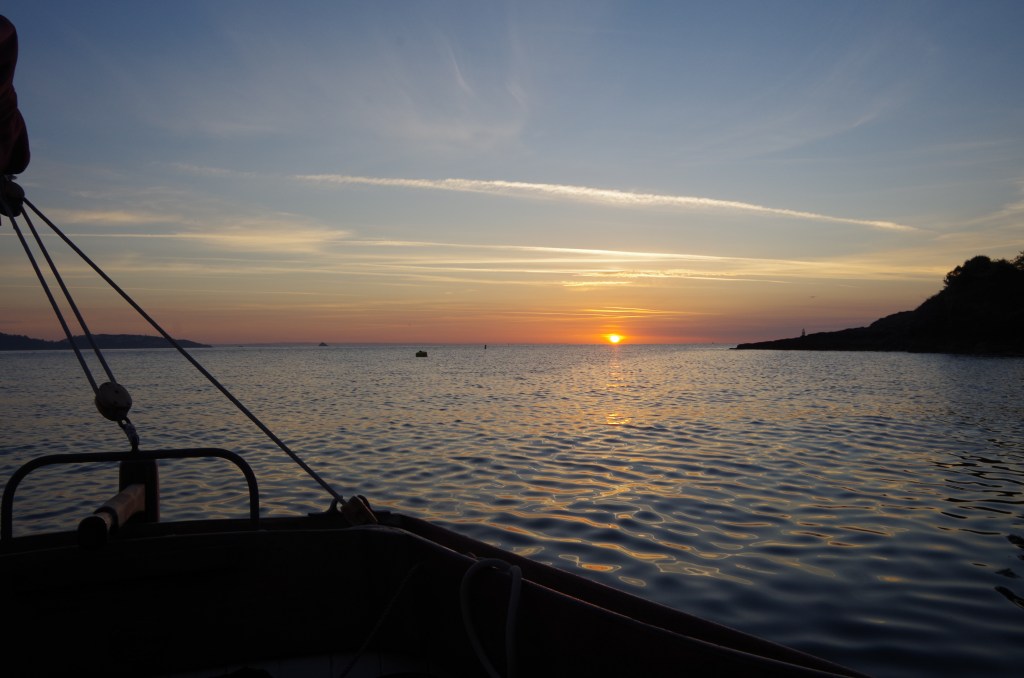
For most of the several hours it took to motor slowly back down to the last bends of the Aulne, where I would anchor that night, the dish just slowly cooked while I piloted and adjusted the Tillerpilot to take us through the many twists and turns of the river. Eventually I anchored just as the sun was disappearing and had a portion of my own saucisson dish…..not quite as good as the street version and it needed the quick addition of some Branston Pickle from the larder to make it work……..never ever go to sea without Branston Pickle by the way.

 Dirty Wet Dog, the great adventure.