

Experimenting with covers, tarps and sailing shelters on the Pathfinder.
Reporting on other projects and work set aside
This week my main work on the boat, apart from making the switch panel go live, was to start experimenting (lets just call it playing around) with some different ideas I have for rain and sun shelter on my Pathfinder. In a way this is the last project to start because the others, rig and electrics, are well underway and with both of them i’m waiting on parts or fittings….and what they are waiting for is for me to catch up with the budget tank……which, right now, is looking pretty empty with at least one more big bill coming in this month.
Iv’e started this post several times as I flip-flop between different ideas of what I want to have but this week was the first time I put hand to cloth and then hand to wood as I made some new parts intended to be bearers for some stainless steel tube to carry a boom gallows which will also be the aft (centre of boat) support for a fixed ‘soft’ shelter. My main idea is that I need something in about the middle of the boat to take the yard and boom when they are down and that job may as well include being the support for a cover at that point.
The dowels (2 bits of yard brush handle) are only there to help me get both sides similarly vertical and the fabric was just me getting used to my sewing machine (Fritz the Beaver) again.

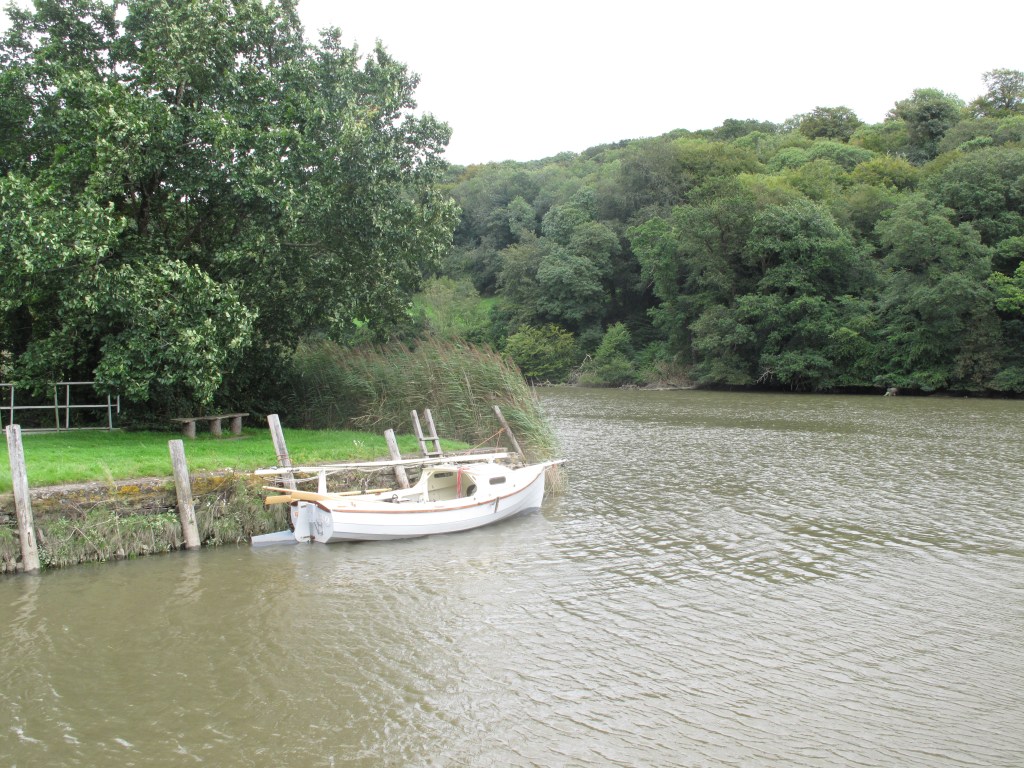
For a little bit of my recent history and experience……last year, as I write, I had the grim experience of being aboard the boat for several nights during wind and rain from dead south : that was ok while the boat lay to the flood but awful on the ebb because there was no escape from the wind driven rain blowing into the open back of the cuddy. I wasn’t exactly winging it as I took a tarp with me to rig as a shelter but the combination of increasing wind and rain and it’s sail area were had me teetering around on a wet and slippery foredeck and ended up with me taking a dip in a muddy dock.
The odd part of all this is that rigging a simple tarp or basha is something I have been doing for years in my outdoors practice and even on windy Dartmoor I can make it work except that in wind and rain I usually try to find at least wind shelter and do a low set while on the boat during those several days the line of the river and moderate southerly made it all have a strong and straight fetch of wind. I said then that had I set up better (with a walk out/survival kit) I would have moored the boat and made a simple bivouac ashore – that’s now one job at the bottom of my shed door reminder list.
The big change that I made this year, with changing the rig from sloop to lug, is that I was able to cut out the compression post/girder and with the result that my head can now go right forward, up against the heel of the mast – what that means is that I end up laying in a head up position (rather than head down and aft) and it means that my head and body are now under the shelter of the cuddy : all it needs now is a bit of protection from wind driven rain from astern.
I still favor making an overall tarp cover for the whole boat and what I think I will experiment with first will be a ridgeline running between both masts (when they are both up) and that will make for a slightly asymmetric layout as the mizzen isn’t on the centerline but off to stbd a few inches. The lesson from my first trip is that a tarp, if I use one has to be a stronger and stiffer fabric and have more permanent connections rigged on the boat.
Putting the boot in (on)
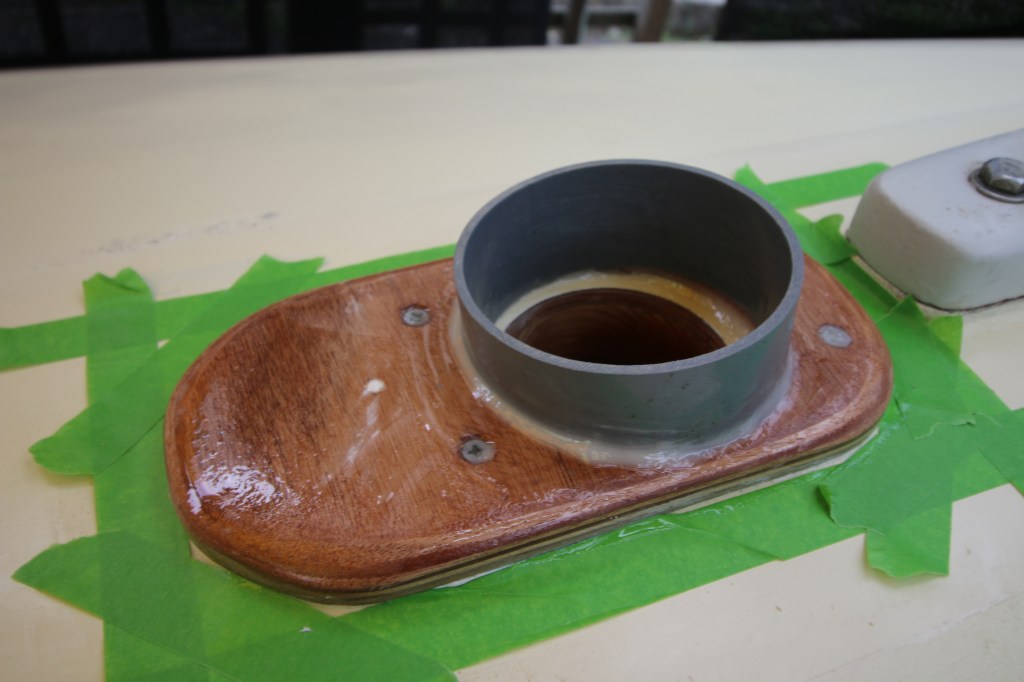
This week iv’e mostly run out of jobs until my new timber arrives to make turned end caps for the various alloy tube spars i’m now working on. Because of that I had a long look at the door to see what I could cross out and what new jobs I could find to add to the list : one thing that’s been in the back of my mind is to make a mast boot or gaiter to stop water from running down the mast and straight through the foredeck hole. Even though the hole is a close fit with the mast there is still some water that gets in during heavy rain so I thought about several different ways of making a seal between the two that would be easy to get on and off – the solution I came up with is a deck plate and raised flange taking the bottom edge of a mast gaiter that will also be fastened around the mast tube.
At this stage i’m not sure what I will make the actual boot, or gaiter, from – in times past and with the bigger boats that I used to be involved with I made several for various boats usually made from truck or car inner tubes. That obviously dates me quite a bit because I don’t think that any motor vehicle tires now come with inner tube : a sewn gaiter that can be laced on is the next obvious choice.
On the gallows this week.
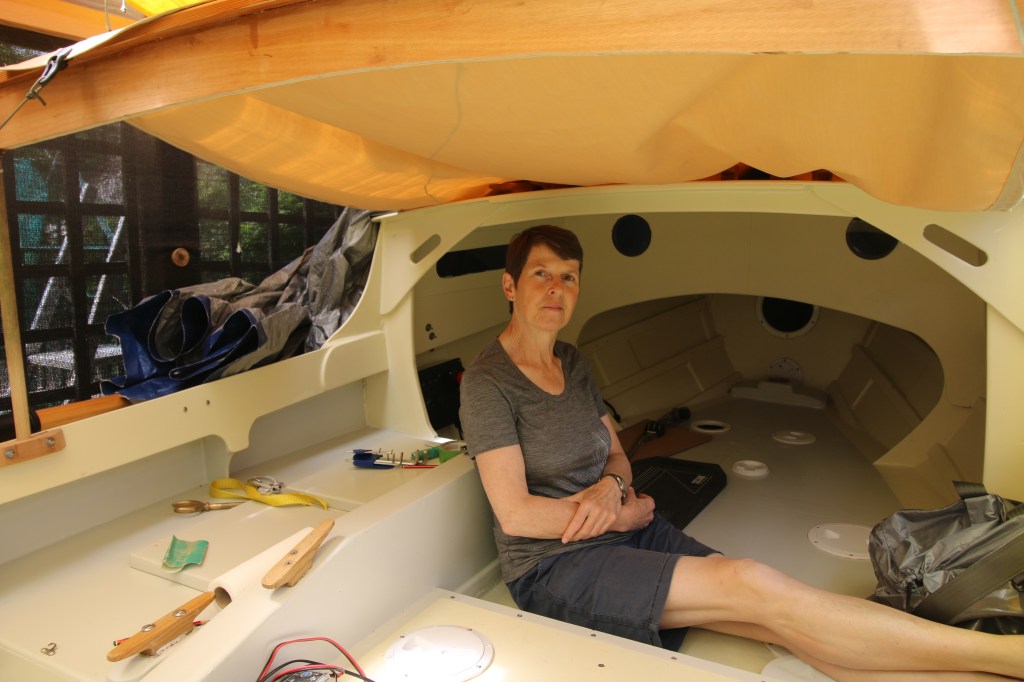
In the middle of the boat this week is my first practical experiment with making a boom gallows that would support the boom and yard when they are stowed and would also serve as an aft support for the back of cuddy tarp which might also act as a central sunshade…..if we ever get any sun. It did happen in recent years that iv’e needed some shelter from sunshine on a hot day and it also makes the boat a much better option for living aboard in nice weather as it seems to increase the living space just where the boat is at it’s widest.
At this stage the temporary boom gallows is made from scrap plywood plus a length of leftover Douglas Fir, the current stanchions are 2 lengths of yard broom and the sunshade is the same piece of fabric that can be fastened down to shelter the back of the cuddy – and when I am sailing solo what will be my sleeping and living space.
Long term, i’m still in favor of making a tarp-like cover that would span the entire length between both masts and be attached to both. That style of cover is what a lot of the dinghy sailors start with and some of them even stay with sophisticated versions of the same basic shape. Having used simple tarps for many years in the great outdoors iv’e owned and used several of them – for a while I even thought of using one of my redundant older ones to make a temporary cover for the Pathfinder. Long term I think a tarp for a boat needs to start with a stronger and stiffer fabric because wind driven rain is almost always the problem.
Spin me right round.
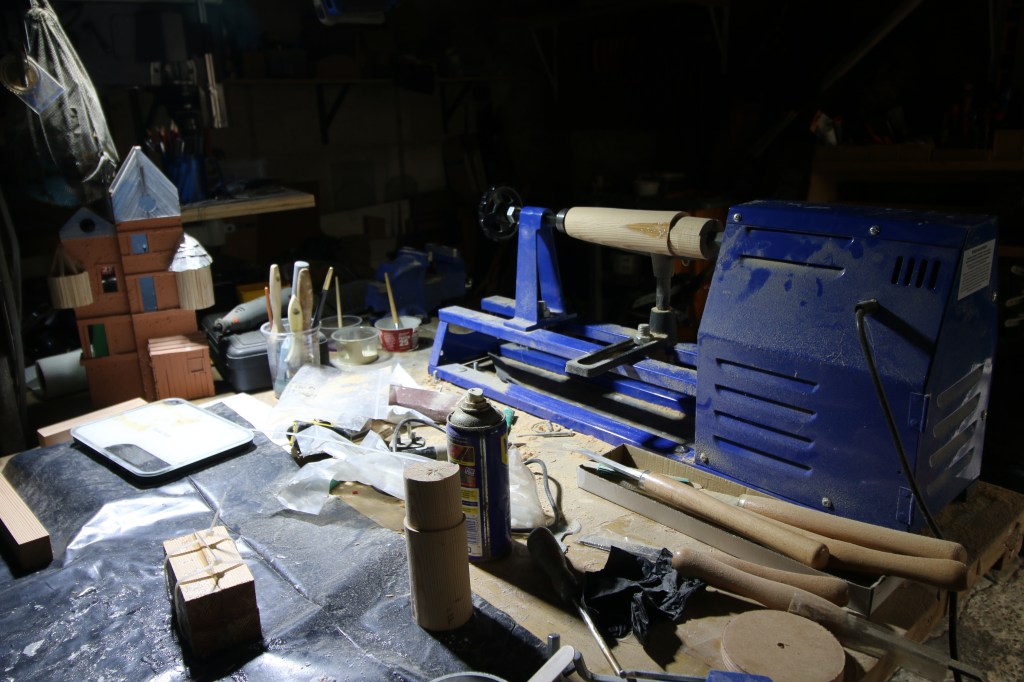
This month I finally got around to using my cheap, Ebay acquired, lathe. Right now, as I write, one of the remaining jobs written up on the inside of my shed door is to turn some end caps/plugs for the mizzen mast and yard ; in time i’ll also spin a pair for my spare mainmast tube although I don’t need that tube at the moment. It’s a very long time, at least 50 years, since I was in the woodwork shop at my school and being taught to use a simple lathe and I can only assume that I didn’t learn much then and have forgotten anything that I did once know. One of the few things that I remember (I was 15 at the time) is that we were told to take our school ties off when using any machine tools as a tie was thought to be very dangerous – what I should have really allowed for though is eye protection and a dust mask. If I did lots of woodturning I would have to invest in a dust collection system , as it is iv’e just come in covered in fine wood flour and the workshop will need half a day to sweep out.
Just for the record I knew I was making 2 high strength (high compression) plugs – one for the base of each mast and then 2 tapered top sections. All round I had to get the mating parts to be a very close fit to take any lateral mast loads into the heel block although when I finish both mast tubes I will bond the plugs in with epoxy resin, so that would allow for a small amount of wiggle room. In the actual job I experimented a bit with trying to make the 2 plugs for the yard from one blank – one end being a mirror of the other. So far those pieces are the only ones that I need to take a second go at because I way overshot my marks one side and ended up with a very slack fit……all in all not a bad effort from a first try.
For my last session on the lathe this week I intend to start with a blank glued up from 4 equal staves with the grain turned 90 degrees for each stave. The top plug for the mainmast will be about as long as this lathe can accommodate but really, if was doing this kind of thing all the time, then I would invest in a much better lathe.

 Dirty Wet Dog, the great adventure.