
Sailing on a small income in the 21st century.
Introduction.
On my desktop right now is a yellowed and dog-eared book called Sailing on a small income by Maurice Griffiths and I think first published by Hutchinson press around 1953 – some five years before I was born. It’s a tiny softback book of only 124 pages and a few black and white photographs and some drawings of the author’s own designs for small yachts. The book is actually one of a ‘small income’ series – the other two mentioned in the book are one about horse riding and one about photography : today though I can’t imagine that anyone would try and put either yachting or horse riding and low income together in the same sentence.
At the same time I am also reading a companion book of the same vintage , the autobiographical book written by Maurice Griffith’s first wife (Dulcie Kennard) who wrote for the 1920’s yachting press under the assumed name Peter Gerard….slightly confusingly she is also known by her second married name as she and Griffiths separated, amicably it seems and Kennard later married an older yachtsman who was also a marine artist. The rather neat thing for me is that a hundred years after both Griffiths and Kennard wrote their cruising life stories is that I can read them and compare them side by side. One of the features of Dulcie’s early sailing life is that she also aspired to being a boat owner and her own ‘captain’ at a time when it was highly unusual, if not unknown, for a woman to have that desire for independence and that call for the sea.
I have been a sailor for over forty years now and for most of that time I got my sailing time by crewing on other people’s boats and the payback for that was usually working on those boats as well and that was definitely on a small income because in those days I was a student nurse on a tiny salary although all I really needed was a set of oilskins , a pair of ubiquitous yellow wellies and my own sleeping bag – my greater expense was in getting to and from whichever boat I was due to be crewing aboard.
I have never once knowingly ridden a horse so I really can’t comment about the cost and difficulty of keeping one today but I did once get to ask a horse riding and horse owning colleague what her thoughts were …..basically that it was sodding hard work, sodding expensive and the end result for her was usually being exhausted, broke and smelling of horseshit !. That very same week, having spent hours on my back on a wet and muddy slipway underneath a boat while I tried to sort out some problem or other I could hardly describe my experience of yachting as a high end playboy kind of life so if anything our common experience of so-called high end middle class pursuits was pretty similar in being more than we could afford, hard and dirty work and not always worth the effort – we both had some very good days with our respective interests though.
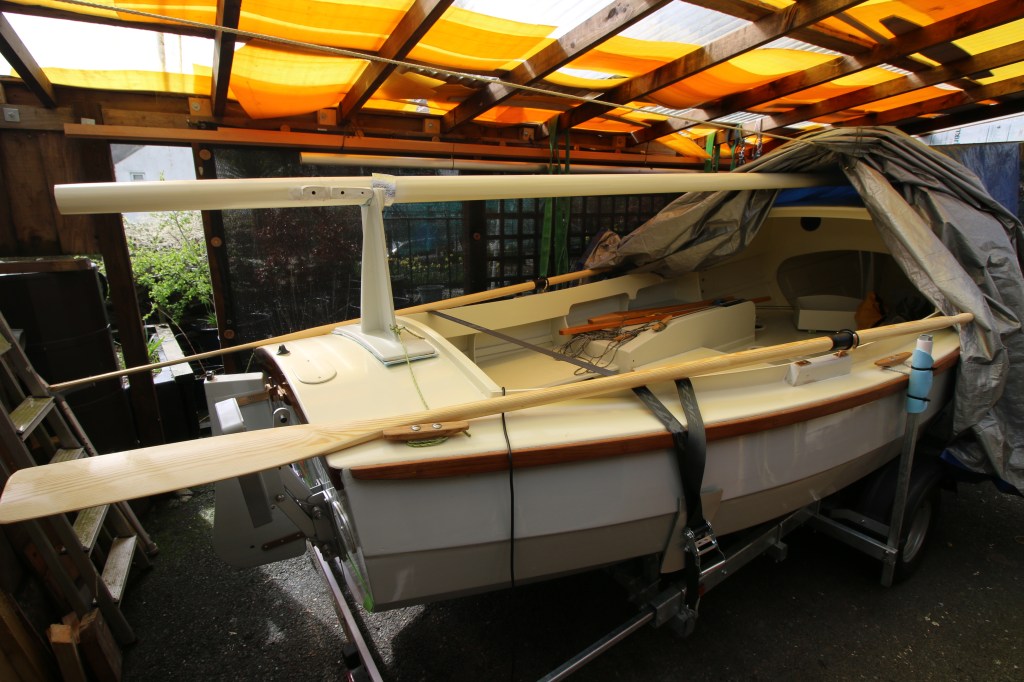
Now, far nearer to the end of my sailing life than it’s beginning – some time back in the previous century, I am once again sailing on a small budget although this time with boats that I have to buy and try to keep so the subject and title is as relevant now as it was to me in the 1970’s. This series of posts, which were originally my project to re write Sailing On a Small Budget for the 21st century will also be a 21st century project in that they will play out on the internet alongside my small boat project to get around the UK by sail and oar in a boat that I have built myself.
Maurice Griffiths was both designing small yachts and writing for the yachting press from 1927 to 1967 so at time when a lot changed – not only in his chosen hobby but of course in the world as well ; he spent his war years serving as a Lieutenant Commander in the Royal Navy volunteer reserve mostly involved in mine clearing operations around the Thames estuary. Even now it is a bit too easy to think of that time as being easier and simpler perhaps although one feature I recognize about his early working life is that he was desperately poor and living in a series of small. poky and cold bedsits in the cheaper parts of London. Having spent most of my early working life in a similar situation in the north west of England I think I understand him a little and especially his need to escape from people and the hectic city life.
Griffiths first wife (Dulcie Kennard) lived a very different early life in that she was mostly brought up in South Africa in a military family that moved back to England shortly after the end of the ‘great’ war of 1914-18. Her early sailing life wasn’t typified by wealth either and her early solo experiences with boats, for that is what she most desired, wasn’t as a skipper/owner but in chartering first a sailing dinghy in Torbay and later a small cruising gaffer in the Solent. After they married they lived together on one of their early shared yachts (Afrin) and Griffiths often described them both struggling with the heavy gear and anchors of that yacht. What does become clear from both of them as writers is that there was very little in the way of sailing instruction available except for one incident in Kennard’s early experience when a helpful hand off a J class yacht (named Steve….which rings a bell slightly`) taught her some basic boat handling skills in leaving a mooring under sail , downwind in a gaff rigged yacht and into a foul tide…..chew on that one modern yachtmasters !
So much has changed……in between Griffiths being the editor of Yachting World and now we have had the huge boom in leisure sailing in the 1960s and 70’s followed by the financial crash of the 1980’s and the subsequent closure of most of the British boatbuilding industry. Boatbuilding itself went from being a craftsman’s job carried out in a shed at the head of a creek somewhere to being an industrial enterprise carried out on an industrial estate miles from the sea and sad to say but many of those cheaply built hulls now lie abandoned after a short working life and now need breaking up at the working taxpayers expense. At the opposite end modern yachts have slowly crept up in size and complexity and seem only suitable for being parked alongside expensive marina berths – I have little to say about that or the large production yachts except to highlight that I think that it’s not the way to do it…..and that there are ways of sailing on a small income in the 21st century.
In his book Sailing on a small income Maurice Griffiths starts out with the assumption that the desire to go sailing equates with the desire to own a boat , so ,logically he takes it as his job to show you what you need to look for when trying to chose perhaps your first boat. I’m not going to do that because it wasn’t the way I went about my own sailing life and in fact most of the people I sailed with in the early years didn’t own sailing boats either but like me simply crewed for other owners who needed an extra hand or several ; one boat I crewed on for several years regularly raced with seven crew and it was often a challenge to put ‘bums on seats’.
My starting point then isn’t so much about owning a small sailing boat although i’ll come to that later on, instead where I want to start is how begin to go sailing and start to get some experience when the desire or maybe just curiosity is there but where you have no experience , no skills and maybe don’t even own a set of oilskins. Secondly I want to explore the why and not just the how of going to sea in a small boat – having recently re read several of Maurice Griffiths’s books I want to explore that question in the way that he might have seen it and try to relate that to my own experience.
I happen to think that Griffiths needed the escape of going to sea, on his own, in a small sailing boat ; my own reading into that aspect of both his life and mine suggests that both of us draw great peace, solace and comfort from being ‘out there’ and essentially alone with and in nature. If anything the reason why some people need that escape may simply be that of temperament – the need or desire will simply be there and the way of expressing it might be by way of the sea especially as this small country becomes ever more populous and our few remaining open spaces closed off to us……as has recently happened down here in the UK’s west country.
The dream, or desire…Who Hath Desired the Sea….is something that both Griffiths and Kennard had and which is the thing that I share with their experience. Trying to understand and explain that desire will form an early section of this thread of posts.
The third man.
A bit later to the party is the third writer whose much more recent book I want to talk about is sailor and academic Mike Bender of Exeter university. In his recent book about the History Of Yachting his major starting point is that we shouldn’t consider yachting or sailing in isolation but rather seek to understand it against the social background it plays out in. For both Griffiths and Kennard that’s firstly the inter-war years and then for Griffiths his time as a Royal Navy reserve officer.
This point is at it’s clearest when considering the life and writing of Dulcie Kennard (writing as Peter Gerard) because the thing that she had the passion and desire to do – to own a boat and go to sea was genuinely new and strange when seen against the social background of the lives of women in the 1920’s. That’s one of the reasons why I think about and write about the social ‘class’ and background of the audience that I think I am writing for – and that has definitely changed during my lifetime. Where once I was a boat-scrubber, winch winder and general BN for a successful surgeon or businessman I begin to see that the social background of boat ownership and associated cruising has also changed.
This piece then is the first in my series of posts or take on the late Maurice Griffiths first book – Sailing on a Small Income but with references to both his later work and that of his first wife Dulcie Kennard. In the first follow-up post I want to first explore this strange desire or passion to go out and about on the sea ……..Who Hath desired the Sea ?

 Dirty Wet Dog, the great adventure.