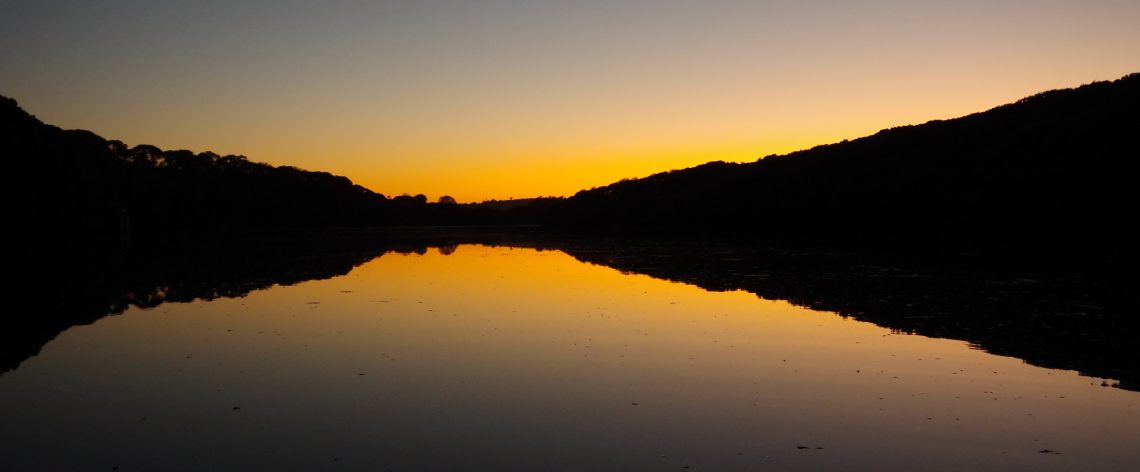

“As the smack roared past Holliwell point and turned her long bowsprit down the crouch the whole river looked like a carpet of little white horses. The flood was running up against a strong wind from a little south of west. From the tracery of foam on the surface we reckoned it was blowing more than force 6 and logged it as a steady seven. And it was cold, too perishing cold, because it was in the middle of January and there was sleet in the air.
Frank Shuttlewood had been tight when we arrived at his yard in Paglesham to fetch her round to Heybridge and he said in his singsong Essex accent, ‘You’ll want all your reefs in that mains’l today Mr Griffiths. He should know, standing there a stocky figure in jersey and kneeboots beside the big black shed for in that shed his grandfather and then his father had built oyster smacks, barges and small barge yachts and he knew as well as anyone on the river how to handle a smack.“
The above sections are taken from from the late Maurice Griffiths book Swatchways and Little Ships and in that book, like many of his other works, the various yachts, Bawley’s, barge yachts and ex fishing smacks all appear as much characters as his crew mates. In his earlier work The Magic of the Swatchways one of his best pieces is his description of his then wife ‘Pete’ at the helm of their home and former smack Afrin, beating up one of the Essex rivers in a snowstorm.
I have to admit though that I used to get their earlier converted smack, and marital home Afrin confused with the later Afrina. Today, i’m pretty sure that these are separate boats and the original Afrin was lost shortly after her new owner took her over. My main impression of smacks from my reading of MG’s books that they were heavy and unhandy boats not really suited to shorthanded crews and narrow rivers. For those that are interested there is a whole section, in fact an ‘interlude for smacks’ in Swatchways and little ships.
A black shed……somewhere in Essex !

Going back several years now to the time when I owned a little Hunter Liberty, all 22 feet and 1 ton of it, I thought that I needed to replace it for the kind of sailing that i’d done even then and the kind of thing I had in mind for the future. By then I had already done one channel crossing and back in the Liberty and while it certainly never scared me even when it was well out of it’s zone for a lightly ballasted cat ketch which was intended for inshore and sheltered waters it did feel a bit flighty and underpowered in the larger channel waves. For some reason I came to the odd conclusion that what I really wanted was a long keeled and gaff rigged classic wooden boat that would ‘take the channel’ and then ‘take the mud’ easily when I got to the other side.
Eventually what I found was a little Deben 4 ton of around the same length as the Liberty but at least 3 times heavier, a lot older than the Liberty and I hoped a far steadier sea boat in a breeze. Of course rather than turning up close to home in the west country the Deben 4 ton was literally just around the coast by one river from where it was built ; the Orwell at Ipswich rather than the Deben. What that meant though was a series of long driving sessions to first go see the boat and then go and set it up for the long delivery sail home and I note, most of the way to windward in the English channel.
My nick-name for Inanda, by the way, was ‘clonk’ for what happened every time my partner turned around inside the little cabin and clonked her head against the odd break in the line of the coachroof that gave the boat a slightly odd appearance. The fact that water always gathered there and contributed towards Inanda being a very wet boat in the rain really didn’t help me later on when I sat rolling at anchor one night behind Dungeness point in heavy rain. That peculiar little break in the coachroof probably contributed to the rot in one side of the cabin …… For several hours I sat wrapped up in my British army bivvi bag until it stopped and only then did I think to light the ‘pansy’ stove to dry me, my gear and the boat out.
In a way it was a kind of classic east coast wooden boat experience but I did soon realize how much work the boat would have needed me to do but equally how unsuited she was to the bigger and steeper waves of the English channel. She was fine, as a boat, when we steadily beat up one of the main channels in the Thames estuary, on the wind with everything set and the tiller pegged while i tried to keep on top of the navigation but hopeless when we cleared the downs a couple of days later and came hard on the wind for the long beat home.
In a way this re-visit of that time and that experience has a funny side because one of the things that I did once I was back home – AND back home from a knee replacement was to write my own version of how the little cutter behaved as we came out from behind Dungeness point. Unlike Griffiths depiction of that big smack “roaring past Holliwell point” the little cutter kind-of ‘oofed’ into the first of a set of waves, slowed quite a bit and then simply stopped dead in the water when she hit the second one and nothing that I did would make her go upwind.
Having never been there before I found the parts of the east coast that I did see, from Ipswich to the Walton Backwaters and then the long and complex route across the Thames estuary disconcerting and strangely disorientating……as though we were going the wrong way all of the time and often in very shallow ‘brown’ water rather than the deep green and blue I was used to in Devon and Cornwall. For this piece I had to pull out the main two folio’s of charts that I used then for the navigation just to remind myself of the route I took between the Walton channel and Ramsgate.
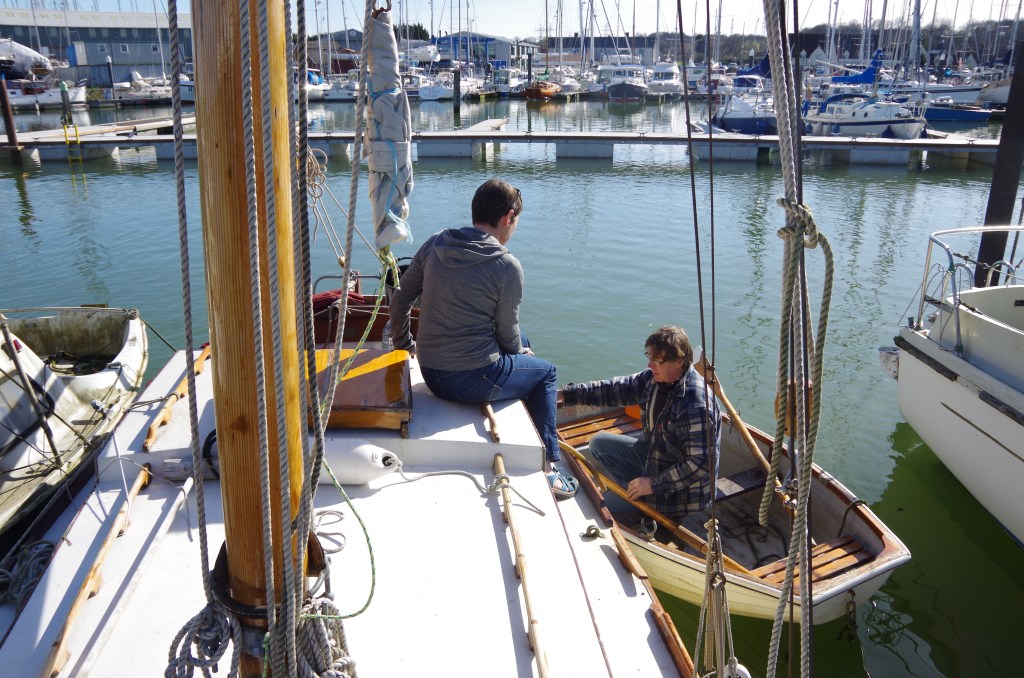
Owner Pete puts us aboard Inanda.
One of the few extra things I had with me during my delivery trip from Ipswich to the Tamar was a dog-eared copy of Griffiths Magic of the Swatchways because I thought that I might at least try and orientate myself to a sailing area that i’d read lots about but little of which made sense. When I first read Maurice Griffiths I did so with a Thames estuary chart to hand. As as I sailed down the Orwell one evening the anchoring spots that he refers to started to make sense and it was even better the next day when I bumped my way up the Pye channel into the Walton Backwaters and eventually anchored in Walton channel. I realized then that his and ‘Petes’ home had been aboard the converted smack Afrin moored less that a mile from where I was anchored.
Connections.
Connection one, is ‘Pete’ (Peter Gerard) and Pete the owner of the Deben 4 ton , Inanda’ – the boat that I bought from him and with which I had my own very brief Maurice Griffiths moments in the Orwell and at anchor in the Walton channel. Owner pete helped me get sorted out with Inanda at the Orwell yacht club and pointed out his own boat, an Essex smack, which he had completely rebuilt to use as a cruising boat.
Connection 2 is that Inanda had originally been bought as a little gaffer for his grown-up children to race in the OGA series and having successfully sold her had bought the old Juanita as a replacement ; Juanita obviously is the famous Falmouth Quay Punt owned for many years by Maurice Griffiths first wife – pete and is the boat that she sailed as a sailing school for women ‘cadets’ as she called them. Thus I saw Juanita for the second time having seen her at least once when she was briefly owned by a sailmaker in Devon.
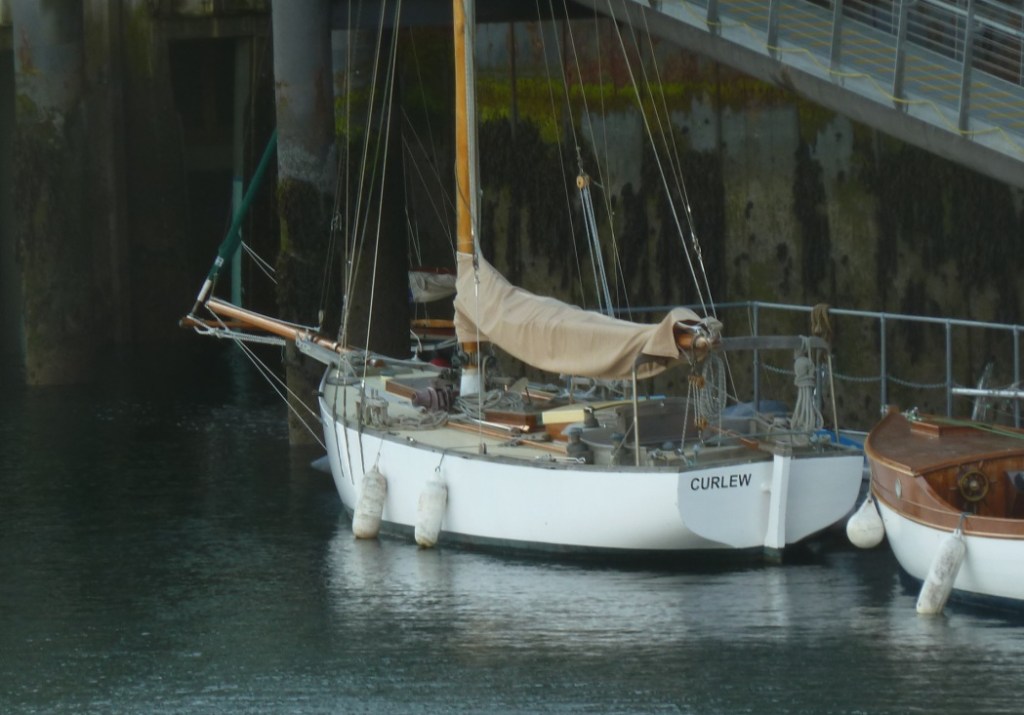
Knowing what I know now about Falmouth Quay Punts I must say that compared with an Essex smack the type seems completely the wrong boat for the east coast rivers and the Thames estuary. That’s purely my opinion of course but based on one I knew at the maritime museum in Falmouth itself (Curlew) and having seen one finishing it’s refit down in Plymouth. The problem, as I see it, is that while the ‘punt’ would be fine for the deep water of the west country their 6 foot draft in a long straight keel could be a nightmare to handle in the tight and shallow east coast rivers. In her autobiography ‘pete’ does mention several groundings and tidal strandings in Juanita so it did really happen. To be perfectly honest I was even a bit nervous with the Deben 4 to and she only drew about 3′ 10″, a few inches shy of half that of Juanita.
Martin, and the unknown Falmouth Quay punt down at QAB ….demonstrating her deep draft.

Connection 3, the various smacks .
Having never had anything to do with the east coast and it’s regional boats i’d never come across an Essex smack and the first one that I actually saw was the one that Pete (Inanda) was just finishing rebuilding – in fact, between going there to see Inanda and then going back to start sailing her around to the Tamar Pete had bought a new mast for his smack and although invited to see both his smack and Juanita I never went aboard either boat. I walked past Pete’s smack every day that I was at the Orwell club and I could see that she was about 36 feet in length and a good ten feet in the beam : once again that’s consistent with what MG says about Afrin and I guess is why she would have made a viable home for him and his wife (the other pete).
In the book that I am re-reading in connection with this post ; Griffiths Swatchways and Little ships his two smacks, Afrin and then Afrina appear several times – I used to mistakenly think it was one boat he was talking about but they are separate boats. At one point Griffiths admits that the big smack needs several crew to handle it and after his divorce from ‘pete’ he sells the smack in favor of a smaller boat. Something I often wondered about Griffiths is whether he would have been much better off with smaller boats for his kind of sailing and it also made me wonder just how suitable a big working smack would be for a modern husband and wife team…..MG says of his smack that it had a 14 foot bowsprit, a 19 foot gaff and a 26 foot main boom and, wait for it……usually deployed an 80 pound fisherman anchor.
There is of course a smack ‘scene’ on the east coast with many former working smacks having been rescued from creeks, rebuilt and now sailing again. Something that pete (Inanda) said was that many of the smacks get rebuilt but then only turn out for the yearly smack races in rivers such as the Colne where several are based now. I got the distinct impression that while pete was happy with the old working smacks being rescued and restored, that what he intended was to use his smack as a cruising boat for the east coast and beyond.
I don’t know that much about the working history of smacks and most of what I know derives more from the Essex smacksmen (and later the apprenticed ‘smack-boys’) working the smacks in the north sea and beyond in the winter and then crewing the big racing yachts during the summer. One account that I came across said that the mate aboard one of the bigger racing yachts (J class I think) made enough from his one successful summer season to have his own smack built. Whatever, it sounds as though the original 36 foot smack type of working fishing boat did work far offshore and accounts I have seen do have them as turning up in many ports in the south west…far from home. Given that kind of history I can well imagine the smack being an effective cruising boat if a little unhandy in it’s home rivers as MG recounts.
And so, the original smack is an engineless working fishing boat of around 36 feet although many it seems were later lengthened and re-rigged from cutters to ketches. One feature I noted about the smack that I saw was that it carried a huge bowsprit of at least 10 feet outboard and a free flying jib flying from a traveller hauled out on the bowsprit. During my own trip home with Inanda I borrowed that idea from the smacks when the jib furler failed to furl or unfurl for the umpteenth time and I gave up on it choosing instead to fly my jib free…..just like a smack.
Lost in the ‘raisin’ (Rays’n).*
Now, where was I ?. One moment i’m trying to write an intelligent and engaging post about one of England’s most important regional/historical vessel and in the next i’m re reading a whole section about ‘smack’ life courtesy of Maurice Griffiths and his book Swatchways and Little Ships. There really is a whole section titled an interlude for smacks so my that was my reading last night ; the only problem I still have with reading MG is that I have to burrow through the stack of charts under the bed to find my Thames area chart – in fact the one I used to refer to is long gone so nowadays I usually refer to the folio that I actually used to navigate with when I crossed the Thames from the Walton channel to Ramsgate. Just for reference I reminded myself that my long beat to the south west must have been via the Black deep because I remember passing the wind-farm (London Array) that blocks one of the old swatchways that Griffiths would certainly have known.
It took me several hours to work out my passage south and a lot of that was just ‘writing up’ the tides that I would have to deal with ; it was definitely near low water as I slipped around the eastern end of the wind farm because there were small waves already breaking on the sand bank at the end and I could see acres, it seemed, of thin water over mud and sand.
Working the tides and the sailing plan while at anchor in the Walton channel

Meanwhile aboard Inanda.
So, I was on board Inanda on a nice morning in the Thames estuary and I know now that we were beating up the Black deep against a nice south-westerly wind with the tiller pegged and the cutter rig trimmed as best I could – at some time in the past one of her previous owners had lengthened her boom and gaff with the result that she didn’t sail well upwind unless she had the first reef pulled in – so that’s how things stood that morning. Meanwhile I was up and down the companionway like a yachtmaster candidate because I was very disorientated by the buoys and other markers.
Crossing the Thames estuary is said to be one of the hardest jobs for the navigator and previous owner pete had already advised me to bypass the channels and swatchways by taking a route around the outside (east) of everything. Of course what I wanted was the full Maurice Griffiths kind of experience which is why I started my crossing from the Walton channel/Pye channel and ducked and dived my way through several of the cuts or swatchways between the main channels and in that way our long beat up the black deep seemed like a couple of hours of relaxation before ducking and diving again to cross the southern side and put into Ramsgate some time after dark.
I was beginning to realize that the work I would have to do with Inanda was both going to be too much for me and possibly even not worth the time it would take. By then I was already trying to work out a schedule of jobs just to enable me to get to what I felt then would be the main work of replacing most of her broken (and sistered-broken) frames – for example that the whole coachroof was going to have to come off, as was the cockpit and then I was going to have to take out the engine…….and so on. The conversations that I’d had with her former owner (pete) seemed to suggest that if I was going to have to take on that level of work then I might as well start off with a boat that would eventually be a much better (and larger) prospect for me. I seem to remember that there was even a hint that working on a slightly larger hull would be easier because the working space is larger – the materials cost would be higher but not by that much.
I know it’s referring to yet another boat type but what I already had in mind was converting my own version of a smack – not an actual smack but what I refer to as the smack of the north west of England : the Morecembe bay Prawner or Nobby. The really strange coincidence was that alongside Pete’s actual smack at the OYC there was already a nobby in a cradle on the slipway at the club.
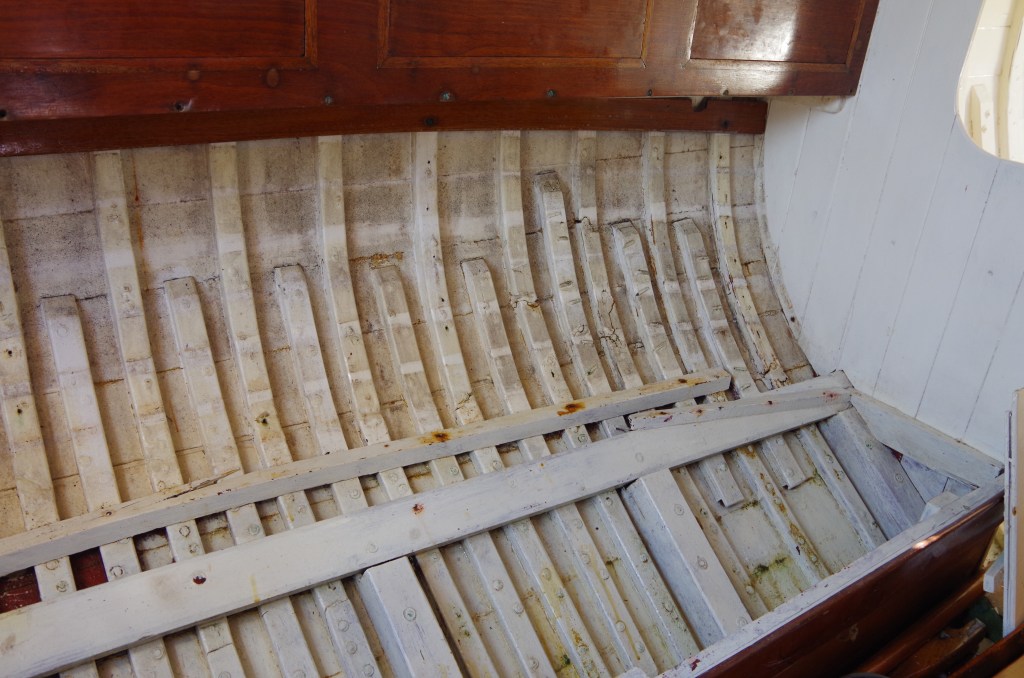
Main job – replace all of Inanda’s frames – except that everything has to come out first.
Ramsgate.
Being in Ramsgate for a couple of days while I re-provisioned Inanda and waited for a slant in the weather that never came gave me even more time to reconsider the Inanda project and to revisit smack-world as i’d begun to think of it. You see, I have an unfortunately ‘medical’ sense of humor coupled with clinical knowledge about the pattern of recreational drug use in my home city (Plymouth at the time) and basically put smack to me is simply Heroin in it’s cut and modified street form. At the time Plymouth had a smack problem and in my job I often had to deal with those patients who had trashed most of their accessible veins by injecting bad street heroin into them.
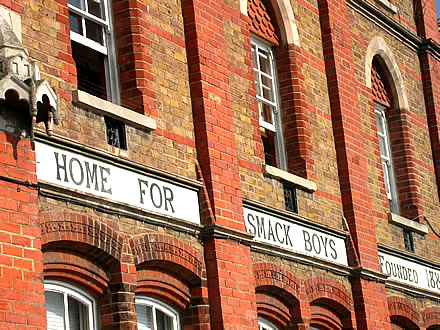
In Ramsgate of course there was still the site of the one time smack-boys association building and I think even Pete struggled a bit with my smack association jokes. In reality though I was beginning to have my doubts about putting so much labor into such a small boat and in fact I was quite glad when I found that Inanda simply couldn’t beat up the English channel – in fact couldn’t even make to windward as well as my lightweight cat-ketch Liberty. It didn’t help that I had an incredibly wet night (inside the boat) the night we rocked and rolled to anchor behind Dungeness point. By the time I all-but gave up and motor-sailed Inanda into Newhaven and then Chichester I knew that I wasn’t going to keep her.
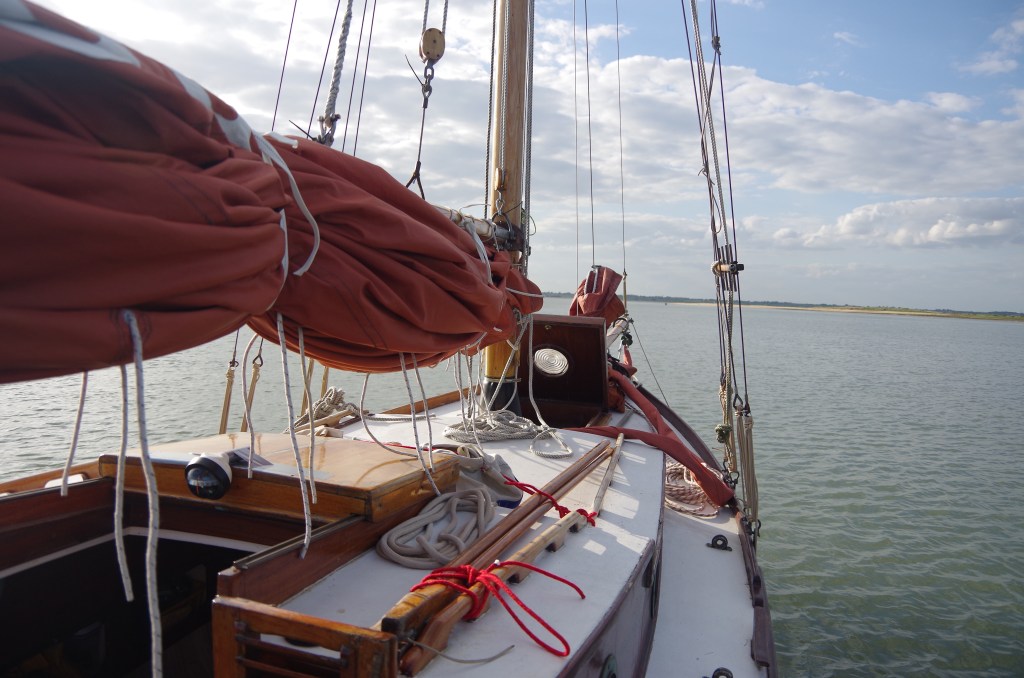
For what I wanted Inanda was a failure – really too small a boat to live aboard comfortably and for whatever hull and sail combination she had she simply couldn’t drive into a channel slop. But, she was a ‘salty’ little boat all the same and the experience of bringing her across the Thames and westward up the English channel had been a good one. Had she actually had any ‘knees’ I would have joked that we both needed a new one but as it is I put her up for sale and in the same week checked in to go and have one of my own replaced.
Back to smacks again.
And so…….Griffiths owned at least 2 converted smacks during his sailing life and had clearly lived aboard the first one, Afrin with his then wife Dulcie/Pete. That they had sailed Afrin in hard winter conditions was obvious and winter sailing became a feature of my own life with the little Liberty once i’d fitted a Pansy stove just like the one i’d had in Inanda.
I often wondered what it would have been like had I been sailing the little Liberty in the opposite direction and ending up on the east coast – after all it would have been all downwind once I got past Chichester and the Liberty would have been a great little boat to explore the east coast rivers and creeks with. Instead of doing it myself back then I had to rely on our man Dylan Winter doing it and filming it aboard his version of the Liberty and aside from getting completely lost while crossing the Thames it looked like a good trip.
I left the Inanda project with two completely contradictory conclusions : on the hand I was absolutely sure that what I wanted was a boat that I could keep on a trailer at home and as you all know that’s eventually what did happen – although not at the time. My opposite brain (the saltier side) kept going back to this idea of a larger, more powerful and working boat style boat that would cope with the English channel and then ‘lay over’ easy in the mud on the opposite side – or equally be at home at anchor in one of the shallow Brittany rivers.
So…….did I ‘fancy a smack’ as I put at the start ?…..no, not exactly because I couldn’t see any way of getting one and restoring it. But…..during the time that I was laid-up after my knee replacement the one thing that I had loads of was thinking and daydreaming time. What I kept going back to was a crude sketch of a boat that I drew the interior layout of that day that I slowly beat up the black deep aboard Inanda. What I did was crudely drew out, from memory, the interior layout of the Frances 26 that i’d owned several years before, stretched it a bit and then worked out how to ‘wrap’ a hull around what I had drawn – I also had in mind everything that i’d learned from Inanda and a little of what I thought I knew about Essex smacks ; I knew, for example, that the working smacks were quite shallow and beamy for their length and , like a Nobby, could dry out upright in soft mud and ‘lay over easy’ on any soft bottom.
My knee recovery project was to, sort-of, design my own smack but one based on a Morecembe bay Prawner (Nobby) where those boats had often been a 28 – 30 foot hull and were intended to dry out in the shallow rivers and creeks of Lancashire. That project went as far as trying to find a donor hull and working up a materials list to do a similar conversion to ‘Curlew’ – the Falmouth quay Punt based now at the Falmouth maritime museum and essentially a sister ship to Peter Gerard’s Juanita.
A smack-y postscript.
To date that trip was my one and only foray into the Thames estuary although I hope to get back there on day with my little ‘expedition’ boat. That of course is the actual boat that came about from one half of my thinking about Inanda although what eventually drove it was something that none of us expected.
My take on a larger ‘salty’ wooden cruising boat, based on a Nobby but inspired by working smacks never happened but the idea for that project kept my mind busy while I couldn’t do much else at home after my knee replacement. What did recently surface was the simple sketch that I drew of the proposed boat’s interior layout which needed to be around 28-30 feet long – which is also more of an ideal size for bashing about in the English channel and, had I based it on a Nobby hull, been a lot better boat for drying out in one of the shallow Brittany rivers.
This story has a bit of a strange ending though because what also still exists are the files that were to be my attempt at a sailing novel based around the building and sailing of a wooden boat like the one I envisaged. It was set in a different time and place ; Essex in the 1980’s though and starts with the rave scene, the destruction of the peace/hippy convoy and sort-of ends with an allusion to the Essex boys shooting of 1995 although along the way (in my version) we would meet people trafficking via the Essex marshes and meet a strange crew including one of my regular readers and a genuine ‘Firestater’…….based slightly on the late Keith Flint of The Prodigy.
I think perhaps it was something to do with the painkillers I was on at the time !……or maybe the paint fumes once again
*We were nowhere near the Rays’n (Raysand) channel but for some odd reason it’s always stuck in my mind.
The book-end of the post.
After the voyage……So, i’m back at home after an interesting, but essentially failed, voyage, back from the east coast and Inanda is sharing my mooring in the Tamar alongside my little Hunter Liberty. Inanda is up for sale and up for grabs via Ebay while i’m laid up at home – having also just got back from having a knee replacement. In a bit i’m going to have to have a first go at getting down the narrow and steep stairs of our 1840’s vintage miners cottage and I suspect that my first try will involve at least 4 points of contact – two of those being my bum cheeks !.
Meanwhile here’s my Griffiths-esque version of his smack starter piece.
As the little cutter nosed out from behind Dungeness point and met the larger and steeper waves of the English channel there didn’t seem to be a flat horizon anywhere – especially ahead where Inanda’s long bowsprit was alternately pointing skywards or burying itself in a cold grey channel sea.
I was already soaked after the long night of rain and the first half hour of spray driving up and over the weather bow but I was equally contemplating going forward and balancing on the tiny foredeck while I handed the jib and then pulled in a third reef.
Inanda had other ideas though, as we cleared the point a bit more the waves, rather than lengthening in deeper water seemed instead to be getting larger with breaking tops and for a while I thought I would have to run off and anchor again and wait until the sea went down a bit. Inanda though slammed into one wave and shuddered a bit as most of the way came off her and then distinctly ‘oofed’ into the next trough where basically she stopped and where I had to drive right off-wind to get her moving again.
It was simply too much for the little cutter even now and what forecast I had been able to get suggested that the wind, rather than moderating in the channel, was going to shift into the north and blow a full gale. Heading even further out from land just seemed pointless and unnecasary so I pulled the last reef down, handed all the fores’ls and started the engine instead using the mains’l to keep her pointing almost dead upwind as I tried to make distance to the west.

 Dirty Wet Dog, the great adventure.