
Pathfinder project post July/August 2023.
As I write it is late July 2023 and I feel that I am weeks, even months now, behind schedule – not only have I still not launched the boat for the first time but the whole summer is slipping past and it’s now three years since iv’e been out on the water. I don’t even want to say that the end is in sight because i’m still creating new lists of things to do before I can go sailing : right now for example i’m working the problem of being able to hoist and lower my sails without resorting to cable ties to hold things together and have still to work out the sheeting positions.
If that sounds a bit negative then the other side is that I did work out what my main problem was on the day that I was trying to bend on the recut mainsail for the first time : basically that the throat cringle position on the sail wasn’t where it should have been, which is 75mm aft of the mast, but has been put in exactly in the throat corner of the sail on the angle between the luff and the head. The results of that mistake (by the sailmaker) were that I spent hours trying to work with what I assumed was the correct throat position and that threw everything out ; the other big mistake was that I tried quick and dirty solutions to try to make everything fit and every single thing that I did just caused more problems.
It didn’t help that I went into the day excessively tired and groggy from a few nights of poor sleep and with the expectation that the job was going to be a nice easy day with an end result of knowing where all of my sheet leads had to go and therefore where the sail handling gear has to go. Instead, I finished the day exhausted and dispirited and then I was somewhat lucky because the next day turned to strong winds and heavy rain so instead of feeling that I had to bash on with the problem I had the day off, we went off to get a bacon bap and a coffee and I got some distance to think about the problems that I had encountered.

I am glad to say that the thinking time while enjoying a bacon bap and coffee away didn’t so much give me the solution but showed me where I had gone wrong and mainly that what I had to do was reverse my moves, correct the quick and dirty fixes that I had tried to make and start over with the sail. The actual solution was to accept the sailmaker’s mistake and work with the throat cringle in it’s actual position and adapt everything else around that.
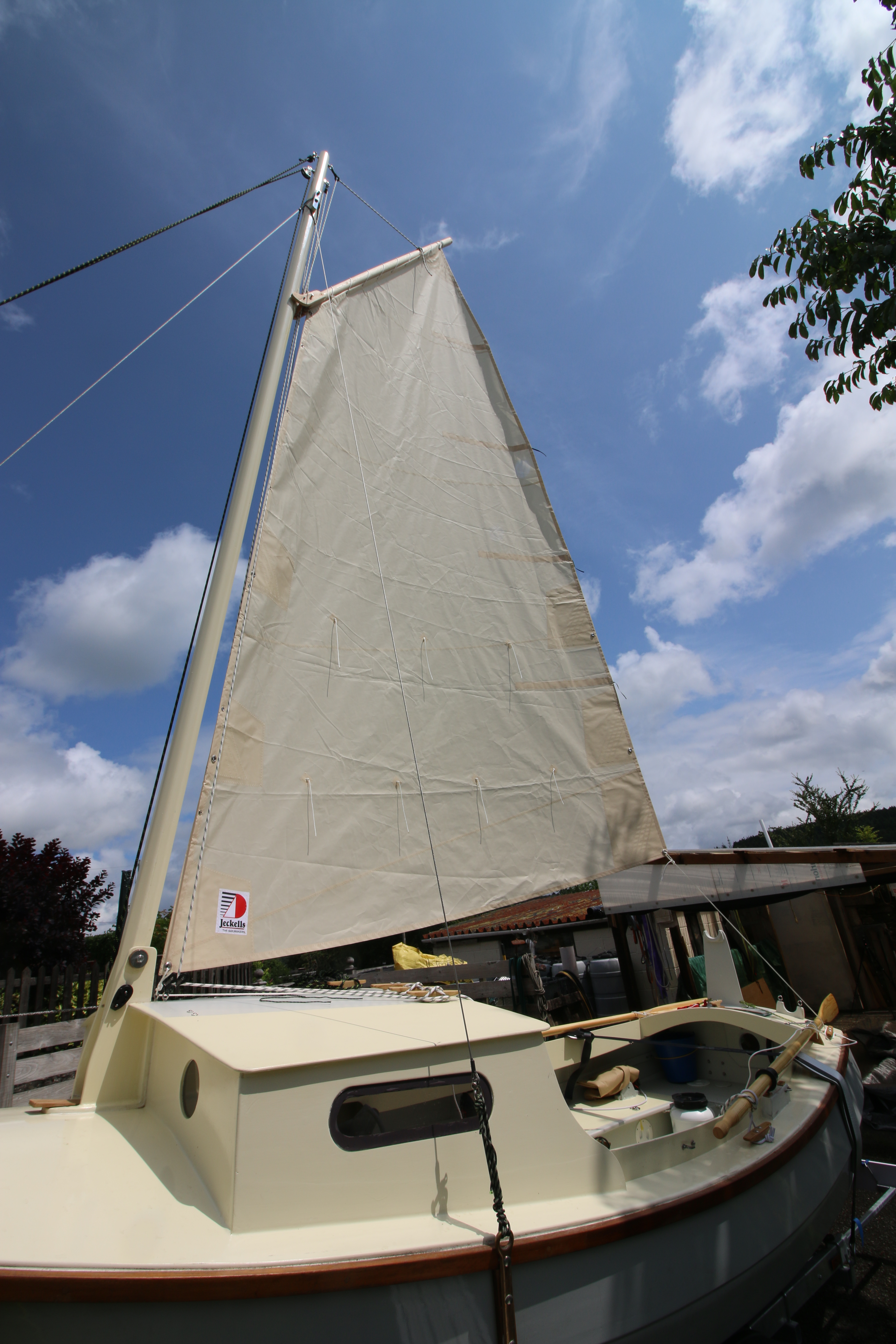
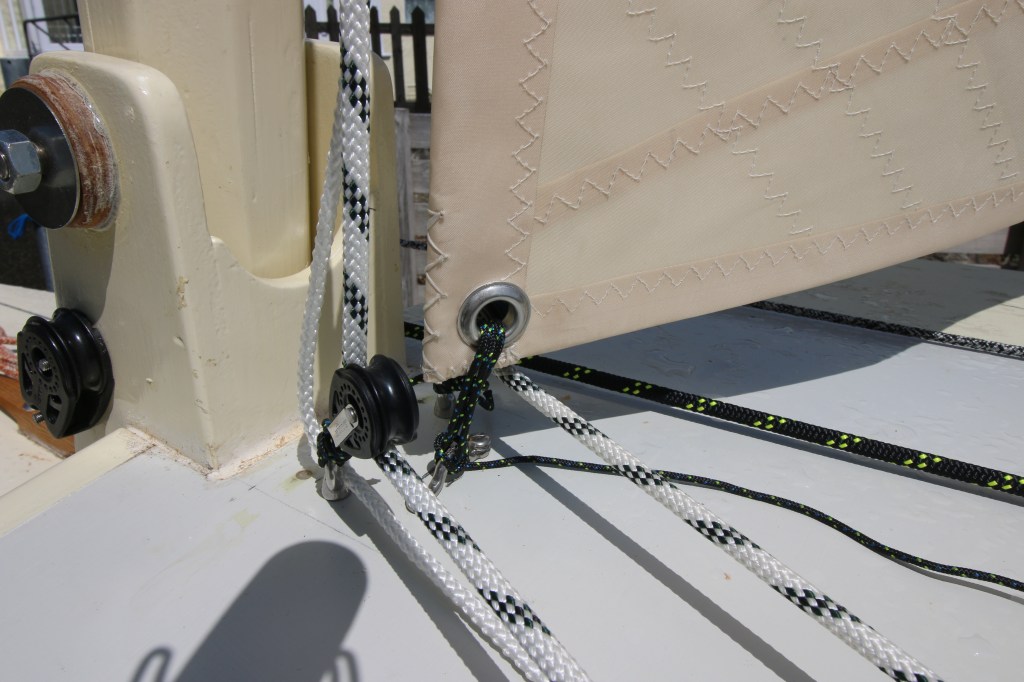
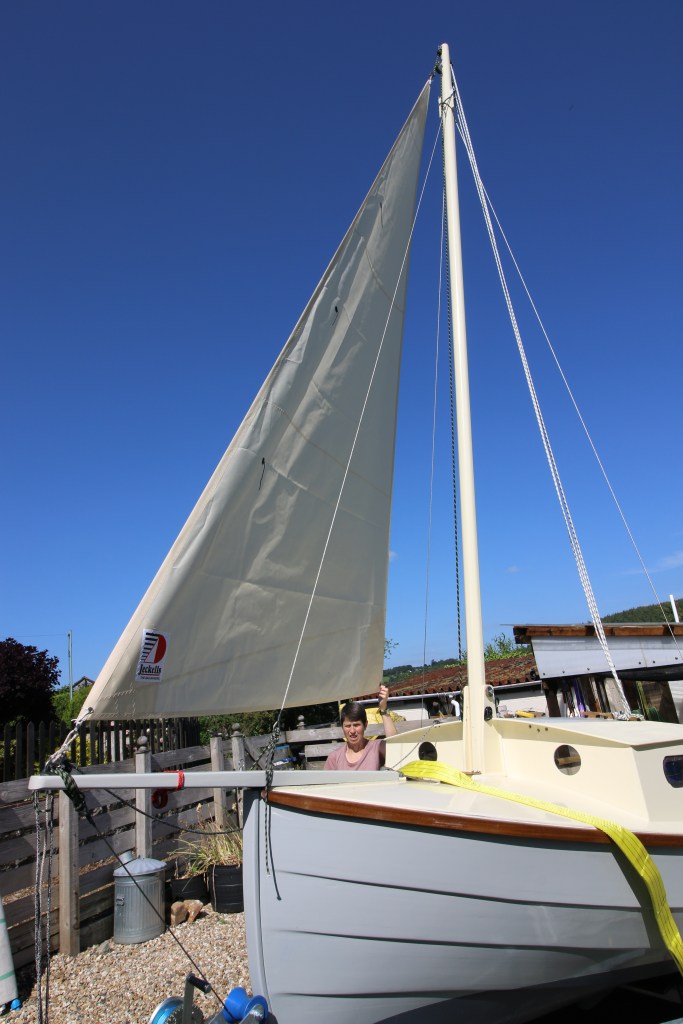
What it means is that the ‘corner’ of the sail between the luff and the head now sits 75mm back from the aft edge of the mast and once again is directly shackled to my newly made jaw strap plate that joins the halyard to the sail. At the bottom end I attached a new eye, bolted through the cuddy roof and that is also 75mm behind the mast – the luff of the sail then simply stretches out between it’s 2 attachment point and everything else comes into line. All it means is that the luff of the sail doesn’t lay against the aft edge of the mast but consistently 75mm behind it. What I thought was an odd looking set-up when I saw it today in fact looks a lot better and a lot like many Dutch working craft which often fly their mains’l with a significant gap between luff and mast.
Today, as I write, I even pulled the first and second reefs down to check that everything works with reefs in, it does and what I need to do next is make up a series of parrels that will allow the sail to slide up and down in it’s new position and in the case of the luff reef points will also resist the aft pull of the leech reefing lines. While I take a break there is resin and filler already in the new holes that I made around the gaff jaws and which are now unnecessary because my ‘simple’ solution seems to have worked.
New tack position, for future convenience the tack is going to get a small Wichard clip laced to the sail and will just clip into the strap eye when I rig the boat. All of the luff cringles will get beaded parrel lines so iv’e just ordered some 50 parrel beads to be going on with.
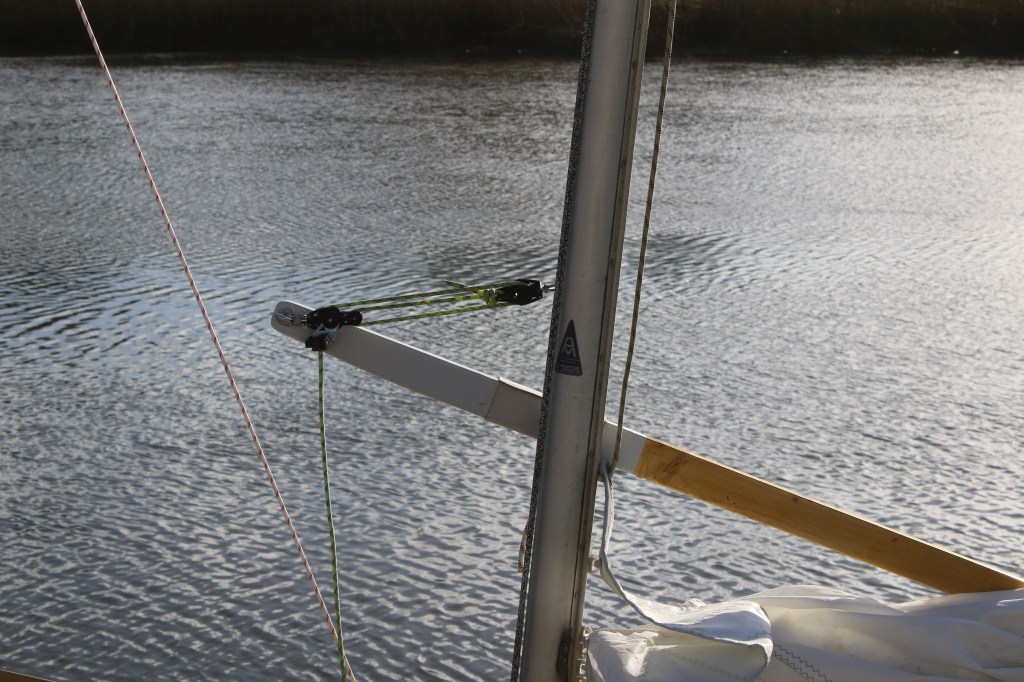
If you’re wondering where the boom is going to go I originally planned for a boom-less rig but the new sail position doesn’t allow me enough space aft to sheet the sail so the sail is going to get a down angled sprit boom just like the ones I ran on the cat ketch (Hunter liberty). I have yet to make a sprit boom and all that’s going to be is a simple length of pine from the wood mill in the valley, tidied up a little, and then something a bit smarter and lighter in the future. It also allows for a vang effect which I think is useful on gaff sails and an inboard sheeting position for the mainsail.
Just as a reminder, the cat ketch Liberty and it’s modified sprit boom rig which I found worked very well. As this post goes to schedule i’m working on different ways to mount the sprit boom which would also allow me to reef as quickly and painlessly as possible : unlike the Liberty’s rig my wooden Pathfinder mast doesn’t have a track and at least one set of parrels- the ones at the second reef will have to quickly removeable to pull the luff down during reefing.
Those of you with boats will know how it often is with them : make one mistake early on in a job and that can be the whole day down the scuppers. Get that one thing right and it doesn’t mean that it’s all going to go well but it may mean that things haven’t gone as badly as they could. *
Getting the mainsail to actually hoist and then look right was a great start to the day and what happened then was what should have happened on day one – start working out and making up all of the small parts and details that make the sail actually set as it should. Late in the day my order of parrel beads arrived but by then i’d already taken the sail and yard off because I had other jobs to do before doing a second hoist and adding that detail : part of that work is epoxy filling my ‘quick-fix’ holes in the end of the yard and doing the (hopefully) final shaping of the spar now that I have seen how it goes.
Up front….
Iv’e hardly given any attention to the boat’s jib since I hoisted it over a month ago just to see if it fitted or whether I had made a mistake there as well. Something I did suddenly realize during my day off is that while the sail might hoist and drop as it should it might not tack properly because of the relative positions of it out at the tip of the bowsprit and the actual forestay which is lashed to the bowsprit just beyond the bow. The actual fixed forestay doesn’t do any real work apart from keeping the mast up when the jib isn’t flying, instead the actual ‘forestay’ load comes directly on the wire luff of the jib itself and for now, due to a tight budget, I may just fly it like a smack does – essentially a free flying jib.
I’m not sure at this stage but I did plan and measure the foretriangle to have a jib on some sort of jib furler although at this stage it’s a luxury I can’t afford when set against sheets, blocks and sheet jammers. A jib furler would be handy because it would mean being able to roll the sail away instantly as and when I need to and to be able to lower as a rolled up ‘sausage’ rather than a whole heap of flapping canvas. Unlike roller reefing sails, which I detest, a furled jib won’t stay aloft but will come down when i’m anchored even if it just lays along the side deck to be out of the way.
Thus far iv’e not had good experiences with the traditional Wykeham-Martin jib furling gear ; I had one as bought with the Deben 4 ton ‘Inanda’ and it never worked for me even once. During my voyage back from Ipswich in Inanda I got so fed up with it that I eventually took it off and got used to just handling the sail as a free flying jib and using the bowsprit traveller to heave it in and out. With this boat a nice cast Bronze fitting would look the part but would be useless if it chose to troll me as Inanda’s did when I really needed it to roll the jib smartly. I did have some thoughts about rigging the Pathfinder as a Dutch style cutter by having a powerful overlapping staysail ‘all inboard’ and only carrying a small balance jib out on the end of the prod. However, designer JW says the boat balances properly as it is as a sloop and would become unbalanced with more sail area out front.
In time I think I may need to add a smaller jib to the sail inventory for those days when the full jib and 2 reefs are still too much sail area – not exactly a storm jib but something like a working jib or what a race boat might call a J4. At some point I really fancy an asymmetric running sail although I have fantasies about going all weird on everyone and flying a square foresail on a carbon fiber yard……I know !
As for right now my ‘working the problem’ included taking the bowsprit off again and moving the forestay connection point as far inboard as I could to give as large a space as possible for the jib to pass through the foretriangle. That was an unpleasant half-hour because the nuts are way up in the bow space beyond the watertight bulkhead and a complete sod to get at : the boat is looking a bit bare right now without it’s prod which is in the workshop getting the jobs done.
It’s highly likely that one of this winter’s jobs will be to make a new bowsprit which will be slightly longer than the standard one ; this would be to help the slight changes in balance that I will have created by having a small amount of rake in the mast and having moved the entire mainsail back by around 75mm. It might be useful also in that I could then carry a downwind and reaching sail further out from the bow.
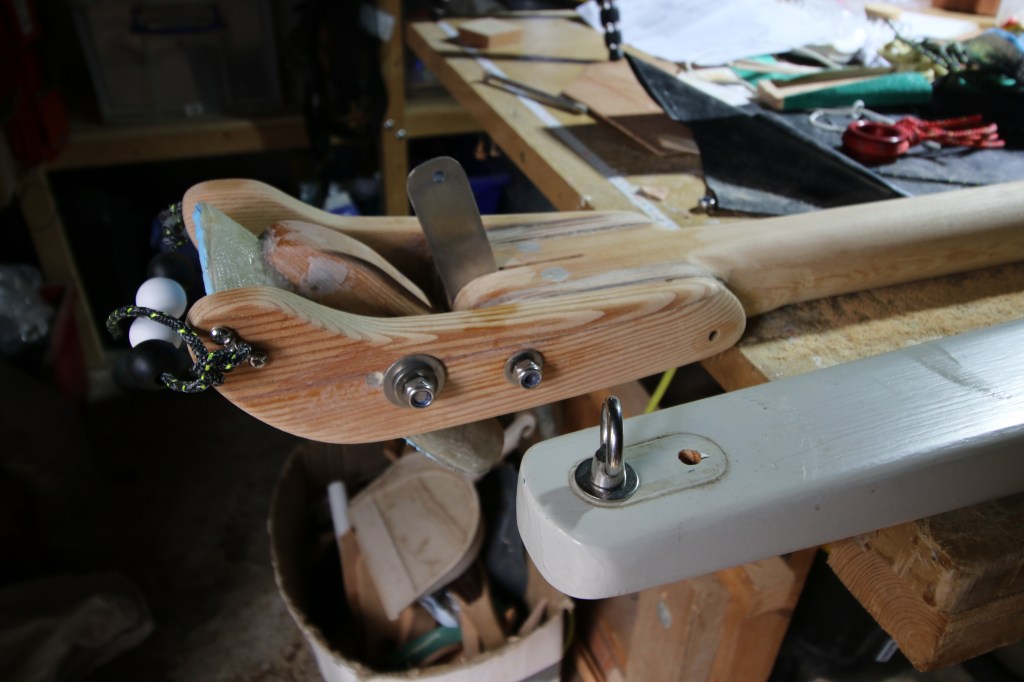
On the bench : the gaff and bowsprit getting some work done.
I’m sorry about the previous post and it’s accompanying video being so negative but, as I said above, I went into the whole thing excessively tired and as soon as things started to go awry I didn’t have the mental flexibility that day to just stop and have a re-think about the problem.
I’m glad to say now that i’m back in a far more positive frame of mind as I turn the ‘boat with a rig’ into a boat with a rig that actually sails. Right now I might, might be within 2 or 3 weeks of a potential launch and starting sea trials. Yes…..I realize that that has just thrown a mighty big hex on the whole project but i’m determined today to end on a positive note.

 Dirty Wet Dog, the great adventure.