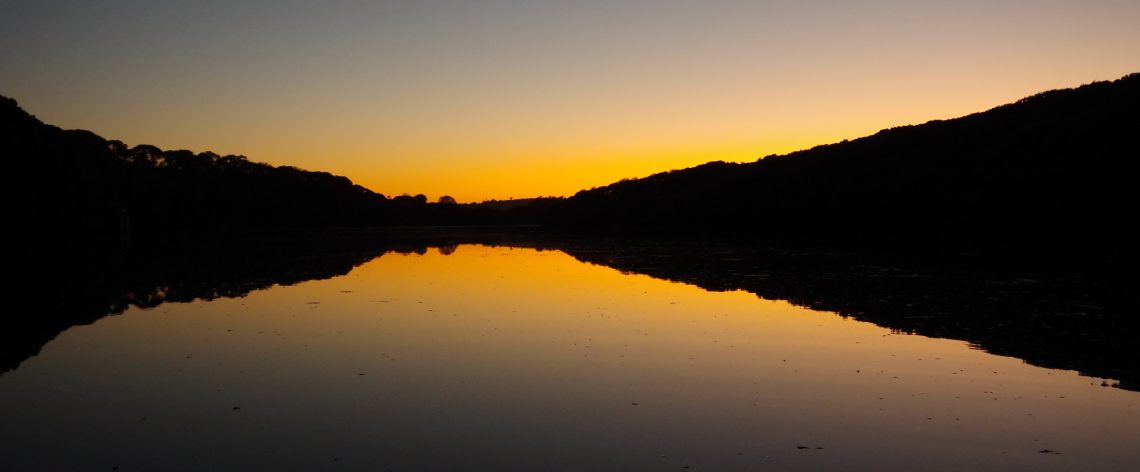


John Welsford’s SCAMP design.
For many yachtsmen rounding or ‘doubling’ the Horn (cape Horn) would be the culmination of a sailing career while for other expedition types it’s merely the kicking-off place for a passage across to the ice shelf of Antarctica aboard something like Pelagic – Skip Novak’s Antarctic expedition yacht. Very few ‘normal’ sailors would ever think to sail and cruise there because it’s an absolute ball-ache to get there and the best option among mainly bad ones is to traverse half of the Southern Ocean first.
For me, I did it the obvious way, which is to climb aboard a Whitbread race Maxi yacht in Auckland New Zealand and head strongly south down the Rhumb line, into the big chilli bin and then some 3 weeks later pass the false cape and then the real one. Not many sailors know this but the false cape looks better than the real one and the other thing that most sailors don’t know is that there’s a small group of rocks awash in the southern ocean just before the Horn itself. The other thing that most sailors don’t know is that you can get an excellent latte and a slice of home made lemon drizzle cake just a few miles north of the infamous cape.
As headlands go the Horn is a bit unusual in that it’s not only the far southern tip of the whole American continent but it’s also the southern tip of it’s own island (Isla Cabo de Hornos) and it’s got an entire complex waterway between it and the mainland of Tierra del Feugo – I have made the mistake in the past of calling that whole area Patagonia which, strictly speaking, is the mountainous region to the north and west.
There are two main centers of civilization down there, one being in Chile (Puerto Williams) and the other being just across the border in Argentina (Ushuaia) – not a lot of people know this but there’s also a tiny settlement called Puerto Harberton which I think is the nearest homestead or farm to the actual Horn where it’s possible to anchor, row ashore and get a decent Latte. As experiences go it’s a bit like going to the actual scene of Peter Jackson/LOTR ‘last alliance battle’ and wandering across the road for a decent latte there too……
Anyway, as places go it’s not exactly the place you would take an eleven foot dinghy to go cruising there – unless your name is Howard Rice and your boat is a modified John Welsford designed SCAMP. My thanks to Howard for pointing me in the direction of the pieces that he wrote for the actual Small Craft Advisory magazine and which are still available as PDF downloads.
Howard Rice photograph – Howard’s SCAMP ‘Southern Cross’.

This post is I feel also a culmination and end point of my several attempts to write about the voyages of very small boats and their owners. I know that there are ridiculously small ‘record’ boats but take no interest in their antics, instead my interest is in small capable boats that the average Joe or Joanne nowadays could build at home, sail, and have a good time doing so. Where at one time I might have featured the Jack Holt designed Mirror dinghy of which it is estimated that some 70.000 were built and over the years introduced thousands of everyday folk to backyard boatbuilding and seat of the pants sailing. Well, there are plenty of older Mirror Dinghy’s to be found cheap online and i’m glad to say that John’s SCAMP design looks to becoming a success too….not that the boats have anything in common except for a similar length perhaps.
The other side to this piece is that it should follow my usual blog rule of interesting boat, interesting skipper and significant voyage…..well it does except that I can’t fill out the voyage and skipper aspects as well as I would like to although on the purely boat side there’s been lots written and several video’s filmed about the SCAMP design. As yet iv’e yet to see one for real and I have high hopes of meeting up with one also being built down here in the south west of England.
Anyway……The Mirror dinghy can be thought of as both a class racing dinghy for a 2 person crew and/or a general purpose cruising dinghy that could generally make it into the driveway at home and tow behind a normal car. Today I know of one that gets used as a cruising boat by a member of the dinghy cruising crowd and at least one more that has been converted into a kind of micro-cruiser. I may have this wrong but I think that the whole idea of building a capable small boat at home and then going sailing pretty well anywhere with it has morphed from Jack Holt’s iconic Mirror dinghy to John Welsford’s improbably different SCAMP design. If there is a modern grass roots revival of small craft adventure sailing then here’s a great example.
The basics……
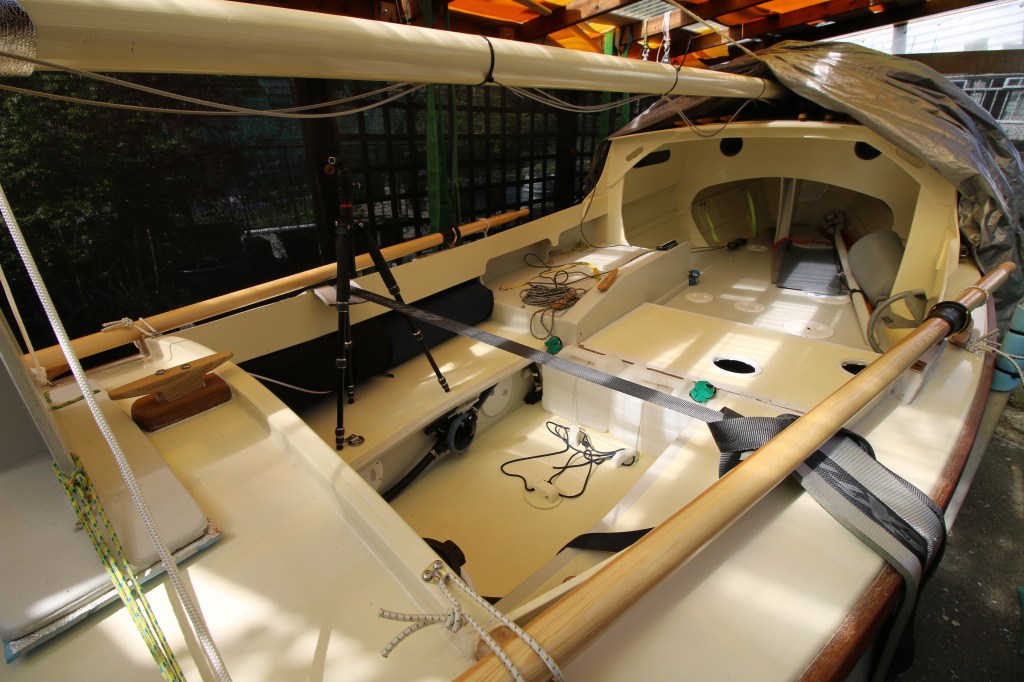
The Mirror dinghy is basically a single chine ‘box’ hull 10 feet and 10 inches in length (3.3 M) and 4 foot 7 inches wide weighing in at 100 Lbs dry. They were originally designed with a gunter rig so that all the spars would stow inside the boat. As a comparison John Welsford’s SCAMP design is a chunky multi-chine hull with a pram style bow up and out of the waterline and comes in at 11 feet and 11 inches long, but is amazingly wide (5 foot 4 inches) for it’s length and comes in at close to twice the weight….there again it’s a much more complex boat with a cuddy and much more volume.
A whole fleet of ‘SCAMPI’……ok …..sorry !
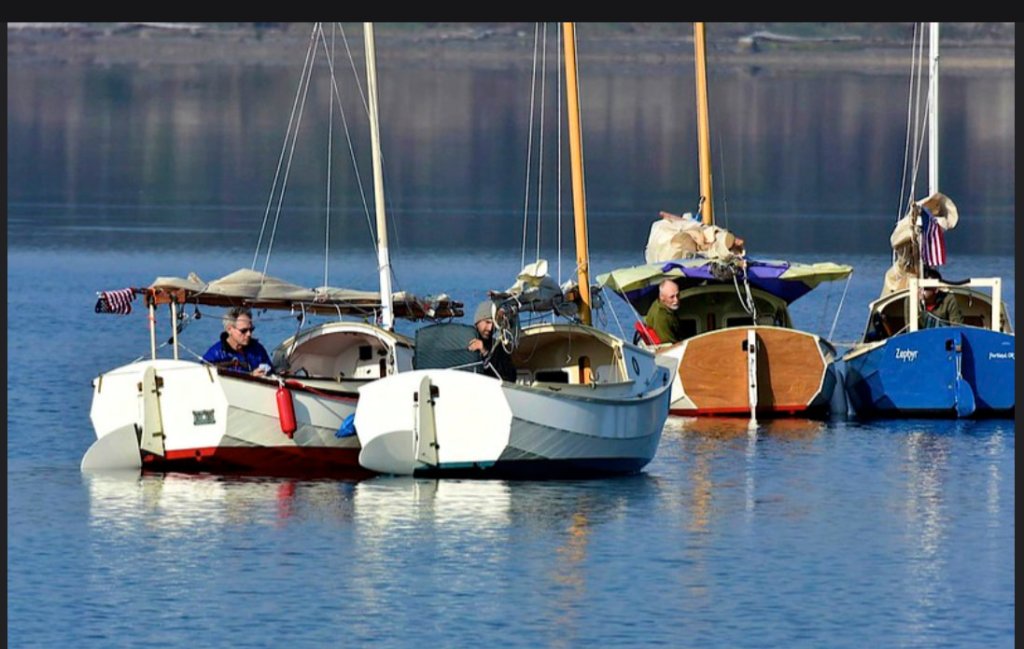
Collaborations.
As I understand it the SCAMP design was originally a collaboration between Kiwi designer John Welsford and the co-editors of the Small Craft Advisory Magazine (SCAMP) Craig Wagner and Josh Colvin, – the following is taken directly from the Wikipedia entry……”The SCAMP (acronym of Small Craft Advisor Magazine Project) is a wooden or fiberglass hulled Balanced Lug rigged sailing dinghy. The boat is 11 ft 11 in (3.63 m) long, and capable of accommodating four persons on a daysail or one to two for overnighting or extended cruising. Craig Wagner and Josh Colvin, editors of Small Craft Advisor Magazine, teamed up with noted New Zealand boat designer, John Welsford, to create what they call a “Mini Microcruiser” sailboat. Welsford considers it possibly the best boat he’s designed, based on “suitability for purpose”.[1] Some early plans details received subsequent revisions by Kees Prins and the Northwest Maritime Center.[2] While no particular feature of the boat is unprecedented, the combination of design elements has produced a “new genre of sailboat”.
The further collaboration was then between John Welsford and outdoors instructor/canoeist Howard Rice to further develop the design for Rice’s intended cruise around the Magellan strait. Southern Cross is essentially the SCAMP hull and cuddy design but with a different rig and a whole load of attention to additional detail and then, as I understand it Howard Rice then had the boat shipped down to Southern Chile to start his voyage.
Howard Rice photograph.

Everyday SCAMP.
While I have huge respect for Howard Rice and his cruise around the Magellan strait in his modified SCAMP i’m wary of touting the success of his boat as a reason for the average Joe and Joanne to build a SCAMP with that voyage as a primary example. Also – I have sailed around that area during three voyages and it’s not a place I would choose to take a boat of that size and type. I suspect that Howard himself would say that the success of his cruise had as much to do with his preparation and training as it did to the basic design of the boat. I would suggest that it’s more valuable to see what other sailors do with their boats – for example that one of my boat choice filters was a boat that had taken part in an Everglades challenge and/or did other extended and independent cruising.
Well….one SCAMP at least has taken part in the Everglades challenge several times – the delightfully named ‘Fat Bottom Girl’ and when I last heard another was being trailed north to sail in one of the great lakes for an extended cruise as soon as the ice broke up.
I did briefly consider SCAMP for my own project but I didn’t because I thought that two other designs from John Welsford’s board seemed closer to what I thought I wanted ; they were initially the rowing/sailing orientated Walkabout which had also taken part in an Everglades Challenge and the near-maximum dinghy/dayboat ‘Pathfinder’. Later on I did also have regrets about having not built Longsteps but as I explained in another post that boat might just not quite work space wise at our place. What I did do was take at least two ideas directly from SCAMP and Long steps and incorporate them into my own Pathfinder build project – the off center centerboard and the cuddy. Given that my project is for a sailing and rowing boat I felt that one of the SCAMP design’s few failings might be that it seems to be the wrong shape to make a good rowing boat but this might even be true of my own Pathfinder compared say to Walkabout or Long steps.
The second and more major reason why I rejected the design for my own project is because of what I call the small boat speed problem ; SCAMP is still a displacement hull and it’s hull speed is still limited by it’s waterline length – with Pathfinder I simply have a lot more waterline and when I worked the numbers I thought I would have more than a knot more hull speed on average. That I think is a big difference when sailing a long coastal or offshore passage in UK waters where tidal gates really are a feature. I think that it’s also true that SCAMP is specifically not an ideal rowing boat shape but then neither is my Pathfinder or her smaller cousin ‘Navigator’. I might…..might have been better off building Long Steps but even now I would be sweating about getting it in and out of the driveway.
Pathfinder
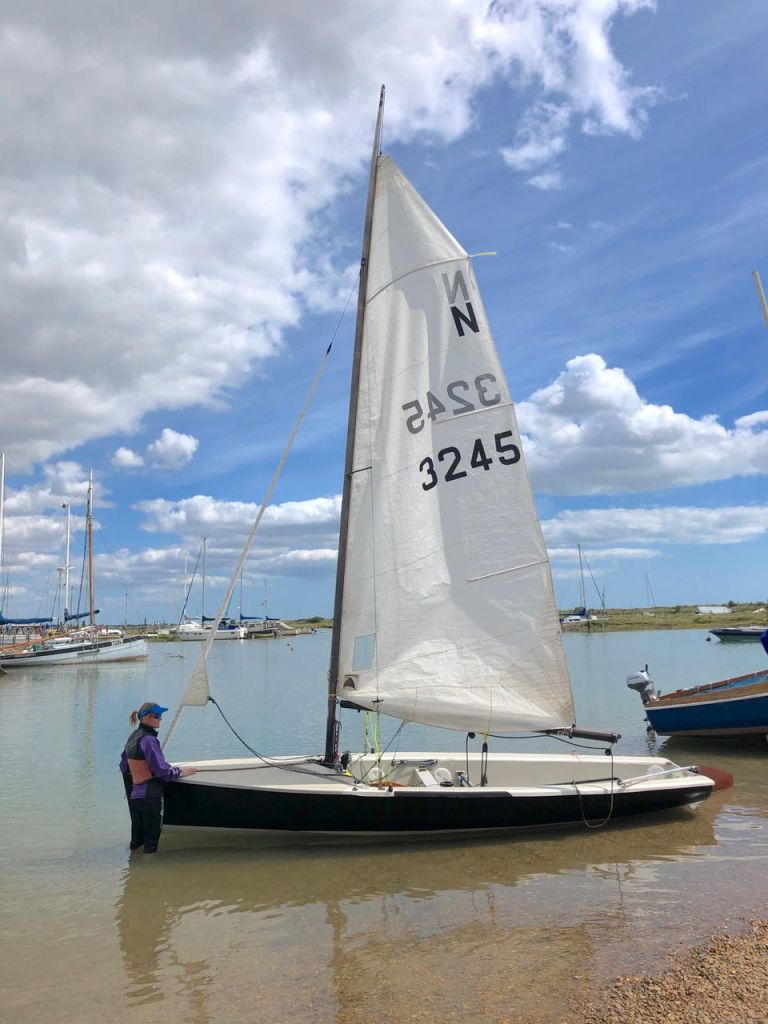
John Welsford’s SCAMP design is basically dinghy sized as it’s length is close to a National 12 dinghy but I think that it’s wrong to compare the design to any general purpose dinghy because it’s features seem more like a shortened version of a larger half decked cruising boat. I call the boat ‘improbable’ in a slightly tongue in cheek way because I know next to nothing about hydrodynamics and can’t for the life of me see how a boat that short and fat sails as well as it does….and they do seem to sail really well. I was brought up on long and slim boats such as Folkboats and Metre class yachts but equally I spent a lot of time with wide sterned IOR race yachts and I know how quickly it can all go wrong in that shape of boat. If anything SCAMP seems more like the short and ‘blunt’ Dutch working craft that I also admire.
As I say, I have taken design features from SCAMP and used them in my own project and then secondly I have pored over Howard Rice’s detailed description of his boat preparation and modifications. What I get from the latter is a more and more detailed boat that I hope takes my boat from summer dayboat to at least a three season expedition boat.
With thanks to John Welsford, Howard Rice, John Hippe and the dozens of others who have built and sailed small sailing boats and added to the story…….
Story post-script.
My original thinking for this post came on the heels of one of my own sailing experiences a few years back and at a time when I owned the smallest boat I had owned and sailed up until that time – the 22 foot Hunter Liberty.
The basic story is that I was at anchor on a ‘dark and stormy night’ at the western end of the Lynher river inland of Plymouth UK. What I had thought was going to be a short, early season weather window which would allow me to sprint down to the west country turned instead to several days of continuous gales ; I did take a brief look at Plymouth sound and waves were actually breaking over the breakwater so I turned and ran back to the shelter of Dandy hole and hid there for a couple of days.
During one of those cold evenings aboard I was tucked up under my mountaineering sleeping bag while sat by the companionway and watching the view change as the boat sheered at anchor like a mad thing. What I saw was a small pram bowed dinghy come out of the shallow creek to the south of Dandy Hole and row across my line of view until it landed on the mud spit that forms the inside curve of where the Lynher turns to the north – I think that point is Redshank point and there’s a small area of rough grass there below the fenced farmers field.
As I remember it the boat looked most like a Mirror dingy as the bow shape and length were about right and the boat had the short stumpy mast that could have been the bottom section only of the gunter rig. Whatever, the skipper landed his little boat, heaved it up the foreshore a bit and seemed to be going ashore with a big old military style Bergen rucksack from which he set up a simple bushcraft style camp and later on I saw the glow of his campfire.
This came at a time when I was thinking about giving up on ‘big’ boats because I was coming up to retirement and I just didn’t want the expense of having to keep the Liberty on a boatyard mooring but as it happened I persisted with the boat and I think it was 2 years later when I retired from the NHS one day and sailed for Brittany the very next afternoon. I had a horrible passage across the channel and then a truly great 110 days cruising around Brittany in the little Liberty which was a superb boat for the trip . I kept in mind though the future idea of owning a much smaller boat – a general purpose dinghy well set up for coastal cruising and stealthy camping ashore ; I messed around with the idea for quite a while and even started looking for a retired racing dinghy like the amazingly quick retired and modified National 18 that used to turn up at the Looe Luggers regatta.
My concept then was to only ever have a boat that I could keep at home, that was my first objective, then to only have a low budget or low initial investment boat such that I could also get on with other things financially. As it happens I broke my second rule the moment I started building Pathfinder and there have been times when I wished that I had built a smaller and simpler boat that only needed a small trailer etc etc. SCAMP would have done the job beautifully I think but once again I would still have preferred something with much more waterline length for passage speed. My actual choice and project that nearly came about was a retired Osprey class dinghy which would have had the speed but not the seaworthiness or sailing comfort that either SCAMP or Pathfinder has.
Anyway…..that’s my story so…..
This is fellow professional sailor’s boat (Gavin Print and partner’s) Osprey dinghy set up as cruising boat.
Postscript 2, the boat, the skipper and the voyage.
If I have a favorite way of writing about things here it is to combine an interesting boat with an equally interesting skipper and combining both with a voyage that is a bit out of the ordinary for any reason. Two of my favorite pieces so far were when I covered Capucine Trochet and her voyage from the bay of Bengal to southern France with the Jute and scrap built Taratari ; the other one, boat skipper and voyage was the various arctic voyages of British small boat sailor Roger Taylor and his two converted production yachts.
For this piece I did want to follow that format with a story about Howard Rice, his pair of SCAMP builds and his voyage in the Magellan strait. At the time I initially wrote this piece I didn’t have a reliable account of his build, his preparation and his voyage, just a few snippets taken from reading the odd comment in SCAMP designer John Welsford’s home page. The actual story involves both of them because designer John also went to Tierra del Fuego and assisted with the set up of Howard Rice’s second SCAMP build – Southern Cross.
Today, as I write, I found a way of getting hold of PDF downloads of the original articles written by Howard himself for the Small Craft Advisory Magazine and i’m working my way through them. Howard also kindly offered me the opportunity to do a Zoom style interview, record the result and maybe to then pen something new. As it happens right now iv’e already got a lot of material to work with just with a couple of PDF downloads and even now it changes the way I think about his preparation and the voyage itself.
I feel though that the piece would need to be in ‘several halves’ as I put it rather badly and a lot of what I would like to cover has already been done – a cover of John’s work and the actual design and only then Howard’s original dream of going to Labrador with a small boat. John himself did once agree to a kind of blog cover but since then he has done at least one accessible presentation with the Dinghy Cruising Association and a more recent cover of some of his design thoughts with his more recent design Long steps.
Well, i’m going to work on it although the day I wrote the second postscript I also got notification about my own sails arriving soon and I feel that i’m now going to be a bit busy for the next few weeks. It’s more likely that i’ll leave the longer writing job until at least this coming winter at which time it would become a great winter project.
Catch you later I hope.

 Dirty Wet Dog, the great adventure.
“I had a dream, I built a 12 foot boat, I shipped it to Patagonia, I sailed the Strait of Magellan, I explored a big chunk of the islands of Tierra del Fuego, I faced down a day of days and I am so glad to have the opportunity to do this. I have seen things that are so beautiful they almost brought tears to my eyes.”
Howard Rice 2017
LikeLike