

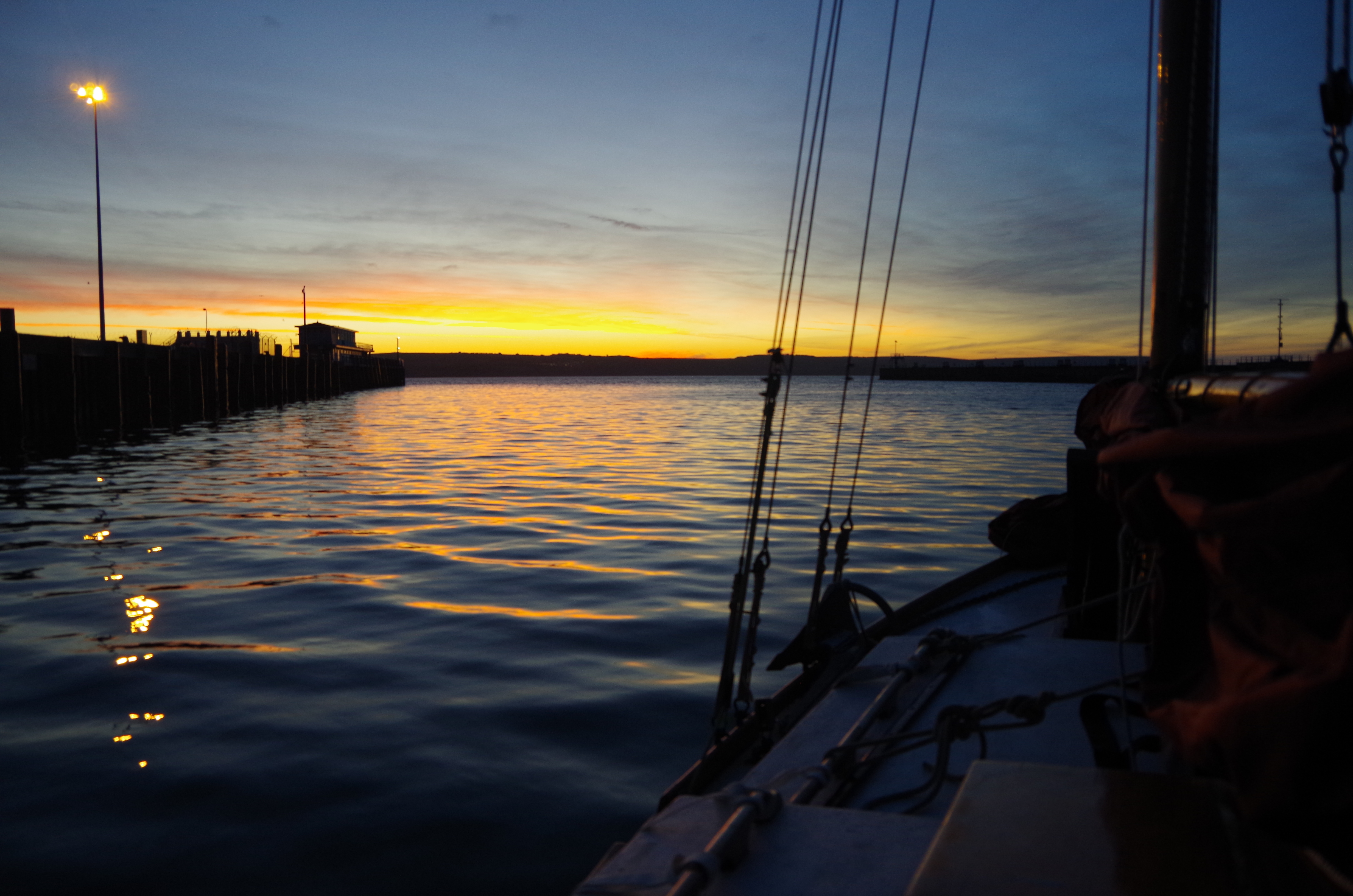
Why size matters in sailboats, 1 the displacement speed problem.
Welcome aboard once more, in this post i’m going back one step and talking in a bit more detail about the relevance of size, length and displacement/weight in sailing boats but this time with a look at why sometimes the smaller boat doesn’t work so well.
Part one, from my logbook mid channel.
WABI”’ real time : it’s late evening and almost the end of July, and day 110 of the voyage, we are about 30 miles into the return cross channel passage from L’Aber-Wrach to the Helford river. We’ve got a nice breeze from the south by south west and the westerly swell is settling so it’s turning into a nice steady passage : i feel fine, i’m keeping to a good watch pattern and i’m eating and drinking well. WABI”’ seems to have a speed problem though, I reckon we should be doing hull speed easily and we’re at least half a knot slow by my estimate.
This seems strange because we are in almost ideal conditions for the boat , a broad reach in 10 to 12 knots , a light sea state and the boat is nicely balanced with the new weight distribution : it can only be the state of the bottom and really only the section between the bilge runners and the centerboard slot…..i know i scrubbed everything else. When i got the boat ashore in Calstock it was very clear that the problem was a heavy growth of small barnacles completely coating the one section of the hull that i hadn’t been able to reach during my last scrub which i did on the beach at Camaret. It was a really neat place to beach WABI”’ right in front of my favourite cafe and cheap of course, the only problem being that the sand, while lovely to walk on was soft enough to let the bilge runners settle well in and obscure the one section of hull that i needed to get at.
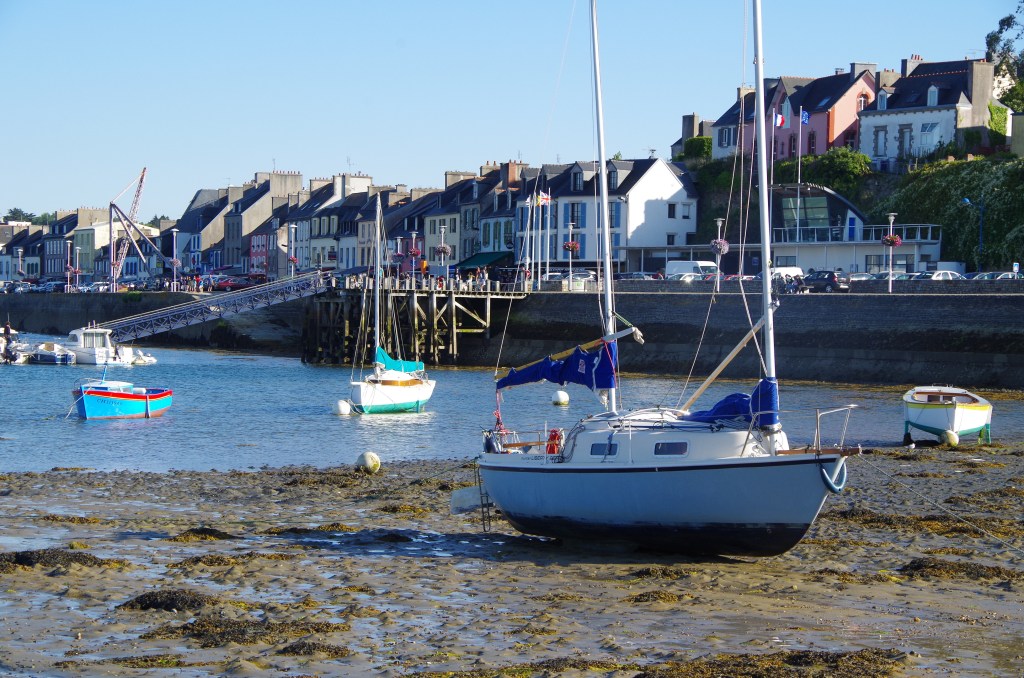
WABI”’ on the beach at the head of the harbor in Camaret Sur Mer.
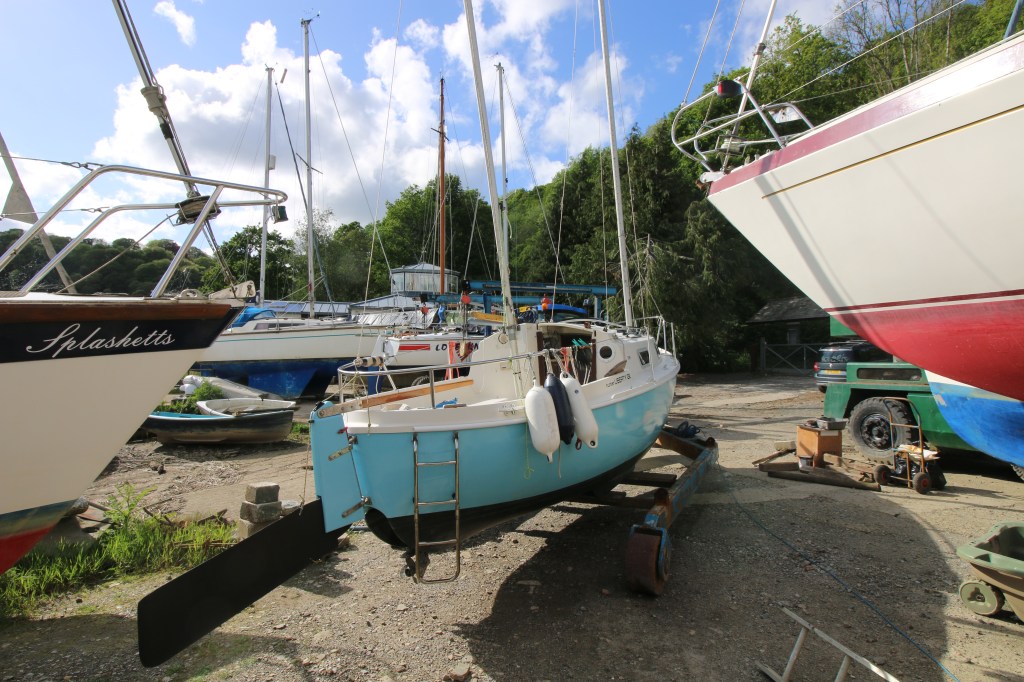
Going back a bit, the last time that i’d had WABI”’ on the slip must have been late in the spring of the year before, i’d definitely scrubbed and wet-sanded her and put on one new coat of antifoul but that was at least a year previous. We don’t actually get much fouling at the yard because the water is partially fresh river water….well ‘fresh’ that is with a fair amount of cow-silt and bull-silt washing down the river. Most of the new growth will have happened during the voyage and i can only guess that the leaching antifouling will have mainly washed off in the high tidal and river flow.
The thing is that iv’e always been meticulous about my boat’s underwater surfaces, to the extent of spending days working my down the grades of wet and dry paper just as though she is a race boat and i did a beach and scrub routine every few weeks during the voyage The lesson if there is one is that less than a third of the hull being foul was reducing my hull speed by one half to three quarters of a knot….and that’s a big loss of speed for a small boat on a long passage.
There’s something that i want to introduce here and that is the overall concept of speed or ‘performance’ in small sailing boats and that is, generally speaking, that our small boats don’t start out with much ‘speed’ to start with and we really can’t afford to throw any of it away.
Every boat that i have in mind for this story is a fairly normal, although small, displacement hull so our passage speed is always limited by our hull speed plus or minus our tidal flow. Displacement hull speed is directly related to waterline length in a ‘hard’ mathematical relationship which can be expressed as the simple formula : Vmax (in knots) = square root of LWL (in feet) x 1.34. Quite crudely this tells us why a boat with a longer waterline length should be faster in displacement conditions than the boat with a shorter waterline length..this can really matter to the small boat sailor on a long coastal or offshore passage.
My boat has a waterline length of just over 19 feet, so using the formula above we can say that the boat has a theoretical hull speed of 5.8 knots although the Liberty never actually does that : my best cruising speed in say moderate downwind conditions is around 5 knots and that’s what i should have been doing for most of the return cross channel passage…..as it happens i note that the moderate amount of fouling i had was knocking my boatspeed down to around 4 to 4.5 knots and that was going to add about 2 hours to my passage time.
Now, that was poor preparation on my part and all it meant on the day was that i was a bit later getting into the Helford river than i had planned and just that 2 hours more tired than i need to have been. On a previous trip my short waterline length had a much more major impact on my passage speed and we then missed a crucial tidal gate, got carried down-tide on a big spring flood in the channel and then had to spend another 4 hours and more motor-sailing to get into port…..that turned into a long, cold and hard night at sea where even half a knot extra hull speed would have got us into port before the foul tide kicked in.
That was, kind-of, an exceptional circumstance where the boat was well prepared, i’d left port as early as i reasonably could, sailed the passage as well as i could and it was simply not having enough waterline length that extended the passage time into an extra night at sea whereas a very slightly longer boat would have been swing to her anchor hours before. In fact on that passage it was really noticeable how much faster were the other cruising boats that left port after us and passed us with that little extra consistent speed.
After that passage i spent some time ‘working the numbers’ for other boats that might have been viable choices , both larger and smaller boats and it doesn’t take much more or less length in a boat to add or lose a half knot or more. A really good example here is what arctic sailor Roger Taylor said in one of his video blogs about the hull speed difference between his first arctic exploration boat based on a 21 foot Corribee and his second one based on an Achilles 24….he says that the average difference is around half a knot which doesn’t sound a lot but on a channel crossing can make the difference between making a tidal gate and being stuck out there as a foul tide builds.
Discussion……
Now, I make it sound as though boatspeed is a one dimensional problem – that of waterline length and the wave making properties of displacement boats ; while that’s true and that displacement speed is a natural hard limit experience with small boats often shows us that they are often quicker (relative to larger boats) than this makes out. Other factors of course are whether we are sailing on a clean and smooth bottom as in my story above, another factor is what condition our sails are in and how well we are using them – on top of those things we can add how well trimmed the boat is and ultimately how well we are sailing it.
Ultimate displacement (hull) speed was only ever a problem in making a cross channel passage because it was the one thing that I could do nothing about compared to everything else that I could tweak or improve in some way – perhaps that was the advantage of having once been a racing sailor who was obsessive about having a ‘slippery bottom’, having the weight in the right place and working on sail trim and tidal strategy.
There is a positive side to smaller boats and their speed and that is that they are usually much more responsive when say there isn’t much wind and when a gust comes along they accelerate and get going much sooner than the larger and heavier yacht. I experienced this several times, once when approaching Berry head in company with one of the big Brixham trawlers on a day of very light westerly’s every time a breath of wind went up a notch the small and lightweight (and smooth bottomed) Liberty picked up speed and pulled ahead of the big sailing trawler. Yes, it also helped that I was tacking downwind on every wind shift and in doing so getting flow across my sails.
Of course…..as soon as we both turned the corner at Berry head and into Torbay I came up to hull speed in the Liberty and the big trawler started to pull away because his theoretical hull speed was about twice that of ours. If there’s a lesson here it is to set up a boat such that we can get it up towards it’s ‘best speed’ at all times because one day that’s really going to count.
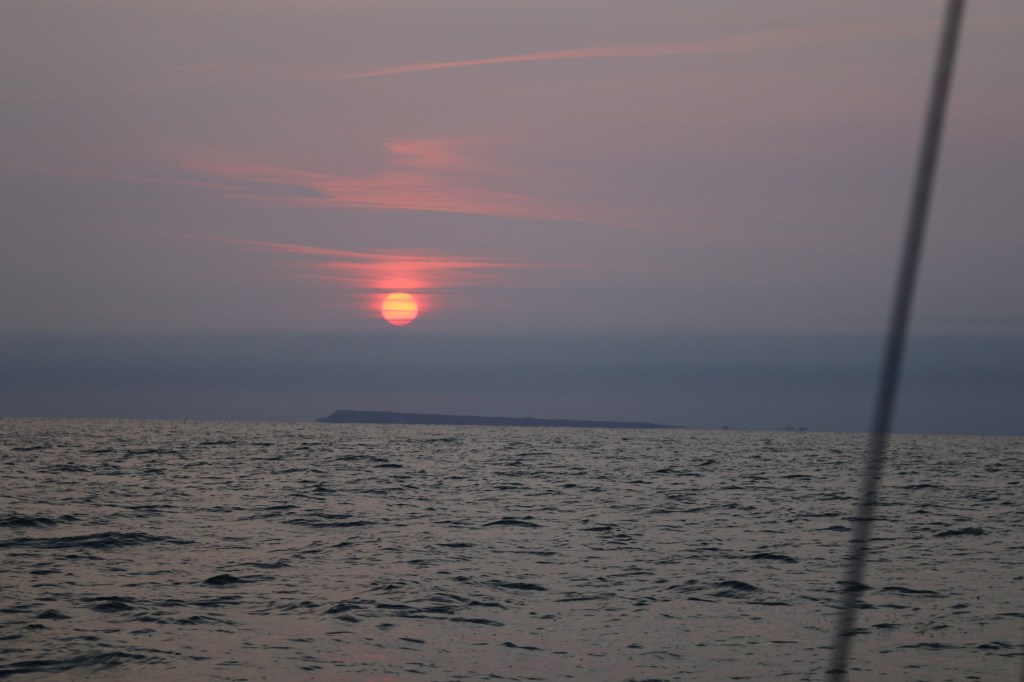
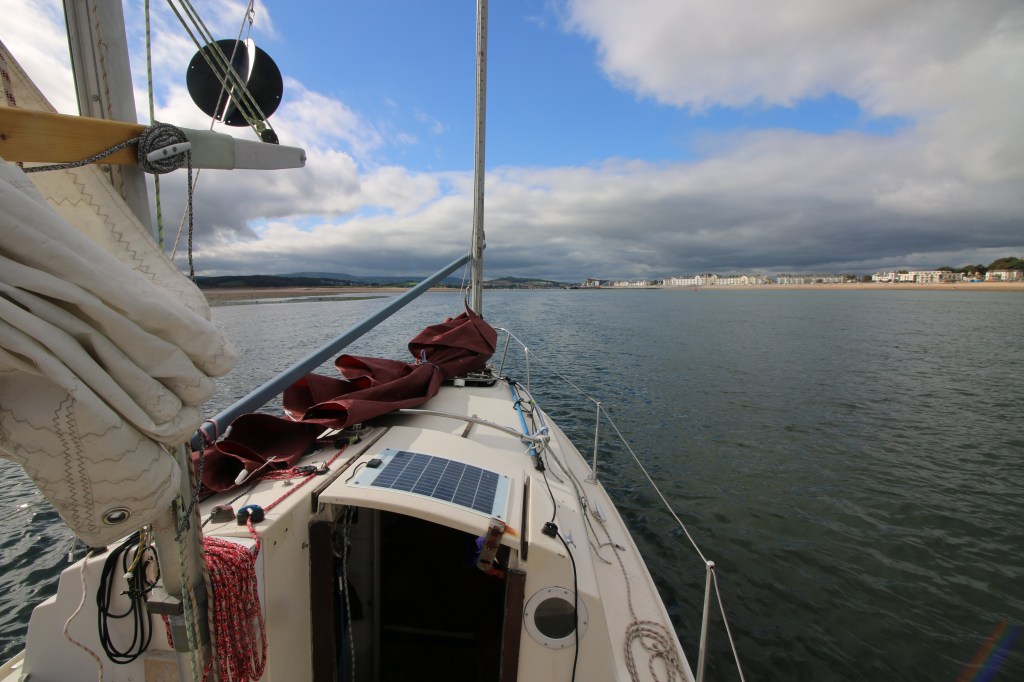
A well sailed passage and waiting for the tide at the Exe bar.

 Dirty Wet Dog, the great adventure.