

The joy of small boats, sixth post, the two most important ‘rules’.
The rule , reason or principle for small boats and simple ones…..extended version.
Welcome back aboard sailors, I guess that some of you are here because you read the original version in which I outlined the five basic rules or principles for being a low-end budget boater with a desire to both have a boat and get out on the water ; some of you are probably wondering what more there is to say about those two basic rules or principles….which means that the rest of you got lost on the way to somewhere else.
As most of you will have read by now I wrote the original work as a complete section of my intended book project and when I wrote the original ‘rules for small boats and basic boaters’ I wrote each rule or principle as a separate piece and included as much supporting material as I felt it needed…..in short I said as much as I felt that I could say and then left it there. When I came to the fifth post in my blog series I thought it best to compress the five principles into one post and only add as much material as seemed necessary to make the principle understood well enough to be argued with – in doing so I edited out most of the detail and anything that seemed a bit pretentious……that for example I feel that owning and sailing a small/smaller boat makes us better people. I will try and argue why I think that is the case but in any event please supply your own bucket just in case it gets a bit too much.
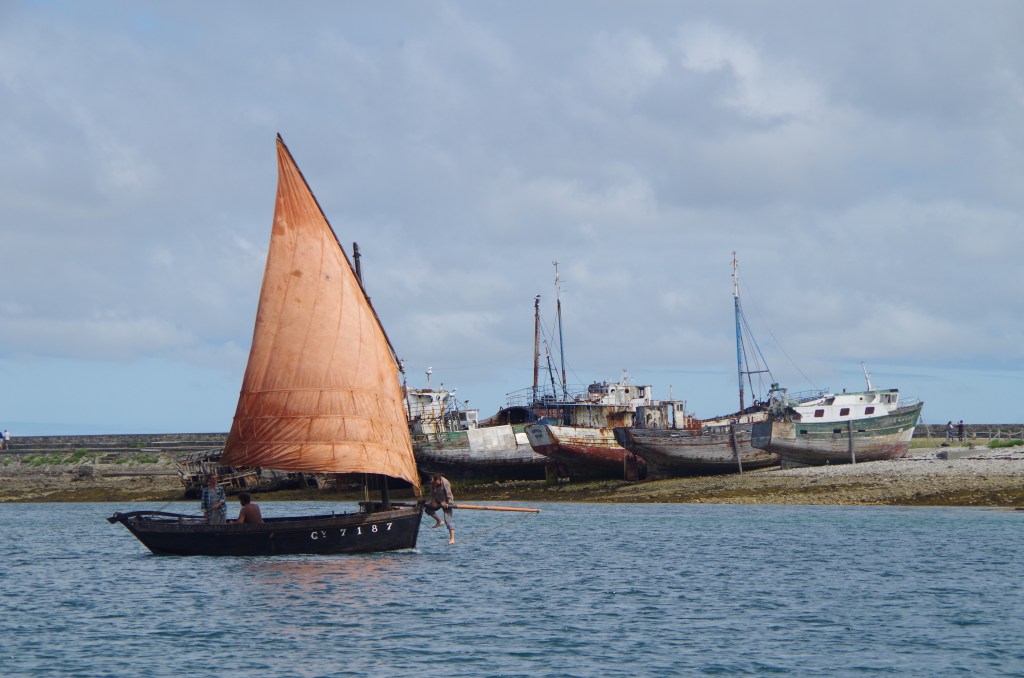
Unknown Lugger, Camaret sur Mer 2019.
Smaller……the directors cut.
In the original piece and in my fifth post of this thread I made the argument that having a small or smaller boat than one we would actually desire might be the only way we can have a boat because it will normally be the case that the smaller (and simpler) one is the only one we can afford. That’s a pretty hard bottom line or it might be as in my case that I could buy a slightly larger boat as I did with the Hunter Liberty but I was then at the mercy (and costs) of a boatyard, which I could no longer tolerate, and going smaller meant that I regained my independence by having that smaller boat at home.
A different take on small boats and a small budget is that all boat equipment goes up in cost exponentially with size – compare a 10 pound anchor with a 20 or thirty pound one just as an example. Needing and having small and light gear often makes it possible to have much more high quality gear…..thinking about really essential equipment here such as sails and anchors. For me small and simple also means an increase in quality which is almost the polar opposite of what the production yacht manufacturers did during the 1980’s and 90’s which I read as ‘built as cheaply as possible’ and fitted out with less than adequate equipment because even then decent equipment was seen to cost too much.
Going to the bottom line on costs then – by not having a boat that has to be on a yard mooring in the summer, being told that I have to vacate said mooring by a specific date and then essentially needing the same yard to store the boat for me ashore…..even if I would prefer to still be on the water….creates a kind of commercial trap, and an expensive one too. By not paying for a summer yard mooring and a storage slot in the yard over the winter I reckoned to not spend about £1200 a year, and that’s at a very basic , low cost yard. Eighteen months (two years plus now) of not spending that kind of amount has already allowed me to spend that much on a trailer for my smaller boat which now lives at home.
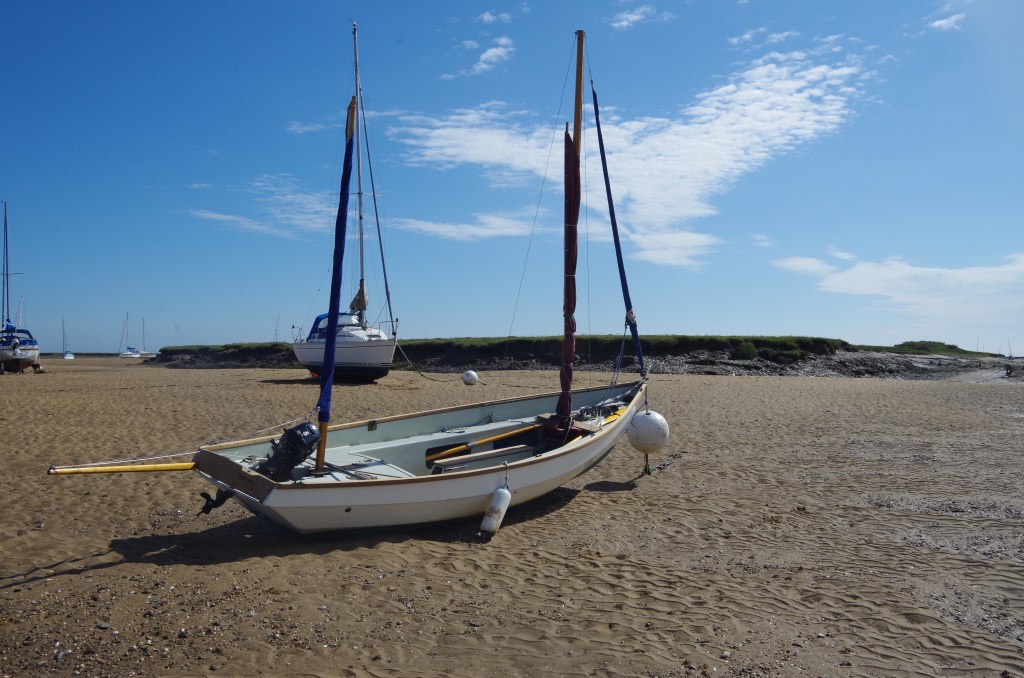
Having my own boat in my own (boat) yard on a trailer means that I can access my boat whenever I want to and because it’s on a trailer I could take a look-see at the weather report, see that Norfolk or the west coast of Scotland is looking nice next week so all I would have to do is load up and drive there. Although I enjoy my challenging offshore voyages in small boats they can be a bit hard going but an hour’s drive gets car, trailer and boat to Plymouth’s ferry port and we can be in Brittany for breakfast…….an hour’s drive would get us to the Rade de Brest and two hours would get us to southern Brittany. Even now I have a future trip planned which would get us to the Bassin D’Archachon in about 8 hours driving with a side option of launching in the Morbihan on the way home.
Norfolk for the weekend perhaps ?
A better sailor.
Every top end tiller waggler (helmsman) and rope tweaker (sail trimmer) that I have ever known started their sailing life in a class dinghy of some kind and nearly all of them raced dinghies before progressing onto bigger boats – i didn’t, by the way, which is one reason why I never became a particularly good sailor. On a good day I mostly get it right because I both think about the art of sailing and have lived long enough to get a reasonable amount of practice – still though I don’t have the natural feel and seat of the pants balance that dinghy sailors seem to come with as standard.
Sailing a well set up dinghy or small dayboat has always struck me as a more subtle and direct skill and experience than being behind the wheel on a big yacht where there is lots of ‘machine’ between hands and water. Larger and heavier yachts don’t respond as well or as quickly to changes in helm and sheet either. Lots of offshore racing on big boats made me a competent crewman in that I could ‘hand reef and steer’ in all conditions but not one who was likely to win races as a helmsman. Racing is only one small aspect of the art of sailing however but even saying that I get the impression that someone who started with a dinghy has a better feel for the art.
A better person…….perhaps.
When I wrote the original piece that this entire thread is based on you have to remember that it was right at the beginning of the pandemic and the near total social lockdown that was imposed on us all and strangely that some people seemed to want to continue indefinitely. My only escape from home in that first year was to walk, from home, a circular route that took me around some mixture of local lanes and footpaths ; temperamentally i’m an extreme introvert, almost asocial in fact but even I felt that I was under house arrest with the local plod cruising around to make sure we were all being good little obedient subjects. A very good psychologist says that introverts find great solace in the outdoors and part of my experience of that has been the time I have been able to spend sailing a small craft and then at anchor is some quiet place. At times I felt that the small craft was my escape capsule into solitude and that the almost direct contact of hand to water via tiller and sheet gave me a connection to nature that I felt I needed…..in short, made me a saner and better person.
In that original piece I went on to explore the idea that small craft might make us ‘better people’ in that I think that there has to be a goodly amount of both humility and humility involved in going to sea in a small boat because we can’t just get away with some of the things that we can in larger vessels. I thought too that as direct an experience as possible of the forces of nature might be the antidote we all need to the unreality of the virtual world and the all too real world of crass consumerism based on the ownership of high end luxury ‘stuff’.
I know that i’m odd in that I consider yachts to be merely high end luxury toys that nobody actually ‘needs’ but merely wants or desires…..important I feel to separate need and desire in our own minds and not to fool ourselves that we need something that we merely desire. I’m not saying that we should somehow self flagellate ourselves into not aspiring to doing the work that gives us the reward of owning things nicely made that we enjoy – but maybe rather that there is something crass and ugly about high end luxury objects like superyachts for example. Maybe smaller craft are simpler a less ugly use of resources or perhaps it is that small craft sailors have less fragile ego’s and can be simply content with less.
There again maybe it’s all complete bollocks…..who can say ?
Why simplicity works well at sea and why complexity lets you down.
In 2020 we were tied alongside the outer pontoon in the river Dart, near to where the RNLI’s fast rigid inflatable was kept up on it’s out of water launching base. During the two days that we were there with both a broken mast and broken engine the RIB went out twice and both times came back towing sailing yachts with non functioning engines – according to the RNLI launch statistics this being the single largest cause for a lifeboat call out.
During the 1990’s I was working at sea and like many professional sailors I ended up having to spend some of my time in the Caribbean – which I heartily dislike. On my second working trip there as mate on an old maxi yacht we ‘fell in’ with a friend of our then skipper who at that time was employed to drive a well known superyacht. While out one day they had experienced a total systems failure when neither engine or generator would start and which meant that nothing else would work because everything relied on power – props of course so the yacht was slowly drifting towards rocks but neither could the crew hoist their mainsail, roll out some jib or even anchor because everything was powered….or in this case not powered, even down to the anchors which were stowed behind nice looking but equally power hungry bow doors that couldn’t be opened. I’m told that the only reason that the yacht was saved was that it’s tender (RIB) was in the water and they just managed to hold the yacht into the wind and off the rocks with it.
I can almost hear the incoming comments along the lines of “lack of maintenance”……except that the superyacht had a conscientious engineer and my outboard motor had been professionally serviced that year. The failure aboard the big yacht was the total failure of the single 12 volt lift pump that pumped fuel to the two main engines and the yacht’s generator.
At the same time Lin and Larry Pardey were sailing first Seraffyn and then Taliesin around the world without engines, just using sail, anchor and sculling oar . In their example sails were hanked on and hoisted by hand, anchors dropped and raised via a manual windlass and when they needed to an anchor that could be rowed out in their dinghy and dropped to windward to haul the boat out of a difficult berth with. Not so much of a lack of maintenance because the Pardey’s were immaculate with theirs but with gear that just didn’t break down as easily.
Today , and for the last 30 years there has been a size creep in production cruising yachts so where once a couple might cruise happily in their 26 foot Westerly (bless them !) and even at the boatyard we thought of the 35 footers as ‘big’ boats : well today it seems that the common cruising yacht sailed by a couple tends to be 38 feet and above. It seems quite normal now for a cruising couple to sail a forty, fifty or even sixty foot yacht – at harbor once in Weymouth the only place I could tie up was alongside a 60+ foot Oyster being sailed by a couple. They handled it competently but only because it had a bow thruster and I noted that nearly everything was done via powered winches. Modern yachts seem to be increasingly reliant on mechanical and electrical systems that can and do break down and once broken those yachts are hard for a couple to just manage with their own strength.
The kind of small boats that I sail nowadays lend themselves well to not having engines because a lot of the time they can be paddled, rowed or single-oar sculled…..and none of that ‘tec’ tends to break down. Modern yachts on the other hand, especially the larger ones, seem to be packed with gear that doesn’t work well in the first place (think roller furling genoa’s) or that breaks down distressingly often.
Please don’t think of me as an anti-technological Luddite throwing wooden sabot’s at those super-modern cotton looms that are all the rage in these parts ; I carry a handheld GPS and a VHF radio but equally I carry and use paper charts rather than computerised tablets and electronic charts and back in my ocean going days I carried a sextant, chronometer and sight reduction tables. Perhaps I should just say that I find complexity of equipment at sea unnecessary and a waste of a small budget that could be better spent on essential high quality items such as better anchors and a wider range of sails.
Once again – to repeat the Pardey’s dictum “Go small, go simple but go now”
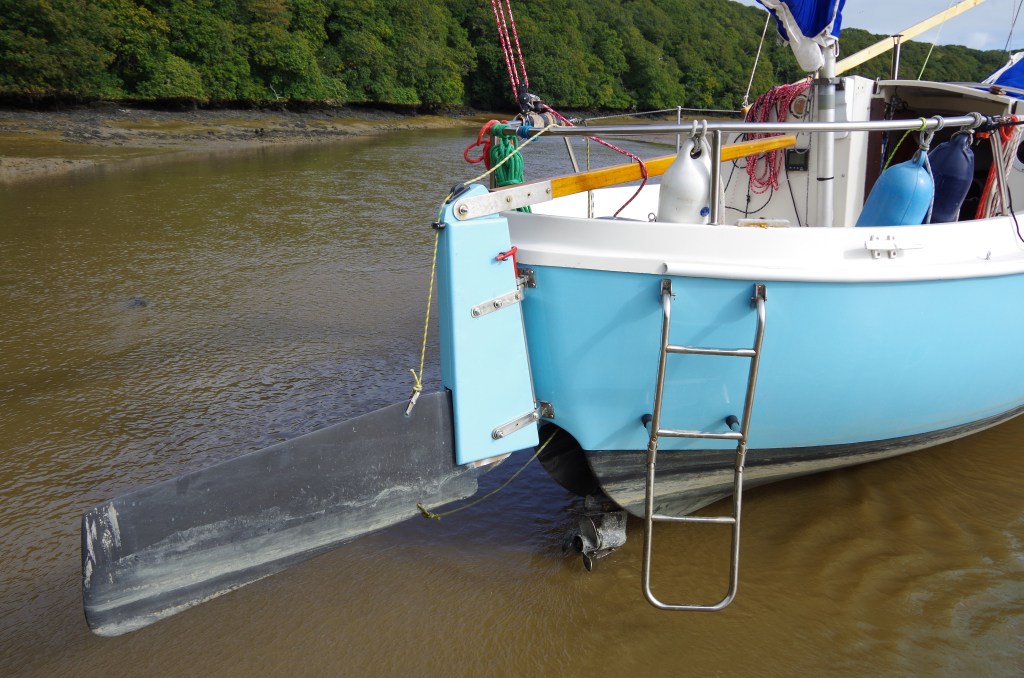
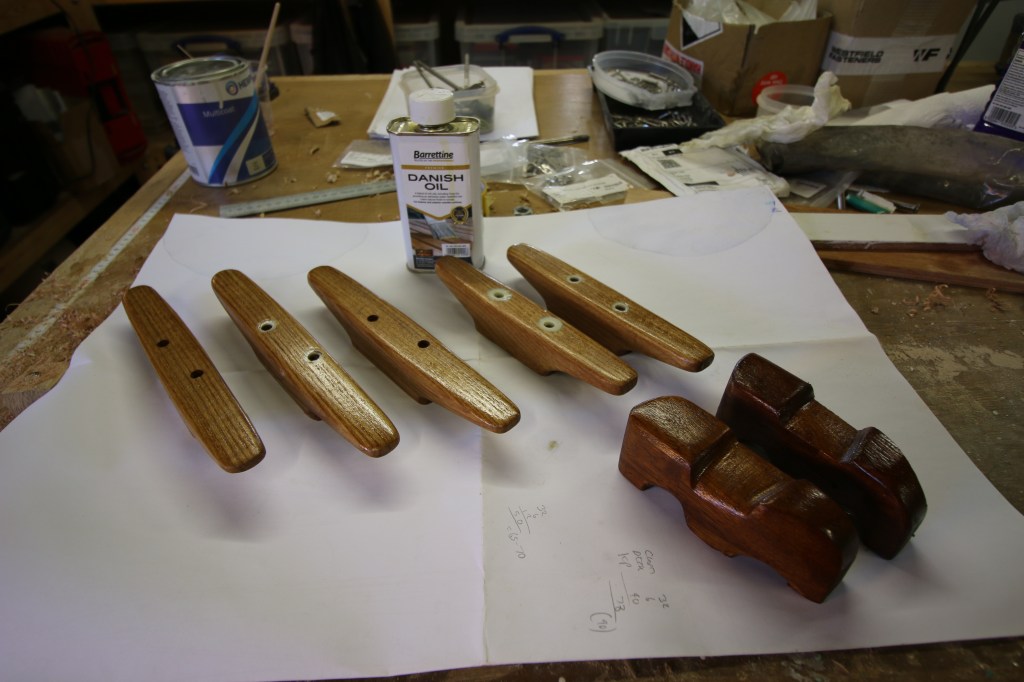
Home made Ash cleats, I already owned a stick of Ash and the work took me a few hours – now go and check the chandlery price of a double and a triple line clutch (jammer).

 Dirty Wet Dog, the great adventure.