

Pathfinder fitting out post , spring 2023.
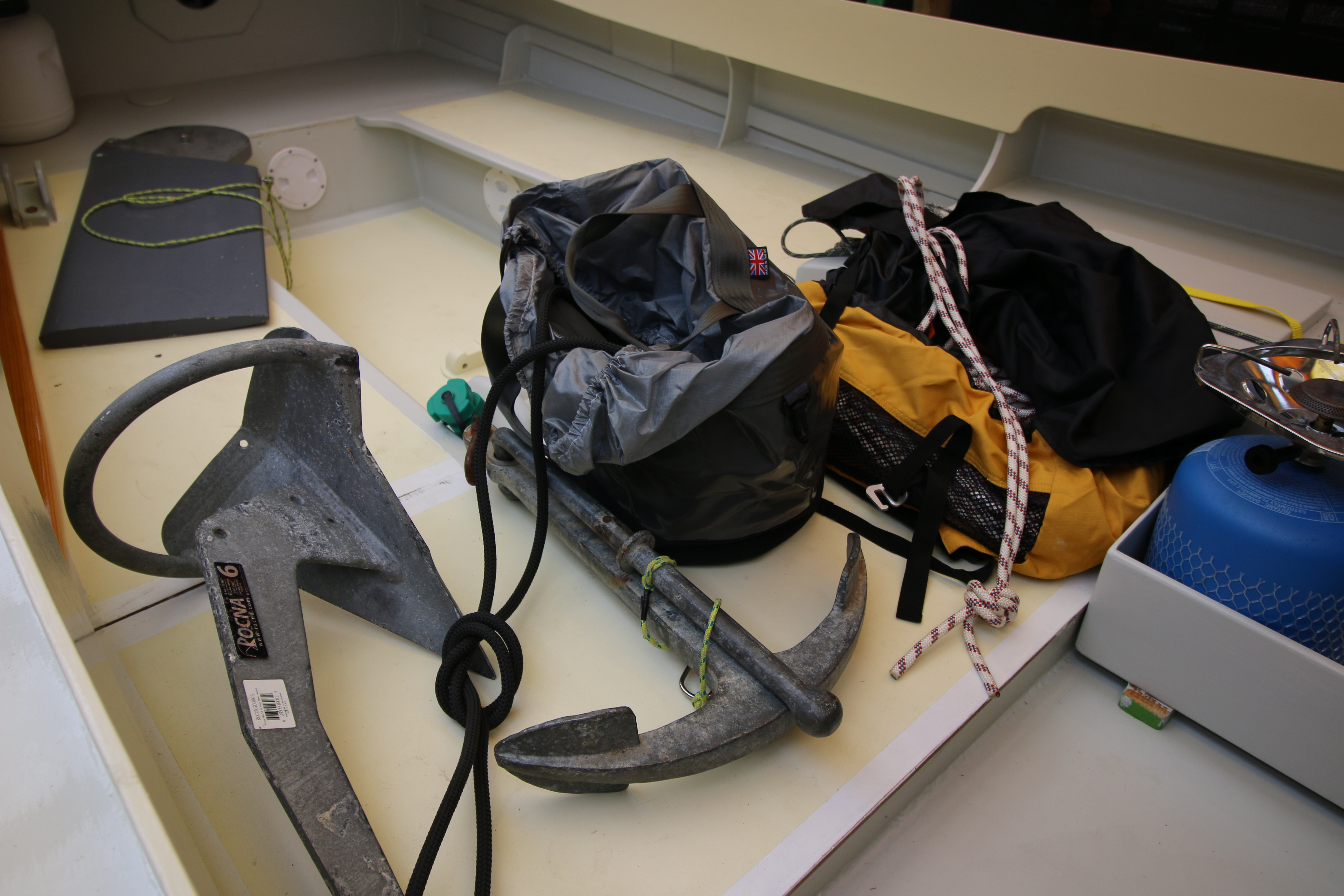
I was just thinking that i’m going to have to launch and sail the Pathfinder in a fairly ‘bare bones’ state this year because iv’e spanked the budget pretty hard and only have a trailer now due to the generosity of my partner who stumped up a big chunk of the cost for what is the single most expensive item in the build. I was thinking that I really need 2 sails at first until I can one day afford 2 mainsails (or gaff mainsail and a trysail) and 2 jibs ; a ‘big-un’ and a ‘little-un’. I already have 2 anchors as I wouldn’t go to sea with less, oddly I have 2 tillers which I know is a bit odd but I actually had 2 on my last boat as well and i’m about to order a pair of ten foot oars, rowlocks and their sockets. I definitely need 2 buckets as one is always a ‘heads’ bucket and it doesn’t work well to share heads duty with the galley bucket !
So far….one of the 2 anchors and 2 of 2 water containers.

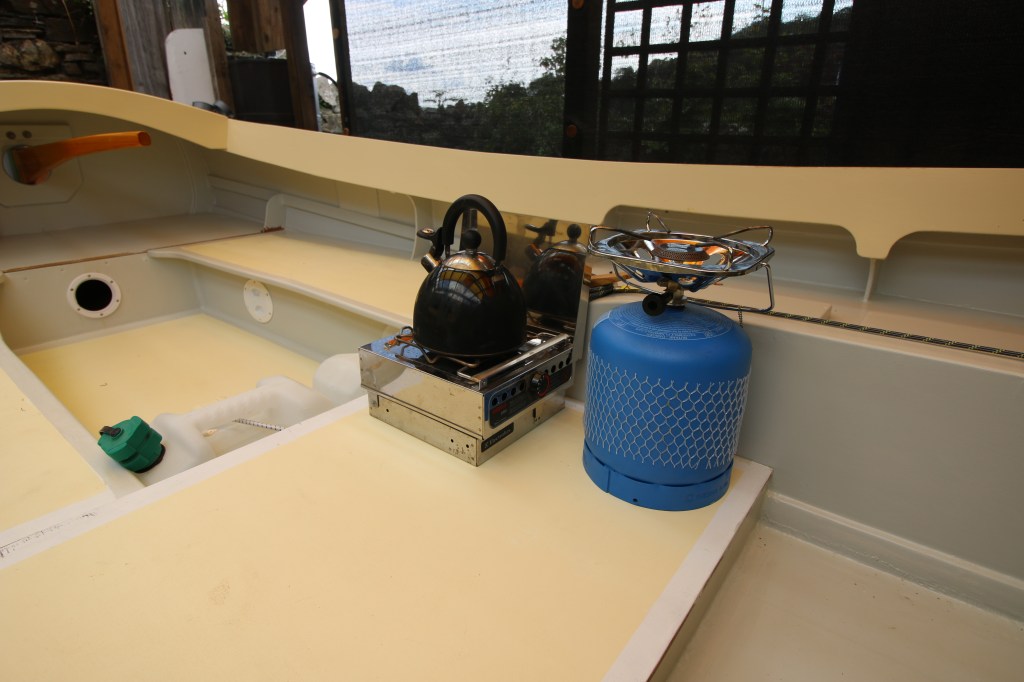
It’s purely coincidence that I own two cooking stoves for the boat but I only intend to carry one of them and even that one doubles as car camping stove duty. Normally I think i’m just going to carry the simple cylinder top Camping Gaz burner because it’s quick and effective and stows in the big galley locker nicely. After last year’s camping fiasco when I only took the one cylinder and ran out of gas one morning and then really had to search around for a replacement cylinder due to supply problems from France I will always be carrying 2 cylinders.
A big part of my fitting out jobs is to make secure stowage and tie down points for every item that is heavy and/or could get thrown around or out of the boat as and when we have a capsize…..i intend to because one of the first things I must do after launching is to work out self rescue and recovery drills. An essential part of that is being able to put the kettle on and not wondering where the kettle and the stove have gone !
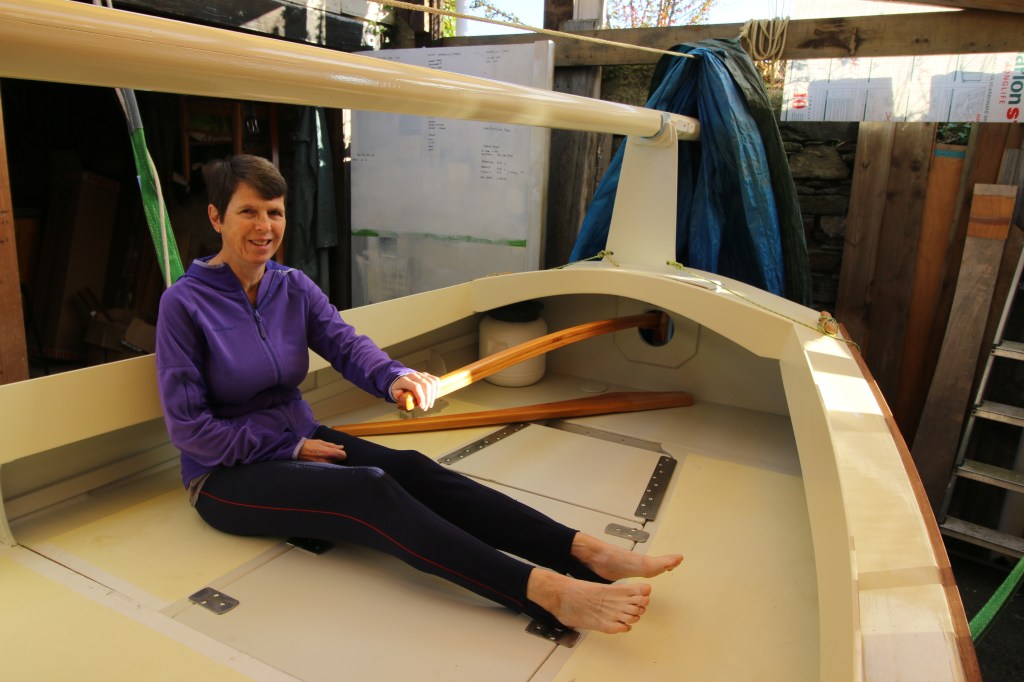
In this post I want to think about the serious task of putting the sea water back where it belongs because the Pathfinder doesn’t have a self draining cockpit although it does have lots of sealed chambers for buoyancy. I once tried to work out the reserve buoyancy of the whole boat and therefore how high or low the flooded hull would float but somewhere along the line I lost count of which compartments I had calculated the volume of and which I hadn’t ; instead of that I just went and watched some video clips of Pathfinders being deliberately capsized and then righted. Quite a lot of water is dumped automatically as the boat comes upright but there seems to be still a lot that remains in the footwell of the cockpit and some that stays in the ‘step’ just forward of the center compartment.
I come partially from a canoe background and one in which we regularly taught some new variation of open canoe rescue skills with everyone in the water and the boat upside down. It’s easy enough to right a flooded open canoe even in choppy open water and the usual practice was to partially bale the canoe out before attempting a re-entry. With the Pathfinder I think it will take a lot more effort to capsize in the first place, will be more difficult to right because it’s stability upside down is quite high – in a way it’s a bit like an old style IOR race boat – but then essential to empty the boat out which I think needs more than basic boat bailers. With canoes we used to make our own ‘fast’ bailers out of 4 liter milk jugs because they are much cheaper and more effective than the tiny ones that yachting chandleries sell .
Buckets are great of course, in fact essential, which is why i’m going to have at least 2 – one will be the smaller and heavily constructed BOSC (bucket of stout construction) as once stipulated by the IOR racing rules, and I will carry at least one, maybe 2 builders style buckets . Often , when I am recovering an anchor into the cockpit the anchor and chain will come up filthy dirty because I anchor a lot over mud so quite often what I do is to recover the anchor and chain into a half bucket of sea water and it always seemed to pay off to have a second bucket of sea water ready for washing down with. My last boat had a surprisingly effective self draining cockpit so it didn’t matter how many buckets of water I sluiced the cockpit with afterwards because it all ran aft and out through a big drain. I can well imagine having to sluice down the Pathfinder’s cockpit after recovering a dirty anchor but the water and mud will just slosh around until I bale it or pump it out.
I think though that my primary tool for emptying the boat is going to have to be a manual bilge pump but I can also see good reason to carry a stirrup pump (or kayak pump), buckets, bailers and sponges and perhaps an electric bilge pump because one day I will carry a large fixed battery as ballast and it would be dead handy to have an electric pump running while I am sluicing more water into the cockpit.
I think it was Roger Taylor who said something along the lines of “the smaller the boat the larger the bilge pump” and i agree with that.
Romance is dead they say !
Last year, when my partner asked me what I wanted for Christmas I just said ‘a trailer’ but of course I didn’t expect her to just go out and buy one for me but what she did do was make a huge contribution to the cost and that’s the one big thing that has allowed this project to move forward. Pushing my luck though, my birthday is coming up and do when my partner asked what I would like I just said ‘a bilge pump’……couple of buckets would go down nicely as well……!
Jackie ‘2 tillers’ December 2022.

 Dirty Wet Dog, the great adventure.