

Ghosting and light weather sailing.
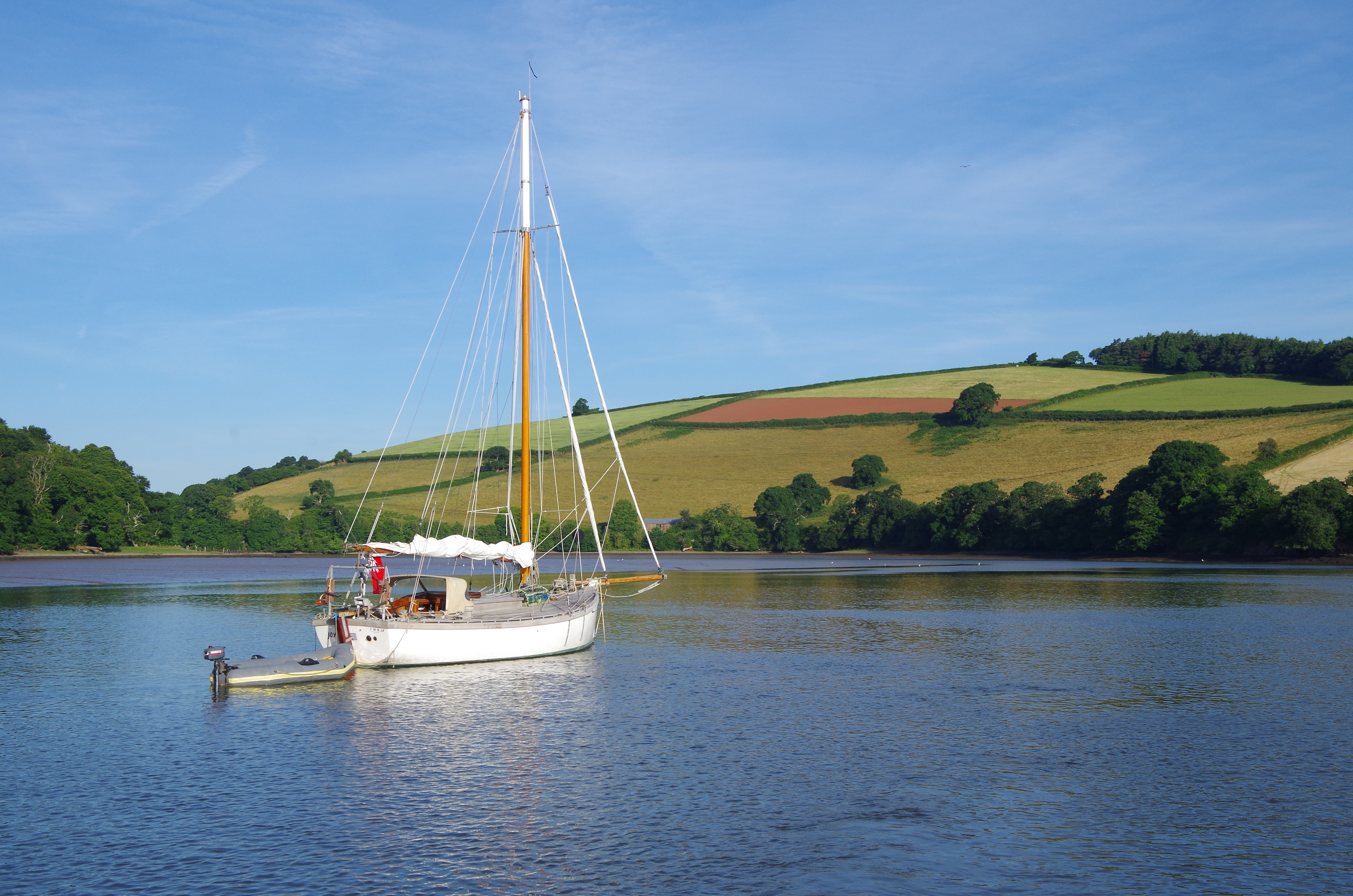
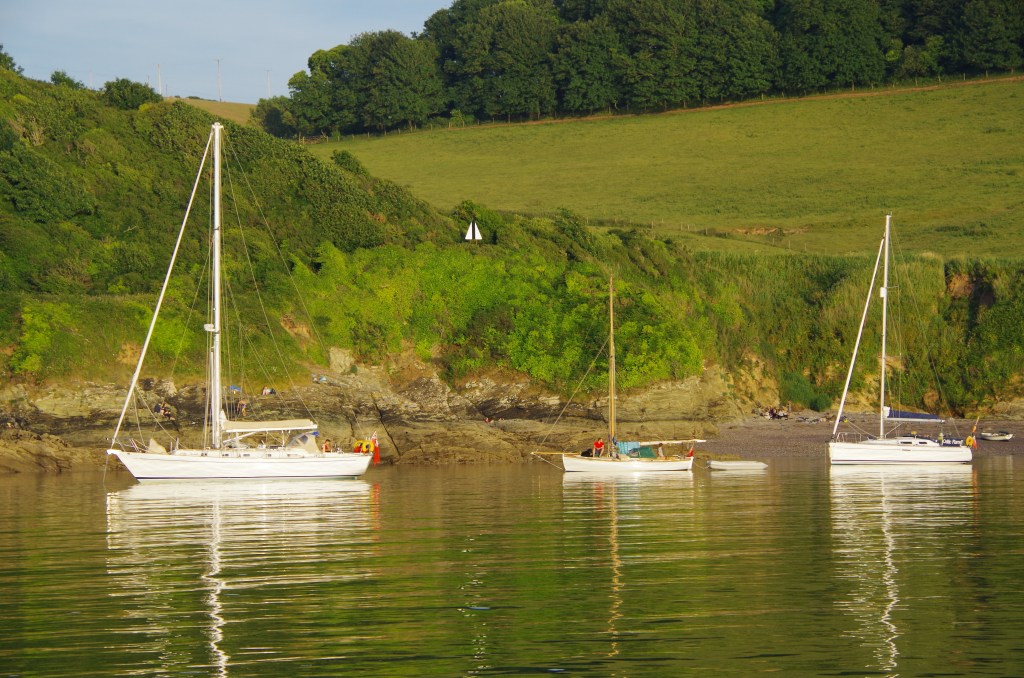
We were at anchor in my Frances 26 on the western side of the Carrick Roads, somewhere in between the reef that lies off the corner of Flushing beach to our south and the shallow spit off the corner at Mylor to our north. It was a quiet evening with a soft southerly blowing up the Carrick roads and as I attended to making the evening meal I popped my head out of the hatch to watch the slow progress of an evening race slowly making their way north up the long harbor.
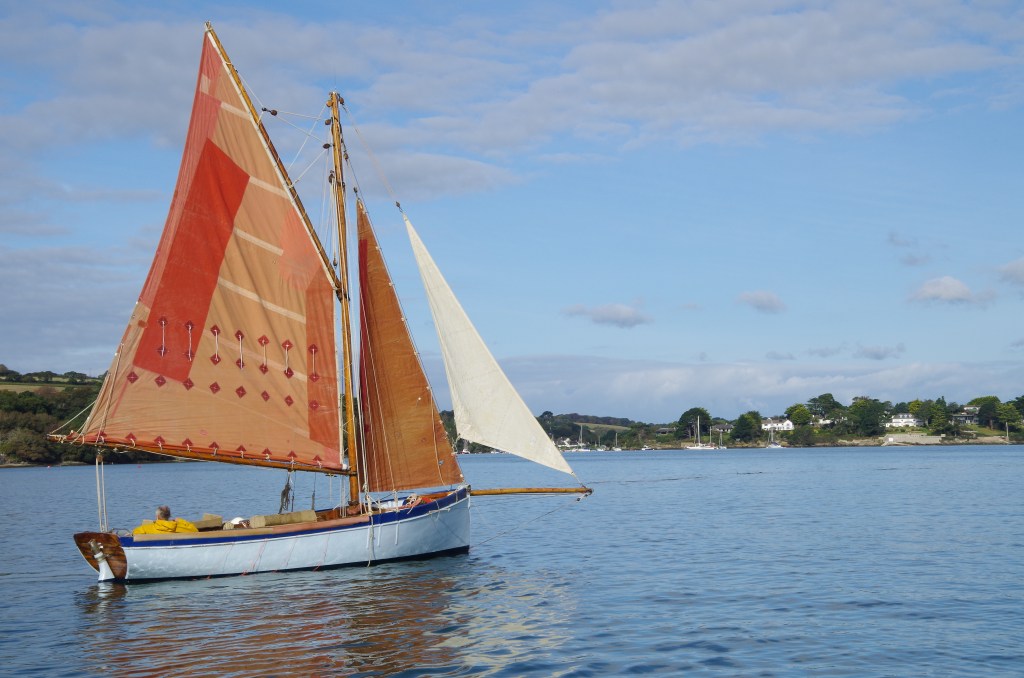
It was colourful of course because everyone was flying a spinnaker, gennaker or in the case of the classic Oyster boats their big yard topsails – I took some photographs but didn’t have a long enough lens to catch anything worth using in a post. The entertaining part is that the race competitors were obviously a mix of the local ‘hot’ race boats, the usual club cruiser-racers and several of the local gaff rigged working boats – and it was one of those that was way out in front of the fleet.
When they came past our temporary anchorage there seemed to be a lot of laughter and jokes going on and the crew looked to have an average age close to the age of their open wooden working craft. There wasn’t much wind at sea level and I guessed that it was their big yard topsail that was doing the work because several of the working boats with the same rig were leading the fleet. I guess also that the working craft were being sailed by working oystermen and their mates who worked these waters every day in the oyster season – also that the oyster dredging boats are mostly engineless and very light on extraneous gear.
In a separate post i’m trying to propose a way of thinking about sailing boats and their performance that has it that a sailing boat has a limited and fixed performance – limited by waterline length – that can’t be added to but can be easily taken away from. For sure , some smaller and lighter boats with decent sail areas can surf and plane in the right conditions and that’s a whole load of fun but that isn’t true for most cruising boats.
With nearly all cruising boats they can get up to their hull speed except that I would add ‘sometimes’ but that most often they won’t because of something that they are doing or have done that will sap some of their speed to a greater or lesser degree. That can happen all the time in the case of the boat’s hull being ‘foul’ with weed and barnacles and it seems very noticeable in light winds. In my example of coming back over the channel after my 110 day cruise I reckon I was losing 20% of my boatspeed all the time because of a patch of weed and barnacles where I couldn’t get at them.
Other things sap boatspeed all or most of the time too – thing such as having too much weight in the boat really hurts in light weather and then having weight in the wrong place affects boatspeed and the boat’s ability to ‘ride’ the waves in heavier weather. Old and baggy sails coupled with old and stretchy halyards come next again more noticeably in light weather ; it’s an odd thing that many sailors think they need ‘full’ sails in light weather when in fact the opposite is true.
My regular observation , of cruising yachts on passage, is that most don’t seem to be able to deal with light weather sailing at all – neither upwind or down – but instead start their engine and donk along in a self created cloud of diesel smoke . If the wind speed is around 5-8 knots, which is common in summer, then their self generated diesel cloud will stay with them as it travels at wind speed with them. Another thing I see at the same time is their mainsail that they’re too lazy to tke down so it just flaps and flogs around – more money to the sailmaker one day.
It’s purely my opinion and therefore irrelevant that many modern cruising boats and especially those from just a few years back just don’t have enough sail area because they are based on failed IOR racing boat design and queasily marketed as ‘cruiser-racers’. Most of them don’t have the multiple sails that IOR yachts had to have to go well and definitely don’t have the downwind sails which is the only way they get near having sail power downwind. Another part to this is that most cruising sailors seem reasonably au fait with having to tack upwind but when it comes to getting downwind they just point the boat in vaguely the right direction and hope for the best.
Very few, if any, cruising sailors know how to go downwind faster by tacking downwind as well as up , or know that the lighter the wind the higher the angle has to be. Instead what I have often seen is the mainsail stowed and the boat schlepping along with just a jib or with a partially rolled genoa. Roller furling genoa’s are perhaps one of the sailing industry’s worst ever inventions after ‘modern’ fin keeled cruiser-racers – the sail kind-of pretends to do it all but is neither a full sized and shaped genoa for light winds and partially rolled it is a bag of poo.
Why most sailors have them is a good question and seems to come down to three things – fear of handing sail on the foredeck, laziness and the sheep-like sense that it’s what everyone expects. For the cost of a modern furling gear plus it’s roller furling genoa a boat could have at least 2 ‘proper’ jibs/genoas that actually did their job and with three different jibs most boats could be made to sail well in most conditions.
Most cruising sailors seem to be scared of spinnakers too and I must admit that a solo sailor or couple would struggle to hoist, gybe and hand a big conventional masthead spinnaker on today’s ‘average’ cruising boat. It can be done but equally it can all go wrong and even if it does go well most cruising sailors wouldn’t know where to begin with ‘banding’ and packing a big spinnaker. There are decent modern options such as the asymmetric cruising chute and even better old fashioned ones called the bowsprit which can really help a boat scoot off downwind with everything pulling well.
Gaffers can be surprisingly quick boats downwind !
If I said I was writing a post about racing and boatspeed in light weather – and then in the same sentence added gaff rig – you would probably wonder what on earth , or sea, that I was thinking about. Many sailors equate gaffers and gaff rig with something that is quaint, picturesque, slow and way out of date except that the evening race story I told at the start really did happen and the ‘old’ gaffer working boats were spanking the modern cruiser-racers.
Personally I think that it is the IOR based, fin keeled and sloop rigged conventional production yachts from the 1980’s that are the slow, un-seamanlike and deadly dull in a mass plastic factory product kind of way but that’s just me throwing opinions around.
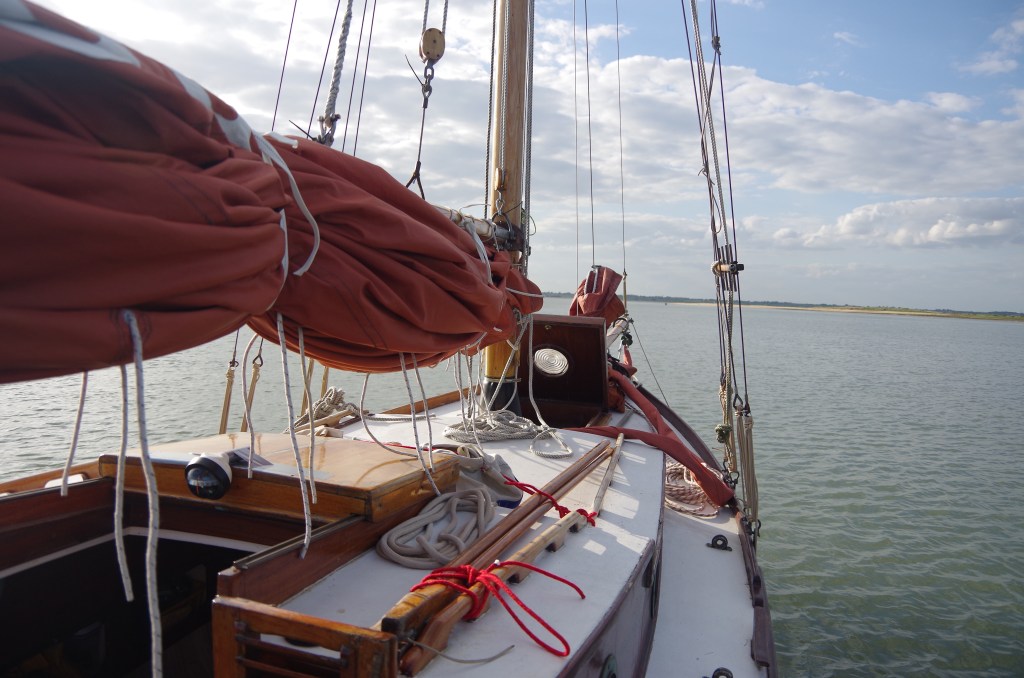
A few years back I had the interesting challenge of sailing the 80+ year old Deben 4 ton and gaff rigged Inanda around from Ipswich on the east coast to near my home in the Tamar valley – that’s Devon and Cornwall btw and a long trip down channel. She was clearly an obviously an old boat that had been kept going and she really needed a lot more skilled love and attention than I could supply , also having recently had a knee replacement I really couldn’t even begin with the work, so I passed her on.
There was one incident in sailing her home that I want to talk about here because it shows up a lot of the odd thinking about gaffers and even more about the so-called ‘seamanship’ of some modern cruising sailors.
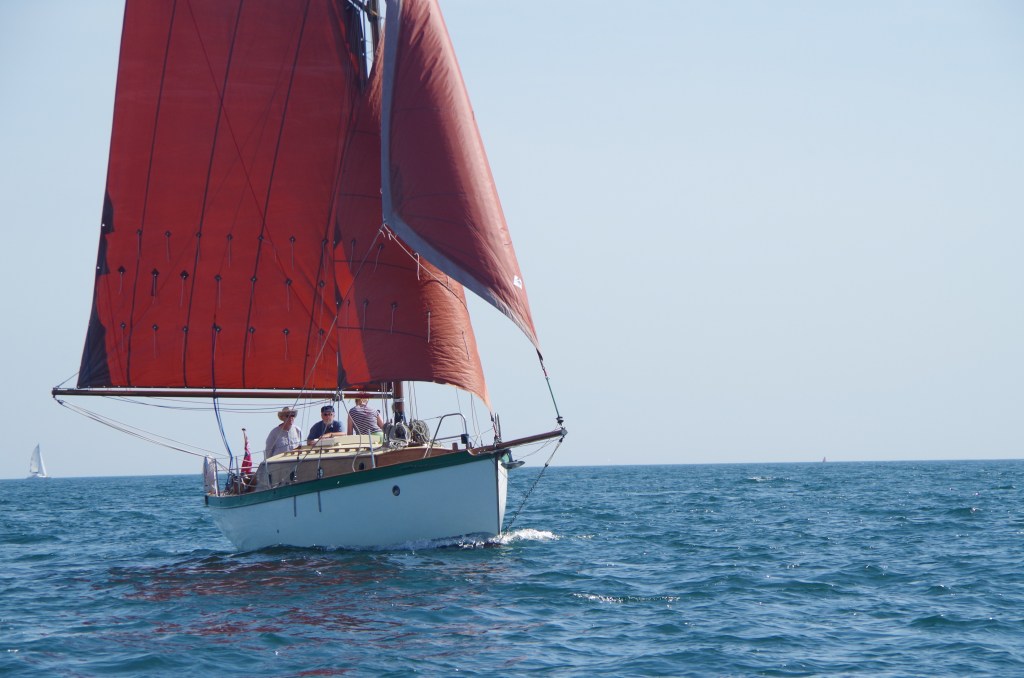
On the last stage of the journey home we came out of Dartmouth on an easy light easterly which would give us a broad reach across to Start point, then a run down past Prawle point and Salcombe ; our plan being to put into the river Yealm at the end of the day and anchor off Cellar beach. Not long after we cleared the Dart entrance another pair of gaffers came out, raised sail and followed us across the bay , one a smaller boat – possibly the smaller of the Norfolk range and one a bit larger than us from the look of her rig.
Having taken a look at the tides it seemed that the best place to be was slightly offshore and the quickest way of doing that was to reach up a bit and I noticed that the larger of the two gaffers did exactly the same. Then, as we ran off downwind it was a lot slower so I used the common gaffers tactic of tacking downwind , the trick being to sail just high enough to get flow across the jib set out on the bowsprit : there was a clear speed difference with flow across the sails and just as with sailing upwind I tacked downwind on the shifts – once again the larger gaffer did exactly the same.
For a while it felt like a mini gaffers America’s cup as we swapped tacks downwind and we were both going well – eventually though his 26 foot plus boat was simply faster in the water than our 22 foot boat – so he came quite close as he passed and gave us a friendly salute as though we had both played our tricks and sailed the best we could.
The other thing that happened is that the pair of us scooted straight past a pair of modern cruiser-racers that had obviously taken a straight line from the Dart to the rocks off Start point and then stayed inshore – from memory both were around 35 feet plus and both of them were lopping along, rolling a bit dead downwind with just their genoa’s set. The funny thing is that after we passed them both there was suddenly a burst of angry sounding shouting aboard one of them – I could just about catch a few words and it was something to do with being overtaken by ‘those’ boats out in the better tide.
Even funnier was what happened another half hour later – both boats tried more sail but we were still leaving them behind so then there was a burst of engine noise and diesel smoke and a mile or so later both yachts came powering past us in their own personal pollution clouds. I could see from the body language of one of the skippers that he really wasn’t being a happy camper that day.
It’s not often when that sort of thing happens and it’s pure comedy when it does, most times it’s the larger and more modern boats leaving the gaffers in their wake except that it gets better again when everyone gets into port ; usually the modern boats will fetch up in a marina and more often that not it’s the older and smaller boats that anchor and in so doing get a bit of peace and quiet.
Several hours later and the smaller gaffer fetched up in the Yealm too – the 3 boats are in the usual spot off Cellar beach and we anchored further over near the northern shore. It was a spectacular sunset sequence too looking out to sea.
Right now of course i’m building my own gaff rigged dayboat cum expedition boat – the standard plans being either a gaff sloop or gaff yawl : as the designer says that the sloop is the quicker boat upwind i’m going with that option although I will lose the benefits of a split rig.
My intention is that the Pathfinder will sail well in all conditions and my particular need is that she will go very well in light conditions because we get a lot of that in the summer in the south west. To achieve that, as iv’e been pointing out, my aim is to keep her bottom clean and super smooth, to keep her as light as I can given the stores and kit that I need to carry, to have as good sails on her as I can get coupled with some low stretch Dyneema halyards and even to invest in some dedicated light weather and downwind sails.
In due course she may need a longer bowsprit and something like an asymmetric spinnaker or reacher (gennaker) and one day may even warrant a taller but lighter rig – after that it’s just a matter of sailing as smart as I can.
Yealm sunset BTW.

Light weather and no engine.
It’s an observation of mine, cynical to be sure, that many modern yachtsmen (rather than sailors) either don’t like light weather or don’t have the skills to turn a slow day into an easy and enjoyable passage and that’s why we often see , hear and smell them blatting downwind in their own personal cloud of diesel fumes. Another take on this is to return to an understanding of the most common cause of RNLI (UK) lifeboat call-out and assist/rescue – that being machinery failure in both motor boats and sailing boats – it’s about half and half. The next part of that is to also understand that most RNLI call outs happen in light to very light conditions and not as often thought because of heavy weather.
Where am I going with this – not just another ramble.
It’s this , recently iv’e been writing about the pros and cons of yacht racing as a way of increasing skill for the cruising sailor and I happen to think, from experience, that the two weather ‘extremes’ are where the racing sailor will always do better than the cruising sailor who has none or little racing experience. From my experience it’s in light weather to ghosting that the difference in boatspeed and/or distance made over the ground between the racing sailor and his cruising sailor opposite will be most apparent because in brisk conditions it’s more about keeping the boat on it’s feet.
The racing sailor will usually do better because most often he (or she) will have a well prepared boat – clean and smooth bottom, crisp sails on non baggy halyards, is more likely to understand sail trim and boat trim and is more likely to know how to either cheat a foul tide or make best advantage of a good one. It’s also likely that the racing sailor will have to have raced in light conditions because they are common during the summer sailing season and over time anyone who has done that will develop the patience to maintain concentration and as likely have tried different wind angle tactics to work out where their boat does well and where it doesn’t.
In my short example above both of us knew how to get airflow over our sails rather than them just being downwind ‘bags’ as demonstrated by the larger cruising boats. The better skill being demonstrated that day was that Theta’s owner also clearly knew where the tide was best and instead of just pointing his boat roughly downwind was tacking downwind like a pro. It’s not just about a posh new cruiser/racer, fancy tiller waggling and a big budget for exotic sails because both of us were sailing relatively old boats with simple cruising sails and clearly enjoying ourselves too.
If there’s a single take away here it is to scrub (and then sand) your boat’s bum more often !
Best wishes slowcoaches.

 Dirty Wet Dog, the great adventure.