
The joy of small boats, post 2 : simplicity.
In my first post of this new thread I laid some of the groundwork for a series of posts by introducing the boat that I owned at the time that I drafted the original work in the form of a section of the book that I was trying to write. I felt that having thought about the subject a lot and done the work that I shouldn’t just consign it to the archive or the recycle bin ; for a while I even thought about completing several of the sections and simply releasing them as a self published and self printable file form but…..I write for the pleasure of doing so and not to try and make a living from it so here goes with the second post.
In that post, just in case you haven’t seen it, I wrote about the boat that I chose as my cruising boat for my home rivers – principally the rivers Tamar and Lynher and then the coast, rivers and creeks of England’s south west country which is where I live and which I happen to think is the best cruising ground for small boats in the whole country…..and yes, i know that many writers from Maurice Griffiths and Charles Stock onwards have waxed lyrical about the east coast and maybe one day I need to go there and ‘grapple with my inner mud’ : the west country rivers are much prettier though.
If you don’t know the south west coast then briefly what we have is a bold ‘windward’ coast that faces onto the English channel and the Atlantic , what few people know though is that we also have some 9 major tidal rivers that penetrate deep into the Devon and Cornwall counties…..and these rivers are usually steep sided and wooded river valleys.
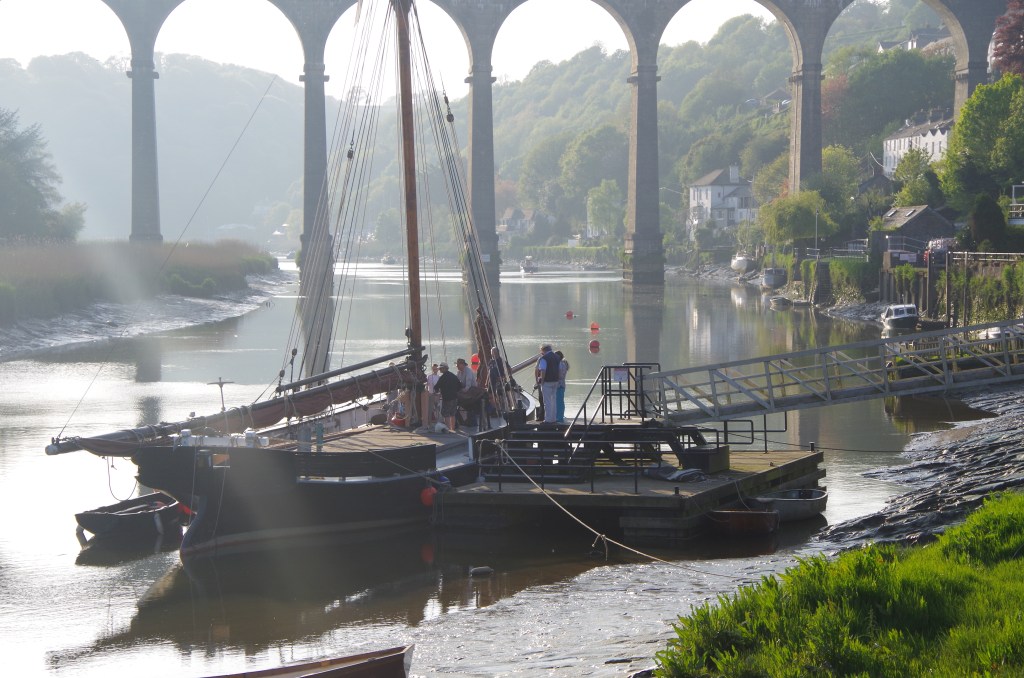
The Tamar at the Calstock railway viaduct, my home mooring used to be just downstream of there.
In the first post of this series I was trying to do something without having to make a big deal of it ; just pointing out that at that time in my life I had only so much budget for a boat – in fact I had to go back to a part time job in order to buy it and run it – but that the boat also had to fit the ‘mission’ and my chosen locale. In a future post i’m going to talk a lot more about why I think that small boats quite literally ‘fit the bill’ for us but also why possibly they do as good a job or better job than larger boats – i’m going to come back to that.
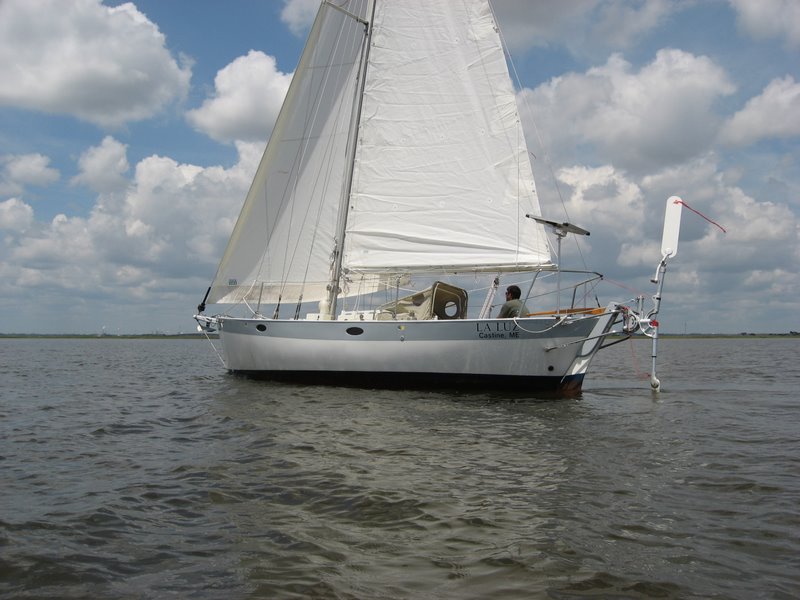
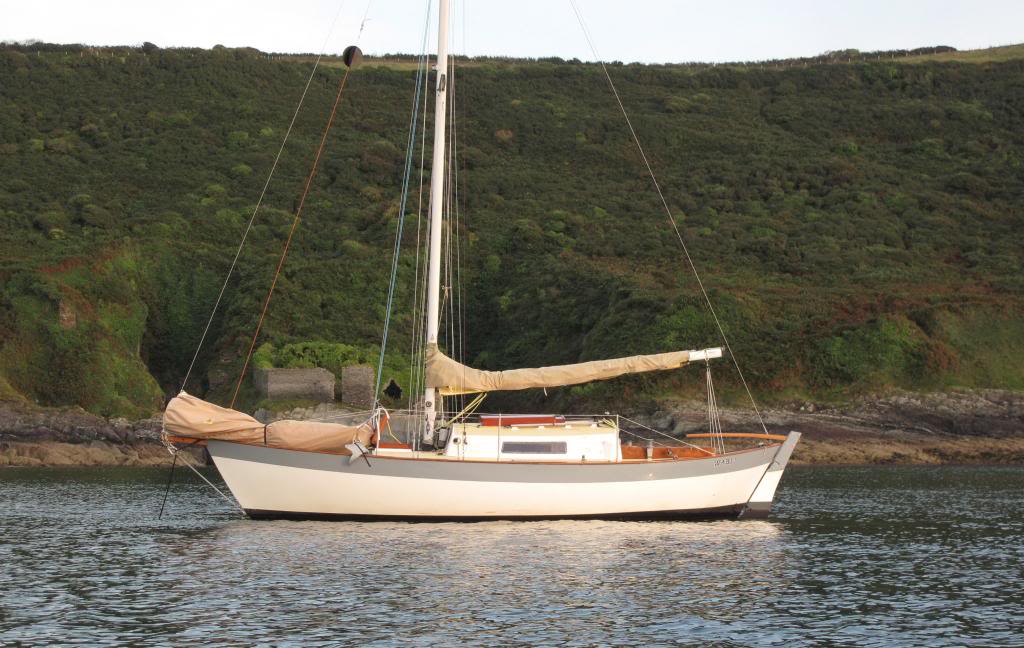
In this post though I want to feature a slightly larger boat, in size, that I owned although significantly larger in terms of it’s displacement but where my main principle was that of simplicity and a second one what we might term ‘unstopability’ . The boat I am talking about is the second WABI – a Frances 26 long keeled yacht designed by Chuck Paine and I would like to think one of the best small offshore and ocean going yachts of it’s time. For my own reasons I thought of my Frances 26 as the ‘Pardey’ boat because it was heavily influenced by the boats and books of Lyn and Larry Pardey.
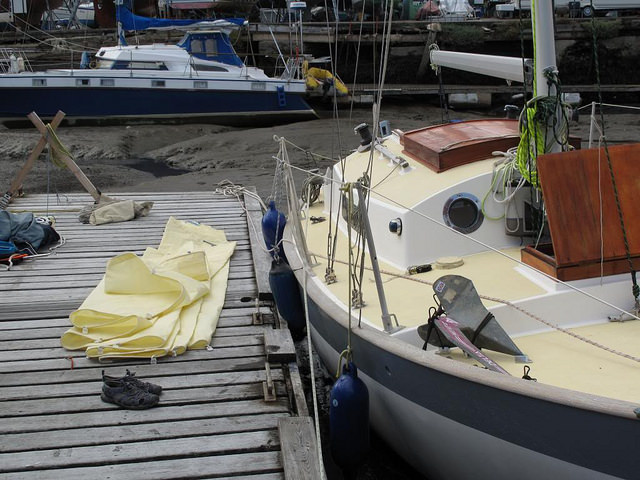
WABI” right at the end of her second refit…..within days I would have my ‘wow’ moment and be at sea heading for Brittany.
The Pardey boats.
Lyn and Larry Pardey built two boats during their lives (Larry died in 2020) ….both designed by Lyle Hess and both traditionally carvel built wooden boats and neither of the boats had engines. The first boat Seraffyn was all of 24 feet and the second, larger boat, Taliesin was 29 feet and intended to be capable of being much more independent and self reliant at sea. Having said that the Pardey’s built,owned and sailed Seaffyn for 8 years before building Taliesin : between the two boats they cruised some 200.000 miles under sail only.
There’s so much I could say about the Pardey’s and their two home built boats but the thing I would say first in relation to this thread is their own expression – almost their mantra of sailing : “Go small, go simple but go now”.
Having grown up as a sailor with twitchy and fragile IOR racing yachts I might even think of myself as a Pardey ‘convert’ in that they espoused a completely different form of boat to the limited type that I usually sailed : one of their principles of boat designs was that of moderate displacement coupled with relatively short ends to give maximum waterline length and coupling that with as much sail area as the actual designer dare add. What that amounted to was boats that are surprisingly quick for their size, good load carriers and having an easy motion : another feature that Larry talked about was that they were ‘unstoppable’ in that they could sail in anything from a whisper to a gale…..and just keep going under sail when larger yachts would generally motor.
The Pardey principle “Go small, go simple but go now”
If I have this right then between them Lin and Larry Pardey wrote 12 books that I know of and then also produced several video tapes and DVD’s about cruising in sailing boats : one of those books – the Care and Feeding of Offshore Crew just about survives on my bookshelf – it’s slowly falling apart having lived aboard my last few cruising boats. In their books , over time, they fully developed their ideas and experience of why smaller boats were a good idea, of why simplicity in boats and equipment was a far more reliable way of going on the water and why it was such a good idea to ‘go now’ rather than leave it until middle age or later life.
In my case i’d already done a lot of sailing including a full circumnavigation when I came to own the Frances 26 and I bought that boat with the plan of going long term cruising when I took early retirement from the NHS at age 55 – to go long term sailing at that point meant that I had to go small and keep it simple because that was all I could do on a small NHS pension. Restoring and refitting the older Frances 26 eventually became a three year project that culminated in the ‘wow’ moment , putting to sea, dialling in the windvane and making for the horizon.
Frances 26 La Luz. Owner’s photograph
That wow moment – heading for the horizon.
One afternoon in the early summer of 2015 I was down at the yard finishing up some small jobs on my Frances 26, WABI” : my refit was as complete as it could be, my sails and gear were aboard and bent on, I had food, water and fuel all aboard because I was partially living aboard while I finished the refit.
The tide had just turned at the yard and was now ebbing down the Hamoaze – for those that don’t know it that’s the section of river that runs past the Royal Navy dockyard at Devonport. I knew that in about 2 hours time the Frances would gently settle into the mud and I also knew that it would be a bit of a fight to get uptide and upwind to one of my favorite anchorages for a night out so instead of either drying out (or mudding out) or motoring hard up the tide I took in my lines and motored out of the short ‘timber pond’ channel behind HMS Raleigh and got my mainsail up as we were swept gently down towards the tidal narrows that would spit me out into Plymouth sound.
There of course the ebbing tide was running strong so I motor-sailed on tickover past Mt Edgecombe to my right and down through the channel over the local feature known as ‘The Bridge’ – essentially the only channel break over the combination of reef and submarine barrier that protects the entrance to the dockyard. As I cleared the channel and got out into some clear air from the west I set the windvane, turned off the engine and went forward to take the sail cover off the big genoa hanked to the forestay off the short bowsprit.
Two steps aft and I was off the (relatively) huge foredeck and at the mast, where most of the sail handling work got done, and hoisting the crispy new genoa, another few steps aft and I was sheeting in the big (to me) genoa. The Frances heeled a few degrees, firmed up and accelerated to steady cruising speed and I spent a few minutes trimming everything just right for a course that would take me out through the western entrance of the sound , past Penlee point and out into the English channel. Sometimes in a wind against tide situation like that a boat get uncomfortably lively as it works it’s way through the standing wave pattern : the moderate displacement Frances took it in it’s easy stride.
I remember that I sat on the engine box with my head and body under the sprayhood, making a quick note in my logbook while I kept watch and ‘cleared all hazards’. Underneath us I knew that the bottom was dropping away as the waves lengthened and the boat settled into it’s long groove…….the other end of which is the passage between the French mainland at the huge Ile Vierge lighthouse and the Ile D’Ouessant (Ushant) out to windward. It was a stunning moment – the boat was almost quiet except for the small noises of water sliding along the hull ……and then the whistle of the kettle. I was as happy and content as I could be.
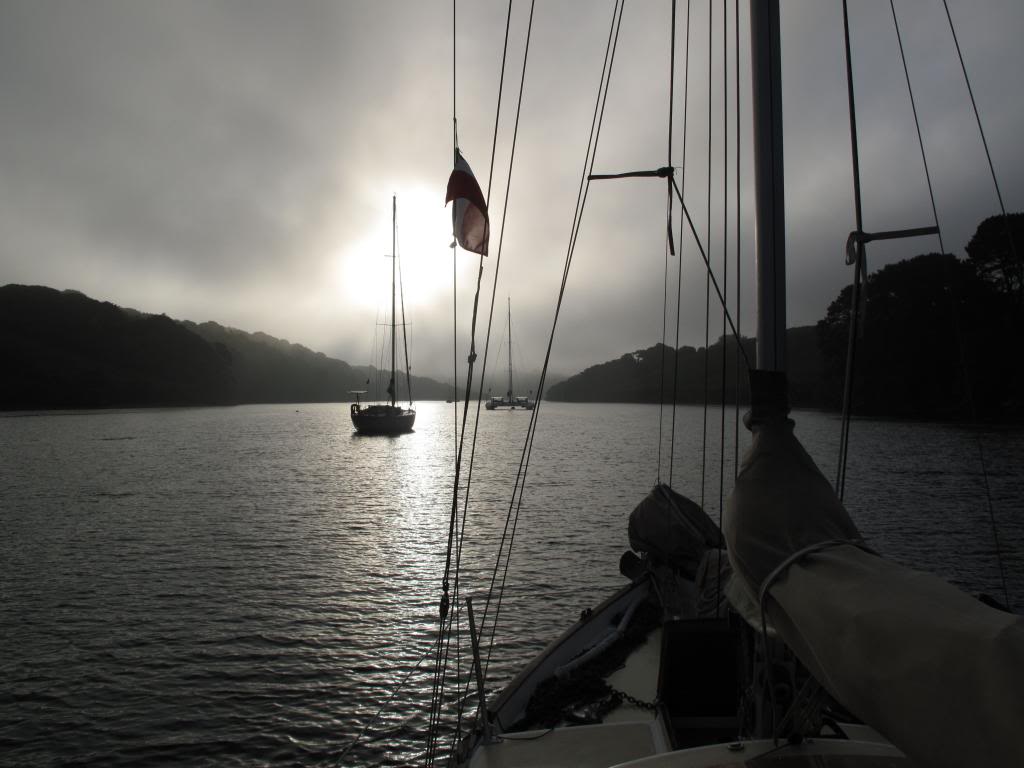
Forty hours later…..a grey morning in L.Aber-Wrach
I thought when writing this post that I would leave it right there , making for the horizon in my newly refitted cruising boat but even I felt that the post lacked detailed content about what the concept of simplicity in boats meant in practice so…..
The actual passage turned into a very long 2 days and nights at sea – 40 hours I reckon before I anchored in a small bay just to the west of the marina at L.Aber-Wrach. The wind dropped quite quickly as I made out past Rame head and I seem to remember having dropped the genoa because it was slatting and backing a bit while I made my dinner below. I do know that we sailed slowly through the first night and I couldn’t sleep because this was actually my first solo offshore passage ; the next day I motored twice – to sprint across the two traffic separation zones at the western end of the channel and to make sure that my batteries were charged.
In the next post I want to pick up on one of the minor incidents that happened and which made me start to think that the Frances was a bit too large and because of it’s draft and fixed keel might stop me from doing some of the things that I wanted to do while in the Brittany rivers. In this post I just want to add a couple of points of content which I feel are some of the important practical points about boat simplicity.
- The Pardeys often said that a long term cruising boat should be in one of two ‘stances’- by that I mean that it should be at sea under sail or sitting securely at anchor to it’s own gear. For me, simplicity also meant economy of budget and the ‘simple’ self reliance of being at anchor say and not in an expensive marina.
- At sea that means being under sail as much of the time as is possible and what that means and requires is that the boat sails well and in turn that means having as large a rig as possible and sails that work across a wide wind range. Their solution in both Seraffyn and Taliesin was to rig them both as cutters and to have a variety of sails that were simply hanked on to stays and not using gear which can and does fail….roller furling for example. With my boat it meant changing the original sailplan from a cutter with a pair of small jibs to a ‘slutter’ which primarily used a 130% genoa which could be reefed vertically and then changed down to a working jib and then if necessary to a smaller staysail on a removable inner forestay.
- Once again , in my example, the cost of a well made roller furling gear not spent meant that I could afford both a working jib and staysail and later on a code zeo for light weather. I know that many sailors like the convenience of roller furling genoas but there are valid arguments against them – one being that in practice the roller furled genoa still only has a narrow working range and at some degree of ‘furl’ doesn’t set well. I was ‘kind-of’ born (as a sailor) on the foredeck of an IOR half tonner so it was no stress and difficulty to me to be working forward on the Frances’s huge foredeck and to change jibs to the best sail for the conditions.
- The second part of long distance sailing simplicity is that the crew should never have to manually steer the boat except for when entering or leaving port – rather that on passage the boat should be under self steering while the crew get on with everything else that should be done. Once again in my case my choice was a well made German wind self-steering gear called a ‘Windpilot’. It was expensive and fitting it was an absolute pain in the butt, it steered the boat immaculately well and in a way I forgot about the steering and got on with the navigation, watchkeeping and self management of that first solo voyage.
- For now, the last detail of the simplicity concept is that when not sailing the boat should be at anchor and using it’s own gear. I occasionally cheated and used an unoccupied mooring but most of the time I was at anchor using slightly heavier anchors, chain and gear than the boat probably needed….I simply went up a size for my best bower anchor and also carried two other anchors and associated gear.
- My last point about simplicity and anchoring also relates to boat size and simplicity once again – and that is that I felt that I should be able to recover my anchors by muscle power alone and that 26 feet of boat and a 15 Kg primary anchor was about my practical limit for that.
That it for this post…..hope to catch you all next time.

 Dirty Wet Dog, the great adventure.