
The joy of…….smaller boats.
Good morning everyone it’s nice to have you aboard. This is going to be the introductory post in a whole new thread that was originally part of my planned book project but which has been sitting on my computer’s desktop, unloved and ignored for the last few years. I think this will be the first of five or six posts that would have formed an entire section of my book, now unlikely to ever finished but which I think has some potential for a series of independent blog posts.
Some of you will understand that I like to write threads rather than stand alone posts – in a thread of related posts I can develop themes that would otherwise be too long for a single post ; there is a limit I think, beyond which a post becomes too long. In previous posts along similar lines I have taken several different approaches to the subject of buying, owning and sailing small craft , in saying ‘small’ here I am generally referring to boats with a limit of about 25 feet and mostly I like to explore downwards from there.
In this introductory post I want to begin by taking the idea of a small cruising boat to it’s logical conclusion and end point – that being the ‘how low can you go’ with a craft intended to cruise in without getting to the point of obviously ‘freak’ craft such as the attempts to cross this ocean or that in the smallest possible boat-like object. I would argue, will argue, that owning , working on and sailing in a normally viable small craft gives us more pleasure and sense of achievement per foot length than anything larger and I hope that I can draw out some general rules and principles that might have value.
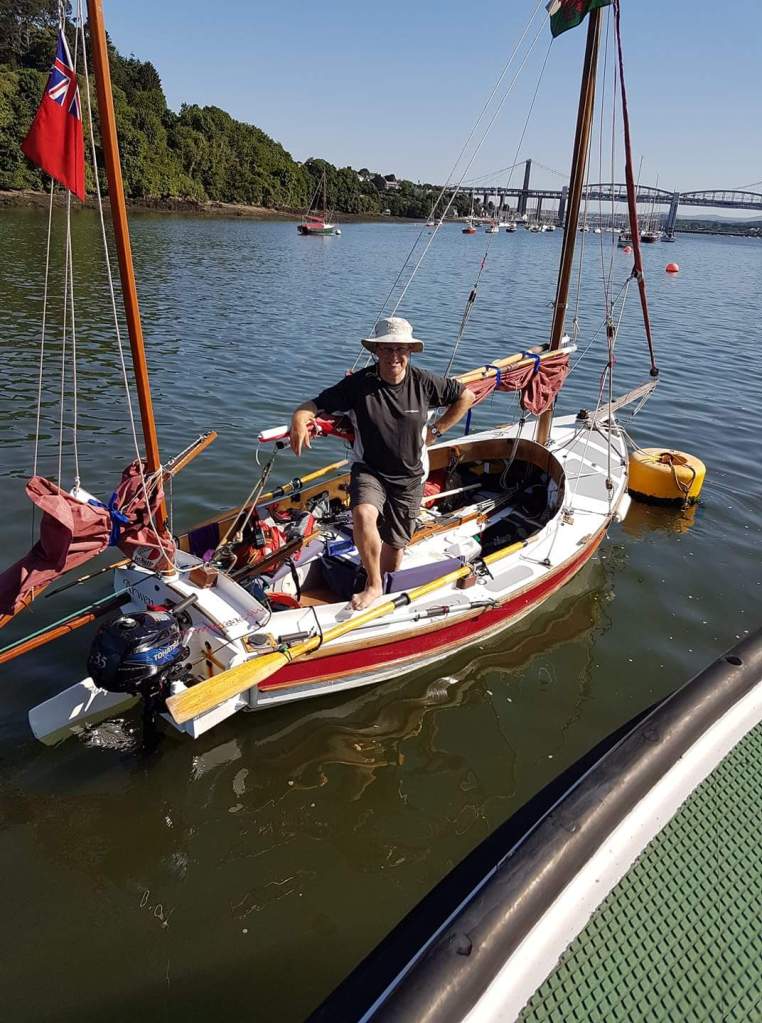
My mate Steve and his boat ‘Arwen’
As is my want let me begin with a sea story.
As per usual it was ‘a dark and stormy night’ – in fact it was early in the year, wet cold and blustery and I was sheltering at anchor aboard my 22 foot cat ketch having failed to make an early season coastal passage from the Tamar down to the west country. I thought I could see a brief weather slot in between a whole series of depressions sweeping in from the Atlantic and maybe there was a brief drop in wind speed but when I passed the narrows out into Plymouth sound I could see swell waves breaking clear over the breakwater so yes…..I wussed out and ran back up the Tamar and into the river Lynher for shelter.
For those that don’t know it the Lynher has several good spots where a shallow draft boat can both anchor over a dense mud bottom and at the same time get into wind shelter – on this occasion the best place to be was at at the westerly limit of the river where it swings around to the north. For those that do know the Plymouth rivers the anchorage is known as ‘Dandy Hole’ – the hole referring to the feature that it is the only deep water anchorage in that part of the river. High ground to the south and west gives shelter from gales from those quadrants and that’s the most common direction for gales in the south west of England.
I should say a few things about my local mooring situation and passage making problems so here goes ; kind-of helps to set the scene for the whole series of posts if you know something about my then home river.
Home…..for my boat at least during these years was usually in some variant of mud berth and with the boat often at the bottom of 20 feet of greasy ladder. The boaytard itself is near enough the eventual head of navigation that the river is both shallow and muddy but also prone to having whole trees washed down the river during heavy rain – and it often rains long and hard this side of Dartmoor.
Passage making from near the head of the Tamar was usually a top of the tide affair and running with the ebb downriver for a few miles and then, if making a coastal passage, running out into Plymouth sound over a feature called ‘The Bridge’ and then either left and east towards the Yealm or Salcombe or right and out of the western entrance to Plymouth sound. In a strong running ebb with a wind from the south or west blowing over it there will usually be a strong wind against tide standing wave pattern in the western entrance and that day I could see both that and a big southerly swell heaping up over the breakwater. My usual tactic when it’s like that is to first retreat to an iffy/maybe anchorage just outside of the ‘narrows’, wait for the tide to finish running out and then run back in with the new flood.
A common problem I used to have if just going overnight was that I would run down the Tamar on the ebb but by then the ebb would also be running strongly out of the Lynher and I would often have to anchor near the confluence of the two rivers while the ebb ran out. Quite often my local sailing made for short moves on a positive tide and then sitting out a contrary tide at anchor.
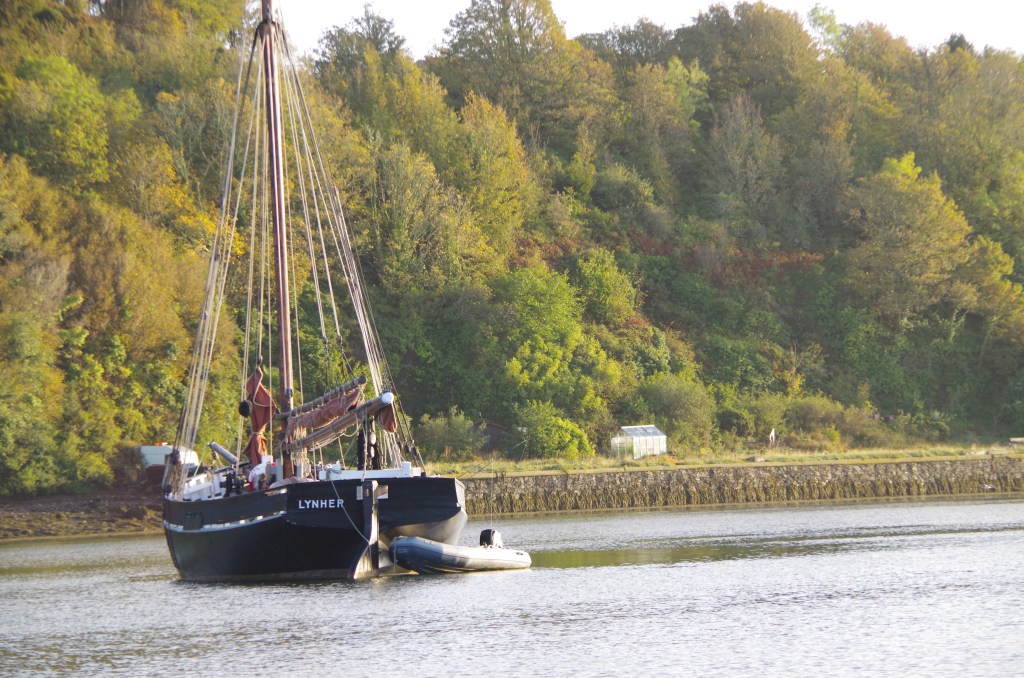
There’s quite a bit of either working with the tide or waiting one out…..in this picture it’s the working boat Lynher waiting for the tide at anchor in Sandacre bay…..coincidentally also in the Lynher.
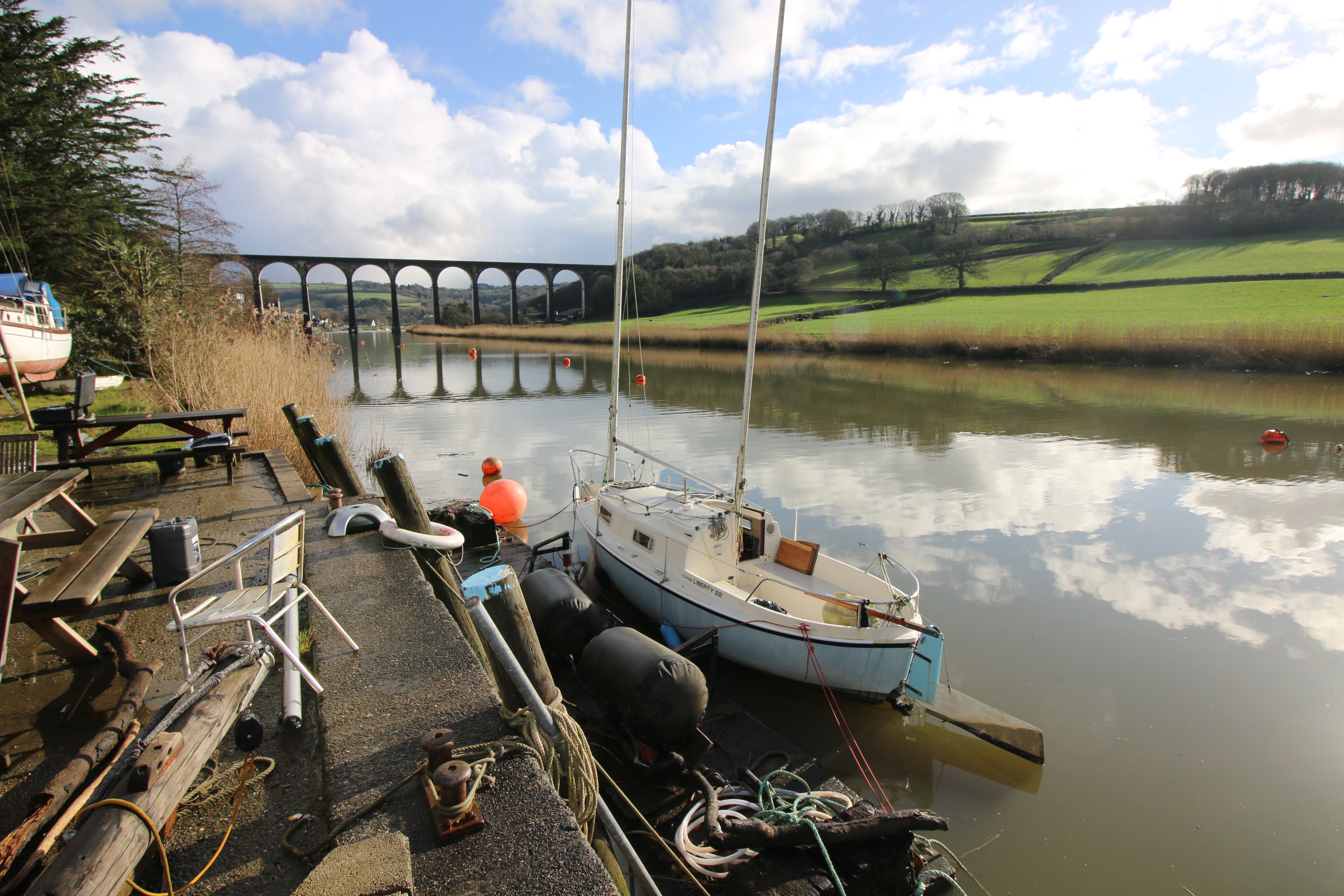
During the time in which these posts were based my boat was a 22 foot, centerboard cat-ketch designed by the late David Thomas and built by the now defunct Hunter boats in England in the early 1980’s. My choice of boat is what is important here because it is one that I felt would be one that I could only just afford, would fit the river and my local mooring situation, was simple in terms of it’s rig and layout and which I felt I could comfortably live aboard during my time afloat.
Somewhere in my extensive library of sea and sailing related books is an essay that I can’r now find and from memory it is titled ‘the perfect boat’ and in it the author described a yacht of about 23 feet as being perfect for his needs ; it might have been something like a Deben 4 ton or similar but the principle was that he felt that a boat of that size was perfect for his needs and I guess matched his budget and his local area. I think that essay came from a time when it was a lot more normal for single sailors to own boats of that size and for the same sailors to be quite ‘rugged’ in the temperament and I would suggest not be looking for , or be able to afford, the luxury of size,
With regard to my own little boat I found it perfect for me on my own and even comfortable for me and my partner together – small yes but then we have a background of being able to be comfortable in small spaces such as tents and bivouac’s together. What the boat lost out with slightly was it’s ability to punch to windward in the larger seas off the west country and in that regard was remarkably similar to the small classic boat (Deben 4 ton) that I owned for a while. Both boats I have to say were remarkably quick boats downwind and with both of them I had a lot of fun out sailing larger and more modern yachts.
I thought of the Liberty as just about the smallest cruising boat that fit my simple needs and also just about the largest one that I could own and maintain. Home, in terms of my mooring situation became a mud berth at the bottom of a greasy ladder and my cruising range I took as the whole of England’s south west coast , which I would argue is the best small boat cruising ground this side of the English channel. In 2019 I crossed the channel for the second time with that boat and then spent 110 days cruising around the even better cruising ground of western and southern Brittany.
On the beach, Morgat I think.
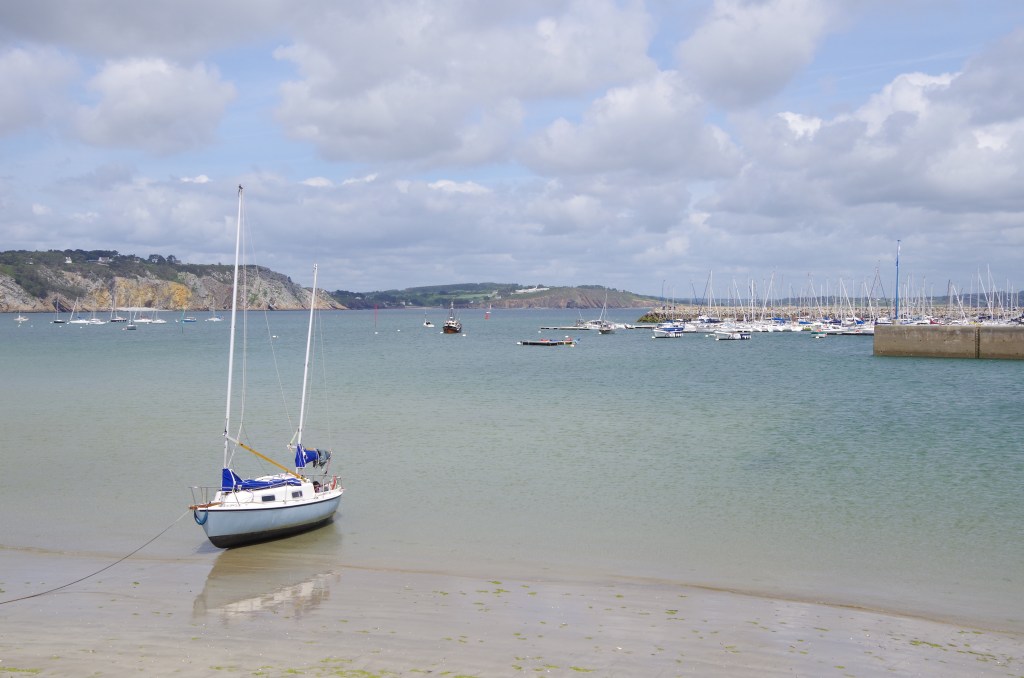
In Brittany I often found that my boat was the smallest one out there and cruising, in fact only once was there a smaller cruising boat at anchor with me and that was marginally smaller French production boat that was at anchor in the Isle’s de Glenans – having come out from Concarneau for the day. In British waters I was nearly always the smallest boat on the water except for the day that I had to work hard to chase my friend Steve Parke and ‘Arwen’ all the way up the Tamar.
Things change and move on, of course they do. There were times when the Liberty felt a bit small and underpowered but that was only twice when making the long cross channel passage in an uncomfortable wind against tide chop – far more times I had the disquieting feeling that the Liberty was larger than I really needed for what I thought I would do next. Now of course i’m coming to the end of building a boat significantly smaller than the 22 foot Liberty and i’m contemplating a voyage in that boat as challenging and interesting as my 110 day Brittany cruise.
With this first introductory post I just wanted to ‘anchor’ the thread in the basis of a small boat that I owned, enjoyed and then moved on from. What i’m going to do with the posts in this thread is take up some of my points about size, simplicity and ‘mission’ and develop each one as separate post – what I am going to do as a first follow-on post is to talk about one of the ideas I had while I owned both the Liberty and the Deben……that being in the form of a question ; just how low (small) could I go.
Best wishes Everyone.

 Dirty Wet Dog, the great adventure.