

Part 2 of my recent post ‘Don’t throw it all away’.
Original post : https://dirtywetdog.co.uk/2022/11/21/dont-throw-it-all-away/
In my original post I mostly made the point that sailing boats generally don’t have much ‘performance’ because nearly all of them are based on displacement hulls, thus top speed is limited, and then that many sailors throw way larger or smaller chunks of that by making simple mistakes. Those common mistakes, in my experience, are things like having a dirty and rough hull after years of badly applied antifouling, old and baggy sails – ditto old and saggy halyards, carrying too much weight in the wrong place and so on.
One of the comments that my original post got online was a boater enthusing that he likes to ‘get his rail down’ – equating too much sail aloft to trying hard to sail his boat well ; sorry to say but unless you are sailing something like a 12 metre class then all that is happening with a modern hull is a lot of leeway – and often a rudder that is acting as a brake. The trim of the boat really does matter with modern hulls as does another factor that I didn’t mention then but will now – that of rudder angle : something , again from experience, in brisk weather is that of a modern boat well heeled over and the driver heaving on the tiller while that unbalanced hull tries to round up.
In this post I want to go off in a different direction and talk about the benefits and downfalls of sailboat racing.
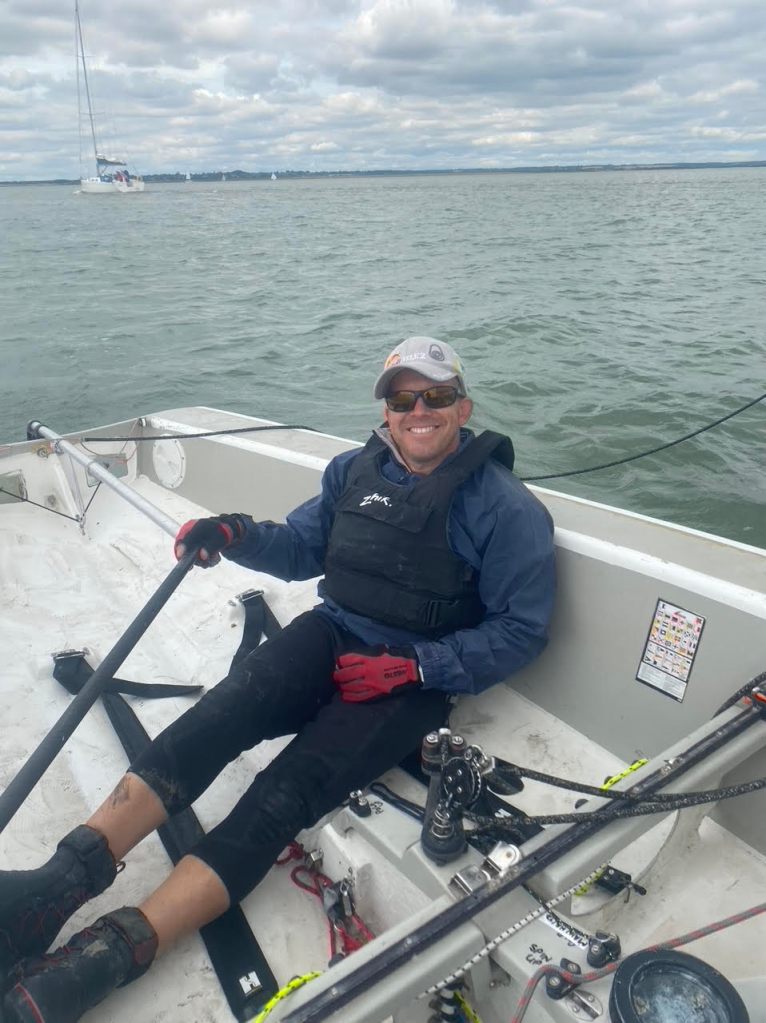
Gavin and his de-tuned Osprey used as a cruising boat (Gavin Print photograph)
Sailing and sailors tend to have a set of ‘rules’, and here i’m not so much talking about the obvious ones such as the rule of the road and the IYRU rule book but the unwritten but seemingly accepted ones – one of those being that starting in sailing dinghies is a good idea and the second being that a season or two as crew on a racing boat is also a good idea. I happen to agree with the dinghy learning experience especially when that is with a good instructor but i’m much less sure about the value of crewing on say a club/offshore racing yacht as an early experience.
My early sailing experience is somewhat unusual in that the first time I sailed was in a 17 foot clinker built one design with a cuddy …….and the second time I sailed was as a much shouted at winch-winder aboard a then hot half ton racing yacht. Today, I smile when I think about that first boat because after hundreds of thousands of sea miles on other boats it’s almost the same boat as I am building for myself right now………that doesn’t half feel like the beginning and end of my life as a sailor……two similar boat shaped book-ends perhaps.
Now, I can’t say that my early experiences of yacht racing were good ones ; there was a lot of shouting and not much skill – neither sailing skill or crew management skill but I guess now that partly what happened was that the better boats tended to have better owner/sailors and regular crew who knew each other and knew what everyone had to do just to get the boat around the course. None of it ‘clicked’ until one of the best sailors in the area laid out the basics in the pub one day – the basics being things like boat preparation (clean bottom, straight rig, weight taken off etc) and then on the water at least telling the crew what needed to happen next.
For my part I couldn’t bring much to the game until I codified the basics in my own mind, found a better boat and owner and offered to do the horrible but essential winter work of getting under the boat and wet sanding the hull to a ‘baby’s bum’ finish : with that I kind-of became the boat’s ‘BN’ as we used to call them back in the day. The other essential thing I learnt was about ‘managing’ the owner – given that he was a hospital consultant and I was a lowly student nurse that might seem to be a bit one sided unless you’re a nurse yourself and know how to deal with ‘difficult’ doctors.
Where the useful side of the experience of yacht racing came in was that I did get to learn every job on the boat from bowman to mast man, to sail trimmer and helm and eventually watch leader (or mate) and navigator. Another side of the whole offshore racing experience is that I acquired a codified ‘rule’ from another boat that was written up and stuck in a prominent position where it would be seen – it was a short series of questions thus…..
Are we going in the right direction.
Are we sailing at best (optimal) speed.
Are we looking after ourselves (and the boat)
It sounds simple enough until you realize that those few questions cover nearly every sailboat racing discipline from difficult tidal navigation through every aspect of boat trim and sail trim and then every aspect of crew management. Today I consider those questions to be the best things I learnt in many thousands of miles of thrashing around the Irish sea, the English channel and eventually the Southern ocean.
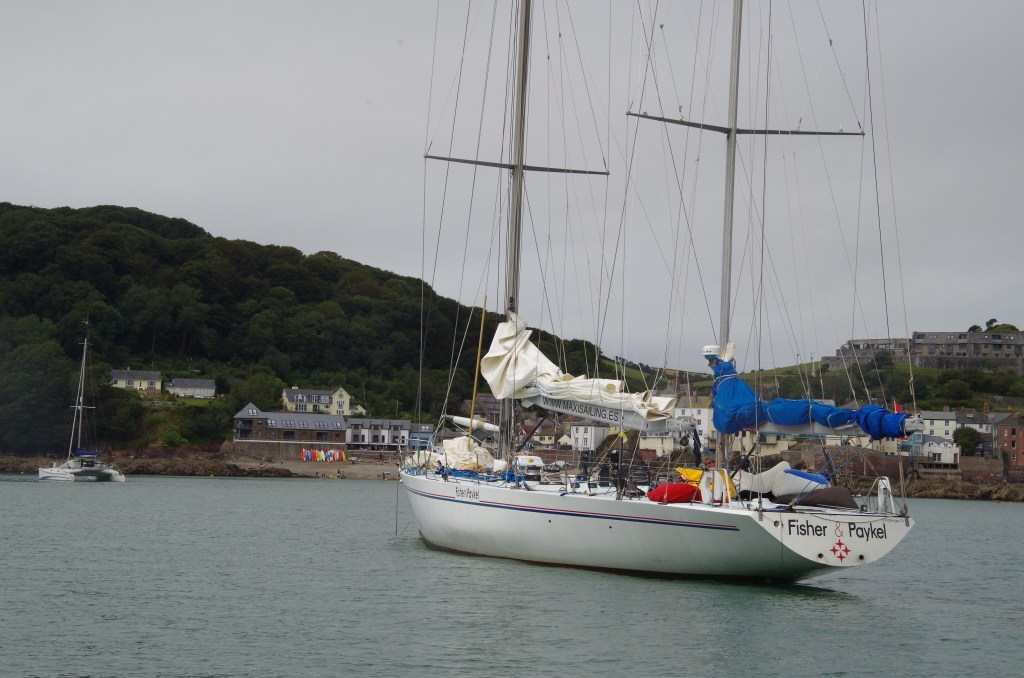
Maxi yacht Fisher & Paykel anchored off Cawsand a couple of years back……ex Whitbread boat from my racing era.
Reasons to be cheerful.
For the newer coastal and offshore sailor I would argue that there are some good reasons to spend some time crewing on a racing sailboat although equally I can find as many and as good reasons to to. Perhaps the best reasons to go crewing on coastal and offshore races for an entire season is that you will most likely get to sail in all conditions from near calms to gale conditions – very few races are not started due to inclement weather. I happen to think that the best part of that is having to sail the boat in light to very light conditions and I say that because my observation is that few cruising sailors are good sailors in light weather – especially downwind and most will just motor when they could have enjoyable sailing.
There is also a good argument that crewing on a race boat will teach the beginner how to prepare a boat well and if they are lucky to see a sailboat being sailed well – that’s a big if of course. I am lucky in that I came up through sailing when it was normal practice to ‘hand reef and steer‘ which in those days meant working at the mast and up on the foredeck maybe changing down headsails in a lumpy rising sea. Today of course many cruising sailors will end up sailing badly under half rolled genoa’s – not realizing that there are far better ways to sail in brisk weather.
Reasons to be wary (of racing).
In my opinion ( and given that opinions are like arseholes !) I would quickly add that there are two or three real good arguments about racing especially if your main purpose for being on the water is as a cruising sailor so…..
First…..that racing isn’t cruising and it might be better to train yourself to be a much better cruising sailor than the average Joe boat owner – there are several ways even I can think of to do just that (see below).
Secondly ……that looking back to my years as a racing sailor I think now that racing creates a very narrow view of both boats and seamanship – in my era for example it gradually gave us some very flimsy and badly built boats that turned out to be very poor craft in heavy weather ; the Fastnet race of 1979 comes to mind. An unfortunate by product of the IOR racing era is that very few boats were successful racing boats and that many, intended as race boats, became a kind of second rate cruiser-racer……neither fish nor fowl !. Successful race boats didn’t then and don’t now produce good cruising boats in fact the ‘fashion’ for new cruising boats today is that they merely seem to ape the worst features of modern race boats.
Third…..and this where things get a bit strange because I need to delve into trait (personality) psychology.
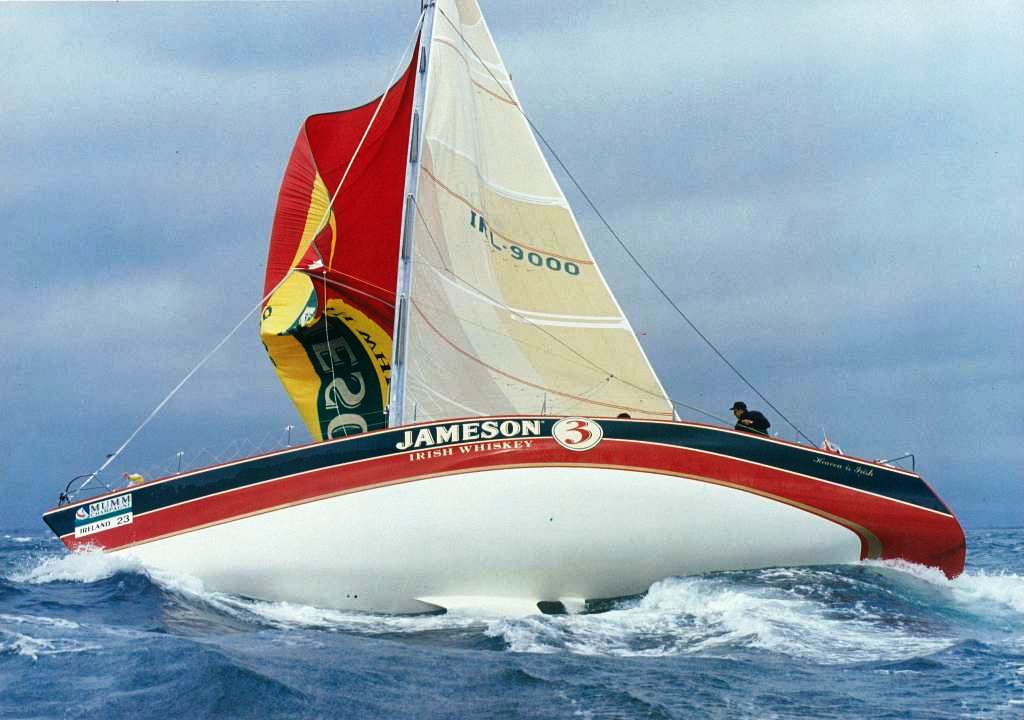
BTDT…….the common sight of an IOR race boat broaching in moderate conditions (photographer unknown)
Today, i’d just like to say that I was never a ‘good’ racing sailor and certainly never a racing ‘yachtsman’ – I guess i’m going to have to explain that one day – but more simply that i’m not a good racing sailor because i’m just not competitive/aggressive/disagreeable enough – and even that is going to take some time to explain.
Simply put though……that to be successful at any competitive pursuit, whether that be in business, profession or sport one needs to have a personality that is competitive : such a thing is actually measurable quite easily and I for one am simply not competitive. That I did comparitively well as a racing crewman, for a while, is that I was smart enough and enough of a worker to sort out the basics – scrubbing and wet sanding hulls is something I was known for.
Thinking back i’m still amused that we won nearly every club ‘offshore’ race in one season simply because we went out with a decently well prepared boat, put the right sails up at the right time, got around the ‘corners’ well enough without huge sail handling snarl-ups and kept ourselves out of the protest room.
Back to sailors/yachtsmenpersons and competitiveness though.
At a basic level of sailing, my level if you like, most can be achieved by good preparation, by sailing in the right direction at the best speed possible, by getting around the marks smoothly and offshore by managing the boat and crew well. At a higher level of sailboat racing, lets say events such as the Olympics , the older style America’s cup and notably match racing it needs something else entirely ; that something being a level of competitiveness that morph’s and reads much clearer as aggressiveness and disagreeableness.
If you want to see examples of that then watch any old footage of the America’s cup (AC) as sailed in meter class boats or equally any match racing ; in either of those the only necessary thing to do is to cross the finish line before the other boat and then successfully argue your case in front of the race committee. In a way the whole way to look at boat on boat racing is of utilizing a set of practices, tactics and ‘rules’ to ‘do a number’ on the other guy.
For a simple and often video recorded analogy look at the world of driving and imagine that the shouty yacht racing businessman is now behind the wheel of his powerful Audi or BMW saloon and muscling his way up the outside lane of the motorway while flashing other drivers to get out of his way – same competitiveness, same aggression, same trait disagreeableness. These people simply have to win, have to be more successful and have to be always ahead of the other guy…….because it’s in their nature to be like that : on the water that can and does manifest as truly obnoxious and ‘shouty’ behaviour.
I realize than many of my readers will either be skeptical of or disinterested in anything that smacks of ‘psycho-babble’ or ‘pop’ psychology : I am too which is why I have no time for Myers-Briggs type personality tests and even less for meaningless made up terms such as ’emotional intelligence’. What I am talking about here is a valid branch of psychology called psychometrics ( essentially measurements) and specifically the Big 5 traits model. For any readers that are interested i’ll add a short section at the end to explain some of the above but for now I would really prefer to talk about cruising boats and cruising sailing.
Lots of racing didn’t turn me into a better racing sailor, if anything it and working in the industry turned me against sailing for several years : then, when I became a small boat cruising sailor I found that not much of my skill, so called, was of much use. As a racing sailor i’d never had to anchor a boat properly – some time I must tell the story of the one time we kedged during a race in the Solent and the anchor just came off the end of the warp.
Today I think that leaving both actual racing and race style boats behind was a huge emancipation as a sailor and doubly so when I escaped the mental constraints of a racing mindset. Where once upon a time I used to think that the most radical looking IOR boats were the ducks nuts I now see them as flimsy, fragile, distorted and fundamentally un-seamanlike – I guess also iv’e grown up a lot more as a sailor to understand my own character a lot more and that is fundamentally not that of a competitive sailor…….I still have a lot of fun outsailing modern boats though.
It used to be the case that sailors/yachtsmen thought in terms of a strict either/or – that you were a racing sailor or a cruising sailor and I heard other either/or divisions along the way – one of which was ocean sailors vs ‘ditch crawlers’ and of course motor-boaters vs actual sailors. The fun one that I want to play with in a future post is based on a a question I was once asked as a beginner sailor “are you a sailor or a yachtsman” ; at the time I didn’t even understand the question.
Today I think that there is a ‘third way’ of sailing and it’s much more to do with not being a modern ‘consumer’ of sailing , not being in a race and not ‘cruising’ in the modern sense of motor-sailing from marina to modern marina. Ok so that sounds a lot more like traditional cruising but it might also take in other elements that have more to do with other elements of outdoor practice – one way I think of that and based on the boat that i’m building right now is the ‘bushcraft’ boat and or some of the concepts of micro-adventures…….iv’e already done most of the big ones ( 3 times around the Horn is enough I feel).
As I write it’s already mid January and although it’s stunningly wet the days have lightened and warmed up a bit, time I feel to get on with my own project, head down to the chandlery for some bits n pieces and get the trailer ordered.
Best wishes Y’awl

 Dirty Wet Dog, the great adventure.