
September cruising post.
Running onto the beach or foreshore under control.
Yes……I know…..i’m mangling Shakespeare’s lines once again so just get used to it ok.
In 2019 I took my little cat ketch (Hunter Liberty) over the English channel and spent 110 days living aboard while cruising around western and southern Brittany. As far as possible I avoided using marinas unless there was no other choice for getting ashore and doing my provisioning – some times I was able to go alongside a quay as I did in Paluden (Aber-Wrach) or alternatively I ran the Liberty up the beach on a falling tide and dried her out. In this post I want to talk about my techniques and timing for deliberate beaching on either sandy beach or muddy foreshore.
Beached on the Plage du Trez Hir below Plougonvelin.
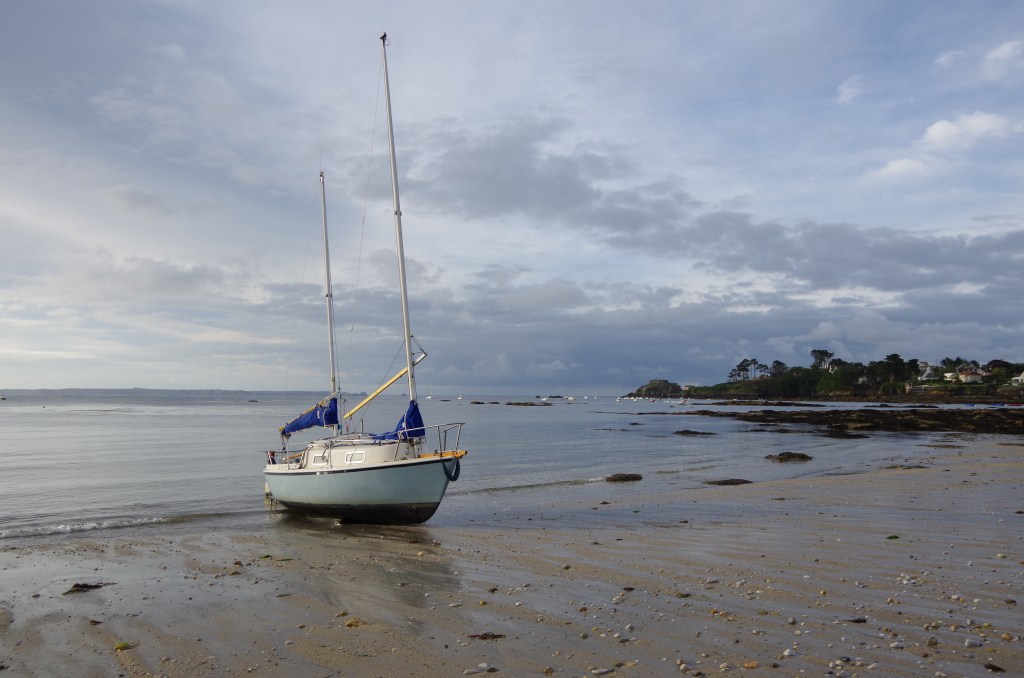
It’s several years since I wrote regularly about cruising in the Little Liberty – by the time of my 3 month Brittany cruise I was well used to drying the boat out on sand or mud but up until then I hadn’t deliberately run the boat up the beach or onto the foreshore and at the time I never thought to write up the technique until somebody asked me about it recently…….so here goes.
The situation in the above photograph was one of the most interesting because I had to drive the boat up a narrow sandy gully between 2 shallow reefs – my aiming point was the painted front door of a row of houses just across the road from the beach.
Drying moorings at Golant and an easy walk ashore to get fresh water.

Drying out the Liberty was usually an easy exercise when I knew the place that I was intending to land on or where the chart suggested that there were no obstructions , at worst all I needed to do was to have a poke around the boat as the tide dropped to make sure that I wasn’t going to land on something sharp. One time in France we decided not to dry out but to anchor in shelter very close inshore in a small bay outside Concarneau, as the tide dropped I could see that we were swinging over a weed bottom so I had a feel with the boathook to make sure that the weed wasn’t attached to rocks……suddenly I felt this odd ‘clicking’ sensation through the plastic boat hood and realized that it was a crab vigorously attacking the boathook.
Beaching on the run, to dry the boat out quickly and leave enough time to get up to the supermarket and back needs a bit more setting up and good timing, the timing is easy enough because all I had to do was aim to hit the beach at say a 2 hours before low water thus giving me around 4 hours to do my jobs. The set up is unlike just drying the boat out in a static setting because sometimes it needs some speed on to maintain steerage and an anchor and warp let out astern to either snub the boat and/or for hauling off later on.
The ideal situation was something like the beach next to the marina and slipway at Morgat – there’s deep water right up to a clean sand beach which I knew because I’d been able to walk on it and have a good look at it the day before – on the day though my main problem was a stiff breeze blowing off the land and on my first approach I lifted the centerboard too soon so the boat started going sideways driven by the windage on the foremast. On my second attempt I kept the boards down longer on the way in and I dropped my stern anchor about 50 metres out from the beach – my stern anchor having a 60 metre warp on it.
With the Liberty the centerboard will just kick up when it touches bottom – if I can I have the centerboard tackle line in my hand so i can feel when the weight comes off it – the centerboard will start to kick up into it’s case and I used to find it more important at that moment to trip the downhaul line on the rudder blade so that the rudder would kick up as well. Depending on the slope of the beach and any wind I could , most times, motor almost all the way onto the beach and then kill the motor just as the bow ran ashore or one of the short keels touched down. As soon as that happened I would make sure that the boards were heaved up, the outboard unlatched and then I would climb over the side and wade ashore with the bow anchor.
Morgat, the deep water is astern and to the right of the boat but we were pushed over by the wind blowing off the land that day.
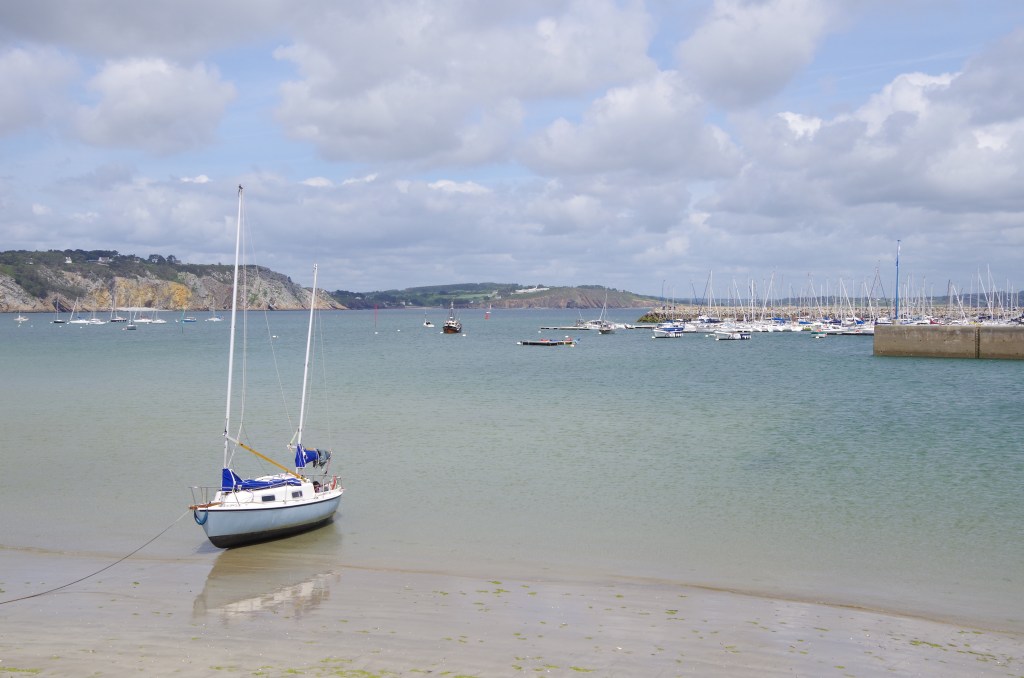
The critical part of the set up and approach is the stern anchor and it’s rode , it is essential to be able to drop the anchor quickly and pay the warp out over the quarter – I found that the best technique was to have the warp flaked down on the cockpit seat in such a way that the warp runs out from the top of the pile. In those days I used to keep the long retrieval warp flaked into a dedicated rope bag that usually lived with the second anchor under the infill bunk space – as I set up the Pathfinder for the same kind of procedure today I am experimenting with a climbers rope bag and a 60 meter length of LSK line.
Rope bag with anchor and 60 meters of low stretch kernmantel line.
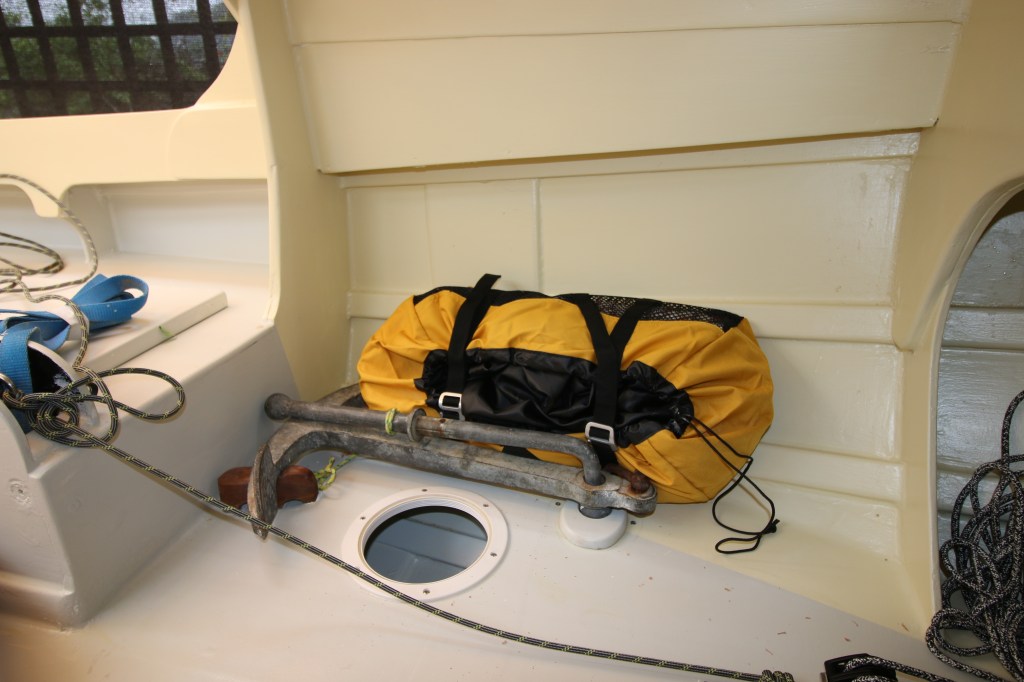
The first few times I tried active beaching I had some difficulty in estimating my stern anchor drop position so what I used to was tie in a spare mooring line to the running end of the warp….from memory that gave me some 80 meters plus of available warp but over time I learnt to time my drop to within a few meters of a best possible placement. I found that the further out (from the beach or foreshore) with the stern anchor the better for hauling off and getting away afterwards – I often ended up with a whole mess of anchor, warp and mooring line on the cockpit sole – especially muddy if it was a gloopy mud foreshore like at Paluden quay.
While it’s easy and pleasant enough to climb over the side into clean clear sea water over sand it was a different matter over the shale and mud off Paluden quay, there I actually pre set up my bow lines from the wall and laid them out so that I would run over them and pick them up – at some point I would decide where to put the boat between the lines so that climbing over the bow was a bit muddy…….but not knee deep in thick black stinking mud.

 Dirty Wet Dog, the great adventure.